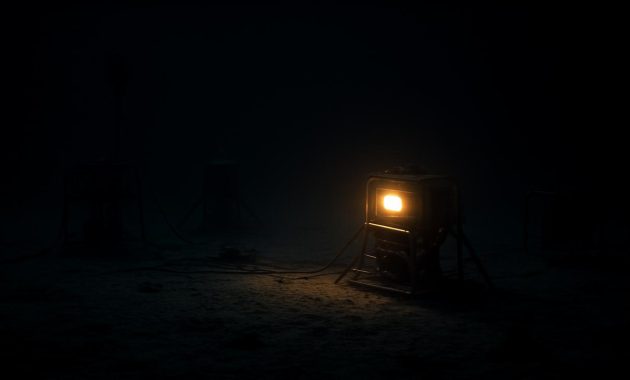
The blackout comes without warning. One moment, the seafloor is a slow-breathing galaxy of tiny lights—flecks of blue and green pulsing in the dark like a distant city at night. The next, everything goes dark. The cameras keep rolling, the sensors keep listening, but it is as if the ocean itself inhales and switches off. No lightning strike, no submarine, no passing whale. Just a quiet, absolute absence of light that leaves even the scientists on the surface holding their breath.
The Night the Ocean Went Dark
When the first blackout appeared on their screens, the research team aboard a small vessel in the North Atlantic thought it was a glitch. A few seconds of static, a minor malfunction in a deep-sea camera rig. Someone tapped the monitor, someone else checked the cables. Out on deck, the waves thudded against the hull, and the smell of salt and diesel mingled under a night sky smeared with stars.
The feed snapped back. The glowing threads of bioluminescent plankton reappeared, swirling in the slow underwater current. Small shrimp-like creatures flickered. A distant eel flashed and vanished.
Then, thirty-two minutes later, it happened again. A soft fade to black—no flaring, no disturbance, just a smothering of light. This time, the room went silent. The chief scientist leaned forward, eyes narrowed. “Record everything,” she said. “Time stamps, sensor readings, current speed, temperature. All of it.”
They didn’t know it yet, but they had just joined a growing group of oceanographers, biologists, and geophysicists who were all watching the same strange phenomenon unfold around the world: mysterious blackouts beneath the sea, moments when entire swaths of the deep ocean seem to go offline.
The Hidden Galaxy Below the Waves
For most of human history, we imagined the deep ocean as a void—a place of eternal night, maybe a few blind fish, and little else. But the reality, scientists now know, is closer to outer space than emptiness. The deep sea is a universe of light. Not sunlight, but bioluminescence: living light, born from chemical reactions inside the bodies of tiny organisms, fish, squid, and drifting colonies of plankton.
Dive thousands of meters down and you enter a world that glows and pulses and sparks. Creatures use light to hunt, to flirt, to hide, and to lie. Some flash bright to scare off predators. Others press their glow close to their bodies like a lantern under a blanket, invisible until they want to be seen. A jelly might drip blue sparks as it drifts; a fish might carry a single green headlamp like a coal miner of the abyss.
These lights are so common that scientists sometimes call the deep ocean “the living night sky.” Hundreds of kilometers of water column shimmer with microscopic blinking—tiny broadcast signals from millions of small lives we’re only just beginning to map.
And that’s what makes the blackouts so jarring. They aren’t just small gaps in data; they’re absences in a place that, by rights, should never be completely dark.
How Do You Track Darkness in the Deep?
Tracking these mysterious blackouts starts with an almost impossible task: watching a world we can’t see with our own eyes. Deep-ocean research relies on a flotilla of robotic witnesses—autonomous underwater vehicles (AUVs), remotely operated vehicles (ROVs), fixed seafloor observatories, and drifting sensor packages that float along like high-tech message bottles in a cold, black sea.
Each of these systems carries an arsenal of tools. Ultra-sensitive low-light cameras. Acoustic sensors listening for the clicks, groans, and distant rumbles of animals and shifting geology. Chemical sniffers that sample the water for oxygen changes, plumes of methane, or faint traces of biological activity. Tiny thermometers that detect temperature shifts of just a fraction of a degree.
In recent years, new generations of instruments have been designed not just to record physical surroundings, but to watch for light itself. Scientists mount photomultiplier tubes and high-ISO cameras on the sides of vehicles, pointed into the dark like eyes accustomed to starlight. They send these systems down for days or weeks, letting them roam currents and hover over canyons, mapping the subtle, glittering traffic of bioluminescence.
It was in these data—long, quiet stretches of light, punctuated by sudden voids—that researchers first noticed a pattern. The ocean, for reasons no one yet understood, was occasionally flipping its lights off.
The First Clues: Patterns in the Gaps
At first the blackouts were dismissed as noise. Equipment failure, sediment clogging a lens, a stray school of fish blocking the view. But as data poured in from different oceans—from the North Atlantic, the Arabian Sea, the waters off Japan and the west coast of the Americas—a strange picture began to emerge.
The blackouts appeared in different places, at different depths, on different platforms built by different teams. The same eerie drop: a rapid fall in bioluminescent flashes, sometimes by more than 90 percent, lasting from a few seconds to more than an hour before slowly recovering.
Not every dive saw them. They didn’t seem to follow the daily rise and fall of animals that migrate to the surface at night and sink by day. They didn’t always match storms or surface events. Instead, they were scattered through the data like missing pages from a book—a book the scientists were, by now, desperate to read.
In a lab full of glowing graphs and scrolling columns of numbers, a young researcher started lining up timestamps. She compared blackout events against anything she could find: seafloor tremors, passing ships, internal ocean waves, even military sonar tests pulled from public records. With each overlay, the mystery both deepened and sharpened. Some blackouts coincided with subtle underwater disturbances. Others seemed completely at odds with anything measurable at the surface.
Theories From the Dark
The ocean is enormous, and so is the range of possible explanations. Each new blackout sends waves through the scientific community, igniting both careful analysis and quiet, coffee-fueled speculation. In conference hallways and shipboard mess rooms, a handful of dominant theories keeps rising to the surface.
1. Predator Shadows
One idea is that the blackouts are moments of collective hiding. In this version of the story, something big—maybe a swarm of hunting squid, maybe a surfacing pod of deep-diving whales, or perhaps even a rarely seen super-predator—moves through the water column. Bioluminescent animals, sensitive to pressure waves and chemical traces, sense the danger and simply switch off. They stay dark, hoping to become invisible in an ocean that suddenly feels too small.
2. Internal Ocean Storms
Another hypothesis points not to animals, but to the water itself. Beneath the surface, the ocean is layered—warm over cold, salty over fresher—and those layers form invisible “internal waves,” some as tall as skyscrapers, rolling silently through the deep. These underwater storms can shift temperature and nutrients in ways that ripple through entire communities of plankton. Perhaps, the theory goes, certain waves throttle the activity of light-producing organisms, snuffing out their glow until conditions settle again.
3. Chemical Blackouts
Then there’s the chemistry angle. Bioluminescent reactions depend on delicate, enzyme-driven processes. Changes in pH, oxygen, or trace chemicals could shut them down temporarily. Could a plume from a distant undersea volcanic vent, or a sudden influx of low-oxygen water from a sinking current, essentially unplug the biochemical battery that powers living light?
4. Human Noise
The ocean is no longer the quiet wilderness it once was. Naval sonar, shipping traffic, seismic surveys, and deep-sea mining exploration all inject energy into the deep: pulses of sound, electric fields, and sediment clouds. Some scientists wonder if certain blackouts might be a response to these intrusions, a kind of stress blackout in the ocean’s night-life—like a city dimming its lights under an unexpected air raid.
None of these theories has yet been proven. Each fits some of the data and strains against the rest. And that is what keeps the ships going back to sea.
Inside a Watch on the Edge of the World
On a gray morning in early fall, a research vessel rocks gently over a deep trench miles off the continental shelf. The air hums with winches and the dull roar of the engines. On deck, an orange AUV, glossy with condensation, hangs like a strange fruit from the crane, about to be lowered into thousands of meters of deep blue nothing.
The team’s mission on this cruise is simple to state and hard to achieve: catch a blackout in the act, and catch everything around it. They’ve tuned their instruments to record at higher frequencies, packed extra batteries, and layered in new sensors to watch for tiny changes in sound, light, and chemistry. Each descent is a fishing trip for absences, a hunt not for what’s visible, but for what vanishes.
In the control room, the glow of monitors paints everyone’s faces the same tired, bluish color. A live camera feed from the AUV shows a slow snow of marine particles drifting past—dead plankton, bits of shell, specks of dust that have taken months to fall. Somewhere beyond that narrow spotlight, bioluminescent organisms are flashing and swirling, too faint for the live feed but bright on the data logs.
Then, not dramatically, not even noticeably at first, the graphs begin to slope downward. Light counts tick lower. Acoustic activity dips. Someone leans closer. Another person stops halfway through a sip of coffee and sets the mug down very carefully.
“We might be going in,” a technician murmurs.
They watch as the bioluminescence curve drops like a slow-motion cliff. In less than a minute, it bottoms out. The camera shows only drifting particles, no flickers. The instruments, still technically working, report a quiet so deep it feels unnatural.
Above them, on the surface, the sky is bright and indifferent. Waves slap the hull. A gull screams. And down below, for reasons the scientists are only beginning to guess at, the ocean’s galaxy of light goes perfectly, perfectly dark.
Reading the Ocean’s Pulse
These blackouts, scattered and elusive, are starting to look less like random flukes and more like a pattern—an uncharted heartbeat in the global ocean. The data flowing in from different expeditions is now being pooled into shared archives, where computers, not humans, scan for subtle relationships.
Machine learning models, trained to spot faint patterns in noisy data, search for common threads. Do blackouts cluster around certain depths? Do they favor particular water temperatures or salinity ranges? Are they more frequent near continental margins, seamounts, or mid-ocean ridges? Or do they trace invisible highways of migrating life we haven’t yet mapped?
For the scientists involved, this work feels a little like eavesdropping on a conversation in a language you barely speak. The ocean has always had its own rhythms—tides, currents, seasons, migrations. But these episodes of sudden darkness suggest something more: a kind of deep-sea coordination, a synchronized response that could tie together physics, biology, and even our own impact on the planet.
To make sense of it, researchers are now designing dedicated blackout missions: long-term observatories anchored like listening posts on the seafloor, floating networks of drifting buoys, and collaborative efforts between countries whose waters share the same deep basins. The big questions are no longer just “What is causing this?” but “What does this mean for life down there—and for us up here?”
Why These Blackouts Matter
It’s tempting to see this as a mystery story—and it is—but the stakes stretch far beyond intellectual curiosity. The deep ocean is one of Earth’s largest living systems. It helps regulate climate, stores massive amounts of carbon, and supports food webs that eventually reach our own dinner plates. Bioluminescent creatures, tiny as they are, play a crucial role in that hidden economy of energy and nutrients.
If something is periodically shutting down their light—whether it’s predators, changing currents, chemical anomalies, or human noise—it may also be changing how they feed, flee, and reproduce. Those changes could ripple outward, altering who thrives, who disappears, and how stable the deep ecosystem remains under the combined pressures of warming, acidification, pollution, and industrial expansion.
Understanding the blackouts might also sharpen our sense of the planet’s boundaries. Many of our activities—deep-sea mining, hydrocarbon exploration, submarine traffic—reach ever further into the abyss with only fragmentary knowledge of what we’re disturbing. A sudden, synchronized darkening of the deep could be an early warning signal, a subtle protest from an ecosystem already strained to its limit.
Or, perhaps, the blackouts are something older and wilder: a long-standing part of the ocean’s natural pulse that we’re only now noticing, simply because we finally have the technology to keep watch. Either way, they remind us of a humbling fact: even in an age of satellites and supercomputers, most of our planet remains not just unexplored—but actively mysterious.
A Table of the Unknown
Scientists are beginning to log and compare blackout events worldwide. Below is a simplified snapshot inspired by ongoing research, showing how scattered—and intriguing—these events are:
| Region | Approx. Depth | Blackout Duration | Notable Nearby Features | Leading Suspected Factors |
|---|---|---|---|---|
| North Atlantic Trench | 3,500–4,200 m | 10–45 minutes | Steep canyon walls, internal waves | Internal ocean storms, predator swarms |
| Arabian Sea Basin | 1,000–2,000 m | 5–20 minutes | Low-oxygen zone, shipping lanes | Chemical changes, human noise |
| Western Pacific Slope | 2,500–3,000 m | Seconds to 5 minutes | Seamount chains, tectonic activity | Seafloor tremors, internal waves |
| Eastern Pacific Margin | 800–1,500 m | Up to 60 minutes | Upwelling zones, productive plankton layers | Plankton shifts, predator avoidance |
The Ocean’s Unfinished Story
On that North Atlantic ship, the blackout eventually lifted. First came a single, hesitant flash—one tiny organism daring to turn its light back on. Then another, and another, until the seafloor galaxy slowly reassembled itself. The graphs climbed. Conversations resumed. Someone remembered their cold coffee.
Later, when the data was downloaded and sifted, the team found small anomalies threaded through the event: a faint tremor on the seafloor hours earlier, a subtle shift in water density, a flutter of distant clicking from unknown animals just before the lights went out. Nothing conclusive. Only clues.
That’s how it is with the deep ocean. Each mission adds a few more puzzle pieces without revealing the whole image. The blackouts could turn out to be a key—something that forces scientists to connect disciplines, to see the ocean as less of a static landscape and more of a restless, communicating system.
Standing on the deck after midnight, the researchers look out over waves that hide unimaginable depth. Somewhere below, their machines are still listening and watching, drifting through a darkness that is not empty but alive with questions. The sea appears flat and featureless in the weak glow of the ship’s lights, yet weighted with secrets.
And down in that pressure-crushed world, there are moments when the lights that have burned for millions of years, flickering in kaleidoscopes of blue and green, suddenly, silently go out.
The scientists keep tracking those absences—those strange, perfect silences in the light—because they suspect that, in understanding why the deep ocean sometimes chooses darkness, we might finally begin to see our blue planet as it really is: not a known world, but a story still being written in the dark.
Frequently Asked Questions
What exactly are “blackouts beneath the sea”?
They are sudden, temporary drops in bioluminescent activity—moments when the usual glow from deep-sea organisms almost completely disappears, even though sensors and cameras are still working normally.
Are these blackouts dangerous to marine life?
No one knows for sure yet. They could be natural responses, like coordinated hiding from predators, or they could signal stress from environmental or human-driven changes. Understanding their cause is key to answering this.
How deep do these blackouts occur?
They’ve been recorded from a few hundred meters down to several thousand meters, mostly in the deeper, darker zones of the ocean where bioluminescent life is common.
Could human activity be causing these events?
It’s possible that noise, sonar, or other disturbances play a role in some regions, but there is no single proven cause. Researchers are actively testing whether human impacts coincide with blackout patterns.
How do scientists study something they can’t see directly?
They use highly sensitive cameras and light detectors on robotic vehicles and seafloor observatories. These instruments measure even faint bioluminescent flashes and record when and where those signals suddenly disappear.
Are these blackouts rare?
They’re not constant, but they’re also not one-in-a-million events. As more instruments stay in the water for longer periods, researchers are finding that blackouts happen often enough to suggest they’re an important part of deep-ocean dynamics.
What might we learn if we solve this mystery?
Understanding the blackouts could reveal how deep-sea communities respond to changes in climate, chemistry, currents, and human noise. It may also uncover new patterns of animal behavior and help guide how we protect and manage the deep ocean in the future.