The first thing Emma remembered was the sound of rain. Not the hospital monitors or the low voices by her bed, but the steady tapping against the window, like gentle fingers insisting that the world was still moving outside. She tried to move her own fingers and felt… nothing. Her hand was a weight on the sheets, foreign and distant. Somewhere, in the blur of beeps and white light, a voice said the word that would rewire her life: stroke.
When the Brain Goes Quiet
A stroke is not always a cinematic collapse in the middle of a crowded room. Sometimes it’s just a slurred word, a coffee mug slipping from your hand, a brief confusion that feels like a bad dream. Inside the skull, though, a much more dramatic scene is unfolding.
Blood, which normally carries oxygen like an invisible river through the brain, suddenly stops flowing to a region. Neurons, those bright, restless talkers of the nervous system, begin to suffocate. Signals fizzle. Pathways go dark. In a matter of minutes, years of memories and practiced motions can start to fray—how to tie a shoe, how to raise an eyebrow, how to shape the word “home.”
Doctors have long described stroke recovery as a race against time. The emergency treatments we have—like clot-busting drugs and surgical removal of clots—are powerful, but the window to use them is narrow, often just a few hours. Miss that window, and the damage can feel terrifyingly permanent. For many patients, stroke doesn’t just steal a moment; it redraws the map of their entire future.
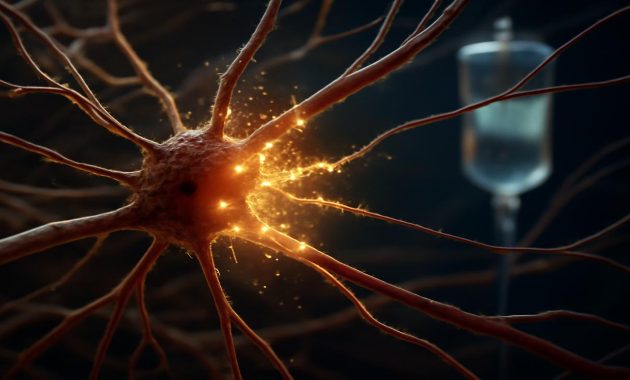
So imagine, for a moment, the opposite: an IV drip quietly running at the bedside, not just stabilizing the damage, but actively coaxing the brain to rebuild itself. Imagine a therapy that doesn’t just stop the fire, but sends in a specialized crew to repair the wiring afterward.
That’s not a line from speculative fiction anymore. In labs and early clinical studies, scientists are now testing a form of IV therapy that may help the brain repair itself after a stroke—reawakening silent circuits, regrowing connections, and shifting the story of what life after stroke can look like.
A Different Kind of Drip
You’ve probably seen IV bags in every hospital drama on TV: clear fluid, thin tube, slow dripping into a patient’s arm. For decades, that drip has been mostly about support—hydration, pain relief, antibiotics. Functional, necessary, but not exactly spectacular.
The new wave of IV therapy for stroke recovery aims to be something else entirely: not a background player, but a main character in the healing process. Instead of just keeping the body stable, this therapy is designed to talk directly to the brain.
In one line of research, the IV fluid carries microscopic packages called exosomes—tiny bubbles released by stem cells. Think of them as biological care packages filled with healing instructions: proteins, lipids, bits of genetic material. When infused into the bloodstream, these exosomes are small enough to slip through the brain’s tight security system, the blood-brain barrier, and deliver their cargo where it’s needed most.
Inside injured brain tissue, those molecular messages seem to do something remarkable. In animal studies, they encourage neurons to sprout new connections, support the growth of blood vessels, and dampen the slow burn of inflammation that can quietly expand the damage long after the initial stroke has passed. Instead of a static scar, the brain becomes more like a regenerating forest—damaged, yes, but suddenly full of new shoots.
Other teams are experimenting with IV cocktails of neuroprotective molecules, growth factors, and even engineered proteins that can help stabilize fragile cells at the edge of the stroke-damaged area—the so-called “penumbra,” a zone of half-shadow where neurons are injured but not yet dead. Protect that twilight zone, the logic goes, and you save function that would otherwise be lost forever.
Inside the Lab Where Neurons Learn to Heal
Step into a stroke research lab and the air hums with a different kind of urgency than an emergency room. There are no sirens here, only the gentle whir of incubators, the glow of microscopes, and computer screens flickering with wave-like patterns of electrical activity. On those screens, bursts of light reveal neurons in culture dishes communicating, forming networks, rewiring themselves in real time.
In one corner, a technician marks the progress of mice that have undergone experimental strokes. The animals walk along a narrow beam, their movements recorded in slow motion. Before treatment, their gait is unsteady; paws slip, bodies wobble. After IV infusion with exosomes or regenerative molecules, many of them show stark improvement—steadier, more coordinated, more themselves.
In another room, scientists watch brain scans from early human trials. That’s where things get especially interesting. In these clinical studies, stroke survivors receive an IV infusion days or even weeks after their stroke—long after the clock would have run out for conventional emergency treatment. Yet in some participants, the therapy appears to nudge the brain into a more plastic, adaptable state.
Functional MRI images reveal it visually: regions once dim after the stroke start to glow with renewed activity. Sometimes, neighboring brain areas seem to take over duties from damaged tissue, like neighbors stepping in when a house on the street goes dark. In others, residual islands of living neurons inside the damaged zone begin to reconnect with the broader brain network.
For patients, the changes are more personal, more tactile. A hand that was stubbornly clenched begins to relax. A foot that dragged now manages a more confident step. A sentence that always dissolved halfway through suddenly holds together from start to finish. Not miracles in the cinematic sense, but small, measurable victories that add up to something quietly extraordinary.
A Quiet Revolution in the IV Bag
Talk with the scientists working on these therapies, and they’ll often resist the temptation to call it a cure. Stroke is complex. The brain’s billions of neurons are not easily replaced or perfectly rewired. But they’ll say something perhaps more important: that we may be entering an era when “this is your life now” is no longer the final sentence in a stroke story.
Part of what makes this possible is timing—not only in the frantic hours after a stroke, but in the weeks and months that follow. The brain has its own rhythms of recovery. For a while after injury, it enters a period of heightened plasticity, where surviving neurons are unusually willing to learn new roles and form new pathways. IV therapies designed to boost that plasticity essentially amplify a natural window of opportunity.
Instead of treating stroke as a single shattering event, these therapies treat it as a long arc—with multiple chances to intervene, support, and reshape the outcome. For families who missed the narrow window for emergency clot-busting drugs, that possibility alone can feel like a door opening.
The Human Moments Behind the Science
Consider again Emma, sitting in a therapy gym weeks after her stroke. The room smells faintly of disinfectant and coffee. Outside, someone is pushing a wheelchair over the threshold, the small bump of rubber on metal echoing softly. Inside, a physical therapist places a bright rubber ball on the table in front of her.
“Just try to lift your hand,” he says gently.
Her fingers lie limp, like they belong to someone else. She stares at them, as if sheer attention might animate them. In the early days, this was the moment she dreaded most—the daily confrontation with what wouldn’t move, wouldn’t respond, wouldn’t return.
But recently, something has changed. After enrolling in a clinical trial, she spent an afternoon in a quiet infusion room, watching clear fluid drip into her arm. There was no lightning bolt, no cinematic awakening. Just a slow, ordinary drip. For a few days afterward, she felt tired, almost disappointed. Science, it turned out, didn’t always announce itself.
Then, on a Tuesday morning, as she reached with her functioning hand to adjust the sleeve on her affected arm, her fingers twitched. The motion was small, doubtful, like a question mark written in muscle. She froze, heart pounding. There it was again: another tiny, hesitant movement.
Now, in the therapy gym, she stares at the rubber ball and gathers her focus. Her muscles feel as though they’re waking from a deep sleep, feeble and confused, but not entirely unreachable. Slowly—so slowly it seems the world might stop to watch—her wrist lifts a fraction of an inch. The ball doesn’t move. But her hand does.
For her, that tiny movement is a seismic event. A hint that the brain inside her skull is not finished negotiating with this new reality, that under the surface, something is repairing, re-routing, relearning.
What the Early Evidence Shows
Stories like Emma’s are becoming more common in clinical research circles, but scientists are careful to pair them with numbers. Anecdotes are powerful; data is what changes medicine.
In early-stage trials with IV stem-cell-derived therapies and exosome-based infusions, researchers have observed:
- Improved scores on standard stroke disability scales compared to control groups.
- Enhanced performance in walking, balance, and grip strength tests.
- Brain imaging that suggests better connectivity and activity in regions adjacent to the stroke injury.
- Reductions in certain markers of inflammation and tissue damage in blood tests.
These are small studies, and they come with plenty of caveats. Not every patient improves. Some improve only modestly. The degree of benefit seems to depend heavily on the size and location of the stroke, the timing of the infusion, and the patient’s overall health. And long-term safety still needs to be carefully monitored, especially when living cells or complex biological products are involved.
But the pattern is encouraging enough that larger, more rigorous trials are now underway in multiple countries. Instead of one experimental protocol in one quiet lab, there’s a global chorus building—neurologists, rehabilitation specialists, bioengineers, and molecular biologists all asking the same question: how far can we push the brain’s capacity to heal itself after catastrophe?
What This Could Mean for Stroke Survivors
If you zoom out from the microscopes and lab benches, the potential impact of truly effective IV brain-repair therapies is almost dizzying. Stroke is one of the leading causes of long-term disability worldwide. Entire families rearrange their lives around its aftermath: home modifications, caregiving schedules, financial sacrifices, emotional recalibration.
An IV therapy that could significantly restore function wouldn’t erase the trauma, but it could soften the edges. It might mean:
- A parent regaining enough hand control to button their child’s coat.
- An artist returning, however imperfectly, to the subtle grip of a paintbrush.
- An older adult once again managing the stairs in their own home.
- A stroke survivor reclaiming the ability to speak, to argue, to tell jokes in their own voice.
To be clear, these therapies are not magic potions. They’re tools—powerful ones—that work best when combined with intensive rehabilitation: physical therapy, occupational therapy, speech therapy, cognitive training. Think of the IV infusion as fertile soil and sunlight; the daily discipline of rehab is the seed and the tending.
There’s another, quieter shift these therapies bring: hope that isn’t just emotional, but biologically grounded. For many years, stroke recovery conversations have leaned heavily on coping, acceptance, adaptation. Those are still essential. But now patients and clinicians can also talk about regeneration and repair—not as distant dreams, but as unfolding possibilities.
A Glimpse at the Road Ahead
Of course, the path from promising research to everyday hospital practice is rarely straight. These therapies must navigate a maze of regulatory approvals, manufacturing challenges, cost considerations, and training for clinicians. Scientists will need to refine dosing—how much, how often, and how soon after a stroke. They’ll need to learn who benefits most: those with small strokes or large ones? Younger patients or older adults? People treated days after stroke, or those months into recovery?
And then there are deeper questions: Can similar IV therapies help repair the brain after other injuries—traumatic brain injury, cardiac arrest, even certain neurodegenerative diseases? Could there be a day when a standard stroke order set in the hospital includes not just blood thinners and imaging, but an IV bag labeled “neurorepair” as routinely as antibiotics are ordered for an infection?
For now, the safest answer is that we’re in the midst of a transformation rather than at its end. The science is still in motion, still revising itself. There will be setbacks and failed trials, revisions of approach, unexpected risks that need solutions. But the momentum is unmistakable: the brain, once treated as largely irreparable after major injury, is being reintroduced to us as a dynamic, repair-capable organ—if we learn how to help it.
Comparing Today’s Stroke Treatments and IV Brain-Repair Therapy
To see how disruptive this new approach could be, it helps to compare it with the tools doctors already use.
| Aspect | Current Standard Stroke Care | Emerging IV Brain-Repair Therapy |
|---|---|---|
| Primary Goal | Stop the stroke, restore blood flow, prevent worsening. | Repair and rewire brain tissue after damage has occurred. |
| Timing Window | Usually within 4.5–24 hours of stroke onset. | Potentially days to weeks after stroke (still under study). |
| Main Tools | Clot-busting drugs, mechanical clot removal, blood pressure control. | Stem cell–derived products, exosomes, growth factors, neuroprotective molecules. |
| Focus | Emergency stabilization. | Long-term functional recovery and neuroplasticity. |
| Evidence Stage | Extensive, large clinical trials, global guidelines. | Early to mid-stage trials; not yet standard of care. |
Living in the In-Between
We live now in a strange, hopeful in-between space. On one side is the old story of stroke—sudden damage, partial recovery, lingering disability, a life permanently divided into “before” and “after.” On the other side is a future where an IV line might carry not just fluids and medications, but a second chance for the brain itself.
Somewhere between those two points, in research hospitals and quiet infusion rooms, volunteers are already lying under warm blankets, watching clear liquid drip down thin tubing, choosing to become part of that future. They are the ones who allow us to move from theory to evidence, from “maybe” to “we know enough to offer this to everyone.”
Outside, rain still taps on windows. Inside, neurons negotiate their own storms—dying, surviving, rewiring. For the first time, we are beginning to offer them not just shelter, but blueprints for rebuilding.
And perhaps, someday, a new kind of sentence will be spoken in the hospital room after a stroke. Not only, “We did everything we could to limit the damage,” but also, “Now let’s see how much we can help your brain come back.”
Frequently Asked Questions
Is IV brain-repair therapy for stroke available to the public yet?
Not as a routine treatment. Most of these therapies are still in clinical trial phases. Some stroke centers and research hospitals are enrolling eligible patients in studies, but outside of those trials, they are generally not available as standard care.
Does this replace emergency stroke treatments like clot-busting drugs?
No. Emergency treatments to restore blood flow remain critical and time-sensitive. IV brain-repair therapies are being designed to work in addition to, not instead of, current standard treatments. Getting to the hospital quickly at the first sign of stroke will always be essential.
How soon after a stroke would someone need this IV therapy?
That’s one of the big questions researchers are still answering. Some trials give the infusion within days of the stroke; others are testing benefits weeks or even months later. Early evidence suggests there may be a window of heightened brain plasticity during which these therapies work best, but the exact timing is still under study.
Are there risks with these new IV treatments?
Any medical intervention carries some risk. So far, early trials of stem-cell-derived and exosome-based IV therapies have shown generally acceptable safety profiles, but side effects and long-term risks are still being monitored. That’s why these treatments are currently limited to controlled studies with careful follow-up.
Can IV therapy fully restore someone to how they were before their stroke?
Complete restoration is rare with any current approach to stroke. The goal of these therapies is to significantly improve recovery—better movement, speech, and independence—rather than guarantee a perfect return to baseline. Outcomes vary widely depending on the severity and location of the stroke and the individual’s health and rehabilitation efforts.
How can someone learn about clinical trials for these treatments?
The most direct way is to speak with a neurologist or stroke specialist, especially at large academic or research hospitals. They can inform patients about ongoing trials, eligibility criteria, and potential risks and benefits of participation.
Will these therapies be very expensive if they become approved?
Cost is a major concern, and there are no final answers yet. Manufacturing complex biological products can be expensive, but as techniques improve and more companies enter the field, prices may come down. Health systems and insurers will also weigh the long-term savings of reduced disability against the upfront costs of treatment.