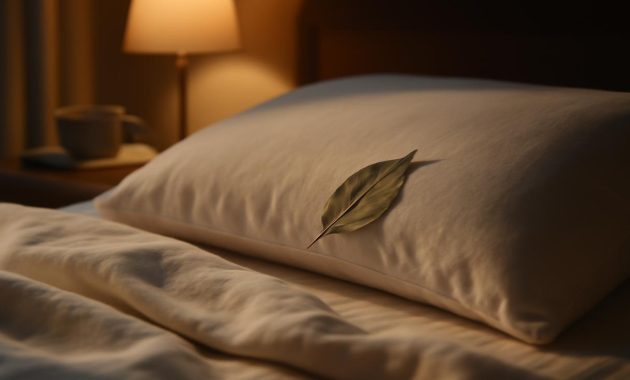
The first time someone suggested I sleep with a bay leaf under my pillow, I laughed so hard I nearly choked on my chamomile tea. A bay leaf. The same stiff, papery thing I absentmindedly throw into pasta sauce and fish out later like a forgotten bookmark. The idea sounded like something rescued from the back pages of an old folk remedy book—charming, a little witchy, and completely impractical. Yet a few months later, there I was, in the soft blue-half-dark of my bedroom, carefully tucking a single bay leaf beneath my pillowcase like it was a love letter or a ticket to somewhere better than my own restless brain.
How a Joke Turned Into a Nighttime Experiment
It started at a dinner party, the kind where the candles burn too low and the conversation gets a little too honest. We were packed around a small wooden table, bowls scraped nearly clean, the air humid with garlic, slow-cooked tomatoes, and the lazy sweetness of red wine. Someone finally admitted what many of us were quietly living: “I honestly can’t remember the last time I woke up rested.”
There was a murmur of agreement—micro-insomnias, scrolling till 1 a.m., waking at 3:27 on the dot with the kind of thoughts that feel heavier in the dark. Careers, kids, aging parents, rent, regret. The usual suspects. Then my friend Lea, who has an uncanny gift for unearthing old-world rituals, said casually, “You know, in my grandmother’s village they used to put a bay leaf under the pillow for sleep and protection.”
I rolled my eyes. “What’s it supposed to do, season my dreams?”
Laughter, clinking glasses, the topic drifted elsewhere. But the image stayed with me—some nameless grandmother in a stone house, tucking a sun-dried leaf under a pillow, believing in something gentle and invisible. I dismissed it, until a week later when I lay awake at 2:14 a.m., the glow from my phone staining the ceiling, my thoughts looping like a stuck song. And the ridiculousness of the idea suddenly became its charm.
“Fine,” I muttered into the dark. “Let’s try the bay leaf.”
The Night I Slipped a Leaf Under My Pillow
The next evening, I pulled out the little jar of bay leaves from the pantry. They made that crisp, papery sound as my fingers shuffled through them, releasing a smell I’d never truly noticed: green and woody, with a faint whisper of eucalyptus and something almost floral. A scent that felt like standing between a forest and a spice market.
I chose a leaf that wasn’t cracked, one with a soft curve and a pale seam running down its center like a spine. It felt absurd to assign it importance, but I did anyway. Maybe that’s what rituals are—ordinary objects promoted to tiny talismans.
In the bedroom, the light was already low, streetlamps turning the curtains into dusky gold. My bed waited, sheets slightly cool, the air faintly scented with laundry soap and the day’s leftover worries. I slid my hand under the pillowcase, creating a small nest, and placed the bay leaf there, smoothing the fabric over it.
I caught myself whispering, “Don’t disappoint me,” to a plant. Then I turned off the lamp.
Did I fall asleep instantly in a swirl of cosmic calm? No. My brain did its usual thing at first: replaying conversations, tallying work tasks, worrying about emails I hadn’t sent. But something else arrived too—a surprising sliver of curiosity. It moved my focus away from what-if catastrophes and toward the sheer, almost childlike question of: Will this do anything?
My senses sharpened. I could smell the faint, herbal trace of the bay leaf, filtered through cotton and warm breath. I noticed the rustle of fabric as I shifted, the far-off hum of a car, a neighbor’s footsteps above. Instead of drowning in my thoughts, I was oddly anchored in my body—tuned to the present moment, not the next crisis. I don’t remember the exact moment I slipped under; only that I woke five hours later, not fully rested, but with the sense that something in the night had softened.
The Bay Leaf Becomes a Ritual, Not a Magic Trick
Rituals rarely announce the day they start. They just quietly repeat themselves until you realize they’ve taken root. By the third or fourth night, putting a bay leaf under my pillow felt less like a stunt and more like a small, private ceremony.
I started doing it deliberately: no screens for the last half-hour, a glass of water instead of a second nightcap, lights dimmed. I’d stand in the kitchen, crack open the spice jar, and let the smell billow out—warm, green, almost medicinal. I’d pick a leaf and hold it between my fingers, tracing its ridge, noticing how something so dry still carried the memory of sunlight and rain.
In that small pause, my whole body would understand: we’re switching modes now. The day is closing. You’re allowed to power down.
What changed first wasn’t the length of my sleep, but the texture of it. The edges stopped feeling so jagged. The 3 a.m. wakeups grew less hostile. Instead of bolt-upright panic, I’d surface slowly, roll over, inhale that faint herbal smell, and drift back more easily. The leaf under my pillow wasn’t sedating me; it was signaling to me. It was my brain’s way of hearing: it’s okay, we’ve done this on purpose.
What Might Actually Be Happening in Your Brain
There’s something strangely soothing about knowing that science doesn’t fully explain your small rituals—and yet, can still brush up against them. Bay leaves, in and of themselves, aren’t proven miracle sleep drugs, but they do carry compounds that interact with our senses in intriguing ways.
Research into aromatics and sleep isn’t new. Our noses are wired straight into the limbic system—the emotional brain, the one that lights up with memory and mood. Even a subtle scent can nudge us into different states: think of how fresh rain can calm you, or how a whiff of an old perfume can drag you back twenty years.
Bay leaves contain essential oils like eugenol and linalool, which are known in other contexts for their potential calming and anti-anxiety effects. We’re not talking about knockout levels from a single dry leaf under your pillow, but the whisper of that scent can still work like a cue. Over time, with repetition, your brain starts filing it under the category: “safe, restful, familiar.”
It’s the same principle as associating a certain playlist with studying, or a specific lamp in the corner with reading. Eventually, your nervous system learns: when this is present, we’re here to do this kind of thing.
So while there’s no major clinical trial proving “bay leaf under pillow cures insomnia,” there is something elegantly simple at play: the power of a consistent sensory signal, wrapped in a bit of story and intention. And that trifecta—scent, story, repetition—can be enough to shift a night from fractured to fluid.
Turning a Leaf Into a Full Night Routine
On its own, the bay leaf is a whisper. But once I started building a small constellation of habits around it, the impact compounded. My bedtime stopped looking like collapse and started resembling a quiet landing.
This is roughly how my nightly ritual evolved around that leaf:
| Step | What I Do | Why It Helps |
|---|---|---|
| 1. Screen Sunset | Shut down phone/laptop 30 minutes before bed. | Reduces mental stimulation and blue light exposure. |
| 2. The Kitchen Pause | Fill a glass of water, open the bay leaf jar, choose a leaf. | Signals transition from “doing” to “winding down.” |
| 3. Scent Check | Inhale the bay leaf’s aroma for a few slow breaths. | Engages the senses and anchors you in the present. |
| 4. The Tuck-In | Slide the leaf under the pillowcase, smooth the fabric. | Creates a tangible ritual of “setting” the night. |
| 5. Final Quiet | Lie down, notice three sounds, three sensations, three breaths. | Gently shifts focus from thoughts to bodily calm. |
Nothing here is dramatic. There are no elaborate tools, no expensive apps. Just a leaf, some air, and my own willingness to show up at the same time, in the same way, often enough that my nervous system got the hint.
When Skepticism Meets Softness
The hardest part of my bay leaf experiment wasn’t believing in the leaf—it was letting go of my need to mock anything that looked even slightly tender. I’d grown so used to armor: sarcasm about self-care, cynicism about wellness trends, eye-rolling at anything that smelled like “manifesting” or moon water.
But there’s a difference between blind belief and quiet openness. Placing a bay leaf under my pillow didn’t require me to sign up for a belief system; it asked for something smaller and much more difficult: to show myself a margin of gentleness at the end of the day.
There are nights when the ritual feels almost ceremonial. I’ll stand by the window in the dark, the city muffled outside, rubbing the leaf gently between my fingers to wake its scent. The air changes—just barely—and my mind follows. Other nights I’m clumsy and tired, half-dropping it, shoving it under the pillow with all the grace of someone late to their own life.
But even then, I notice the difference between “I collapsed into bed” and “I arrived here.” The leaf is my marker of arrival.
Not Every Night Is Magic—And That’s Okay
I wish I could say that the bay leaf cured my insomnia in one enchanted week. It didn’t. There are still nights when my heart races, when deadlines roar louder than any plant-based charm, when sleep feels like a country I no longer have a passport to.
Yet when I look back over the past few months, the pattern is undeniable: my bad nights are less frequent; my good nights are deeper. I wake fewer times, and when I do, I don’t feel so alarmed by my own consciousness. It’s as if the ritual gives me a thread I can follow back into rest instead of wandering the mental labyrinth for hours.
The bay leaf didn’t fix my life. It didn’t erase stress or cure my tendency to overthink. What it did was create a narrow bridge between day and night—simple, scented, and just solid enough to carry me most evenings from one side to the other without falling into the gap.
How to Try It Yourself (Without Making It Weird)
If you’re curious—maybe the way I was curious in that desperate, 2 a.m. kind of way—trying this for yourself doesn’t need to be dramatic. It just needs to be intentional.
Here’s a gentle way to begin:
- Choose your leaf. Use a dry bay leaf from your kitchen—ideally unbroken, clean, and not brittle enough to crumble. Hold it in your hand for a moment.
- Give it a job. Silently, or out loud if that feels right, assign a simple purpose: “This is my reminder to rest.” Not a spell, not a demand—just a clear, kind intention.
- Engage your senses. Inhale its scent slowly. Notice texture, color, even the tiny veins. You’re teaching your brain: this is our nighttime signal.
- Tuck it in safely. Slip the leaf under your pillowcase rather than just the pillow so it doesn’t poke or shift too much during the night.
- Pair it with one calming habit. Read a few pages of a quiet book, stretch, or simply breathe in for four counts and out for six. Let the leaf be part of a small, steady cluster of cues.
Give it a week. Not as a trial where you’ll “fire” the leaf if it doesn’t perform, but as an experiment in paying gentle attention to your own transitions. Notice not only how you sleep, but how you arrive at sleep. The point isn’t perfection; it’s softness.
You might discover what I did: that half the magic of any ritual is in the way it makes you show up for yourself, even for sixty seconds at the edge of the day.
The Small, Strange Things That Save Us
Sometimes I imagine a line of people across history, stretching back through centuries and across continents—each of them in their own quiet room at night, placing something small near their bed. A sprig of lavender. A bowl of water. A stone. A prayer. A leaf.
None of these objects, by themselves, could carry the weight of all those fears and hopes. But what they did, and still do, is create a pause. A moment of “I am here, and I am doing this on purpose.” A way of telling the nervous system: we have one small thing we can control, right here in our hands.
The night I stopped mocking the bay leaf and started slipping it under my pillow, I wasn’t secretly becoming superstitious. I was, without quite realizing it, becoming more willing to care for the parts of me that only speak up after dark—the anxious one, the tired one, the one who just wants to feel held by something steady.
In the morning, I sometimes forget the leaf is there until I make the bed. I’ll lift the pillow and see it, a little flatter, a little more curled at the edges. A witness to my night. I’ll pick it up, thank it silently, and decide whether it’s ready to be retired or asked to stay for one more sleep.
It’s still funny to me, in a way. This stiff, green-brown sliver of plant matter, living its second life as a nightly companion. But there’s a tenderness in that humor now. I no longer roll my eyes at the idea that something so small can change the way I move through the night. Because it has.
Maybe you’ll try it and feel nothing. Maybe your leaf will just be a leaf, and that’s okay. Or maybe, in the middle of some future restless night, you’ll catch the faintest trace of its scent and realize that, without fanfare, your body has started to believe you when you say, “It’s time to rest.”
FAQ: Bay Leaf Under the Pillow and Night Routines
Does a bay leaf under the pillow really help you sleep?
There’s no definitive scientific proof that a bay leaf alone will cure insomnia. However, its subtle scent can act as a calming cue for your brain, especially if you pair it with a consistent bedtime routine. Over time, your nervous system can associate that smell and ritual with rest, which may make it easier to fall and stay asleep.
Is it safe to sleep with a bay leaf under my pillow?
For most people, yes. Use a dry, intact leaf and place it under the pillowcase so it doesn’t scratch or crumble. If you have allergies to bay leaves or strong plant sensitivities, test it first by handling and smelling it during the day. If any irritation occurs, skip this ritual.
How often should I replace the bay leaf?
Replace it when it becomes fragile, breaks apart, or loses most of its scent. For many people, this is every one to two weeks. Let the act of choosing a new leaf become part of the ritual—it reinforces the sense of intention and freshness.
Can I combine the bay leaf with other sleep aids?
Yes. The bay leaf ritual works well alongside other gentle sleep supports like reading, breathing exercises, stretching, or herbal teas. If you use medical sleep aids or have a sleep disorder, continue to follow professional advice; consider the bay leaf a complementary, not primary, strategy.
What if it doesn’t work for me?
If you don’t notice any change after a couple of weeks, that’s okay. Sleep is complex and deeply individual. You might still benefit from the idea behind the ritual—creating a small, consistent, sensory cue at night—by choosing a different object, scent, or practice that resonates more with you.