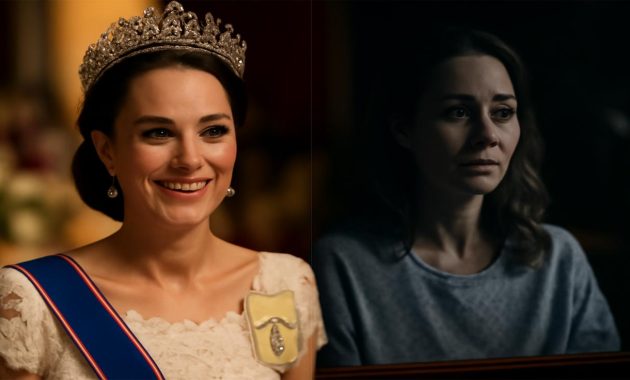
The light hits her first. A thousand crystals in the chandelier catch on the diamonds in her hair, throwing silver rain across the ceiling. The room inhales together. Cameras rise like a mechanical tide. And at the center of all that glittering expectation stands Catherine, Princess of Wales—Kate—smiling in that familiar, measured way that says: “I’m fine. Everything is fine.”
It is a state banquet, the kind dreamed up by etiquette books and costume dramas. Gilded candelabras, polished napkin rings, the faint murmur of violins drifting under the hum of careful conversation. The table stretches like a white river through the hall, bright with crystal and gold-rimmed plates. A monarchy on display, and at its radiant heart, a woman wearing one of the world’s most famous tiaras while quietly fighting a very human, very private battle with her own health.
From the outside, it looks like perfection. Up close, it is something far more complicated—fragile, luminous, and full of the sharp contrasts that come when duty and illness occupy the same body.
When the Room Expects a Princess
The first thing you notice at an event like this is not the dress or the jewels, but the choreography. Footmen glide, stewards hover, and cameras silently track each movement. Everything is arranged so that nothing appears arranged. It is a world where even spontaneity is planned in advance.
When Kate steps into the banquet hall, the atmosphere shifts. There is a brief, almost imperceptible pause, like a held breath. The tiara she wears—intricate, ice-bright, an echo of royal history—immediately becomes the focal point. Light clings to it. It transforms her profile into something almost mythic, the living silhouette of a storybook queen.
And yet, beneath the shimmer of diamonds and the silk of her gown, her body is busy fighting its own quiet war. Treatment cycles, medical scans, restless nights—the long private geography of a health journey that rarely appears in photographs. The applause is for the role she plays tonight, but the real struggle isn’t written into the seating plan.
There’s a detail the cameras don’t catch: the way she adjusts her posture to conserve energy, the careful pacing of her steps, the subtle mechanics of someone deeply aware of every ounce of strength they’re spending. Illness has a way of making you calculate effort in teaspoons instead of hours. But a banquet like this doesn’t pause for fatigue. A princess can’t simply excuse herself from symbolism.
The Weight of a Tiara
There is a quiet truth rarely spoken outside the palace walls: tiaras are heavy. Not metaphorically, though that, too—but physically. They press into the scalp, they need to be pinned and anchored, they demand stillness from the neck and balance from the spine. They are small crowns that require your body to hold them up without flinching.
For someone going through treatment or any serious health condition, the weight isn’t just the metal and gemstones. It’s what the tiara represents: continuity, strength, reassurance. To wear it is to tell the world, “The story still holds. The institution is intact. You can relax.”
Illness, by contrast, is the opposite of reassurance. It introduces question marks where there used to be periods. It asks you to make peace with uncertainty. It slows you when the world still expects you to move at full speed. To stand in a storm of flashbulbs while carrying that duality—royal icon and vulnerable patient—is an act of quiet, disciplined bravery most of us will never be asked to perform.
And yet, under the gleam, she smiles. Not a wide, careless grin, but the composed, steady smile of someone who knows that sometimes courage looks like showing up when you’d rather disappear under a duvet and let the world move on without you.
Behind the Banquet: The Private Hours No One Sees
For a moment, imagine the afternoon before this glittering night. The palace corridors are hushed but busy. Florists move in efficient silence, placing centerpieces. Chefs test sauces one last time. Security teams check and recheck routes and doors. Somewhere upstairs, in a quieter room, Kate prepares for the evening with a much more complicated checklist.
There might be medications to time, side effects to manage, energy levels to assess. A conversation with a doctor revisited in her mind. Family logistics—bedtimes, school drop-offs, reassuring three developing young minds that Mummy is okay, even when “okay” is a moving target.
Then comes hair and makeup, the slow transformation from woman-in-treatment to princess-in-public. It’s not about vanity. It’s armor. Powder that softens tiredness, liner that brightens eyes dulled by fatigue, expertly arranged hair that conceals any subtle changes brought on by treatment. The tiara is the final piece of that armor, a glittering answer to the unspoken question: “Is she strong enough for this?”
Most of us, when we’re unwell, are given permission to shrink our world. We can cancel plans, decline invitations, retreat into soft clothes and dim rooms. Kate does not always have that luxury. Her personal world—diagnosis, fear, physical discomfort—has to coexist with state visits, charity engagements, and the expectation that she will embody grace even on her worst days.
That coexistence is not just performance; it’s an emotional tightrope. She knows millions are watching not only for glamour, but for signs. Is she thinner? Is she pale? Does she look tired? Every photograph becomes a data point in a global guessing game about her health, a game she didn’t ask to play.
Duty, Privacy, and the Thin Line Between
Royal life has always been a negotiation between public service and personal privacy, but illness sharpens that tension to a fine edge. On one hand, there is a genuine sense of duty—to reassure, to say, “I am still here, I am still working, I am still part of this story.” On the other hand, there is the deeply human need to process fear and pain in protected spaces, without commentary or judgment.
Kate’s appearance at a formal banquet, tiara secure, posture impeccable, is not just an act of continuity for the monarchy. It also reflects a decision: to share her presence, but not every detail of her struggle. To acknowledge that something is happening without handing it over entirely to the public arena.
In a culture addicted to transparency, where people livestream their hospital stays and film their tears, that restraint can be bewildering. But privacy, especially in illness, is a kind of medicine. It allows the person to be more than the diagnosis, to maintain a sense of self that isn’t endlessly dissected and defined by their worst days.
The banquet is a performance, yes—but not in the cynical sense. It is a formal ritual in which she offers up the healthiest, most complete version of herself she can assemble that evening. Not to deny her vulnerability, but to refuse to let it be the only story told about her.
The Sound of Silverware and Unasked Questions
Inside the hall, the evening unfurls with practiced elegance. Glasses chime softly as toasts are made. Cutlery touches porcelain in a delicate, nearly synchronized rhythm. The conversations around the long table flow in polite currents—trade agreements, cultural ties, sports, art, the weather in surprisingly specific detail.
Kate leans slightly toward a guest, listening intently, her expression vivid, engaged. She laughs at the right moment, her eyes crinkling in a way that, for a beat, feels completely unburdened. But even in that warmth, there is a perimeter everyone understands not to cross.
The unasked questions hang in the glittering air nonetheless. How are you, really? Are you sleeping? Are you frightened? How do you manage the treatment with three children, a public role, a body you can no longer fully trust?
There is compassion in the room, yes—but it is dressed in protocol. People talk around the topic, offering gentle, coded concern. “You look wonderful” can sometimes mean “I was worried you might not be strong enough to be here tonight.” A simple “We’re thinking of you” carries an entire continent of empathy, tucked inside formality.
She is both the symbol and the person, sitting in one chair. The symbol must be luminous, reassuring. The person might be thinking about the next scan, the next side effect, the next conversation with her children about why she sometimes has to rest more, disappear more, guard herself more fiercely than before.
A Quiet Table of Contrasts
Look more closely, and the banquet table itself becomes a map of contrasts—between image and reality, perfection and effort, spectacle and the fragile body at its center.
| What the World Sees | What Might Be Happening Within |
|---|---|
| A flawless gown, perfectly tailored and serene | Fabric chosen to be gentle on sensitive skin, cut to allow for discreet medical devices or changes in weight |
| A dazzling tiara, catching every light in the room | The literal weight on a body perhaps already fatigued, symbolizing expectations that feel heavier than the diamonds themselves |
| Graceful posture at the table, effortless conversation | Careful energy management, mental check-ins: “How long can I stay? When will I need to rest?” |
| A reassuring public presence | The quiet presence of fear, hope, and the unknown—carried with practiced composure |
This is the paradox of public illness: to be simultaneously over-seen and under-understood. To exist as headlines and close-ups while the most meaningful parts of the story—grief, grit, the thousand tiny choices of endurance—remain necessarily invisible.
The Human Heart Behind the Crown
It is tempting, when we talk about royalty, to drift into abstraction. “The Firm.” “The Crown.” “The Monarchy.” Grand, distant words. But on nights like this, with the light catching on her cheekbones and the tiara sitting like a fragment of starlight above her brow, what stands before us is not an institution. It is a person enduring something hard.
There’s a moment—easy to miss, quick as a blink—when the speeches end and the applause swells. The orchestra hesitates before beginning the next piece. In that breath between duties, her face softens. Her eyes move across the room, not quite focusing on anything, as if she’s listening inward instead of outward. Then, in an instant, the royal composure returns. The next conversation starts. The smile lifts again like a curtain.
For anyone who has navigated their own health crisis, this dance is familiar. The display of “I’m okay” that you offer to protect the people around you. The private negotiations you make with your own body: “Give me two more hours. Just get me through this one thing.” The way you become fluent in two languages at once—outward calm, inward chaos.
Kate’s situation magnifies that experience onto an almost unimaginable scale. Where most of us perform for a handful of loved ones or colleagues, she performs for nations. Where our worst days might be witnessed by a small circle, hers risk becoming public conversation, endlessly replayed, zoomed in, dissected for clues.
And still, she shows up. Not every time—no one could, nor should—but often enough to remind the world that illness, while life-altering, does not erase identity. She is still a mother, a wife, a future queen consort, a woman who loves the outdoors, photography, laughter, the ordinary rituals of family life. The diagnosis did not replace all that; it only threaded through it, an unwelcome addition to an already full tapestry.
What Her Tiara Moment Whispers to the Rest of Us
Strip away the palaces and processions, and what remains is something deeply relatable: the attempt to remain yourself under the pressure of illness. When we see Kate in her tiara at a state banquet, the image can easily feel like another world—one of unreachable privilege and jeweled problem-solving. But inside that world lives a very familiar question: “How do I keep being me while my body changes, while my future feels uncertain?”
In that sense, her tiara moment is not just royal theater. It is a quiet message, even if unintentional, to anyone sitting at their own small kitchen table, wearing no diamonds, just hospital bracelets and soft pajamas: This, too, is what illness can look like. Not just beds and IV drips, but brief returns to normalcy, to ceremony, to joy—even if those returns are carefully managed and paid for later in fatigue.
Her presence at such an event doesn’t negate the reality of her health challenge. It complicates it. It reminds us that people in treatment might still laugh, still dress up, still perform at work, still host dinner, still crack jokes and listen to music. The body can be embattled and still produce moments of splendor. The heart can be frightened and still hold grace.
For viewers far away, watching shaky phone recordings and sharp professional photographs, the key is to remember both halves of the story. Don’t let the diamonds blind you to the difficulty. Don’t let the diagnosis erase the dignity of showing up. Hold both truths together: the breathtaking sparkle of the tiara and the invisible bravery of the woman wearing it.
The Banquet Ends, the Battle Continues
Eventually, even the grandest evenings must close. The speeches are finished, the cutlery cleared, the last few jokes shared in soft tones as guests drift toward exits and waiting cars. The hall quiets, its grandeur settling into shadows. Staff move quickly now, neatly, stacking, polishing, resetting the palace for tomorrow’s demands.
Somewhere away from the cooling glow of the chandeliers, Kate steps out of the center of the stage. The tiara is carefully removed, each pin eased free from her hair. The gown is unzipped, the jewelry unhooked and laid out on velvet trays. What remains is just a woman in the in-between space after adrenaline and before rest.
Perhaps there is a moment in front of a mirror: face clean, shoulders bare, the faint marks of where fabric and metal pressed against her skin all evening. The outer armor is gone. The quiet, familiar vulnerability returns. She is again the person who must navigate appointments, treatments, conversations with doctors, moments of private fear and stubborn hope.
The banquet will live on in photographs that circle the globe. Headlines will describe her tiara, her gown, her poise. Some will note the contrast between her appearance and her condition. Others will speculate, analyze, over-interpret. That’s the nature of public life in the digital age.
But the truest part of the story may never be written—that internal ledger of effort and courage that only she can see. The decision to go. The calculation of cost. The determination to walk into the light when retreat would have been so much easier. The choice to let the world see her not just as a patient, and not only as a princess, but as something harder to categorize: a human being finding her way through uncertainty with as much dignity as she can gather.
Tomorrow will bring new headlines, new events, new tests—both medical and emotional. The tiara will go back to its case. The battle will continue behind closed doors and inside a body that must be listened to more carefully than ever before.
And yet, that single night, that glittering state banquet, will remain a snapshot on the long arc of her story: the moment when diamonds flashed beneath chandeliers while, beneath the sparkle, a quieter, deeper kind of radiance held its ground—a courage no camera can fully capture, but that everyone, on some level, recognizes.
Frequently Asked Questions
Why is Kate Middleton’s tiara moment at a state banquet so significant?
It stands out because it visually represents the clash between her public role and her private health struggle. The tiara and the formal setting symbolize continuity, strength, and tradition, while behind that glittering image she is living through a deeply personal and vulnerable chapter with her health. The contrast makes the moment emotionally resonant far beyond royal fanfare.
Does attending such events mean her health issues are minor?
Not necessarily. Many people undergoing treatment or living with serious conditions still have periods when they can work, socialize, or appear in public. Being well enough for a carefully managed event does not erase the ongoing challenges, side effects, or uncertainty that come with a significant health diagnosis.
Why doesn’t she share every detail of her medical situation?
Medical information is intensely personal. Even public figures have the right to privacy around their health. Sharing selectively allows her to acknowledge that something serious is happening while still protecting her family, her own emotional well-being, and her ability to process the experience away from constant scrutiny.
How might her public appearances affect others going through illness?
Seeing her balancing treatment with moments of normalcy can be encouraging for some people, reminding them that they are more than their diagnosis and can still have days of beauty, purpose, and joy. It can also validate the invisible effort required to “look okay” when feeling unwell, something many patients know all too well.
What can we learn from the contrast between her public image and private battle?
The contrast invites us to be gentler and less judgmental with everyone we encounter. It’s a reminder that what we see on the surface—glamour, competence, calm—often hides untold struggles. Whether someone wears a tiara or a t-shirt, we rarely know the full story behind their composure, and a little empathy can bridge that unseen distance.