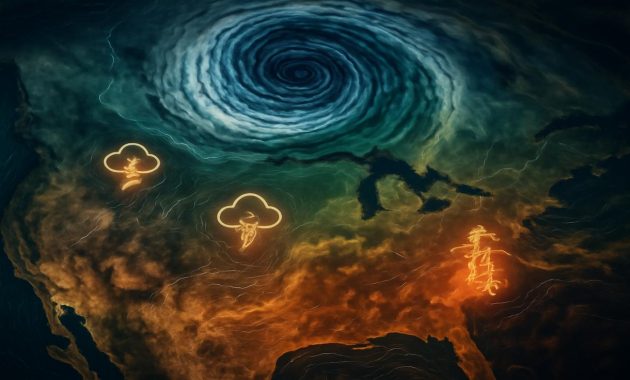
The first sign that something unusual was happening high above our heads wasn’t a headline or a forecast map. It was the sky itself. In some places, the air felt wrong for the season—too soft where it should have been razor-sharp, too still where it should have been restless. A thin, pearly haze clung to the horizon while local meteorologists shuffled their graphics and recalibrated their tone. Behind the familiar icons of snowflakes and wind arrows, something vast and invisible was starting to shift: the polar vortex, that frigid, whirling crown of air that lives far above the Arctic, was beginning to come undone.
The Quiet Engine Above the World
To really feel what’s coming, imagine yourself standing alone on a frozen lake in the deep of winter. The air is so cold it tastes metallic. Each breath cuts. Somewhere beyond the treeline, a snowmobile growls, but the ice beneath your boots is perfectly still—unyielding, constant, timeless. That’s the polar vortex on a normal year: a great, steady engine of cold, spinning tightly over the North Pole, so distant that we rarely think about it, yet so powerful that our everyday weather quietly bows to it.
High up in the stratosphere, roughly 10 to 30 miles above the ground, this river of icy wind circles the pole like a jet racing around a track. Inside its loop, bitter Arctic air is mostly locked away, contained. Outside the loop, the mid-latitudes—where most of us live—enjoy a relatively predictable rotation of seasons: cold, sure, but not deep Arctic cold. Stormy at times, but rarely feral.
But the vortex isn’t a machine made of steel and gears. It’s made of air, and air listens to everything: ocean temperatures, shifting currents, mountain ranges, sea ice, and the erratic pulses of heat rising from the lower atmosphere. Every so often, the balance tilts. Waves of energy rise from the troposphere—our familiar weather layer—into the stratosphere and slam into the vortex like invisible ocean swells hitting a cliff. Sometimes they just rattle it. Sometimes they crack it wide open.
This year, specialists are watching exactly that kind of crack begin to form. The phrase they use is dry and technical—“a polar vortex disruption,” possibly even a “sudden stratospheric warming event”—but what it means on the ground is visceral. It means the engine that normally keeps the worst of the cold pinned to the Arctic may be about to stutter and throw its gears into our backyards.
A Rare Disruption—and Why It Matters Now
In the jargon of atmospheric science, a “disruption” of the polar vortex happens when that high-altitude ring of wind weakens, wobbles, or even breaks apart into smaller whirlpools of cold. Sometimes it shifts off the pole. Sometimes it splits in two. Either way, the neat barrier between the frozen north and the rest of the world starts to fray.
Specialists have been quietly circling dates on their model runs, watching temperatures in the stratosphere spike over the Arctic and winds slacken where they should be fierce. To most people, that might sound abstract, but it’s a bit like a mechanic hearing a subtle change in the hum of a car engine and knowing something big is about to fail. That hum—those wind speeds and temperature gradients—tell forecasters that the vortex could soon send massive, wandering lobes of cold air surging south into North America, Europe, or Asia.
We’ve seen this story before. The notorious “Beast from the East” that gripped Europe in 2018, the deadly Texas freeze of February 2021, and several paralyzing North American cold snaps over the last decade were all linked, in some way, to disrupted polar vortices. Not every vortex shift leads to disaster, and not every cold outbreak is the vortex’s fault. But when this system goes awry, it nudges the dice toward extremes: sharper cold, more tangled jet streams, and storms that behave less like orderly marching bands and more like improv jazz.
What makes this coming disruption especially important is not just the cold itself, but the world it’s dropping into. Our power grids are aging. Our cities are bigger. Our demand for electricity—especially during harsh weather—is higher than ever. When specialists say this rare shift may intensify storms and energy demand, they’re not being dramatic. They’re describing a collision course between atmospheric chaos and human infrastructure that’s already stretched thin.
When the Sky Tilts: From Vortex to Front Door
So what does a polar vortex disruption actually feel like from ground level? It doesn’t announce itself with a label. There’s no alert on your phone that says “vortex fragment inbound.” It slips into your life through the small, sensory details of a day that doesn’t behave the way it should.
Maybe you live in a coastal city where winter usually means a damp chill, grey skies, and a polite dusting of snow that melts by lunch. One morning, the air bites harder when you step outside. The wind feels like it has sharpened teeth. Within days, ordinary flurries swell into fat, wind-blown sheets of snow that blur the edges of buildings. The streets empty. The world becomes a quieter, muffled place, the steady hiss of tires on wet pavement replaced by the crunch of boots on frozen crust.
In another part of the world, the cold arrives as a shock so sudden it feels like a prank. One week you’re in a light jacket, the next you’re rummaging through closets for forgotten mittens. Pipes groan. Power lines glaze with ice. The familiar hum of refrigerators and heaters becomes something you’re suddenly listening for, as if the sound of appliances has turned into a lifeline.
That’s the human side of a disrupted vortex: not just lower numbers on a thermometer, but the sensation of normalcy slipping. The jet stream, which usually snakes across continents in a relatively smooth band, starts to fold and buckle. Deep troughs of Arctic air plunge south, while ridges of warmer air push north in other places, sometimes melting ice roads in the Arctic while parents in mid-latitude suburbs chip ice off their cars before dawn.
Storms feed off those contrasts—between warm and cold, wet and dry, high and low pressure. When the atmospheric steering currents are distorted by a staggering polar vortex, they can stall systems in place, intensify them, or fling them in strange directions. That might mean nor’easters that barrel up the Atlantic coast, snowstorms that hit regions more accustomed to rain, or freezing rain events that wrap neighborhoods in treacherous glass.
The Invisible Tug on the Power Grid
As the weather grows stranger, another system begins to strain—one even more tightly woven into our daily lives than the jet stream: the electric grid. Utilities planners have a phrase almost as bloodless as “polar vortex disruption”: they call it “peak load.” In plain terms, it’s the moment when everyone, all at once, reaches for the thermostat, the space heater, the electric kettle, the stove, the hot water—asking the grid to be not just reliable, but heroic.
During a significant cold wave tied to a polar vortex event, that peak can spike sharply. Electric heaters and heat pumps churn day and night. Natural gas demand jumps, not just for direct heating but also for power plants feeding the grid. If the cold also brings ice and snow, the very infrastructure needed to deliver that energy—lines, substations, gas wells, wind turbines, even coal piles—can freeze, clog, or fail.
Here is where the atmospheric and the human meet, in a quiet but consequential tug-of-war. In control rooms, operators stare at massive screens of fluctuating demand, balancing generation and consumption almost second by second, keeping a delicate equilibrium. A gust of wind that knocks out a line in one region, a frozen sensor at a gas facility in another, and a surge of heaters flicking on as the sun sets can all combine into a dangerous tipping point.
To understand this interplay, it helps to see how weather and energy demand often move together:
| Weather Pattern | Typical Impact on Energy Demand | Potential Grid Challenge |
|---|---|---|
| Normal Winter Cold | Moderate increase in heating demand | Generally manageable with planned capacity |
| Sharp Cold Snap | Rapid spike in electricity and gas usage | Stress on peak generation and fuel supply |
| Prolonged Arctic Outbreak | Sustained high demand, 24/7 heating | Equipment fatigue, fuel constraints, rolling outages |
| Ice & Heavy Snowstorm | Localized surges as outages and restorations alternate | Downed lines, access issues, slow repairs |
Now add in a disrupted polar vortex, which doesn’t just deliver cold, but cold that can be deeper, more geographically widespread, and more persistent than many regions are designed to handle. The stress on the grid is no longer just a winter inconvenience; it’s a structural test. How resilient is our network when the sky itself starts improvising?
What makes this moment striking is how closely specialists are linking atmospheric signals to infrastructure consequences. Meteorologists share early vortex disruption hints with energy planners, who in turn calculate how much extra capacity, fuel, and flexibility they might need. It’s a reminder that the drama playing out miles overhead is no longer just a curiosity for weather enthusiasts; it’s a practical, daily-life concern that can decide whether your home stays warm on a bitter night.
Stories from the Edge of the Cold
Every rare atmospheric shift eventually turns into something tangible: a story told over dinner, a news clip, a memory framed by a particular sensation of cold or quiet. Think back to a winter storm that left an impression on you—maybe roads were so glassy that cars crawled like beetles, or the silence after a heavy snowfall felt thick enough to touch. Those moments are where a phrase like “polar vortex disruption” leaves the lab and walks into your life.
In a small town that thought of itself as too far south for serious snow, children might wake to a landscape so transformed they barely recognize their own street. Trees bow under ice, their branches clinking softly in the wind. The usual roar of traffic is replaced by a milder soundscape: a distant generator, the muffled scrape of someone trying to dig out a car, the laugh of a neighbor who has just slipped and recovered.
Inside homes, people layer sweaters and blankets, knowing the grid is strained and trying to avoid adding one more watt to the load. Candlelight flickers against frosted windows in neighborhoods where lines have gone down. In the countryside, farmers check water lines for their animals, breaking ice in troughs, watching the sky with a wary eye as new bands of snow swirl in on unfamiliar wind angles.
This is the human experience behind the headlines—tiny acts of adaptation and resilience. Someone shares an extension cord so a neighbor can keep their fridge running off a small generator. A local library turns into a warm refuge, its usual hush replaced with murmured gratitude. The particular cold outside feels less like weather and more like a presence: something vast has bent down from the Arctic and is breathing against the doors.
And for those who work in the thick of it—grid operators, road crews, meteorologists, paramedics—these events are a blur of long hours and small decisions with big consequences. Whether a tree gets trimmed before an ice storm, whether a forecast emphasizes the right risk at the right moment, whether a power plant secures enough fuel before roads freeze—each of those choices is a stitch in a fragile safety net humans weave under an unruly sky.
Living with a Restless Atmosphere
It would be comforting to think of the polar vortex as a rare villain, an occasional intruder into our otherwise steady winters. But the deeper story is more complicated. Our atmosphere is not a calm, balanced system slightly disturbed from time to time. It is a restless, dynamic, ever-shifting tapestry of heat, moisture, and motion, now further nudged by the steady warming of the planet.
Scientists are cautious about drawing straight lines, but they’re asking hard questions. As the Arctic warms faster than the mid-latitudes, the contrast that helps drive the polar jet stream is changing. Sea ice is shrinking. Snow cover patterns are evolving. Some studies suggest these shifts may be making the jet stream more wavy and persistent at times—more favorable for blocking patterns and extreme weather events, including some kinds of cold outbreaks linked to vortex disruptions.
It’s an unsettling paradox: in a warming world, episodes of intense cold may still occur, and sometimes in surprising places. The average temperature of the planet is rising, but that doesn’t mean a smooth, gentle warming everywhere. Instead, it’s as if someone is adding energy to an already turbulent system, giving the dice more spin each time they’re thrown.
As these rare polar shifts happen, they become tests: of our scientific understanding, of our ability to anticipate and adapt, and of our willingness to prepare for events that live in the tail ends of probability curves. The more we learn about the vortex and its moods, the more we see that the line between “normal winter” and “once-in-a-generation event” is not a wall, but a sliding scale we’re still trying to read.
Yet embedded in this uncertainty is a strange kind of clarity: the recognition that we are inseparable from the sky above us. The warm air rising from cities and power plants, the heat stored in oceans, the shrinking ice caps—they all whisper upward into the atmosphere, nudging patterns, shifting boundaries. And the atmosphere, in turn, answers us with weather that traces those invisible conversations.
Preparing for the Next Deep Breath of Winter
As specialists warn that a polar vortex disruption is on the way, and that this rare shift may intensify storms and energy demand, the message is not one of panic, but of awareness. High above, the stratosphere is rewriting its winter script. Down here, we have the chance to rewrite how we respond.
On a personal level, it can be as simple as taking winter seriously, even in places where cold snaps once felt like flukes. Checking that your home is weather-sealed, that you have extra blankets, batteries, and a way to stay informed if the power flickers. Knowing how to drain an outdoor faucet before it bursts, or how to help a neighbor who might be more vulnerable to the cold.
On a community level, the questions grow larger. Are buildings insulated well enough to ride out extended freezes without overwhelming the grid? Do cities have plans for warming centers and clear communication when energy supplies tighten? Are grids flexible and interconnected enough to shift power where it’s needed when storms exploit distant weak points?
And on a broader scale still, the polar vortex becomes part of an even bigger conversation about resilience in a climate that no longer behaves like the one our infrastructure was built for. Investing in stronger, smarter grids; diversifying energy sources; improving forecasting and communication; designing cities that can bend without breaking under unusual weather—these are not abstract policy dreams. They are practical forms of respect for an atmosphere that is, by nature, unruly.
Somewhere, right now, far above the Arctic night, the vortex is feeling the first tugs of change. Winds that usually race in tight circles are wavering. Temperatures in the thin, high air are climbing in odd places. Within weeks, those shifts may be reflected in the sky over your own home—in the angle of the wind against your windows, in the way snow piles at your door, in the hours your heater hums without rest.
When it happens, you might remember that this isn’t just “bad weather.” It’s a moment when the deep architecture of winter has flexed. A reminder that we live in the thin, delicate layer between Earth and space, treading on the skin of a planet whose breath we can feel, but never control. The polar vortex will eventually find its balance again, spinning back into its familiar, frigid crown. But the memory of its disruption—of storms sharpened and grids strained—will linger as one more chapter in our unfolding story of how we live beneath a changing sky.
Frequently Asked Questions
What exactly is the polar vortex?
The polar vortex is a large area of low pressure and very cold air high in the atmosphere, centered over the polar regions. It’s not a single storm, but a broad, swirling circulation in the stratosphere that helps contain the coldest Arctic air.
What does it mean when specialists say the polar vortex is “disrupted”?
A disruption occurs when the normally strong, circular winds of the vortex weaken, wobble, or split apart. This can allow pockets of extremely cold Arctic air to spill southward into North America, Europe, or Asia, increasing the risk of severe cold outbreaks and intense storms.
Does a disrupted polar vortex always mean extreme cold where I live?
No. The effects depend on how the disruption unfolds and how the jet stream responds. Some regions may experience brutal cold, while others might see milder or even warmer-than-average conditions. Forecasts become especially important during these periods.
How can a polar vortex disruption increase energy demand?
When Arctic air pushes into heavily populated regions, heating demand surges. Electric heaters, heat pumps, and gas furnaces run longer and harder, causing sharp spikes in electricity and fuel use. If the weather also damages infrastructure, the grid can become stressed or overloaded.
Is climate change causing more polar vortex disruptions?
Scientists are still studying this. Some research suggests that rapid Arctic warming and changes in sea ice and snow cover may be influencing the jet stream and the stability of the polar vortex, potentially making certain types of disruptions more likely. However, the relationship is complex and still an active area of research.
How can I prepare for a severe cold event linked to the polar vortex?
Improve home insulation, protect pipes from freezing, keep a basic emergency kit with blankets, nonperishable food, water, flashlights, and batteries, and stay tuned to local forecasts and utility updates. If you rely on electricity for heat, have a plan for how to stay warm during potential outages.
Are these events going to become the “new normal”?
Extreme events—whether heat waves, floods, or severe cold spells—are expected to remain part of our climate, and some may become more frequent or intense as the planet warms. While each winter is different, building resilience into our homes, communities, and energy systems is a sensible response to an atmosphere that is increasingly dynamic.