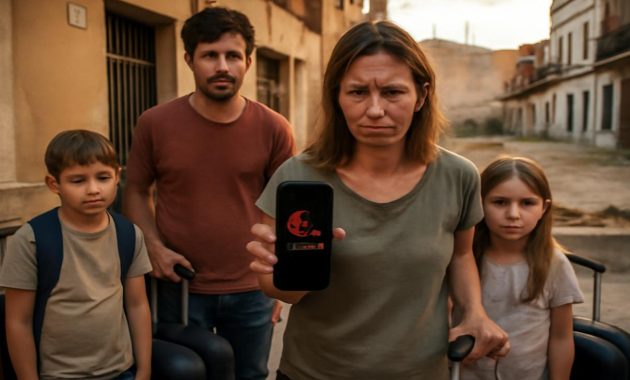
The road curled along the Spanish coast like a lazy ribbon, sunlight flashing on the sea to their left, the rental car filled with that bright, late-afternoon excitement that comes right before a holiday finally becomes real. The kids were pressed to the windows, pointing at the distant whitewashed houses clinging to the hillsides. In the passenger seat, Anna held her phone up like a compass, the blue dot inching toward the red pin that promised: “Your holiday home.” After weeks of work stress, school runs, bills, and barely time to breathe, this was it. Ten days in a quiet Spanish village. A small house with a pool. A terrace where they would eat long, slow dinners, the air smelling of rosemary, olive trees, and sea salt. All neatly reserved through Booking.com for €1,800. What could possibly go wrong?
The Dream That Started With a Screen
It had begun months before, on a gray evening back in Germany. Rain had locked the family indoors, and the house smelled faintly of wet shoes in the hallway. The children were arguing over a board game. The heating hummed. On the sofa, lit only by the blue light of her laptop, Anna clicked through holiday rentals and sighed.
“We need something small, but not cramped,” she said, angling the laptop so her partner Marc could see. “Close enough to the beach, but not in one of those crowded strips. And not too expensive.”
Marc leaned in, his hair still damp from the shower, and scrolled lazily. The children, half-listening, perked up every time the word “pool” appeared on the screen. They were a normal middle-income family: not poor, not rich, the sort of people for whom €1,800 was a serious decision, a number that carried the weight of hours worked and compromises made. A bigger car could wait. Home renovations would wait again. This would be their splurge for the year.
And then they saw it.
A neat white house, tiled roof edged with warm terracotta. Two bedrooms. A small but sparkling pool, rimmed with blue mosaic. Bougainvillea pouring over a low wall in a tangle of magenta and green. A terrace with a simple wooden table and four chairs, bathed in soft golden sunset light. “Quiet, family-friendly area,” the description promised. “Short drive to the beach. Fully equipped kitchen. Free Wi-Fi. Air conditioning.”
The reviews were oddly sparse, but good. “Lovely place,” one read. “Perfect for a quiet week.” Another: “Great location. Would come again.” The photos looked real enough—slightly imperfect, like a friend’s snapshots rather than glossy brochure images. The price: €1,800 for ten nights in August. Not cheap, but not outrageous for high season.
They hesitated, cross-checking dates, flight prices, the school calendar. Then, with that tiny rush that comes from committing to something in a single click, they booked it. Confirmation email. Reference number. The comforting corporate blue of Booking.com’s logo at the top.
“We’re going to Spain!” the kids shouted, leaping off the sofa, turning that gray evening into something suddenly bright and bearable.
The Countdown to Paradise
Over the next weeks, the house became a kind of mental postcard that each of them returned to when work dragged or school seemed endless. When classmates talked about Bali or Florida, the children could hold their own with a simple, proud “We’re going to Spain.”
At night, when the children were in bed, Anna would re-open the confirmation email—not because she doubted it, but because she loved looking at the photos and imagining herself there. She could feel the morning air on that terrace, slightly cool from the night but already promising heat. She imagined carrying a bowl of peaches outside, slicing them as the kids splashed in the pool. She could almost smell the suncream, hear the sound of cicadas rising in the trees.
Marc, more practical, checked the details instead. He read the instructions from the host: “Text me when you land. I will send you directions and meet you at the property.” A Spanish number. A name: “Juan.” Vague but not suspicious. Many rentals used hosts acting as intermediaries for owners. He also looked at the Booking.com customer support options, quietly reassured by the wide net of safety implied in phrases like “24/7 support” and “We’re here for you.”
“Even if the host is late or something, we can always call Booking,” he’d said. “That’s why we booked through them and not some random site.”
In the invisible space between his words and hers, trust settled in—a soft, unexamined belief that with big, known platforms, nothing catastrophic could really happen.
Arrival: Heat, Hope, and the Blue Dot on the Map
The day they arrived, the Spanish sun wrapped around them like a thick blanket. The air on the tarmac shimmered. The children emerged from the plane sticky and excited, blinking against the light. In the rental car office, the family stumbled through signatures and insurance options, their German-accented English meeting the rapid Spanish-English rhythm of the clerk. The world smelled of sun-baked asphalt, sunscreen, and distant ocean.
As they rolled out of the airport, the kids pushed windows down, the hot air blasting through the car like the breath of some enormous furnace. But beyond that heat lay something cooler: the promise of the pool, the tiled floors, the shaded terrace. The house began to feel not like an online listing, but like a physical certainty they were driving toward.
“Text the host,” Marc said, keeping one hand on the wheel, the other guiding them around a roundabout where a cluster of palm trees stood, fronds whispering in the wind.
Anna typed quickly. “Hi, it’s Anna. We’ve landed and are driving to the property now. See you soon!”
The message ticked to “delivered” but remained unread. She watched the screen, waiting for the “typing…” bubble that never came.
“Maybe he’s driving,” she shrugged. “Or cleaning the house.”
The blue GPS dot crawled over the map, out of the city, into the more open countryside where the land rose and fell in soft, dry hills. Olive trees dotted the slopes like tiny gray-green umbrellas. Vines traced lines across fields. The sky was a hard, perfect blue.
The children’s voices rose in the backseat. “How big is the pool again? Can we go in right away? Do we have to unpack first?”
“Pool first,” Marc decreed. “Unpacking later. It’s the law of holiday physics.”
As they got closer to the location pin, the roads narrowed. The car bumped over cracked asphalt, dust lifting in small clouds. They passed a sleepy bar with plastic chairs out front, old men watching the world through half-lidded eyes. A dog lay sprawled in a strip of shade, barely lifting its head as they went by. The village was pretty in that slightly worn, unfussy way of places that don’t try to impress tourists.
The House That Wasn’t There
“Turn left here,” the navigation app said. They did, onto a smaller lane flanked by stone walls. White houses rose on either side, some pristine, others with peeling paint and bougainvillea creeping wildly over them.
“Two hundred meters,” the calm GPS voice instructed. “Your destination is on the right.”
The lane curved gently. Numbers painted next to doors ticked upward: 14, 16, 18…
“Okay, it should be right… here.”
Marc slowed the car to a crawl. On the right stood a weathered stone wall, waist-high, topped with dry weeds. Behind it: an empty, dusty plot, scattered with rocks, a few scraggly bushes, and discarded building materials. Beyond that, another house, but nothing like the one in their booking photos. No pool. No terrace table. Just sun-blasted dirt and the faint hum of insects.
“No, that can’t be it,” Anna said, laughing at first, that nervous little laugh people use when they’re not yet ready to let the possibility of disaster in. “Maybe the GPS is off. Maybe it’s the next one.”
They rolled forward. Number 20. Number 22. Then the lane ended in a dead end, facing another old stone wall tangled with dry vines.
“Check the address again,” Marc said, putting the car in reverse, easing them back slowly.
She checked. The address in the Booking.com confirmation matched what the navigation showed. She checked the photos again, zooming in on the street view in her mind: that low wall, the blue pool, the white façade. Nothing around them matched.
They parked in a sliver of shade. The car’s interior smelled of hot plastic and the faint citrus of the rental company’s air freshener. The children fell quiet, sensing that the adult energy had shifted from excitement to something heavier.
“Maybe it’s behind that empty lot?” the older child suggested. “Like, down a driveway or something?”
They got out of the car. Heat hit them like a solid wall. The sound of cicadas swelled. Somewhere, a radio played faintly from an open window. A dog barked, once, and then stopped.
They walked the length of the lane. Every house they passed was either clearly occupied, shutters drawn against the heat, or visibly different from the rental photos. There was no hidden driveway, no back entrance, no sign with the host’s name, no “Casa Juan.”
They looked back at the empty lot. Dust stirred in a lazy swirl. A plastic bag, caught in a bramble, flapped weakly. It might have been a future house once, in someone’s plans. But right now, it was exactly what it looked like: nothing.
“We’ll Call Booking. It’ll Be Fine.”
They tried the host first. The number rang once, twice, then clicked to silence. No voicemail message. No explanation. Just dead air. Anna tried again. Same result. She sent another message: “We’re here at the address but can’t find the house. Please call.” No answer. No read receipt. Nothing.
They stood there in the sun, phone screens bright and hard to read, the air heavy, time stretching in a way that felt suddenly very long.
“It’s okay,” Marc said, pushing away his own growing unease. “We’ll call Booking.com. That’s why they exist. They’ll sort it out.”
He found the customer service number in the confirmation email and tapped it. The phone rang, a generic tone cutting thinly through the sound of the cicadas. Then a recorded voice: “Welcome to Booking.com. Please hold while we connect you to an agent.”
He put the call on speaker. The children leaned in, eyes wide, as if they were listening to a story and waiting for the twist where everything turns out fine. Tinny hold music played, some polite classical piece stripped of emotion.
Finally, a voice came on the line. Polite, slightly distant, in accented English. “Hello, this is Booking.com support. How can I help you today?”
Marc explained: the address, the empty lot, the unreachable host. The agent asked for the reservation number. He read it out, digits careful in the thickening heat.
“Okay, one moment please,” the agent said. There was a pause, the click of keys faintly audible. “I will try to contact the property for you.”
They waited. Dust swirled again across the empty lot. A small lizard flashed over a stone, vanished into a crack. The children shifted from one foot to the other.
Then—the line went dead.
At first, they all just stared at the phone, as if some invisible hand might reach out of it and offer an apology. The call had cut off without warning. No beep, no crackle, no explanation. Just silence.
“Maybe the connection dropped,” Anna said, though the signal bars at the top of the screen were full.
They called again. The process repeated: hold music, an agent, a promise to contact the host. Then, midway through the slightly scripted sympathy—“I understand this must be very frustrating for you”—click. Silence.
They tried four times. Each time the story played out the same way, like a broken record skipping at the same point in a song. Each time, hope rose—voice on the line, notes tapped into a system somewhere, a suggestion that they were being taken seriously—then hope was abruptly cut off with the call itself.
The Sinking Feeling of Being on Your Own
By the fourth call, something in the air around them had changed, thickening with a kind of disbelief that edged toward anger. They sat back in the car now, the air-conditioning finally fighting the heat, the empty lot visible through the dusty windshield like a mirage that refused to become real.
The children’s earlier chatter had dissolved into restless fidgeting. “So… where are we going to sleep?” the younger one asked quietly.
It was a simple question, but it cut through every adult layer of denial and patience. Where were they going to sleep? The nearest hotels shown on the map were either fully booked or wildly expensive. The village didn’t seem overrun with options; it was the sort of place where accommodation is hidden in private homes and quietly-managed rentals, not blinking neon signs.
They tried the host again. No answer. They texted, emailed, messaged through the Booking.com app. All of it went into the same silent void, as if they were calling into an empty, echoing room.
With each unanswered attempt, the emotional ground shifted. First came confusion—this must be a mistake. Then came frustration—why wasn’t anyone doing anything? Slowly, something harder and sharper took root: the realization that they had done everything “right,” booked through a major platform, paid their €1,800 well in advance, trusted the protective gloss of a known brand—and yet here they were, sitting on a dead-end lane beside an empty lot, with nowhere to go.
The worst part wasn’t just the missing house. It was the sensation of being cut off. Each time Booking.com support dropped the call, it wasn’t just a technical issue. It felt like an invisible door closing in their faces. A reminder that beyond the friendly slogans and reassurances, they were still small people facing a large, impersonal system that could simply… disconnect.
How It Feels When a Holiday Becomes a Cautionary Tale
If you’ve ever been stranded—missed flight, lost luggage, overbooked hotel—you know that travel stress carries a particular taste. It’s metallic, like pennies on your tongue. Your heart beats a little faster, every small decision suddenly weighted with consequence. Add children, exhaustion, and the heat of a Spanish afternoon, and that stress sharpens into something almost surreal.
They started looking online for any mention of similar situations. Their mobile data strained under frantic searching: “Booking.com fake rental Spain,” “property doesn’t exist Booking,” “no house on arrival.” Stories surfaced—some old, some recent—of travelers arriving at addresses to find hotels closed, apartments unbuilt, or hosts vanished. In each story, between the lines of polite corporate responses and carefully phrased apologies, there was the same essential truth: the platform is a marketplace, not a guardian angel.
Some travelers had their money refunded, eventually, after weeks of emails and documentation. Others were offered alternative accommodation far beyond their budgets and left to argue about the difference. Some fought chargebacks with their banks. Many described the same phrase: “We called, and the calls were cut off.”
That phrase, once written in a complaint, sounds almost too simple. But in the moment, on that dusty lane, it meant this: hope, suspended, then severed. Each dropped call was another reminder that the safety net they had imagined under them—the big brand, the customer service promise, the idea that someone was looking out for them—was thinner, patchier, than they’d believed.
Later, when they would tell the story back home—to friends around a table, to colleagues in an office kitchen, to relatives on the phone—it would acquire a sort of dark humor. “We paid €1,800 for an empty lot,” Marc would say, and people would laugh in disbelief, shake their heads, ask “But how is that even possible?” They would use it as a cautionary tale, a warning about blind trust in platforms.
But in that first afternoon, laughter was a long way off. There was only the here and now: the tired kids, the heat, the quiet village, the knowledge that night was coming and they did not have a place to rest.
The Last-Minute Scramble for Shelter
They did what people have always done when systems fail them: they turned to strangers nearby. At the tiny bar they’d passed on the way in, the owner listened to their halting mix of English, German, and translation-app Spanish.
“No casa,” he said, looking at the address. “Aquí, nothing. Land only.” He gestured with his hand, a flat sweep that could have meant empty land, or empty promises, or both.
He made a call to a friend. Another call. Shook his head. In the end, he pointed them toward a small family-run guesthouse in the next town, one that still had two rooms left. Not cheap, not what they’d planned, but solid; four walls and clean sheets always are.
They drove there with the hollow feeling of people paying twice for the same thing: once for a house that didn’t exist, and now again for beds that did.
That first night in the guesthouse, as the children finally fell asleep in unfamiliar beds, the adults lay awake, lit only by the glow of their phones. They filed complaints. They wrote everything down—the times of the calls, the names of the agents they managed to catch before the line dropped, the unread messages to the host, the photos they’d taken of the empty lot and the street numbers.
Outside, the Spanish night wrapped quietly around the building. Crickets chirped. Somewhere, a dog barked in the distance. The scent of dry earth and jasmine drifted through the slightly open window. These were the same sounds and smells the family had imagined for their holiday, but now they were steeped in a different story—one of bruised trust and unexpected vulnerability.
Lessons Written in Dust and Data
In the end, after days of emails and back-and-forth messages, Booking.com processed a refund. It did not arrive immediately. It certainly did not arrive in time to pay for the guesthouse or to erase the anxiety of those first hours in Spain. There were apologies, but they were typed, templated, tidy. There was no real way to refund the feeling of being stranded with children in a foreign country, clutching a confirmation email that had turned to fiction.
What remained, long after the bank balance was corrected, was something less easily reconciled: a crack in the way the family trusted the digital world.
Most of us live with a quiet faith in platforms. We accept glossy app interfaces and familiar logos as shields against chaos. We trust that someone, somewhere, has vetted the host, checked the photos, verified the address. But behind those screens are systems that depend on scale, algorithms, and speed—systems that will never know the feeling of standing on a hot lane beside an empty lot, with tired children and a sinking heart.
The family’s story is not unique. Variations of it have played out in cities and villages around the world, wherever digital convenience and old-fashioned reality meet in a fragile handshake. But it is specific, and that specificity matters: the stone walls of that lane, the dog in the shade, the smell of dust and sun, the exact number €1,800 appearing in their minds like a neon sign every time another call dropped.
If there is a lesson, it’s not simply “Don’t use Booking.com” or “Avoid online platforms.” The world is too entangled for easy boycotts and neat morals. It might instead be this: treat every digital promise as the beginning of a story, not the end of one. Check more, ask more, question more. Look up the address on street view if you can, cross-check reviews on different sites, be wary of listings with few or generic reviews, screenshots everything. And, perhaps most importantly, remember that customer service slogans are comfort, not contracts.
For the family, Spain did eventually offer them good days. They swam in a different, smaller pool. They ate grilled fish under string lights in a noisy restaurant instead of on their quiet terrace. They watched the sunset from a rocky outcrop rather than their imagined balcony. The country itself was still generous: the sea warm, the sky wide, the evenings soft and long.
But every now and then, as they walked past a pretty white house with bright blue shutters, or watched other families unlocking front doors that were actually there, they felt a small, sharp tug in the chest. An awareness that somewhere in the labyrinth of the online travel marketplace, their dream house still exists only as data—a listing that once told a beautiful lie for €1,800, and answered every question with a silent, unbroken call.
Quick Reality Check: What Can Travelers Do?
Experiences like this are rare, but they’re not imaginary. No system is airtight, and when money, distance, and expectations collide, the gap between promise and reality can be brutal. While no checklist can guarantee safety, here are a few sanity anchors travelers often find useful:
| Step | Why It Matters |
|---|---|
| Cross-check the address on maps/street view | Confirms there’s a real building, not an empty lot or construction site. |
| Read reviews across multiple platforms | Generic, repeated, or very few reviews can be a red flag. |
| Contact the host well in advance | Slow, evasive, or no replies before arrival may signal trouble. |
| Keep screenshots of the listing | If something goes wrong, you’ll need evidence of what was promised. |
| Know your payment protection | Credit cards and some banks offer chargebacks in case of fraud or non-delivery. |
None of this should be necessary, in a perfect world. But travel has always asked us to balance trust with caution, hope with preparation. The digital age hasn’t erased that old equation; it has simply dressed it up in glossy interfaces and instant confirmations. The story of one family and their missing Spanish house is a reminder that behind every booking number, there is still a real road, a real address—and, sometimes, a very real empty space where a home was supposed to be.
FAQ
What should I do if I arrive and my rental doesn’t exist?
Document everything immediately: take photos of the address, surrounding buildings, and any empty lots or closed properties. Try to contact the host via all available channels (phone, app, email) and note the times. Then contact the booking platform’s support and your bank or card provider. The more evidence you have, the easier it is to request a refund or chargeback.
Can I get my money back from platforms like Booking.com in cases like this?
Often you can, but it may not be instant. Platforms typically investigate first, which can take days or weeks. Keep all records: confirmations, messages, call logs, and photos. If the platform is slow or unhelpful, you can sometimes pursue a chargeback through your bank or credit card provider, especially if you can show that the service was never delivered.
How can I tell if a rental listing might be fake or unreliable?
Red flags include very few or suspiciously generic reviews, mismatched photos, unclear addresses, or hosts who are slow to respond or avoid specific questions. Cross-check the address on an online map, look for the property on other platforms, and pay attention to how transparent the host is about details like check-in, keys, and local contact information.
Is booking through big platforms safer than booking directly?
Large platforms offer some advantages—centralized reviews, standardized payment systems, and formal support channels. However, they are marketplaces, not traditional travel agencies, and they often act as intermediaries rather than full guarantors. They can help, but they cannot completely eliminate risk, so independent checks are still important.
What can I do before traveling to reduce the risk of this happening?
Verify the address, contact the host ahead of time, save offline copies of your booking and directions, and research backup options in the area (such as nearby hotels or guesthouses). Make sure you know your bank’s or card’s dispute policies. A little preparation doesn’t kill the magic of travel—it quietly protects it.