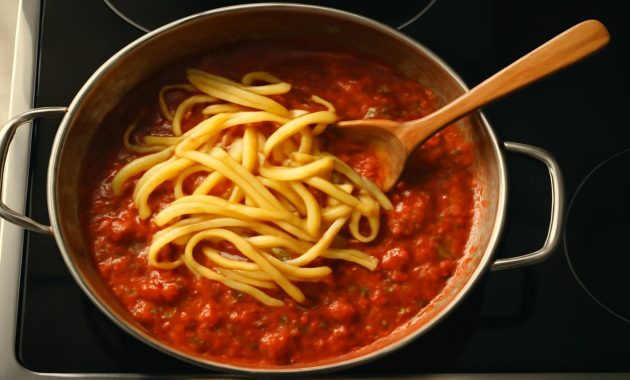
The first thing you notice is the sound. A gentle hiss, like summer rain on hot pavement, as dry pasta slips into a wide skillet already crowded with chopped tomatoes, garlic, a pool of olive oil, and a scatter of basil. No separate pot of water roaring on the back burner. No colander waiting in the sink. Just one pan, one quiet promise: dinner, simplified.
This is pasta cooked directly in its sauce—a method that feels almost like cheating, except it comes with a kind of weeknight magic. The starch from the pasta thickens the sauce, the flavors cling to every curve and hollow, and you stand there wondering why you spent so many years babysitting two different pots like it was some immutable law of the universe.
It’s not a trend so much as a revolution in slow motion—one that’s quietly rewriting what “quick dinner” means on a Tuesday night when you’re tired, hungry, and five minutes away from ordering takeout. Only now, you don’t have to.
Why One-Pan Pasta Feels Like Getting Away With Something
There’s a particular kind of relief that comes on the nights you know you’ll cook, but you also know you don’t have much left in the tank. The idea of boiling water, stirring sauce in another pan, draining, tossing, cleaning—it’s not hard, exactly. It’s just… a lot. A lot of steps. A lot of dishes. A lot of little decisions when all you want is to eat and decompress.
One-pan, sauce-cooked pasta shrinks all that down. You’re not making “a pasta dish.” You’re just putting everything in the same pan, adding water or broth, and letting basic physics take the wheel. The pasta softens as it absorbs liquid. The starch released into the skillet naturally thickens the sauce. Aromatics—garlic, shallots, onion—infuse every strand from the inside out, rather than just clinging to the outside like an afterthought.
There’s also something psychologically soothing about it. You see the whole meal in one glance: the pasta, the tomato chunks collapsing into jammy sweetness, the greens wilting into silky ribbons, the Parmesan waiting on the counter. You’re not juggling multiple burners or timers. You’re simply nudging one pan toward done.
And somewhere between stirring and tasting, you realize you’ve collapsed what used to be five or six steps into two: assemble, simmer. That’s where the time savings begin.
The Science Behind the Shortcut
At first, cooking pasta in sauce feels like breaking a rule. Isn’t the golden standard gallons of boiling salted water? Turns out, that “standard” was built for restaurant kitchens and industrial efficiency, not home cooks trying to get dinner on the table in 20–25 minutes.
When you cook pasta in a big pot of water, most of the starch ends up going down the drain. With the sauce method, that starch stays put. It seeps out of the pasta and swirls into the liquid, gradually transforming it from thin and splashy to glossy and clingy. That’s why one-pan pasta often feels “restaurant-level” silky without a lot of butter or cream.
The pasta also has more intimate contact with flavor. Instead of plain water, it’s simmering in broth, tomato juices, wine, or a garlicky, herby mix that seeps into the noodle itself as it cooks. It’s like marinating and boiling at the same time.
There’s a small trade-off: you need to be more attentive in the beginning. The liquid level matters. Too much, and you’ll have soup. Too little, and the pasta might stick or cook unevenly. But “attentive” doesn’t mean hard. It just means you’ll stir once in a while, add a splash more water if needed, and taste as you go—a rhythm you’re probably already used to with any good sauce.
How It Slashes Your Prep Time in Half
On paper, cooking pasta in sauce saves maybe 10–15 minutes. In real life, it can feel like more, because you’re compressing everything: tasks, dishes, clean-up, decisions.
Think about a classic pasta night:
- Boil water (and wait… and wait…)
- Salt water
- Add pasta, stir, check doneness
- Simultaneously sauté aromatics in another pan
- Add tomatoes, broth, or cream to make the sauce
- Drain pasta, reserve water (if you remember)
- Toss pasta with sauce, adjust with pasta water, season again
Now compare that to a one-pan approach:
- Add everything to a wide skillet—pasta, aromatics, tomato, oil, seasoning
- Pour in water or broth
- Simmer, stir occasionally, taste, and adjust
The time savings aren’t just about the clock. They’re about removing friction. You’re not managing multiple timelines; you’re just guiding one dish slowly toward glossy doneness. And then there’s the clean-up: one skillet, one spoon, one cutting board. That’s it. No strainer dripping in the sink, no second pan to soak.
To make the time savings more tangible, here’s a simple comparison of a typical 2-pot pasta dinner versus a one-pan, sauce-cooked version for a weekday meal:
| Step | Traditional Pasta | Pasta Cooked in Sauce |
|---|---|---|
| Total active prep time | 20–30 minutes | 10–15 minutes |
| Number of pots/pans | 2–3 + colander | 1 skillet or pot |
| Water boiling time | 10 minutes (average) | 0 minutes (no separate pot) |
| Cleanup effort | Medium–high | Low |
| Flavor concentration | Good, sauce coats surface | High, pasta absorbs sauce as it cooks |
None of this requires you to be a precise or fussy cook. In fact, the people who fall hardest for one-pan pasta are usually the ones who love to cook—just not every single night.
Building a One-Pan Pasta: A Sensory Walk-Through
Picture this on a weeknight when you walk in the door hungry, with exactly 30 minutes before everyone starts raiding the snack drawer.
You set a wide skillet on the stove and film the bottom with olive oil. As it warms, the scent drifts up, fruity and green. You toss in pressed garlic and maybe a sliced shallot. They hit the oil with a soft sizzle—no aggressive spatter, just a low murmur. Within a minute, the garlic edges go pale gold, and the kitchen smells like the start of something promising.
Now the shortcut: instead of reaching for a pot, you grab a box of dry pasta—spaghetti, penne, fusilli, whatever you have. You break the long strands in half right over the skillet if needed, letting them fan out into the oil and aromatics. You sprinkle in salt, a pinch of chili flakes if you like a subtle tingle, and then in go the chopped tomatoes (fresh or canned), maybe a splash of broth or water, and a handful of torn basil or oregano.
Here comes the “rule-breaking” moment: you pour in just enough water or broth to nearly cover the pasta. Not a vat, just a shallow pool. As it comes to a simmer, the pasta softens and starts slipping below the surface. You stir, press the dry pieces down, and watch as the liquid turns cloudy with starch.
Over the next 8–12 minutes, the pasta swells and bends. The sauce thickens and darkens; the scent of tomato, garlic, and herbs intensifies. You taste a strand—it’s almost there. You add another small splash of water, just a quarter cup, and cook it another minute or two. Suddenly, it’s perfect: tender but still springy, the sauce reduced to a glossy, clinging coat that kisses every curve.
You finish it with a swirl of butter or a thread of good olive oil off the heat, a fistful of grated Parmesan snowing down, maybe some torn basil leaves. The skillet looks like it came out of a little trattoria kitchen, except you’ve dirtied exactly one pan and one spoon, and you barely looked at the clock.
Endless Variations Without Extra Work
Once you get comfortable with the basic formula—pasta + aromatics + liquid + time—the possibilities widen in a way that feels almost unfair for how easy it is.
Want something cozy and creamy? Start with onions and garlic, add mushrooms, a handful of short pasta, vegetable or chicken broth, and finish with cream or mascarpone at the end. Need something bright and summery? Toss cherry tomatoes, zucchini slices, and basil into the pan, add pasta and water, and finish with lemon zest and a sharp grating of pecorino.
Hearty and protein-packed? Brown some sausage, pancetta, or chickpeas in the pan first. Scrape up the browned bits with your liquid, then add your pasta and simmer everything together. The browned fond infuses every bite without you ever making a “separate sauce.”
Some quick flavor ideas, all built on the same one-pan method:
- Garlic-Tomato-Basil Spaghetti: Simple, bright, weeknight-proof.
- Creamy Mushroom Farfalle: Earthy mushrooms, thyme, and cream swirling into a velvety sauce.
- Spicy Sausage Rigatoni: Crumbled sausage, chili flakes, tomatoes, and a final handful of arugula.
- Lemon-Broccoli Orzo: Tiny pasta, small broccoli florets, lemon zest, and Parmesan.
- Chickpea & Spinach Penne: Pantry beans, wilted greens, and a squeeze of lemon for balance.
None of these ask you to juggle multiple burners. You’re just layering flavors into a single pan and letting simmering water do the heavy lifting.
The Quiet Joy of Fewer Dishes
Everyone talks about how fast one-pan pasta is, but the unsung hero might be the cleanup. When the plates are empty and the kitchen is warm with that post-dinner contentment, there’s a small moment of triumph when you look over at the sink and realize… there isn’t much there.
One skillet. Maybe the wooden spoon. A knife and cutting board. The grater you used for cheese. It feels manageable in a way that changes how often you’re willing to cook on a weeknight. Cooking no longer comes with the mental surcharge of “and then I’ll be scrubbing dishes at 9 p.m.”
This part of the revolution is subtle but powerful. The less punishing the cleanup, the more likely you are to cook again tomorrow. Over time, that means more real food, fewer last-minute takeout orders, and a home that smells—regularly—like garlic hitting warm olive oil.
Tips, Tweaks, and Tiny Secrets for Success
Like any good kitchen shortcut, pasta cooked in the sauce has its own little rhythm. A few gentle guidelines make the difference between “pretty good” and “wow, we’re doing this every week.”
- Use a wide pan: A large skillet or sauté pan gives the pasta room to spread out, which helps it cook evenly and prevents clumping.
- Start with less liquid than you think: You can always add more. Aim to nearly cover the pasta; top up with small splashes as it cooks.
- Stir regularly, especially early on: This keeps the pasta from sticking to the pan or to itself as it softens.
- Salt in stages: Season the aromatics, then the liquid, then adjust at the end. The flavors become more concentrated as the liquid reduces.
- Finish off the heat: A knob of butter or a drizzle of olive oil plus cheese off the heat makes the sauce silky and lush without risk of breaking.
- Taste, taste, taste: You’re not just checking for doneness; you’re guiding the final flavor—more salt, a squeeze of lemon, extra pepper.
You don’t need a precise recipe every time. Once you know that most dry pasta cooks happily in about 8–12 minutes of gentle simmering with roughly enough water or broth to just cover, the rest is pure improvisation.
Why This Simple Shift Matters More Than It Seems
At first glance, pasta cooked in its own sauce is a small change: one pan instead of two. But it touches all the points that make weeknight cooking feel possible or impossible—the time, the energy, the cleanup, the sense of reward.
When dinner takes less effort, you do it more often. When dinner dirties fewer dishes, you don’t dread the aftermath. When dinner tastes richer, silkier, more “restaurant-y” with less fuss, it stops feeling like a chore and starts feeling like a small, daily pleasure.
This is how revolutions really happen in home kitchens. Not with elaborate new gadgets or complicated techniques, but with one simple idea that keeps proving itself over and over again: Put the pasta in the pan, pour in the liquid, let it drink up the sauce as it softens, and eat well—fast.
Somewhere in the quiet between the simmering and the stirring, in the moment when you taste a strand and it’s just right—springy, saucy, deeply flavored—you realize this isn’t just about speed. It’s about making weeknights gentler, about borrowing back a few minutes of your evening and spending them at the table instead of over the sink.
And tomorrow night, when you walk into the kitchen and reach for that single, trusty pan again, you’ll feel it: this tiny act of everyday defiance against complicated cooking. Pasta, cooked in the sauce, is no longer just a trick. It’s a new default.
Frequently Asked Questions
Does cooking pasta in the sauce really save that much time?
Yes. You skip the whole “boil a big pot of water” step, which often takes 8–10 minutes on its own. You’re combining cooking the pasta and making the sauce into one action, and you’re washing far fewer dishes afterward. The overall time may only drop by 10–15 minutes, but the process feels dramatically simpler.
Will the pasta cook evenly without a big pot of water?
It will, as long as you use a wide pan, add enough liquid to mostly cover the pasta, and stir regularly. Breaking long pasta in half can help it fit better and cook more evenly. If some pieces seem undercooked, add a splash of water and cook for another minute or two.
Do I need a special type of pasta for this method?
No. Most standard dried pasta shapes work well—spaghetti, linguine, penne, fusilli, rigatoni, farfalle, and orzo are all great. Very thick shapes may need a bit more liquid and time, and fresh pasta cooks too quickly and can turn mushy, so dried pasta is usually best.
How do I know how much liquid to add?
A good starting point is to add enough water, broth, or a mix of both to just about cover the pasta in the pan. As it cooks and the liquid reduces, you can add small splashes if the pan looks dry or the pasta isn’t tender yet. It’s easier to add more than to simmer off too much.
Can I make this method healthier?
Absolutely. Use whole-grain or legume-based pasta, lean proteins like chicken or chickpeas, and plenty of vegetables—broccoli, spinach, zucchini, tomatoes, or peas cook beautifully with this method. Because the sauce concentrates as it cooks, you don’t need heavy cream or lots of cheese to get rich flavor.
What if my sauce ends up too thin or too thick?
If it’s too thin, keep simmering uncovered for a couple more minutes and stir frequently—the starch will help thicken it as the liquid reduces. If it’s too thick or starts to stick, add a small splash of water or broth, stir, and cook gently until the texture feels right.
Can I make one-pan pasta ahead of time?
It’s best fresh, because the pasta will continue to absorb sauce as it sits. If you need to make it ahead, undercook the pasta slightly and keep a bit of extra liquid on hand. When reheating, add a splash of water or broth to loosen the sauce and warm gently on the stove.