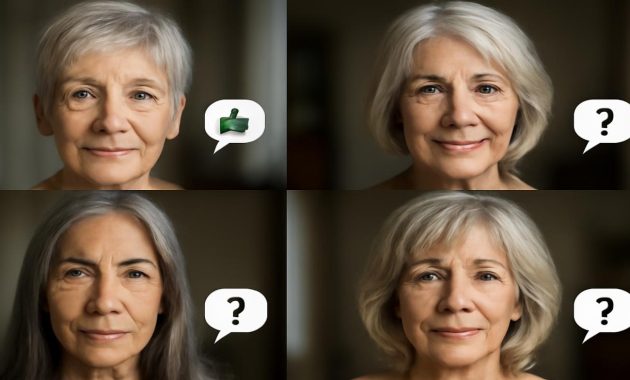
The first time Marianne cut her hair short, the sound of the scissors was louder than she expected—sharp, final, echoing in the small salon like a door closing and another opening. A soft curtain of silver and ash fell around the chair, some strands catching the light as they dropped to the floor. At sixty-four, she watched herself in the mirror with the uneasy curiosity of someone meeting a distant relative. Was this what “younger” looked like now? Or was this what honest looked like? The stylist, a woman in her thirties with rose-gold hair, smiled and said, “You’re going to love this. It’s going to take ten years off.” Marianne wasn’t sure whether to be excited… or slightly offended.
The Quiet War Happening Above Our Shoulders
Hair, especially for women over sixty, is no longer just hair. It’s become a battleground. On one side are the age-defying promises: “anti aging” haircuts, youthful bangs, volume-boosting bobs, and cleverly layered crops that are supposed to rewind the clock. On the other side stand the voices insisting that gray, sparse, and wispy can be beautiful too—that thinning hair and silver streaks are not flaws to hide but stories to be seen.
In the middle are women like Marianne, hovering in the salon chair between two mirrors: one reflecting who they were at forty, another reflecting who they are at sixty-five. Somewhere between them lies a simple, quietly radical question: Do I want to look younger, or do I want to look like myself?
For many, the answer is: both. That’s where the “anti aging” haircuts step in—four styles that keep popping up in magazines, on social media, and in salons. They’re praised for lifting, softening, and brightening the face; they’re criticized for playing into a culture obsessed with staying young at all costs. The hair, like the debate, is layered and complicated.
The Four Haircuts Everyone Is Talking About
Walk into any salon that caters to women over sixty and you’ll hear the same vocabulary on repeat: face-framing, light-reflecting, neck-skimming, volume-building. Underneath these buzzwords are four shapes that stylists often recommend when someone sits down and whispers, “I want to look fresher, younger… but not like I’m trying too hard.”
| Haircut | Core Idea | Best For |
|---|---|---|
| Soft Layered Bob | Face-framing movement, gentle volume | Fine to medium hair, wavy or straight |
| Textured Pixie | Short, airy, and lifted at the crown | Thinning hair, strong facial features |
| Shoulder-Length Shag | Choppy layers, playful fringe | Thick or naturally wavy hair |
| Curly Sculpted Cut | Defined shape that follows curl pattern | Natural curls or coils |
These four cuts have an almost mythic status in the modern over-60 hair conversation. They promise lift for hair that’s going flat, softness where lines have grown sharper, movement where stiffness has crept in. Whether they actually make someone look younger is only part of the story. The real question is how they make someone feel when they walk out of the salon and the breeze slides through what’s left—or newly revealed—on their head.
1. The Soft Layered Bob: A Gentle Edit, Not a Rewrite
When hairdressers talk about “softness,” they often mean layers that are almost invisible but incredibly intentional. The soft layered bob is the haircut equivalent of good lighting. It doesn’t scream “new look!” so much as whisper, “Did you sleep better? Go on vacation? Fall in love?”
Picture hair skimming the jawline or just brushing the collarbone. The ends aren’t blunt; they’re feathered. Around the face, light layers create a kind of moving frame that shifts with every turn of the head. On silver or white hair, the effect can be luminous—light catches on each layer like sunlit water.
Some stylists swear by this haircut for women over sixty. They say it lifts the cheekbones, softens the jaw, and adds air where hair has grown heavy. For women whose hair has thinned but not disappeared, the layered bob can make what’s there look intentional rather than sparse. It says, “I meant for it to do this.”
But ask a different kind of expert—those who spend their days talking about ageism, self-acceptance, and realistic beauty standards—and you’ll hear another perspective. To them, the language of “anti aging” around this cut feels loaded. If you need a certain bob to be seen as “fresh,” what does that say about the years you already carry on your face?
Marianne chose a version of this bob. When she got home, she stood in her bathroom, tilting her head left, then right. Her silver hair now swung softly above her shoulders instead of hanging below them. She did look more awake, somehow. But she also felt slightly edited, as though an invisible stylist had trimmed not just her hair, but the visible markers of her age.
2. The Textured Pixie: Freedom, Rebellion, or Disguise?
The textured pixie is the haircut that inspires both envy and fear. It is, in many ways, the bravest of the four because there’s nowhere to hide. Once you cut your hair this short, every line of your face, every angle of your jaw, every crease of your neck has a new relationship with the world.
For women in their sixties, especially those dealing with thinning hair, the pixie can be thrilling. Instead of trying to coax volume out of reluctant strands, this cut flips the script: less hair, more intention. The crown is often cut with choppy texture, giving the illusion of fullness. Side-swept bangs—or just a gentle fringe—can soften the forehead without feeling like “old-fashioned bangs.”
Short hair has a way of amplifying personality. A woman with a textured pixie often looks like she knows something the rest of us don’t. She looks like she might ride a bicycle through the city at dawn or decide, on a random Tuesday, to take a train to the coast just to smell the sea. The haircut says fearless, whether the wearer feels that way or not.
Some dermatologists and hair specialists quietly applaud this move. From a practical standpoint, short hair can make thinning less obvious, reduce breakage, and ease the strain on delicate follicles. They’ll tell you that clinging to long, heavy hair when it’s getting sparser can tug at the scalp and draw attention to exactly what you’re trying to hide.
Yet the critics circle back: if a pixie is framed as a “solution” to looking older, does it turn natural hair loss and graying into a problem that must be solved? Is shorn hair a celebration of freedom, or a clever disguise? The answer lives in the eyes of the woman in the mirror. Some feel stripped bare, suddenly exposed. Others feel like they’ve shed not just hair but expectations—of youth, of femininity, of being “soft” and “pretty” in a way that once mattered deeply.
3. The Shoulder-Length Shag: The Illusion of Motion
The shag has made a comeback, but not the stiff, hairsprayed version of the seventies. Today’s over-60 shag is looser, more organic, and kinder. It grazes the shoulders, with layers that start around the cheekbones and tumble downward. Wispy, curtain-like bangs sometimes graze the eyebrows, blending into the rest of the hair instead of sitting like a separate, obvious feature.
For women with some natural wave or body, this haircut can feel like stepping into their own weather system. The hair moves. It flips. It collapses and resurrects itself in the span of a humid afternoon. There’s a youthful nonchalance to it, a sense of, “My hair just does this” that’s particularly intoxicating when so many other parts of the body now require effort, stretching, support.
Stylists often recommend the shag for women whose hair has started to thin near the scalp but still has density at the ends. By carving in layers, they lighten the load so the roots don’t have to work so hard to hold things up. On gray hair, the varied lengths can highlight the different shades within the silver—smoky near the scalp, snowy on the tips, sometimes with streaks of pewter or pale blonde.
The shag, perhaps more than the other cuts, sits on the fence between illusion and honesty. It embraces movement, texture, and imperfection, which feels aligned with the reality of aging. But it also plays optical tricks: drawing the eye outwards and down, fluttering around the jawline, gently disguising the thinning crown or the deepening lines at the temples.
A sociologist might say: this haircut mirrors how we talk about aging when we’re trying to be polite. We call it “embracing the journey” while still smoothing the sharpest edges, blurring the parts that make people uncomfortable. It’s not dishonest, exactly. But it’s curated.
4. The Sculpted Curl: Letting the Spiral Speak
If straight hair is a sentence, curly and coiled hair is a whole story—sometimes several stacked together. For women over sixty with natural curls, the usual “anti aging” advice often fails completely. Thin layers that flatter straight hair can turn curls into frizz. Blunt bobs can make ringlets bunch up around the chin like a ruffled collar from a costume drama.
Enter the sculpted curly cut. Instead of forcing curls into a shape designed for straight hair, this cut begins with the curl pattern itself. Hair is often cut dry, in its natural state. The stylist watches how each curl falls, how it shrinks, how it springs back when touched. The shape emerges from what the hair already wants to do—rounded, oval, a soft triangle, sometimes even a halo that floats just above the shoulders.
When done well, this cut can be transformative. Curls that once looked wild or unruly suddenly have presence and intention. The volume around the face can create a lifting effect similar to the layered bob, but with more drama and joy. Silver curls, especially, can shimmer like moonlight caught in a spiral staircase.
Curly specialists are often the most vocal advocates for embracing what’s real. They’ll tell you that the goal isn’t to look younger; it’s to look alive. Defined curls, even if they’re sparse in places, read as energetic. The hair doesn’t have to be full to be expressive.
But here, too, tension sneaks in. To keep curls springy and defined often requires products, routines, cuts every six to eight weeks. Is this commitment an act of self-love or another form of maintenance demanded by a culture that struggles to see aging as beautiful when it’s left entirely to its own devices?
The Honesty of Gray, the Reality of Thinning
Behind the trending haircuts sits a quieter, heavier question: what does it mean to be honest about aging when the body—and especially the hair—can feel like a renegade, doing its own thing without asking permission?
For some women, honesty looks like letting the gray grow in, even if it comes in patches, streaks, or a surprising yellowish tinge. They watch the demarcation line between dye and natural color creep down from the roots, a slow, inevitable tide. Some transition with highlights, others simply stop and wait. When the last of the dye is finally cut off, they feel… relief. The mirror no longer shows a person in hiding.
For others, honesty isn’t about displaying every sign of age—it’s about acknowledging what makes them feel most themselves. That might mean keeping a hint of warm blond over the gray, or choosing an uplifting bob because it matches the energy they still feel rushing through their body when they walk fast or laugh hard. They’ll say, “This is still me,” and the “me” they refer to is not just their chronological age, but their inner weather.
Experts who oppose the term “anti aging” argue that it frames age as an enemy, a thing to battle and outwit. They would rather see us talk about “pro vitality,” or simply “hair that suits you now.” They point out that thinning hair is not a moral failure or a personal shortcoming. It’s biology. It’s hormones taking their bow. It’s genetics showing its hand.
And yet, wanting to soften the look of that thinning, to shape it into something flattering, is also deeply human. We decorate our spaces, choose clothes that fit our changing bodies, apply moisturizer to drying skin. Are these acts of denial, or care? Somewhere in the overlap between the two, women over sixty are making daily, complicated choices about their hair.
Listening to the Woman in the Chair
What’s striking, if you spend time in salons that cater to older women, is that the conversation rarely stays on hair. While scissors work and dryers hum, stories spill out—illnesses, grandchildren, retirement, loss, new romances, long marriages. Hair, for many, becomes a stand-in for everything else that’s changing.
A woman who chooses a pixie after a divorce might tell you she “needed a change,” but what she often means is that she needed to see a different self in the mirror, one not anchored to the past. Another who carefully maintains her long, silver braid might be holding onto a sense of continuity: this is who I’ve always been, just in another shade.
Where experts divide most sharply is not over layers or lengths, but over the language we use—and the pressure that hides inside it. “Anti aging haircut” sounds, on the surface, like a bit of marketing shorthand. But to some, it’s a small, daily reminder that aging is a problem to be fixed. To others, it’s just a way of describing styles that, quite simply, make them smile when they catch their reflection in a shop window.
The haircuts themselves are neutral. A soft bob, a shag, a pixie, sculpted curls—these are tools, not verdicts. The ethics live in the intention behind them. Are they chosen out of fear—of being invisible, of being dismissed, of no longer being seen as desirable? Or are they chosen out of curiosity and play, as if to say, “I’ve had this face for sixty-plus years; what else can I do with it?”
Marianne, for her part, kept the soft layered bob. But a month later, she asked her stylist to cut it even shorter around the back, letting the silver hug the nape of her neck. “I thought I wanted to look younger,” she said, “but I think what I actually wanted was to look like I hadn’t given up.” There’s a difference, and she could feel it every time the wind moved through her hair.
FAQ
Do “anti aging” haircuts really make you look younger?
They can create a more lifted, refreshed look by adding movement, volume, and balance around the face. But “younger” is subjective. The most effective haircut is the one that makes you feel more vibrant and at ease, not the one that erases every sign of age.
Is it better to cut hair short as it starts thinning after 60?
Shorter cuts like pixies or layered bobs often make thinning less noticeable and reduce weight on fragile follicles. However, there’s no rule. Some women with gentle thinning still look and feel wonderful with longer hair, especially if it’s well-shaped and lightly layered.
How can I embrace my gray hair without feeling “older”?
Focus on shape, texture, and shine. A modern cut—whether bob, shag, or sculpted curls—can make gray hair look intentional and stylish. Regular trims, gentle products, and good conditioning keep gray hair bright and lively instead of dull.
Are bangs a good idea for women over 60?
Soft, wispy, or side-swept bangs can soften forehead lines and frame the eyes beautifully. Heavy, blunt bangs can sometimes feel harsh. The key is tailoring fringe to your face shape, hair texture, and how much styling you’re willing to do.
How often should women over 60 get their hair cut?
Every 6–10 weeks is typical, depending on the haircut and how fast your hair grows. Short pixies and sculpted curls usually need more frequent trims to keep their shape; longer bobs and shags can stretch a bit longer between appointments.
Can I still color my hair and be “honest” about aging?
Honesty is less about whether you color and more about whether you feel pressured to hide your age. Many women choose soft, natural-looking color or subtle highlights to enhance what they have while still accepting the reality of aging underneath.
How do I choose between these four popular haircuts?
Consider your hair texture, your lifestyle, and what feels emotionally right. If you want low maintenance and have thinning hair, a textured pixie or soft bob might suit you. If you love movement and have some natural wave, a shag can be playful. If you have curls, a sculpted curly cut will respect your texture. Above all, choose what makes you feel most like yourself now—not the self you think you’re supposed to be.