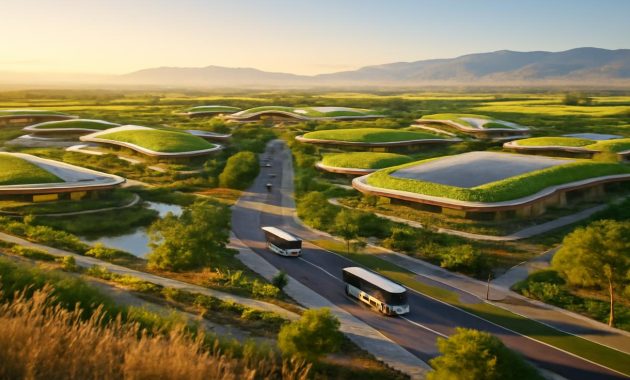
By the time the fog pulls back from the hills and the early California light turns everything the color of polished brass, the land looks almost empty—just waves of tawny grass, a few leaning fence posts, the distant blink of a radio tower. Yet this quiet valley between the Bay and the state capital is being asked to hold an idea so large it barely fits inside a sentence: a brand-new American city for 400,000 people, dreamed up almost from scratch. They’re calling it Solano Foundry, and if its creators are to be believed, it will be more ambitious than Silicon Valley itself.
The Valley That Wasn’t Looking for a City
There is a particular sound to this part of Northern California, an in-between region that most travelers only glimpse through a car window on the way from San Francisco to Sacramento. The wind moves through the dry grass with a papery whisper. Far-off cattle bells clink like lazy metronomes. Occasionally, a freight train groans past, the steel-on-steel echo lingering long after the engines have disappeared.
Solano County has always lived in the shadow of its louder neighbors. To the west, the Bay Area spins and sparks, a place where fortunes are coded into being in glass towers. To the east, Sacramento hums along as the state’s political pulse. Solano is the quiet connective tissue, a patchwork of ranch land, aging suburbs, and low-slung industrial sites that smell faintly of diesel and sun-baked asphalt.
So when rumors emerged that a group of powerful investors, backed by some of the most recognizable names in American tech and finance, had secretly bought tens of thousands of acres here, locals were baffled. Then cautious. Then, in many cases, angry. The project had a name—Solano Foundry—and behind that name was a question: could this land, long dismissed as “in-between,” be recast as the beating heart of a new American experiment?
The Dream of Solano Foundry
Solano Foundry is not a subdivision with better branding. On paper, it is a generational gamble: a dense, walkable, transit-first city aimed to house 400,000 residents—roughly the population of Oakland—without layering that many people onto crumbling old infrastructure. The idea, its champions say, is to build a functioning, future-forward city with the same careful intention you might bring to hand-forging a piece of steel: heat, pressure, and time, applied just right.
Imagine standing at what is now a quiet gravel turnout on a county road. Ten years from now, if the plan unfolds as its designers intend, you might look out at tree-lined boulevards where traffic moves slowly because most people are walking, biking, or gliding by on electric shuttles. Corner cafés lean open to the breeze. Children streak past, trailing the high, bright sound of playground laughter. Solar panels lie like black lakes atop flat roofs, drinking in the long California sun.
In this vision, Solano Foundry is part laboratory, part refuge. A refuge for teachers pushed out of the Bay Area by rent, for nurses exhausted by two-hour commutes, for young families who have quietly done the math and realized that homeownership in the traditional tech corridors is as distant as the moon. And a laboratory for what a 21st-century American city might look like if it were built to align climate resilience, digital infrastructure, and human-scale neighborhoods from day one.
The ambition is bracing: not to copy Silicon Valley’s startup campuses, but to surpass them—emotionally, physically, ethically. Where Silicon Valley stitched private innovation into a public landscape not built for it, Solano Foundry is meant to reverse the equation: public life first, with innovation flowing around and through it like a river around a rock.
From Stealth Purchases to a Public Promise
What gives this story its tension is not only the vision, but the way it emerged. For years, limited liability companies with bland names quietly acquired farmland and ranches, sometimes paying multiples of market value. Locals swapped theories over coffee: a foreign sovereign fund, a secret military project, another Amazon warehouse.
When the backers finally stepped into the light, the list read like a who’s who of American high-tech and high finance—people who, for better or worse, have already helped define how we live and work. With them came a pledge: this was not going to be another exurban sprawl experiment, but a tightly planned, climate-conscious city that would offer what the Bay Area increasingly could not—abundant housing, functional infrastructure, and a kind of civic optimism that has grown thin in many older cities.
Yet a promise on paper is not a city. A plan is not a community. And in the gap between those truths is where the Solano Foundry story lives right now: half speculative fiction, half environmental negotiation, stitched together by lawyers, planners, activists, and the people who already call this county home.
Designing a City Like a Living Organism
To understand what makes Solano Foundry different from a typical master-planned development, you have to zoom in—not just on the glossy renderings of sun-drenched plazas, but on the duller, deeper details: energy grids, transportation corridors, water cycles, zoning codes, soil maps, firebreaks.
Think of the city as a living body. Streets are not simply lanes for cars; they are arteries for people, data, and energy. Parks are not afterthoughts but the city’s lungs, helping cool the urban heat, giving migratory birds a place to rest, offering children a patch of earth to dig into. Buildings are bones and skin, insulating, supporting, and aging in place.
The planners behind Solano Foundry talk about this openly: they want to treat the city as an integrated ecosystem, where decisions about housing density, tree canopy, and drainage swales are inseparable from decisions about economic opportunity and social equity. In practice, that means thinking about how a nurse living on the eastern edge of the city gets to work on a rainy Tuesday morning, or whether a teenager in the northern district can find an apprenticeship within a short bike ride.
To bring some of these ideas into focus, it helps to lay out their most-publicized goals side by side:
| Pillar | Solano Foundry Vision | Traditional Tech Region |
|---|---|---|
| Housing | High-density, mixed-income neighborhoods with abundant apartments and “missing middle” housing; legal frameworks that favor building up over sprawl. | Limited supply, restrictive zoning, single-family dominance, sky-high rents and home prices. |
| Mobility | Walking, biking, and transit prioritized; car-light design with short blocks and calm streets. | Car-centric streets, long commutes, fragmented transit networks. |
| Economy | Blend of advanced manufacturing, clean tech, digital industries, and local services, with space for small businesses baked in. | High-concentration of software and finance; many support workers priced out or commuting from afar. |
| Environment | Renewable-heavy grid, water reuse, native landscaping, and wildfire-conscious edges. | Retrofitting old systems for climate realities; patchwork resilience. |
| Civic Life | Planned public spaces, cultural hubs, and civic institutions from day one, with room for community-led shaping. | Civic space evolving reactively; social fabric stretched by inequality and displacement. |
Rows in a table are tidy; cities are not. Yet you can feel the intent here: to avoid the “success disaster” of Silicon Valley, where the very innovation that made the region rich also made it unlivable for many. Solano Foundry is meant to be a place where you might launch a startup in a co-working studio… and still afford a two-bedroom apartment walking distance from a park.
Streets Built for Feet, Not Horsepower
If you walk through a typical Silicon Valley office park, the air smells like asphalt, hot plastic, and landscaping chemicals. There are sidewalks, technically, but they feel incidental—threaded between parking lots and driveways like an obligation instead of an invitation. Solano Foundry’s designers insist they are starting from the opposite assumption: human bodies first.
Picture a street where the loudest sound is not an engine but the rumble of a skateboard over pavers, the murmur of café conversations, the occasional bark of a dog. Planters overflow with rosemary and native grasses, brushing your shins as you pass. Crosswalks are wide and frequent. Shade trees stand close enough to throw overlapping shadows by noon, letting you walk almost the entire length of the district in a kind of green corridor.
Cars are allowed, but they do not dominate. Most housing clusters are planned with short blocks and clear sightlines, making it safer for children to walk to school and for elders to shuffle to the corner market. Transit stops are not just metal posts and schedules; they are mini-plazas with benches, bike racks, maybe a food cart when the weather’s good. The goal is to make the default choice—walking, biking, taking transit—also the easiest and most pleasant choice.
This kind of mobility design is not merely a lifestyle perk; it’s a climate strategy. Every trip taken by foot or wheel that isn’t a car cuts emissions, noise, and the need for vast parking lots that sit baking in the sun. In a new city, those lots never have to exist in the first place.
Foundry, Not Fantasy: Jobs and Industry
The word “foundry” evokes heat, weight, sparks. It’s a place where raw material is transformed into something with structure and purpose. The people behind Solano Foundry chose that term deliberately. They don’t just want a bedroom community where residents sleep and then flee elsewhere for work. They want a city that hums during business hours too, with opportunities for people across the skills and income spectrum.
In the early proposals, three economic currents stand out. The first is advanced manufacturing: the precise, automated, increasingly low-waste production of everything from battery components to medical devices. These facilities don’t look like Victorian factories; they’re quieter, cleaner, but still full of that sense of things being made. The second is clean technology and climate solutions: solar engineering labs, carbon-removal startups, grid optimization firms. The third is the more familiar layer of digital tech—software companies, AI research groups, design studios—woven into the mix but not allowed to monopolize it.
For a place to be more “ambitious than Silicon Valley,” that ambition cannot just be measured in market caps. It has to show up in how a barista, a mechanic, or a school librarian experiences their work day. Does a high school graduate see a path from an internship at a local fabrication shop to a career that lets them stay in the city and raise a family? Does a mid-career nurse at the new hospital feel less invisible because her commute is 10 minutes by bus instead of 90 by car?
A city’s economy is more than its industries; it’s the choreography between them. Solano Foundry, if it works, will be a place where small businesses—corner grocers, clinics, bakeries, studios—are given space to anchor neighborhoods rather than being squeezed out by speculative rents. That means designing street-level retail into buildings from day one, creating flexible commercial leases, and ensuring that zoning doesn’t accidentally outlaw the very human-scale activity that makes a street feel alive.
The Quiet Work of Climate Resilience
Not all ambition is loud. For every aerial rendering of sunlit plazas, there’s a quieter diagram somewhere showing stormwater retention basins, wetland buffers, and emergency evacuation routes. If you walk the edges of Solano County in late summer, you can smell why this matters: the faint, dry metallic tang of grass that could go up in flames after one bad spark. Wildfire season has lengthened and sharpened in California; any new city here has to be built with that in mind.
That means planning defensible space at the wildland-urban interface, using fire-resistant materials, designing street layouts that give fire crews access, and embedding sensors and communication tools into the landscape so that early warnings reach people quickly. It also means treating water as a precious, cyclical asset rather than a one-way input. Recycled water systems for irrigation, efficient fixtures, green infrastructure that lets rain soak back into the ground instead of racing off into overwhelmed drains—these are the invisible muscles of a resilient city.
Energy, too, is being reconsidered. Instead of a tangle of retrofitted wires and substations, Solano Foundry can, in theory, build a more flexible grid from the ground up: rooftop solar on most buildings, neighborhood-scale batteries, microgrids that can island themselves if the larger network fails. On a hot August night, when air conditioners purr in unison and the sky hangs low and yellow, that kind of redundancy may make the difference between a rolling blackout and a city that barely notices the strain.
The Conflict Written Into the Soil
Every utopian sketch runs into the hard edges of reality eventually, and in Solano County those edges are literal property lines and long memories. The land targeted for Solano Foundry is not empty. It holds ranches where families have watched three, four, five generations grow up under the same wide sky. It includes agricultural parcels that, while not postcard vineyards, still produce food and livelihoods.
For many locals, the initial secrecy of the land purchases felt like an invasion. People learned that their neighbors had sold only after the ink was dry. Others worried they were being slowly surrounded by a vision they had never been invited to shape. Town halls grew tense. The phrase “company town” floated through conversations, an old American fear wearing new clothes.
Legally, to build a city of this scale, the project needs more than money; it needs the active cooperation of Solano County voters and state regulators. That means environmental impact reports, transportation studies, negotiations over water use, and detailed answers to uneasy questions. What happens to existing small towns nearby? How will emergency services stretch to cover a suddenly denser region? Will long-time residents be pushed aside by rising land values, or offered a meaningful role in the new economy?
The democratic test of Solano Foundry may end up mattering as much as its urban design. If the city is truly to be “more ambitious than Silicon Valley,” that ambition must include a deeper respect for consent and participation—listening to those who stand to lose as much as to those who stand to gain. The land may feel vast, but trust is a more limited resource.
A Prototype for Future American Cities?
Squint a little, and Solano Foundry becomes more than a local story. Across the United States, a quiet crisis is unfolding: cities straining under the weight of their own success, affordability evaporating, infrastructure aging faster than it can be repaired. We add people but not homes; we buy electric cars but drive them over 1950s road networks.
What happens if, instead of endlessly patching our old systems, we occasionally start fresh? Not in the wilderness, but in places like this: landscapes near existing metro regions, threaded with power lines and highways but not yet ossified into patterns that are impossible to change. Solano Foundry could be one prototype—an audacious, risky, politically fraught prototype—for a new pattern of American urbanization.
If it fails, the lesson will be loud: that private capital and big ideas are not enough to conjure a city people actually want to call home. If it works—even partially—it might provide a template other regions could adapt, showing how to build dense, low-carbon, economically diverse communities without repeating the mistakes of the last half-century.
In that sense, the stakes reach far beyond this one stretch of California soil. They touch on who gets to imagine our shared future, and how those imaginations are translated into brick, fiber cable, and tree roots.
Standing in the Wind, Listening
Visit the proposed site today and it might not look like the birthplace of anything. That’s the trick. Big ideas rarely announce themselves with fireworks. There’s just the wind, smelling faintly of dust and sun-warmed weeds, pushing against your cheeks. A hawk cutting slow arcs overhead. The faint tick of cooling metal from a pickup that has just rolled to a stop along the fence line.
Somewhere in a conference room miles away, people are arguing over setbacks and sewage systems, over bond financing and building codes, over school district boundaries and bus routes. Somewhere else, a fifth-generation rancher is looking at an offer sheet and weighing the pull of history against the push of possibility. A high school student in Vallejo is scrolling through a news story about the project, wondering whether this imagined city might be the place where she designs her first battery system or opens her first bakery.
Cities do not appear overnight. They accrete—first on paper, then in policies, then in rebar and concrete, and finally in the interlocking choices of the people who move there, stay there, leave there. Solano Foundry, as an idea, is molten right now: bright, formless, potentially dangerous, not yet poured into a shape we can all see clearly.
Stand there in the wind, and you can almost feel the weight of the question hanging in the air: can we do better than Silicon Valley—not only at generating wealth, but at creating a place where 400,000 people might live decently, breathe easier, and feel that the city they inhabit was built with them, not merely around them? The answer, when it comes, will not just define this valley. It will echo through the way America thinks about building anything new at all.
Frequently Asked Questions About Solano Foundry
What exactly is Solano Foundry?
Solano Foundry is a proposed new city in Solano County, California, envisioned to eventually house around 400,000 residents. It aims to be a dense, walkable, climate-conscious community with a diverse local economy, rather than a traditional car-dependent suburb.
Why is it described as more ambitious than Silicon Valley?
Silicon Valley grew organically around technology companies without a coordinated plan for housing, transit, or affordability. Solano Foundry’s backers claim they want to design all of those systems together from the start—housing, transportation, energy, jobs, and public spaces—so that economic innovation and everyday livability rise in tandem.
Who is backing the project?
The project is supported by a consortium of investors that includes prominent figures from the technology and finance sectors. While individual names draw attention, the key point is that it is primarily privately funded and driven, working within public planning and regulatory frameworks.
What kinds of jobs are expected in Solano Foundry?
Plans emphasize a mix of advanced manufacturing, clean technology, and digital industries, along with essential local services such as healthcare, education, retail, hospitality, and small businesses. The goal is to create a full economic ecosystem, not just one dominant industry.
How will the city address climate and environmental concerns?
Early concepts highlight renewable-heavy energy systems, water recycling, green infrastructure for stormwater, wildfire-aware design at the edges of development, and extensive tree canopy and parks to mitigate heat. Because the city is being planned from scratch, these elements can be built into the foundation rather than added later.
What are local residents concerned about?
Concerns include loss of agricultural land and rural character, strain on water and infrastructure, increased traffic, and a feeling of exclusion because early land purchases were made quietly. Many also worry about whether local voices—and existing communities—will have real power in shaping the project’s future.
When will Solano Foundry actually be built?
Timelines depend on approvals from county and state authorities, environmental reviews, infrastructure planning, and voter sentiment. Even if everything moves forward, full build-out would take many years, unfolding in phases as infrastructure and demand grow.
Could Solano Foundry become a model for other new cities?
If it successfully delivers affordable housing, sustainable infrastructure, and a balanced economy, other regions may study it as a template for building new communities near existing metro areas. If it fails or repeats familiar mistakes, it may instead serve as a cautionary tale about the limits of private ambition in public space.