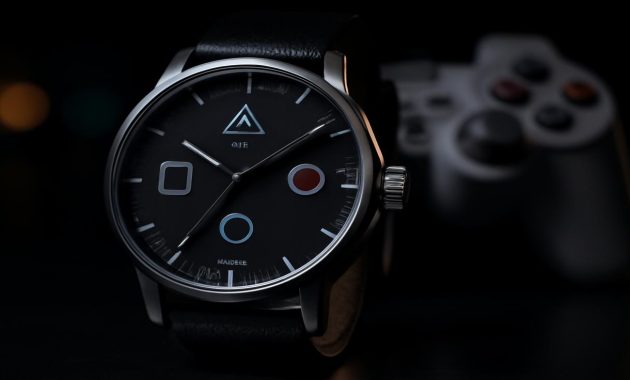
The second hand sweeps over a tiny circle of symbols you’ve known since childhood. The four shapes—triangle, circle, X, square—glow softly on your wrist, as if they’re remembering you too. There’s a faint reflection of them on the glass of the café window, superimposed over a city that has grown up alongside you: brighter, louder, more crowded. For a moment, though, it’s just you, the ticking of a limited-edition watch, and thirty years of PlayStation memories quietly coming back to life.
A Birthday Measured in Heartbeats and Loading Screens
Thirty years is a long time in technology, but somehow it doesn’t feel that way when you think about PlayStation. It feels like yesterday that a blocky grey console slipped under bulky CRT televisions, its startup chime echoing through bedrooms and living rooms around the world. That sound was more than a logo; it was a doorway. A portal to worlds of low-poly forests, clattering city streets, neon-lit racetracks, and hauntingly quiet ruins.
Now, three decades later, Sony is celebrating that doorway—those worlds, and the people who stepped through them—with something surprisingly analog: an exclusive watch collection created with Anicorn. It’s a celebration that doesn’t flash across a screen or buzz with notifications. Instead, it sits quietly on your wrist, counting seconds the way the earliest loading bars once counted your anticipation.
From the first PlayStation to the latest PS5, time has been measured in progress bars, day–night cycles in open worlds, and that “just one more level” stretch deep into midnight. The anniversary watches somehow bottle that feeling without a single pixel. They trade resolution for reflection, tech specs for texture, and it’s that contrast—between digital legacy and mechanical precision—that makes this collaboration so unexpectedly emotional.
A Console, a Culture, and a Silent Click on Your Wrist
On paper, the collaboration between PlayStation and Anicorn makes immediate sense. Anicorn has built its reputation on graphic-forward timepieces that blur the lines between watchmaking, design, and storytelling. PlayStation, on the other hand, has built entire universes around a handful of buttons and a simple idea: let players feel something real in imaginary worlds.
But on the wrist, the watches feel less like a corporate partnership and more like a reunion. A quiet nod to the nights you stayed up too late, the friends you made on worn-out couches, and the small rituals of gaming life: blowing dust from discs, grappling with tangled controller cables, sliding that iconic memory card into place.
The watch case is smooth under your fingers, weighty enough to feel deliberate but not heavy. There’s a familiarity in the way your thumb grazes the etched symbols, like finding an old controller in a drawer. The color palettes draw from the console lineage—industrial grey that recalls the PS1, deep blacks and crisp whites echoing the PS5’s bold contrast, flashes of blue that might as well be memories of status lights and interface highlights.
Where screens once glowed, brushed metal and precision-cut dials sit instead, gently catching natural light. Time is no longer something you watch count down before a boss fight—here, it’s something you’re simply invited to notice.
The Design Language of a Lifetime of Play
There’s an art to making nostalgia feel fresh instead of kitschy. Anicorn approaches the PlayStation legacy the way a nature writer might approach a familiar forest—paying attention not to the obvious landmarks, but to the details. The curve of the lugs echoes the smooth, rounded transitions of older console shells. Indices and markers keep their minimalist discipline, but they carry just enough personality to whisper: this is meant for those who remember.
The dial often feels like a tiny landscape. Circular motifs hint at discs spinning in the dark. Linear markers carry the same deliberate geometry that shaped the PlayStation UI, from the early, simple menus to the sleek, paneled designs of modern dashboards. Even the crown, small and unassuming, has a tactile specificity—the kind of object you roll between finger and thumb, the way you once did with a thumbstick learning a new control scheme.
The choice of materials plays a quiet symphony of eras. Steel, treated and finished with restrained care, hints at the durable, no-nonsense engineering that let consoles survive dorm rooms, kids’ bedrooms, and moves between apartments. Straps—whether leather, rubber, or textile—feel like an answer to the texture of controller grips and console finishes. Slightly matte, reassuring, built for touch.
Even the way the watch sits on the wrist feels familiar. There’s an echo of the way a controller nestles into your palms: designed not to dominate your body, but to disappear into it until the only thing you’re aware of is experience.
Where Timekeeping Meets Storykeeping
Look closer, and the watch reveals itself as less of a tribute piece and more of a story archive. Those iconic PlayStation symbols aren’t just printed; they’re integrated with a designer’s respect for negative space and legibility. They occupy the dial like constellations—small, deliberate points that guide the eye.
The limited nature of the collection adds another layer of narrative. Every set number stamped on the back becomes a chapter marker. For one person, it might be the year they first picked up a DualShock controller. For another, the age they played a game that changed how they saw storytelling forever. The watch doesn’t know this, of course. But you do. And that’s enough.
Anicorn’s typography and layout choices pay homage without leaning into pastiche. No cartoonish fonts, no cluttered logos. It’s restraint as respect. A shared understanding that the people who grew up with PlayStation are now adults who live in apartments decorated with plants and art prints, who stack books beside their game collections, who care about both frame rates and the feel of a good wool sweater.
Three Decades of Play, Captured in a Single Glance
Wear one of these watches, and it quickly becomes less about what’s on the dial and more about what it unlocks in your memory. A glance at your wrist while waiting at a crosswalk becomes a fast cut montage.
You remember the early days of the first PlayStation, where everything felt big and new. Polygonal characters with sharp corners but soft hearts. Save points that felt like safe rooms not just for the character, but for you—breathing spaces between school or work and whatever boss awaited in the next room.
You remember the PS2 years, when the console was a permanent fixture in overheated dorm rooms and cramped apartments. Discs in mismatched cases, controllers with worn thumbsticks, a tangle of wires behind the TV like some wild root system. Time then was measured in “just 15 more minutes,” which inevitably spilled into two hours, and then three.
You remember the PS3 and PS4 eras, of course. The way online play dissolved distance. The ritual of putting on a headset and hearing your friends’ voices come through, tinny at first, then warmer as laughter filled the spaces between matches. And finally, the PS5 era, where games began to feel less like separate experiences and more like continuous landscapes, shaped by haptics and sound design that seemed to breathe.
All of that—thirty years of technological evolution, artistic ambition, and deeply personal moments—is somehow held, quietly, in this small mechanical object that doesn’t even need electricity to function. It beats on, second by second, the way game worlds once cycled through sunrises and sunsets while you explored them.
The Quiet Ritual of Owning Something That Remembers
Part of what makes this watch collection fascinating is its stubborn insistence on being physical in an age where time is everywhere and nowhere. Your phone screen glows with numbers. Your console interface tells you the hour as you navigate menus. Your laptop tracks meetings and calendars. Time has become a notification more than an experience.
The Anicorn x PlayStation watch resists that. You have to turn your wrist to see it. There’s no buzz, no vibration, no urgent color-coded alert. It recreates the small ritual of pressing the power button on a console: a conscious action that signals, “I’m here now.”
In that way, it feels incredibly modern despite being mechanical. We live in a culture that’s constantly demanding our split attention. A device that does one thing beautifully—like measuring time, or telling a story through its design—feels almost radical. A reminder that focus itself can be a kind of luxury.
Limited, Numbered, and Intentionally Human
Like a rare collector’s edition game or a first-pressing vinyl, these watches exist in finite quantities. Limited editions have always held a strange pull in the gaming world. They’re not just about rarity—they’re about belonging. The sense that you were there for a moment in time, or that a particular era mattered enough to you that you wanted to hold onto a piece of it.
The back of the watch, with its engraved number, feels like the quiet side of fandom. No shouting, no flashing lights, no shouting your allegiance across social media. Just a small, personal acknowledgment: this is part of my story. I chose this on purpose.
It’s easy to imagine these watches aging gracefully. The steel mellowing with hairline scratches from daily life. Straps conforming to the shape of your wrist. Maybe the symbols on the dial catch the eye of someone sitting next to you on a train, and a conversation sparks—“Is that… a PlayStation watch?” A shared smile, maybe a memory swapped about a game that kept you both up all night in different cities, different years.
Objects like this don’t stay pristine; they become companions. Time wears into them the same way save files once recorded your choices and failures and triumphs. There’s a certain poetic symmetry in that: a watch designed to celebrate three decades of play, slowly building its own archive of hours and days spent living beyond the screen.
From Controller to Collector: A Different Kind of Keepsake
Collectors of gaming memorabilia know how delicate the balance can be between meaningful and cluttered. Shelves can quickly fill with statues, art books, limited-run discs, themed accessories. Each one has a story, but not all of them become part of your actual daily life.
This is where the Anicorn collaboration feels particularly thoughtful. A watch is inherently practical; you can justify it in a way you can’t always justify a boxed figurine. It moves with you through workdays, commutes, and late-night gaming sessions. It slots into your life rather than perches at the edge of it.
In that sense, the watch functions almost like a wearable memory card. Not one you insert into a console, but one you carry into every room you step into. Every time you pull your sleeve back slightly to check the time before a meeting or while waiting for a download to finish, you’re tapping that internal save file: thirty years of games, friendships, discoveries, and tiny life shifts prompted by pixels.
A PlayStation Story Told Without a Single Screen
Step back from the product details, and this collaboration starts to feel like a small cultural marker. Gaming, and PlayStation specifically, has moved from teenage bedrooms into the mainstream of adult life. It’s lived long enough that its earliest players are now parents, mentors, leaders, people who make decisions shaping cities and cultures. The line between “gamer” and “everyone else” has blurred.
An analog watch collection that honors that journey doesn’t scream for attention; it acknowledges that games are now woven into the fabric of modern memory. Just as a certain song can transport you back to a summer, or the smell of rain on hot pavement can time-travel you to childhood, the symbols on the dial have that quietly transportive power.
What’s striking is how this celebration chooses slowness as its language. No launch trailer blasting through your feed, no fast-cut montage fighting for your eyes. Instead: steel, glass, motion, reflection. Time passing, trackable but unhurried.
Put the watch face under natural light and you’ll see it: the way highlights glide across the surface as the second hand moves. There’s a calmness to it that’s strangely reminiscent of those little pauses in games—the view from a cliffside in an RPG, or the moment before a race starts when engines rumble but haven’t yet roared forward. Potential, held just for a breath.
Choosing a Watch, Choosing a Memory
If you find yourself drawn to a piece from this collection, it probably won’t be because it’s the rarest, or has the most complications, or even because of its exact specifications. It will be because something in its design lines up with a version of you—past, present, or hoped-for.
Maybe you’re pulled toward the color scheme that mirrors the first console you ever bought with your own money. Maybe you like the cleaner, futuristic feel that reflects the current minimalist, white-and-black silhouette of PlayStation hardware. Or maybe it’s simply the way the symbols sit on the dial, understated yet unmistakable.
Whatever the reason, the choice becomes part of the story. And once it’s strapped to your wrist, the watch starts doing what timepieces have always done best: quietly marking the flow of days while you get on with the business of living them.
There will be workdays where the only gaming you manage is a quick scroll through news about upcoming releases. There will be late nights where you lose yourself in a new world until the watch tells you it’s much, much later than you thought. There will be weekends where it peeks out from under a cuff as you hand a controller to a younger player, watching them experience, for the first time, some small miracle you remember from your own childhood.
Thirty years ago, the first PlayStation asked a simple question: what if you could step into stories? Today, this anniversary collaboration with Anicorn asks a quieter one: what if the stories you stepped into never really left you?
The answer, turning slowly on your wrist, seems clear. They didn’t. They just learned how to tell time.
PlayStation x Anicorn Watch Collection at a Glance
| Feature | Details |
|---|---|
| Collaboration | PlayStation 30th Anniversary x Anicorn Watches |
| Design Focus | PlayStation iconography, minimalism, and console-inspired color palettes |
| Key Motifs | Triangle, circle, X, square symbols; disc-inspired dial elements |
| Edition Type | Limited, numbered collection |
| Intended Audience | PlayStation fans, design lovers, and collectors of narrative-driven objects |
| Core Experience | A wearable celebration of 30 years of PlayStation history and storytelling |
Frequently Asked Questions
Why did PlayStation choose to celebrate 30 years with a watch collection?
PlayStation’s 30th anniversary marks a milestone where its earliest players have grown into adults with rich lives, responsibilities, and evolving tastes. A watch—especially one designed with a studio like Anicorn—offers a mature, subtle way to honor that journey. It transforms gaming nostalgia into an everyday object that fits seamlessly into modern life, rather than living only on a shelf or a screen.
What makes the Anicorn collaboration special compared to other gaming merchandise?
Unlike typical gaming merchandise that often leans on overt branding, this collection focuses on design language and emotional resonance. Anicorn’s minimalist, conceptual approach means the watches communicate PlayStation’s identity through shape, color, and texture rather than loud logos. They’re built to be worn in any setting—office, café, weekend trip—while quietly signaling a deep connection to gaming culture.
Is this collection mainly for hardcore collectors?
Collectors will certainly appreciate the limited, numbered nature of the pieces, but the collection isn’t only for them. It’s aimed at anyone whose life has been meaningfully shaped by PlayStation: people who grew up with the consoles, rediscovered games later in life, or simply appreciate thoughtful design rooted in cultural history. It’s less about having a rare item and more about having a personal, wearable story.
How does the watch design reflect different generations of PlayStation?
The design details echo the evolution of PlayStation hardware and interfaces. Colors reference the original grey consoles and the bold contrast of modern systems. Clean lines and restrained details recall menu layouts and UI elements through the years. Above all, the iconic shape symbols unify the generations, representing a constant thread that has followed players from console to console.
Why choose an analog watch in a digital, screen-filled era?
An analog watch introduces a slower, more intentional relationship with time. In a world where every device buzzes, pings, and pushes notifications, a mechanical or analog timepiece becomes a calm counterpoint. For a brand rooted in interactive digital experiences, choosing a quiet, physical object to mark its 30th year is symbolic—it acknowledges the lasting impact of those digital worlds on our offline lives.