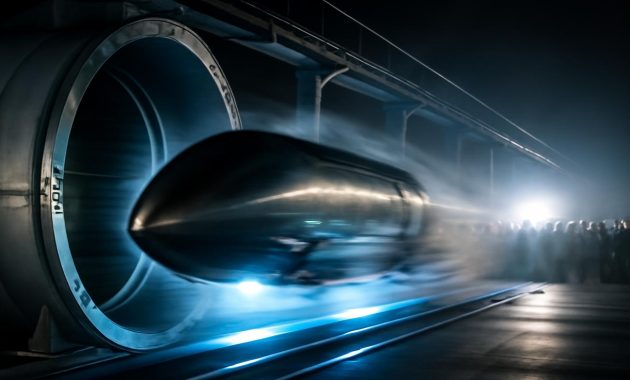
The sound is not so much a roar as a low, electric hush—like a storm building somewhere just out of sight. Along a sleek concrete tube on the outskirts of Datong in northern China, a slim silver capsule waits, humming quietly. Engineers stand behind glass, eyes flicking between screens and the smooth curve of the vacuum tube. Someone counts down in Mandarin. Three. Two. One. For two seconds, the laws of everyday experience vanish. The capsule lunges forward, and the future of trains lurches with it.
Two Seconds That Bent the Idea of Distance
On paper, it sounds almost underwhelming: a two-second test run, a few dozen meters of motion, and then silence again. But those two seconds in China’s hyperloop-style test tube have already begun to echo across the world of transportation.
The capsule reportedly hit around 623 km/h—over 387 mph—inside a vacuum tube, smashing existing records for high-speed ground transport. To put that in context, the world’s fastest commercial trains today, like Japan’s Shinkansen or China’s own Fuxing bullet trains, top out around 350 km/h in normal service. Magnetic-levitation trains—maglevs—have hit higher speeds in testing, but doing that inside a sealed, low-pressure tube opens an entirely different chapter.
Hyperloop, once a Silicon Valley buzzword and PowerPoint dream, has begun to take on something more solid, more metallic, more real. And in these few seconds of motion in China, we saw just how quickly the center of gravity for this technology might be shifting.
This is more than an engineering stunt. It’s a full-on attempt to rewrite how we think about the basic physics of going from A to B. When you strip away the air that slows trains down and replace wheels with hovering magnetic fields, you are no longer simply upgrading railways—you are reimagining what a “train” even is.
The Feeling of Speed Without the Wind
Step with your mind into that capsule for a moment.
There is no rush of wind past the window, no rattling of tracks beneath your feet. The air pressure inside is controlled and steady, and outside the tube the world is muted, distanced. The cabin is almost eerily quiet. You might feel a gentle push as the capsule accelerates, like a smooth airplane takeoff, except there is no sky and no runway—just a tube, a vacuum, and an invisible magnetic force pulling you forward.
At 600 km/h, the landscape around you would become an abstract smear—if you could see it at all. In many hyperloop concepts, the view outside is either limited or replaced by augmented windows, screens that show you either the actual terrain or a calming simulation. Some designers imagine capsules with soft lighting, warm colors, and minimalistic interiors to counterbalance the strangeness of hurtling through a tube at jetliner speeds.
What’s astonishing about China’s test is how quickly all of this has gone from science-fiction illustration to lab reality. Only a decade ago, hyperloop systems were mostly pretty renderings and speculative white papers. Now, rails—or rather, tubes—are being laid, magnets are humming, and capsules are moving.
China’s Giant Experiment in a Sealed Tube
The test track in Datong is not just a gadget for headlines; it is a prototype of a possible new kind of national infrastructure. Still in its early stages, the project is envisioned to stretch eventually over dozens of kilometers, a next-generation testbed for ultra-high-speed ground travel.
Here’s what makes it different:
- Vacuum or near-vacuum tube: By sucking most of the air out of the tube, engineers reduce air resistance to a fraction of what it is in the open. That allows much higher speeds with less energy.
- Magnetic levitation: Instead of wheels on rails, the capsule floats a few millimeters above the track on a cushion of magnetic forces. Friction—the constant enemy of speed—is drastically reduced.
- Linear motors: Rather than one big rotating engine, a linear electric motor laid out along the track pulls (or pushes) the capsule forward, like unrolling the inside of an electric motor into a long strip.
Combine these elements, and you get the fundamental recipe for hyperloop-style systems: lower drag, lower friction, higher speeds, and the potential—at least in theory—for trains that cruise faster than most commercial aircraft.
China is not the only country dabbling in this. From Europe to the Middle East, companies have been building test tracks, raising funding, and sharing teasers of capsule designs. But China brings something unique to the table: a proven record of taking extremely ambitious rail projects and building them at breathtaking scale.
It is the same country that knit together the world’s largest high-speed rail network in just over a decade, threading bullet trains across mountains, rivers, and deserts. That experience matters. If hyperloop-style trains are ever going to carry millions of people, it won’t be because one capsule in one tube went fast for a few seconds. It will be because someone can build thousands of kilometers of this stuff, at cost, with enough reliability to trust your commute—or your national economy—to it.
What a Hyperloop World Might Actually Feel Like
Rethinking Distance on the Map
We tend to understand distance not in kilometers, but in hours. The flight from Beijing to Shanghai? About two and a half hours in the air, half a day door to door. A train trip between big cities in Europe? Three, four, five hours. The world shrinks or expands depending not on geography, but on how long we spend moving between dots on the map.
Hyperloop-like trains could crush that mental map. Imagine crossing 1,000 kilometers—about the distance between Berlin and Rome, or Los Angeles and Denver—in little more than an hour. Think about what it would mean to live in one city and work or study in another that used to be “too far” except for rare trips. Regions that feel separate today—economically, culturally, socially—could lock together like puzzle pieces.
It’s not limited to passengers, either. Freight could move at similar blistering speeds, especially high-value or time-sensitive goods: medical supplies, critical components, fresh produce. Containers humming through sealed tubes beneath or alongside ordinary rail lines, linking ports, inland hubs, and logistics centers into something more like a circulatory system than a chain.
But beneath the big, abstract possibilities, there are smaller, more intimate details to imagine.
The Texture of a Hyper-Speed Journey
You arrive at a station that looks more like an airport terminal crossed with a sleek metro hub. No sprawling runway, no roar of jet turbines, just the quiet presence of the tube—a long, opaque cylinder disappearing into the distance. Security is there, of course, but perhaps more seamless, more automated. Trains arrive every few minutes instead of in irregular clumps.
Inside the capsule, seats might not even face forwards. At such high and steady speeds, direction could become almost irrelevant. Some concepts show pods with lounge-like seating, small tables, even standing spaces for shorter hops. Lighting would be warm and indirect, designed to soothe the body while the world outside blurs into data on a screen.
Acceleration and braking become as much psychological design problems as engineering challenges. Your body can only handle so much push and pull before discomfort sets in. So the launch might feel like a smooth, elongated elevator ride rather than the sharp jolt of a roller coaster. The system would trade a bit of top speed for human comfort—unless cargo is the only thing on board.
And then there’s silence. No engine howl. No air buffeting the windows. Just the low hum of electronics and the distant thrum of systems doing their work. It would be fast, yes, but also oddly calm—like sliding through space, untethered from weather and turbulence and the friction of the open world.
How It Stacks Up Against Today’s Fastest Trains and Planes
To understand just how radical this shift could be, it helps to put it next to the vehicles we already know.
| Mode | Typical Top Speed | Environment | Key Limitation |
|---|---|---|---|
| Conventional high-speed train | 250–350 km/h | Open air, steel rails | Air resistance, wheel–rail friction |
| Maglev (test record) | ~600 km/h | Open air, guideway | Air resistance still high at speed |
| Commercial jet | 800–900 km/h (cruise) | High-altitude atmosphere | Airport delays, emissions, weather |
| Hyperloop-style tube train (test) | ~623 km/h (early test) | Low-pressure tube, maglev | Engineering, safety, cost, scaling |
China’s test already places tube-based trains in the same speed conversation as the best maglev systems—and the goal, whispered between design documents and promotional videos, is even more aggressive: 1,000 km/h and beyond. At that point, trains become horizontal airplanes, minus the altitude and, ideally, much of the carbon footprint.
But, as always, the devil rides in on the details.
The Challenges Hiding in the Tube
Engineering on the Edge of the Possible
Maintaining a long tube at low air pressure is not a trivial job. Every joint, every segment, every access door must seal nearly perfectly. Temperature changes across seasons and days cause expansion and contraction. Ground shifts minutely over time. A single leak might not be catastrophic, but over hundreds of kilometers, the maintenance demands balloon.
Then there is safety. What happens if there is a sudden loss of pressure? How do you evacuate passengers from a capsule stranded in the middle of a sealed tube? Can emergency responders reach them quickly enough? Each of these questions leads to whole libraries of designs, simulations, and stress tests.
Power is another factor. Shooting heavy capsules through a tube at such speeds requires large bursts of energy, even if overall efficiency is better than aircraft. The grid connections, energy storage, and backup systems have to be massive, resilient, and smart.
China’s two-second test doesn’t answer these questions; it simply proves that the physics of speed in a tube can be tamed, at least for a heartbeat of time. The next decade will be about moving from “we can make it go fast” to “we can make it go fast, safely, every day, for decades, for millions of people.”
Economics, Politics, and the Long View
Hyperloop-style projects don’t just live or die on engineering merit. They must weave themselves through a thicket of economics and politics. Building these systems will likely cost more than conventional rail and could rival or exceed the price tag of high-speed rail and airports combined. Investors and governments will ask: Is it worth it?
The answer may lie in where they are built first. Dense, high-travel corridors—between megacities, along major economic belts—offer the best chance of success. China’s experience with high-speed rail shows that, given enough passengers and freight, giant rail projects can eventually pay off, not just in ticket sales, but in expanded economic activity along their routes.
But there will be trade-offs. Land use. Environmental disruption during construction. Questions of fairness: who gets served by these ultra-fast tubes, and who is left watching them streak by overhead or underground?
And then there’s the symbolic layer. Infrastructure of this scale is also a statement of intent. It says: We are thinking not just in terms of years, but of generations. In building ultra-fast trains, China and others are also building narratives about who leads in the technologies that shape how the 21st century moves.
The Future Trains We Haven’t Quite Named Yet
Beyond “Hyperloop” as a Buzzword
The word “hyperloop” itself is starting to feel too small, too tied to one particular bundle of Silicon Valley dreams. What we’re really talking about is the next branch in the family tree of trains—a branch that leaves steel rails and open air behind.
In a few decades, we may simply call them “express lines” or “tubes,” the way high-speed rail lines in Japan are just “Shinkansen,” not “super-magical-future-rail.” The awe will fade into routine, as it always does. What was once miraculous will become mildly annoying when your train is ten minutes late.
But the first time you step into one of these capsules, feel the soft press of acceleration, and watch a journey that used to claim half your day shrink into a quick hop before lunch, you may remember that two-second test in northern China. You might think of the engineers watching a silver capsule leap forward, their faces half-lit by screens and half by the gleam of something larger than a record: a change in what we dare to expect from the ground beneath our feet.
Someday, something like this may carry students between campuses in different cities, grandparents to New Year reunions hundreds of kilometers away, musicians on tours that zigzag across continents in compressed bursts of motion. It might send fresh fruit from distant farms to urban markets in the time it once took just to drive across town. It might thread together countries, or even entire regions, with a quiet, hidden network of pressurized veins.
We are still standing at the station, tickets not yet printed, most of the line still theoretical steel in empty fields. But for two seconds, a capsule in China moved so fast that the present moment almost couldn’t contain it. And in that flicker of motion, a new kind of train—quieter, swifter, more audacious—announced itself. Not as a finished promise, but as a question to the rest of the world:
Do we want to move this fast? And if we do, what kind of future are we ready to build around that speed?
FAQ
What exactly is a hyperloop-style train?
It’s a transport system where capsules or pods travel inside a low-pressure tube, usually using magnetic levitation instead of wheels. Reduced air resistance and friction allow much higher speeds than conventional trains.
How fast did China’s test capsule actually go?
Reports indicate it reached around 623 km/h (about 387 mph) during a short test run inside a vacuum tube, setting a new benchmark for tube-based rail prototypes.
Is this faster than current high-speed trains?
Yes. Most high-speed trains operate between 250 and 350 km/h. Some maglev systems in testing have approached 600 km/h, but doing this inside a tube where air resistance is much lower opens the door to even higher, more efficient speeds.
Will hyperloop-style trains replace airplanes?
They’re more likely to compete with short- and medium-haul flights, especially between major cities a few hundred to about 1,500 kilometers apart. Long-haul intercontinental flights will still need aircraft for the foreseeable future.
Are there safety concerns with traveling in a tube?
Yes, and they’re significant. Engineers must plan for emergencies like sudden pressure changes, power failures, or capsule malfunctions. Safe evacuation and rescue procedures in a sealed tube are among the biggest design challenges.
When could passengers realistically ride on such systems?
Even in optimistic scenarios, widespread commercial use is likely at least a decade or more away. Extensive testing, regulatory approval, and massive construction projects must come first.
Why is China’s role in this so important?
China has already built the world’s largest high-speed rail network in a short time, showing it can execute huge rail projects at scale. Its early success with tube-based high-speed tests may accelerate global adoption—or at least raise the bar for what’s possible.