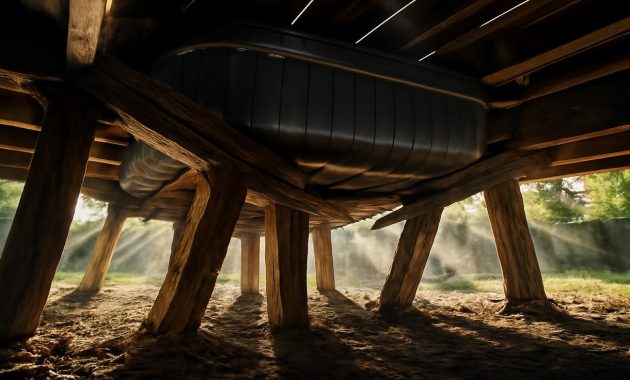
The first time Helen heard the crack, she thought it was a squirrel. A dry pop in the evening air, sharp but distant, like a twig stepped on in the woods. She lifted her head from the warm swirl of the backyard spa, steam beading on her glasses, and listened. Nothing. Just the faint rush of the pump, the soft hum of a neighbor’s air conditioner, the clink of wind chimes on the porch. Her husband, Art, leaned back against the molded headrest, eyes closed, silver hair glistening. “You worry too much,” he murmured, mist curling around his words. “Relax. This is why we got it.”
The Lure of Warm Water in Later Years
For many older adults, a backyard spa seems less like a luxury and more like a promise: relief for aching joints, warmth for hands that stiffen in the cold, a private sanctuary steps from the back door. It’s the dream of staying in your own home longer, of trading crowded physical therapy clinics for starlit soaks, of turning an ordinary deck into a tiny resort where the night air smells faintly of pine and wet wood.
Doctors often applaud the gentle benefits of warm water—buoyancy that removes pressure from knees and hips, heat that coaxes tight muscles to loosen. Seniors who once dreaded the climb out of bed in the morning suddenly imagine starting the day with weightless stretches under the sky, or ending it with a slow, meditative soak while owls call from the trees.
The spa catalogs make it all feel effortless. Smooth-shell tubs glowing with underwater LEDs. Smiling gray-haired couples with towels wrapped around their shoulders. Clean lines, clean water, clean living. But what those soothing photos rarely show is what’s underneath: the quiet skeleton of beams and joists bearing more weight than they were ever meant to carry.
When a Dream Spa Meets a Tired Old Deck
Helen and Art’s deck had been built in the late eighties, back when lumber was cheaper, codes were looser, and nobody was thinking about dropping 4,000–6,000 pounds of water and fiberglass onto those aging boards. Like many decks across the country, it had weathered summers of barbecues, winters of snowdrifts, and a thousand freeze-thaw cycles that had gently, invisibly, gnawed at its strength.
If you walk out onto a deck, you rarely think about weight. You feel open air, not structural load. The planks flex a little underfoot and it’s easy to mistake that softness for charm. But a spa, once filled, is less like a piece of furniture and more like parking a small car on a wooden balcony—and then inviting your friends to climb into it.
Engineers describe it in “pounds per square foot,” but you don’t need a math degree to understand the difference between six people chatting over lemonade and six people submerged in 104-degree water, the deck joists straining beneath them. Every gallon weighs a bit over eight pounds. A mid-sized spa can hold 300–500 gallons before a single person steps inside. Add the shell, the frame, the pumps, the cover, the steps, the people, and suddenly the quiet deck becomes a platform under enormous, constant stress.
The Quiet Threat Beneath the Boards
Deck collapses almost never arrive as jumping, cinematic disasters. They arrive slowly, like rot in a fallen log. A ledger board softens where water sneaks behind the siding. A bolt rusts inside its own hole. The soil at one corner post heaves and slumps with the seasons. Each little weakness steals just a sliver of safety, unnoticed, until a new load—heavy, warm, inviting—pushes the structure beyond what it can bear.
Aging bodies and aging decks share something in common: on the surface, things can look fine long after the real problems have begun. A coat of stain on the railings. A new set of planters. Freshly planted roses at the edge of the stairs. None of it reveals whether the support posts are sinking, or whether the beams are undersized for the weight they are now asked to carry.
For seniors, the stakes are harshly non-theoretical. A younger body might walk away from a fall with bruises and a story to tell; an older hip might not survive the same drop. A tumble onto splintered lumber is not just painful—it can be life-changing in the most literal sense, turning independent living into a long term care question in a single bad second.
And yet, the warm water still calls. The muscles still ache. The idea of soaking quietly under the stars is no less powerful just because gravity, time, and physics have joined forces under your feet. So how do we hold these truths at once—the deep joy and the real risk—and find a path that honors both?
Why Load Calculations Matter More With Age
There is a simple word for what stands between a safe, long-term backyard spa and an accident: calculations. Not guesses, not “it’s probably fine,” not “the guy at the store said most decks can handle it.” Actual structural load calculations by someone trained to do them.
At its heart, a load calculation is just a way of asking a wooden structure a very direct question: Can you truly handle this, every day, for years, with no warning if you’re about to fail? Engineers and qualified contractors answer that question by measuring spans, checking post sizes, studying connectors, and figuring out how many pounds each piece can carry before it yields.
Many older decks were built to older standards, often with a design load of 40 pounds per square foot for people and furniture—not the 100 pounds per square foot or more that a spa and its bathers may impose on a concentrated area. When families add a spa without adjusting the structure, they are quietly tripling or quadrupling the stress on parts of the deck that were never asked to carry it before.
For seniors, there is a second, quieter calculation too. It’s the equation of risk and remaining time. A sixty- or seventy-year-old may ask, “How many good years of use will this spa give me?” But they rarely ask, “What is the cost, to my body and my independence, if this deck fails under me?” A professional who takes load seriously helps answer both questions, weighing joy against danger in a way that respects the realities of aging.
Choosing Safety Without Giving Up the Water
The solution is not to shame older adults out of wanting a spa. Quite the opposite. The solution is to honor how precious that comfort is by building a foundation worthy of it. To say: your body deserves the warmth and the safety. Your remaining years deserve both relief and stability underfoot.
That starts with a quiet, almost meditative act: noticing. Notice how your deck feels when you walk across it. Does it bounce or sway? Are there hairline cracks in the support posts? Rust on the hardware? Soft spots at the edges where water pools after rain? Stairs that creak under your weight?
Then, go deeper than noticing. Bring in someone who can see what your eyes and fingers can’t. A licensed structural engineer. A well-qualified, code-aware deck builder. They will not be seduced by the aroma of cedar or the smoothness of your new stain. They’ll be counting spans and joists, measuring post sizes, poking at the ledger where it meets the house, checking for proper flashing, asking the unforgiving questions.
When it comes to spas on decks, the conversation often falls into a few common scenarios. It can help to think of them side-by-side:
| Scenario | Risk Level for Seniors | Key Considerations |
|---|---|---|
| Existing older deck, spa added without calculations | High | Unknown load capacity, hidden rot, outdated connectors, no reinforcement for concentrated weight. |
| Existing deck, evaluated and reinforced for spa | Moderate to Low | Engineered supports, added beams/posts, upgraded hardware, clear load path to ground. |
| Spa on separate, ground-level pad beside deck | Low | Concrete slab or pavers designed for spa weight, minimal fall height, simple access modifications. |
| New deck designed from scratch for spa | Low | Modern codes, proper load calculations, heavier framing, specialized footings for spa zone. |
Notice how the safest options either spread the load to the ground directly, or build the deck around the spa with full knowledge of the weight involved. For seniors, where a single misstep can change the shape of life, these distinctions are not academic. They are the difference between quiet routine and sudden catastrophe.
Designing for Aging Bodies, Not Just Aging Wood
Even on a structurally sound deck, the way a spa is placed and accessed can tilt the balance toward safety or risk—especially for older users whose balance or vision might not be what it once was.
Imagine winter, steam lifting into the cold air, a thin skin of ice beginning to trace along the outer steps. A single misjudged step, a wet footprint on smooth wood, and the fall that follows. When designers think empathetically about aging, they begin to adjust everything: step height, handrail shapes, lighting, surface grip, even where towels hang within arm’s reach.
Good design for seniors often includes:
- Wide, shallow steps leading to the spa, with consistent riser heights that don’t surprise tired knees.
- Solid handrails on both sides of any stairs, easy to grasp with arthritic fingers.
- Non-slip surfaces around and leading into the spa—textured decking, rubber mats rated for wet areas, careful avoidance of glossy finishes.
- Soft, indirect lighting that reduces glare on wet surfaces but reveals every edge and step at night.
- Stable seating or benches near the spa so older adults can dry, dress, and rest without perching on a wobbly chair.
These choices do not erase the romance of the backyard spa. They deepen it. They say: we expect you to use this in December and in August, in good health and on stiff days, alone and with visitors. We expect the spa to be part of the everyday fabric of your life, not a precarious treat you must tiptoe around.
The Psychology of “It’ll Be Fine”
There is a stubborn human optimism that blooms around backyards. Maybe it’s the open sky, or the way a deck blurs the line between indoors and out. Homeowners who would never cut a corner on a roof replacement shrug casually about thousands of pounds of water and human weight hovering above a concrete patio. “It’s been there for years,” they say. “We’ve had twenty people up here for parties. It’ll be fine.”
But a spa is not a party. It is a constant load, day after day, in the same spot. Water does not go home at 10 p.m. The structure never gets to breathe. Temperature swings and moisture add their own slow, invisible pressure. Where people stand and move, weight shifts; where water sits, it presses down and out, implacable.
Seniors, especially those who grew up in “do it yourself” eras, can be especially vulnerable to this optimism. They remember adding a shed here, a porch there, a bit of extra weight without trouble. But lumber is not what it once was. Codes have grown stricter because failures have taught hard lessons. A modern spa on an old deck is not just “more of the same”—it is an entirely different category of demand.
There is quiet courage in saying, “I don’t actually know if this is safe.” In picking up the phone, not to the spa salesperson, but to the person who understands tension, compression, and shear, and how bones—wooden and human—break under load. That courage is a form of love: love for one’s own aging body, love for a partner who shares the water, love for grandchildren who may climb in someday, giggling in the steam.
A Different Kind of Investment
When people talk about the cost of a backyard spa, they usually mean the price tag on the tub, the electrical work, the water care system. Structural work—the reinforcement, the new footings, the separate pad—can feel like an annoying add-on. But seen through the lens of aging, it is the truest part of the investment.
The spa itself may last a decade or two. Pumps will fail, covers will sag, shells will dull. The structure that holds it, if done right, will quietly outlast them all. You may one day replace the spa with a planter or a bench, but the deck or pad will remain, steady and unremarkable, doing its job so well you forget to notice it.
For seniors, spending money on what you will rarely see is an act of trust in your future self. It’s a way of saying: “I plan to be here, using this safely, long enough that it’s worth doing right.” In that way, proper load calculations and safe design are less about fear and more about hope.
Which brings us back, on a cool evening, to Helen and Art.
Listening to the Wood
A week after the first crack, there was another—louder this time, and closer. Helen stiffened in the water. She thought of the photos she’d seen in the local paper of a collapsed deck at a restaurant, splintered boards, overturned chairs. She thought of her sister’s broken hip from a simple fall in the kitchen. She thought of how the deck shuddered a little when their grandchildren ran across it.
The next morning, she called a contractor recommended by a neighbor. He came with a tape measure and a quiet frown, and before he even descended the stairs to examine the posts, he shook his head slightly at the sight of the spa hugging the railing.
“It’s not that these old decks were badly built,” he told them later, sitting at their kitchen table with a cup of coffee. “It’s that they weren’t built for that,” he said, pointing toward the window and the gleaming tub beyond. He explained joist spans, ledger bolts, and soil bearing capacity in plain language, and recommended bringing in an engineer to confirm his concerns.
Three months later, the spa sat on a newly poured concrete pad at ground level, snug beside the rebuilt lower section of the deck. The steps down were broad and gentle. A sturdy handrail lined the path. At night, small warm lights traced the edges, reflected in the water. The upper deck, relieved of its burden, felt firmer underfoot. On quiet evenings, you could still hear the faint creak of wood adjusting to temperature, but not the sharp crack that had once raised the hairs on Helen’s neck.
In the spa, knee-deep in heat, Art ran a hand along the sturdy rail. “Feels different,” he admitted.
“Feels like we’re planning to keep enjoying this,” Helen replied, closing her eyes. Somewhere beneath them, concrete and carefully calculated rebar held steady. Aging bones floated above, buoyed by water, by planning, and by the simple, stubborn desire to keep living fully—and safely—in the place they called home.
Frequently Asked Questions
Can my existing deck safely support a backyard spa?
It might, but you should never assume it can without a professional evaluation. Most older decks were not designed for the concentrated weight of a filled spa plus people. A licensed structural engineer or experienced, code-savvy deck contractor should perform load calculations and inspect the structure before any spa is installed.
What makes spa loads different from normal deck use?
A spa adds a large, constant, and very concentrated load. Water is heavy, and that weight doesn’t move around or leave after a few hours like guests at a party. This continuous load, focused over a small area, can push older or underbuilt decks beyond their safe capacity.
Are seniors at higher risk if a deck collapses?
Yes. Older adults are more likely to suffer serious injuries—such as hip fractures, head trauma, or spinal injuries—from falls. Recovery can be longer and more complicated, and injuries may impact independence and long-term living arrangements.
Is putting the spa on the ground always safer than on a deck?
Generally, a properly designed ground-level pad (such as a reinforced concrete slab) is safer and simpler structurally than placing a spa on an elevated deck. However, access, drainage, and slip hazards still need to be carefully considered, especially for seniors.
What safety features should seniors prioritize around a backyard spa?
Key features include non-slip walking surfaces, sturdy handrails, wide and shallow steps, good low-glare lighting, secure seating nearby, and easy-to-reach controls. Combined with a structure designed through proper load calculations, these elements significantly reduce the risk of falls and injuries.