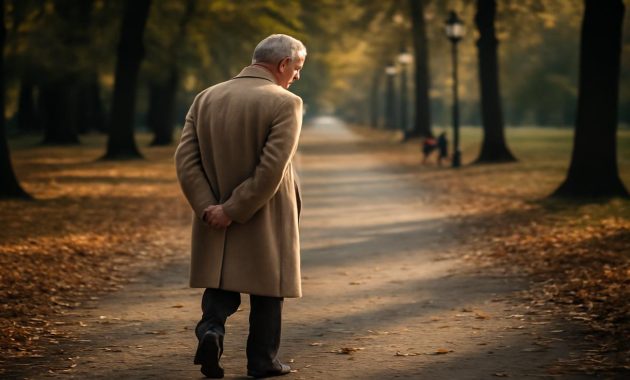
The first thing you notice is the sound. Shoes brushing gravel, a faint crunch with every step, and two hands loosely folded behind a back. It’s an ordinary scene—someone strolling through a park, down a street, along a beach path—so ordinary that you might not give it a second thought. Yet once you start paying attention, you see it everywhere: the old man circling the pond at dawn, the student pacing a campus quad, the manager walking a quiet hallway between meetings. Different ages, different cultures, different stories. But the same, simple posture: walking with hands clasped behind.
The Quiet Story Your Body Tells Before You Speak
Psychologists have a phrase for the things we do without realizing we’re doing them: nonverbal behavior. Before we ever learned to speak, our bodies were already telling the world how we felt—curious, anxious, open, threatened, bored, alive with possibility.
Walking with your hands behind your back is one of those small, almost invisible signals. It seems harmless, even a bit quaint—like something borrowed from a black‑and‑white movie or an old painting of philosophers in stone courtyards. But when psychologists peel back the layers, this posture says a surprising amount about what’s happening inside the mind.
To see it clearly, picture yourself in motion. Your spine is reasonably straight. Your shoulders soften and drop. Your gaze is free to wander ahead, to the sky, to the horizon. Your hands, which usually hover near the front of your body, are tucked away out of sight, fingers loosely interlaced or resting on one another between your shoulder blades. It’s a small shift, but your entire sense of space changes. You’re not guarding your front. You’re not leading with your fists or your phone. You are, in a subtle way, exposing your vulnerability.
And that is where psychology perks up and leans in.
Why Some Minds Think Better With Hands Behind Their Back
The link between strolling and thinking
There is a reason the image of a “thinking walk” feels so universal. From ancient philosophers pacing their colonnades to scientists wandering garden paths, walking has long been tied to deep thought. Modern research backs this up: movement increases blood flow to the brain, and gentle, rhythmic motion can nudge the mind into a more associative, creative mode.
Now add the detail of those hands behind your back. When you’re not gesturing, not fiddling with your phone, not carrying a bag, your physical world narrows. You’ve given your hands a job—simply to rest—and in doing so, you free up mental bandwidth. Some psychologists argue that small motor tasks can compete with cognitive resources. When you take your hands out of the conversation, your inner dialogue becomes louder, clearer.
People often report that they walk this way when they’re “in their head.” They’re mulling over a decision, replaying a conversation, hunting for a solution they can’t quite name yet. The posture, in this sense, is like placing a “Do Not Disturb” sign on the front of the body. It gently tells the world—and your own nervous system—that you’re busy elsewhere, on the inside.
Body language as a thinking ritual
Every ritual has its costume. For some, it’s rolling up sleeves before starting a big task. For others, it’s tying their hair back before solving a problem. Walking with your hands folded behind your back can become a quiet, personal uniform for focused thought.
Psychologically, rituals reduce uncertainty. The brain loves patterns because patterns feel safe. If, over the years, you’ve happened to take your most thoughtful walks with your hands behind you, your mind will start to associate that posture with clarity and contemplation. The next time you slip into it without thinking, the internal message might be: “Now, it’s time to think.”
That’s why you’ll often see teachers, professors, or mentors default to this walk in classrooms, corridors, and campus lawns. They’re navigating not just space, but ideas—testing, arranging, and revising thoughts as they stroll. Their body falls into the familiar pattern their mind associates with reflection.
| What You Notice | Possible Inner State | Psychological Meaning |
|---|---|---|
| Slow pace, hands loosely clasped behind | Calm reflection, light curiosity | Comfort with surroundings, mind wandering, low threat |
| Head slightly down, tight grip of fingers | Worry, rumination, problem‑solving under stress | Mental overdrive, using posture to contain tension |
| Brisk stride, upright posture, open chest | Confidence, sense of authority or purpose | Nonverbal signal of control and self‑possession |
| Frequent pausing to look around while walking | Curiosity, observational mode | Attentive presence, integrating environment and thought |
Is It Confidence, Or Just Comfort?
What an open front of the body whispers
From a body‑language perspective, the front of your body is prime real estate. It houses your vital organs, your heart, your gut. When people feel threatened or anxious, they instinctively protect this area—crossed arms, bag clutched to the chest, hands in pockets at the front, phone shielded like armor.
Walking with your hands behind your back does the opposite. It leaves your torso exposed. This is one reason many psychologists read it as a sign of perceived safety or quiet confidence. You are not broadcasting readiness to defend yourself. You’re not braced. You’re, in a word, unguarded.
This doesn’t always mean that you consciously feel powerful. Sometimes it just means you feel at ease. Perhaps you’re in a familiar neighborhood or a workplace you know well, on a path you’ve walked a hundred times before. The environment feels predictable, so your body relaxes into a more exposed, trusting posture.
The fine line between authority and arrogance
There is another layer, and it depends heavily on context. In some formal settings, hands behind the back can signal authority. Think of military officers inspecting a line of soldiers, or security staff pacing a perimeter. The gesture can say: “I’m in control here. I’m observing, not performing.”
But seen through a different lens, it can also be interpreted as aloofness. If someone is already perceived as distant or unapproachable, this posture might magnify that impression—especially if their chin is lifted and they rarely make eye contact. It’s a reminder that body language is never read in isolation. The same walk that seems wise and reflective on a quiet path might look dismissive in a tense meeting.
Psychologists encourage paying attention to clusters of signals. Is the person smiling? Is their face soft, their eyes engaged, their shoulders relaxed? Then the posture likely leans toward comfort and ease. Are their lips pressed tight, jaw clenched, strides sharp and fast? The same hands‑behind‑back position might then be more about containing irritation or asserting distance.
Hidden Tension: When Calm Posture Holds Restless Thoughts
The contained storm behind a composed walk
On the surface, walking with your hands behind your back can look serene—even elegant. But sometimes, a placid body hides an active, even stormy mind. The nervous system has a crafty habit: when it can’t express tension outwardly in words or big movements, it channels it into tiny, repetitive gestures.
Notice what’s happening with the fingers. Are they gently resting, or are they picking at skin, twisting a ring, rubbing knuckles back and forth? These micro‑movements give psychologists clues. They can indicate that the person is deep in problem‑solving mode, rehearsing scenarios, weighing options—what researchers call “cognitive load.”
In this scenario, the hands‑behind‑back posture works almost like a psychological container. It keeps the hands out of the way, preventing more disruptive fidgeting—pocket rummaging, face touching, hair pulling. This is useful in professional settings, where people feel pressure to appear composed even when their mind is racing.
Pacing as an emotional regulator
Then there’s the pacing. Many people instinctively walk when they are anxious, angry, or upset. Movement helps metabolize emotion; it gives the nervous system something to do with all that activated energy. For some, clasping the hands behind the back while pacing becomes a way to keep the emotional “spillover” contained.
Here, psychology reads the walk as a compromise. The body wants to move; the social self wants to appear under control. The result is a measured pace, hands anchored together, emotions quietly burning off through the rhythm of the steps rather than erupting in gestures or raised voices.
From the outside, you might see a person moving in clean, controlled lines and assume they’re calm. But ask them later, and they may describe that walk as the only thing that kept them from saying something they’d regret. The shoulders, the jaw, the hands tell that deeper story—if you watch closely.
Cultural Echoes and Personal Histories
What you learned without anyone teaching you
Not all body language is universal. Some of it is inherited through culture, quietly passed down from grandparents, teachers, or the characters we admired in books and films. The habit of folding your hands behind your back can carry the echoes of all those influences.
In some places, older generations walked this way as a sign of respect or attentiveness—during religious services, on school grounds, in front of elders. Children watched and copied. Over time, the posture detached from its original rules and became simply “how thoughtful people walk.” An internal script formed: if you’re observing, learning, or pondering, this is how your body arranges itself.
Psychologists call these internal scripts embodied memories. We don’t always remember where we picked them up; they live, instead, in the muscles and rhythms of how we move. You might find yourself strolling a museum, hands behind your back, not because you decided to—but because every museum guard, every quiet guide, every reflective elder you ever saw did the same.
When habit becomes identity
Over the years, these repeated choices can crystallize into part of how you see yourself. The reflective walker. The observer. The one who hangs back at the edge of the crowd, hands tucked away, taking everything in before acting.
Identity and posture then reinforce each other. You believe yourself to be thoughtful, so you move like someone who is thoughtful. You move like someone who is thoughtful, so others reflect that identity back to you in their expectations and descriptions. And without quite realizing it, your simple, everyday walk becomes one of the small ways you carry your story through the world.
What It Means When You Catch Yourself Doing It
Turning a habit into a moment of self‑awareness
The next time you realize your hands have slipped behind your back as you walk, treat it as a gentle invitation. Instead of shrugging it off as just a quirk, pause—if only in your mind—and ask a few quiet questions:
- What am I thinking about right now?
- Do I feel safe and relaxed, or am I trying to contain strong emotions?
- Is my body open and loose, or tight and controlled?
Often, the answers will surprise you. The posture might reveal that you feel more at ease in this place than you thought, or that you’re carrying more stress about an upcoming decision than you’ve admitted to yourself. Either way, it becomes a subtle feedback system—a way your body taps you on the shoulder and says, “Hey, look at what’s going on in here.”
Psychology doesn’t claim that one gesture can read your mind like a book. But it does suggest that when you notice patterns—how you walk when you’re overwhelmed, how you stand when you’re proud, how you sit when you’re ashamed—you gain a different kind of literacy. You learn to read yourself with the same patient curiosity you might give to a stranger on a park bench.
There’s a certain beauty in that. The simple act of walking, something you do thousands of times a day without thinking, becomes a window into everything you are thinking, feeling, and becoming. The ground under your feet changes—dirt path, city pavement, polished hallway floor—but the message your body sends remains softly, insistently present.
Hands behind your back, you move forward. You are, perhaps without knowing it, telling the world: I am here, I am thinking, I am open enough to walk unguarded, and complex enough that even this quiet posture contains more than one meaning.
Frequently Asked Questions
Does walking with my hands behind my back always mean I’m confident?
No. While an exposed front of the body can signal comfort or confidence, context matters. You might walk this way because you feel relaxed and safe, but you might also do it while deeply worried, using the posture to contain tension. Look at your pace, facial expression, and muscle tightness to understand what it means for you in that moment.
Is this posture a sign of intelligence or deep thinking?
Not inherently. Walking with your hands behind your back is associated with reflection because many people adopt it when they’re thinking or observing. But it’s a correlation, not a guarantee. Some thoughtful people never walk this way, and some who do may simply find it comfortable.
Why do older people seem to walk like this more often?
Several factors play a role. Habit and culture are big ones—many older adults grew up seeing authority figures and elders walk this way. There can also be physical reasons: it may feel more comfortable for the shoulders or back, or provide a sense of balance. Over time, what begins as comfort or imitation becomes a familiar, almost automatic style of walking.
Can I consciously use this posture to appear more confident?
Yes, to a point. Adopting an open, relaxed, hands‑behind‑back walk in safe situations can project calm authority and ease. But if you feel very anxious or tense inside, others may still sense that through your facial expression, voice, and overall body stiffness. Confidence comes across most clearly when the posture matches a genuine sense of inner steadiness.
Is walking with hands behind the back bad for posture or health?
For most people, doing this occasionally and naturally is not harmful. In fact, if it gently opens the chest and relaxes the shoulders, it can feel quite good. However, forcing the position, pulling the shoulders excessively back, or using it as your only way of walking could create strain. As with any posture, comfort, variety of movement, and listening to your body are key.