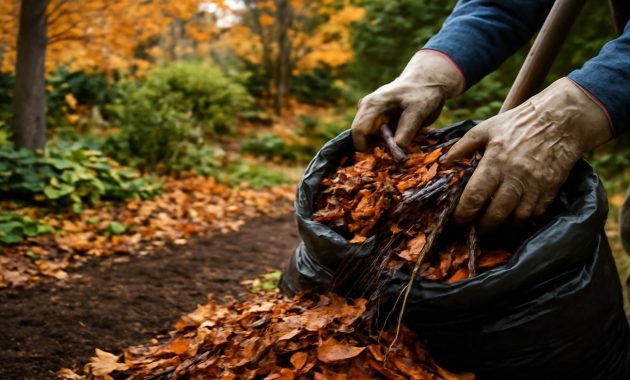
The first leaf doesn’t fall so much as it lets go. You notice it only because of the sound—a soft, papery skid across the patio stones—then suddenly you’re seeing all of them: bronze, saffron, wine-red, spotted, curling, drifting down in lazy spirals. Autumn has arrived, and with it, the familiar ritual. Rakes are pulled from hooks, leaf blowers roar to life down the street, and thick black bags begin to appear at the curb like a strange new crop. Every year, the same thing happens. And every year, gardeners make the same quiet mistake with their leaves.
The Rustle Underfoot We’ve Been Taught to Fear
There is a particular Saturday sound in autumn: the steady scrape of a rake over grass. For generations, we’ve been trained to believe that a “good” garden in fall is a cleared garden. No leaves on the lawn, no clutter in the flower beds, no drift of crisp color heaped against the fence. Clean lines, sharp edges, everything put away.
Maybe you know the choreography by heart. The day is cool but bright, the kind of blue sky that makes the reds and golds almost glow. You tug on an old sweater, step outside, and the air smells of woodsmoke and distant chimneys waking up after summer. There’s that faint, sweet scent of drying leaves—something between tea and earth—and you pause for just a second to breathe it in.
Then habit kicks in. Leaves become a problem to solve. You rake them into high, crackling piles. Children crash into them, toss them overhead, rain them down like confetti, but eventually they all end up the same way: stuffed into plastic bags, dragged to the curb, destined for wherever “away” is. The lawn is left shaved and bare, the beds are stripped, and the soil underneath is exposed, suddenly naked to the coming cold.
We tell ourselves this is what a responsible gardener does. We’re protecting the grass. We’re preventing mold. We’re keeping everything tidy. The mistake isn’t that we care for our gardens. The mistake is that we don’t realize what we’re throwing away.
The Secret Life of a Leaf Once It Falls
Here’s what a fallen leaf really is: a tiny, portable package of nutrients and shelter. In the tree, that leaf pulled sunlight from the sky and turned it into food. All season long, it borrowed minerals from the soil through the roots. When autumn comes and the leaf finally drops, it’s returning much of that treasure back to the ground.
Crush a dry leaf in your hand and you can feel the delicate skeleton of veins crumble to dust. That dust is carbon and nitrogen and a scattering of trace elements. Left where it falls—or gathered and used thoughtfully—it becomes one of the finest gifts you can offer your garden. Instead, many of us pay to have it hauled away, only to buy fertilizer and mulch later to replace what we just removed.
The real magic happens slowly, in layers. Picture a single maple leaf landing in your garden bed. A few more join it, overlapping like scales on a sleeping dragon. Rain darkens them; frost curls their edges; fungi thread themselves silently through the softening tissue. Insects sneak underneath: tiny beetles, pill bugs, centipedes, delicate spiders. Earthworms tug leaf fragments underground. Microbes wake and feast.
All winter, this quiet banquet goes on. By spring, what was once a tapestry of bright color has become a thin, crumbly layer of rich, dark material that smells faintly sweet and alive. The soil beneath is looser, more sponge-like. It holds water better. It looks, simply, fertile.
The mistake isn’t raking, exactly. It’s raking without listening. It’s tidying without understanding that the mess has a purpose, that the rustle underfoot isn’t just leftover summer, but the beginning of next year’s growth.
The Creatures Hidden in Your Leaf Piles
Of course, it’s not just the soil that loves fallen leaves. Autumn is also eviction notice for a whole world of small animals, and the leaves are their last, best chance to find shelter.
If you’ve ever parted a leaf pile in late fall, you might have seen them: a woolly bear caterpillar curled into a tight comma, a ladybug tucked deep inside, a toad eyeing you from beneath a damp, curling oak leaf. Moths and butterflies overwinter as chrysalises attached to dead stems or hidden in the leaf litter. Solitary bees nest in hollow stalks and shallow soil, sometimes under the very blanket of leaves we’re so quick to remove.
To us, a neat, bare garden might look “finished” for the season. To these creatures, it can look like a barren, wind-swept desert.
And birds—those bright, darting flashes in winter’s gray—depend on this messy underworld, too. When chickadees and wrens hop through your beds in December, they aren’t just admiring your planting scheme. They’re hunting for the insects and larvae that survived under leaves. Strip the ground clean, and you strip away their pantry.
It’s easy to forget, standing with a rake in hand, that our gardens are only ours in the loosest sense. They are also waystations and winter homes, breakfast buffets and nurseries. The leaves we bag up are more than clutter. They’re architecture.
Where Neatness Helps — and Where It Hurts
None of this means you should simply abandon your yard to ankle-deep drifts of leaves and walk away. Grass really can suffocate under thick, wet layers, especially if you’re dealing with large, leathery leaves like oak or sycamore. In spring, you might find moldy patches or yellowed turf where you hoped for a green carpet.
But the solution isn’t to send every last leaf off in a truck. It’s to get a little more precise—strategic, even—about what “tidy” really needs to look like.
Imagine your garden as a patchwork of zones, each with its own needs and tolerances. The front lawn that doubles as a play field? That’s a place where you probably want to keep heavy leaf cover under control. The back corner beneath the old tree, where nothing much grows and the soil is always a bit dry? That spot could become a leaf haven, a miniature forest floor. The perennial beds by the fence? They might appreciate a gentle quilt of shredded leaves as winter protection.
Instead of treating leaves as a single, uniform problem, you can start making small, intentional choices:
| Garden Area | What to Do with Leaves | Why It Helps |
|---|---|---|
| Main lawn / high-traffic grass | Mulch with mower or lightly rake off heavy layers | Prevents smothering grass while returning nutrients |
| Flower and shrub beds | Spread 2–3 cm of shredded leaves over soil | Insulates roots, feeds soil life, reduces weeds |
| Under trees and along fences | Let a natural leaf layer accumulate | Creates habitat for insects, birds, and small wildlife |
| Vegetable patch | Add leaves to paths and compost heap | Keeps mud down, balances compost, builds future soil |
| Hard surfaces (paths, drains) | Clear away and relocate to beds or compost | Prevents slipping and blocked drains, uses leaves as resource |
Once you start thinking this way, raking becomes less about erasing autumn and more about rearranging it.
The Simple Art of Mulching, Not Removing
There’s a gentler sound than raking in autumn: the hum of a mower set to high, passing over a thin layer of leaves and turning them into confetti. Mulching leaves directly into the lawn can be one of the easiest shifts a gardener makes.
When you run dry leaves under a mower, they shatter into small pieces that filter down between the blades of grass. As they break down, they feed the soil organisms that, in turn, help keep your lawn healthier and less dependent on store-bought fertilizers. It’s the same leaf, the same nutrients, simply redirected instead of removed.
In beds and borders, shredded leaves become a soft, patchwork blanket. You can make your own by raking leaves into a pile and mowing over them, or by using a leaf shredder if you have one. Then you scatter that crisp, papery mix beneath your shrubs and perennials, leaving a little space around the crowns of plants. Over winter, the shredded leaves settle and begin to decompose, protecting roots from temperature swings and feeding the life below.
This is where the “mistake” many gardeners make becomes most obvious: we invest hours and energy in removing a resource, and then again in replacing it. Mulching leaves instead is less work overall. It’s also strangely satisfying—listening to that delicate crunch as your boots press through a light layer of leaf mulch, knowing that beneath it, important things are quietly happening.
The Quiet Shift: From Controlling to Collaborating
Autumn has a way of revealing what kind of gardener you are, or perhaps what kind of relationship you want with your patch of earth. Spring and summer are about adding: plants, seeds, water, structures. Autumn asks what you’re willing to leave.
Look out at a leaf-covered yard and you might see chaos. But look again with a different lens and you might see the beginning of a partnership. Instead of battling the season, you start to work with it.
This doesn’t mean letting go of beauty. In fact, a garden that keeps some of its natural autumn layers often looks softer, more grounded. A ring of leaves at the base of a tree echoes the forest. A tucked-away corner where leaves gather becomes a deliberate “wild” spot, a reminder that not everything has to be orchestrated by human hands.
Try this: choose one small area of your garden this year and decide not to over-clean it. Maybe it’s a bed at the side, or the ground beneath a favorite shrub. Let a modest layer of leaves stay. Notice what happens. In winter, see which birds visit there more often. In early spring, gently lift a few leaves and see what’s sheltering below. Over a couple of years, watch how the soil changes, how the plants there respond.
The first time you do this, you may feel a twinge of guilt, as if you forgot to finish your chores. But gradually, that feeling is replaced by a different one: curiosity. What else was I clearing away without thinking? What else might the garden do for itself, if I let it?
Compost: Saving Autumn for Another Season
If you truly have more leaves than your garden can comfortably host on the ground, you still don’t need to send them off in plastic shrouds. A compost heap—or even a simple, hidden leaf pile—can turn the excess into something golden for future seasons.
Leaves are what composters call “browns”: carbon-rich materials that balance out “greens” like kitchen scraps and fresh clippings. Pile dry leaves in a corner, moisten them a little, add some grass clippings or a shovelful of garden soil now and then, and time will quietly change it all into crumbly, dark leaf mold—one of the most luxurious soil improvers you can get.
There’s a kind of pleasure in this slow alchemy. On a chilly afternoon, you open the compost bin or turn the leaf pile, and a faint warmth rises, carrying that unmistakable, loamy scent. Months from now, you’ll dig this softness into beds, tuck it around new plants, and the leaves that once covered everything in too-muchness will be invisibly feeding the roots of another year’s blooms.
In this way, you’re not fighting autumn anymore; you’re banking it.
Rethinking the “Perfect” Autumn Garden
Walk down a neighborhood street in late fall and you’ll often see a pattern: some yards shaved clean, bags lined up like soldiers at attention; others with a scatter of leaves still warming the ground. One looks finished. The other looks, perhaps, a bit undone.
But perfection is a moving target in gardening, and it’s usually the wrong one. A perfectly tidy autumn garden might be impressive for a weekend, but a living autumn garden—the kind that’s thinking ahead to spring—is allowed a few rough edges.
The birds don’t care if your beds look like a magazine spread. The soil doesn’t respond to symmetry. Insects and toads won’t compliment your immaculate lawn. They’re all looking for something far simpler: cover, food, a place to ride out the cold.
Every year, when the first leaves start to fall, gardeners stand at a crossroads between two stories. In one, we treat autumn as mess to manage until the real business of gardening returns in spring. In the other, we understand that this is the season when the foundation for next year is quietly laid. The difference isn’t in how many tools hang in your shed. It’s in whether you see those leaves as garbage or as gifts.
The mistake we make isn’t just that we rake and bag. It’s that we rush to erase the very thing our gardens—and the wild lives that pass through them—are asking us to keep.
Frequently Asked Questions
Will leaving leaves on my lawn kill the grass?
Very thick, wet layers of whole leaves can smother grass, especially on smaller lawns. Instead of leaving heavy mats, chop the leaves with a mower and allow a light layer of leaf pieces to fall between the blades. If the layer is so deep that you can’t see much grass afterward, move some of those leaves to beds, around trees, or into a compost pile.
Are leaves on the ground bad for allergies or mold?
Damp, compacted piles can sometimes develop mold that bothers sensitive people, especially if they’re frequently disturbed. Spreading leaves in thinner layers, shredding them, and avoiding large, soggy heaps against the house reduces this risk. Outdoors, a normal layer of leaves breaking down is part of a healthy ecosystem and usually not a major issue for most gardeners.
What about pests like slugs, snails, or rodents in leaf piles?
Any shelter can attract some pests, but balanced habitats also attract their predators. Birds, beetles, frogs, and toads all hunt slugs and insects in leaf litter. To reduce potential rodent issues, avoid piling leaves directly against buildings or wood structures, and keep compost heaps well managed. A moderate, well-placed leaf layer usually increases overall balance rather than causing infestation.
Can I use any type of leaves as mulch?
Most tree leaves are excellent mulch once they’re shredded or partly broken down. Very thick, tough leaves (like some oaks, magnolia, or sycamore) are better chopped first so they don’t form a dense mat. Avoid using leaves heavily treated with chemicals or collected from areas exposed to significant pollutants. If you’re unsure, compost them for a season before spreading.
When should I move or clear leaves in spring?
In early spring, many beneficial insects and small creatures are still using leaf litter for cover. If you need to tidy, wait until daytime temperatures are consistently warmer and plants are starting active growth. Then gently move or thin leaf layers, relocating them to compost piles or paths instead of removing them entirely. This timing gives overwintering wildlife a better chance to emerge safely.