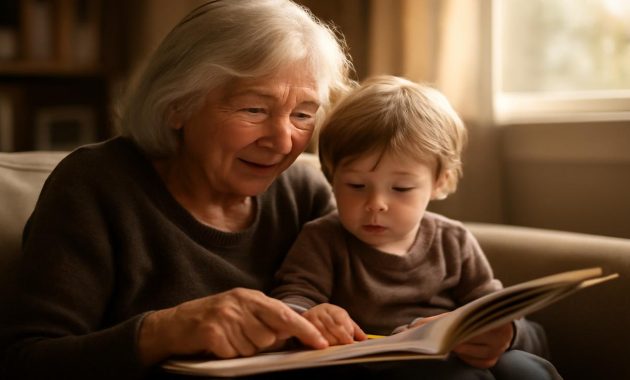
The first thing you notice is the sound. Not the television murmuring from the corner, or the ticking clock, but the soft, breathy giggles floating from beneath the old oak dining table. Four-year-old Eli is hiding there with his grandfather, both of them pressed shoulder to shoulder, conspirators in some invisible adventure. The kitchen smells faintly of oranges and dish soap, and afternoon light paints a gold band across the floor where their socked feet peek out. Eli’s parents call from the driveway, but he doesn’t answer right away. He is somewhere else entirely now, in that small, wild world that exists only when he is with his grandfather.
This scene plays out in a thousand different ways, in a thousand different homes: a grandmother teaching her granddaughter the slow, reverent art of kneading bread; a grandfather and grandson whispering secrets over a shared fishing rod; a grandchild who runs past both parents at the door to fling themselves into an elderly embrace. These bonds can feel almost magnetic—unusually deep, unusually steady. For years, people have chalked this up to “just how it is” or blamed it on the novelty of grandparents who “get to spoil them.” But psychology, creeping quietly into family living rooms with carefully designed studies and long-term data, has started to sketch out a surprisingly intricate picture of why certain grandparent–grandchild relationships become so uniquely powerful.
The Invisible Thread: Why Some Bonds Feel Instantly Stronger
Psychologists sometimes talk about “felt security”—that deep, body-level sense that you are safe, seen, and held in mind by someone else. Grandchildren who feel this with a grandparent describe things in simple language: “I can tell her anything,” “He always shows up,” “She just gets me.” Underneath those small sentences lie complex patterns of behavior, biology, and timing that researchers can now see with a bit more clarity.
One major factor is the emotional climate the grandparent creates. While parents are often tugged in ten different directions—bills, chores, emails, homework—grandparents, especially those who are retired or partially so, frequently have something that modern parents rarely do: time that isn’t fractured into shards. A grandparent may sit longer with a story, tolerate more silences, or allow a child’s curiosity to wander without hurrying it along. This unhurried presence sends a powerful psychological signal: you matter enough for me to slow my entire day down around you.
Research on attachment suggests that these repeated experiences of being calmly received and consistently responded to are like water to the roots of the relationship. It’s not just the big gestures; it’s a pattern of micro-moments—eyes that lift from the newspaper when a child walks in, a hand reaching out on the stairs, the habit of remembering a favorite snack or the exact way a child likes their toast. These seemingly small behaviors help a child’s nervous system relax in that person’s presence. Over time, the brain starts to map: “Here, I am okay.”
But that raises the next question: why do some grandparents naturally create this soft, spacious emotional zone, while others remain affectionate yet somehow distant, hovering at the edges of family life?
The Psychology of “The Favorite Grandparent”
The phrase itself feels a little taboo—no one likes to admit there might be a “favorite” grandparent in the family. Yet when researchers quietly ask grandchildren which grandparent they feel closest to, patterns emerge with surprising consistency. It’s not always the one who lives closest or spends the most money or bakes the most cookies. The answer, often, lies in something psychologists call “emotional attunement.”
Attunement is the ability to pick up on another person’s inner state—to notice the tiny slump in a child’s shoulders, the hint of disappointment in a half-smile, the spark of curiosity behind a question—and respond in a way that fits. It is less about grand gestures and more about feeling with, not just for, the child. Some grandparents seem to come wired with this ability, and in many cases, it has roots in their own past.
Grandparents who experienced secure, warm relationships with their own caregivers tend to find it easier to offer that same presence to their grandchildren. Their internal “template” for connection is one of safety and reliability, making it natural for them to step into a steady, nurturing role. Others, who had more chaotic or distant childhoods, sometimes discover a fierce motivation to “do it differently this time.” The grandparent–grandchild bond can become a place of healing, where old patterns are gently rewritten through new, more loving behaviors. Psychologists have observed this “intergenerational repair” in many families, where a once-distant parent transforms into a deeply invested grandparent.
There is also the question of similarity. Studies have found that grandchildren often feel more bonded to the grandparent whose temperament echoes their own. The introverted child may gravitate towards the quiet grandmother who loves reading on the sofa, while the exuberant, endlessly talkative grandchild finds home in the grandfather who will dance in the kitchen and spin improbable stories for hours. In these mirrored traits, both sides often feel deeply “seen.”
Time, Presence, and the Science of “Just Being There”
In family psychology, there’s a concept sometimes called “functional presence”—not just being physically around, but being emotionally accessible and meaningfully involved. The grandparent who lives three streets away but rarely looks up from their phone may, paradoxically, feel more distant to a child than the grandmother who lives across the ocean but writes letters, sends voice messages, and asks thoughtful questions in every video call.
Still, the raw availability of time matters. In longitudinal studies, children who formed the strongest grandparent bonds often had one or more of these conditions present:
- The grandparent was regularly involved in daily routines (school pickups, meals, bedtime rituals).
- The grandparent offered reliable emotional support to the child’s parents, which stabilized the entire household.
- The grandparent was a “stress buffer” during family crises—illness, divorce, financial hardship.
In each case, the grandparent’s role extended beyond “fun visitor” and into “quiet anchor.” When grandparents help hold the structure of everyday life, children unconsciously assign them a role in their inner emotional architecture as well. Something like: When things get shaky, you will still be here.
Interestingly, psychological research also shows that the meaning of time spent matters more than raw hours. A rushed afternoon of errands where a child is mostly told to “hurry up” or “be quiet” may do little for the bond. But a twenty-minute pocket of undivided attention—sitting in the garden naming clouds, fixing a broken toy together, listening deeply to a story about a playground dispute—can leave an imprint that glows for years. The nervous system remembers not the length of time, but the quality of the encounter.
Even across distance, intentional rituals can keep this sense of presence alive. A standing “Sunday story call,” where a grandparent reads a chapter over video chat; a postcard tradition; a shared journal mailed back and forth with doodles and notes. These small, recurring acts teach the child: you think of me even when I am not there. That knowledge is profoundly regulating for a young mind still learning how to feel attached and independent at the same time.
The Subtle Power of Stories and Family Memory
One of the quiet superpowers of grandparents lies in their role as storytellers, and psychology has grown increasingly interested in what that storytelling actually does to a child’s developing mind. When a grandmother tells her grandson what his father was like as a boy, or a grandfather shares how he felt leaving his home country, they are offering more than nostalgia. They are handing the child a map.
Family stories help children locate themselves in a larger narrative: You belong to a chain of people who have loved, struggled, moved, failed, tried again. Studies on children’s knowledge of family history have shown fascinating correlations: kids who can answer simple questions like “Where did Grandma grow up?” or “How did our family handle that hard time?” tend to show higher resilience and self-esteem. The stories themselves are less important than the underlying message: we have faced things, we have gotten through together, and you are part of this woven line.
Grandparents who naturally fold children into these narratives—inviting them into old recipes, familiar songs, rituals from past generations—often end up forming unusually strong bonds. They are not just loving an individual child in front of them; they are inviting that child into a living, breathing continuity. For a young psyche prone to feeling small and adrift, this can feel grounding in ways that are hard to articulate but easy to sense: I come from somewhere. I am not alone.
This storytelling often engages multiple senses. The smell of a particular spice blend, the sound of a lullaby in a language the child doesn’t fully understand, the feel of a well-worn photo album under small fingers—these sensory anchors become emotional shorthand. Long after the child has grown, the faintest whiff of that same spice in a restaurant can pull forth an entire inner movie of afternoons in Grandma’s kitchen. The bond lives on not just in memory, but in the body.
When Grandparents Step In as Emotional First Responders
Sometimes, the strongest grandparent–grandchild bonds are forged not in ordinary time, but in moments of fracture. A divorce. A parent’s illness. The slow, creeping stress of financial strain. In these spaces, grandparents often step forward as quiet emotional first responders, offering stability where everything else feels unsteady.
Psychology research on “kinship support” shows that when extended family members—especially grandparents—actively buffer children during stressful periods, the long-term psychological outcomes are often markedly better. Children who have at least one reliable, emotionally available adult outside their immediate parents tend to show lower levels of anxiety and depression later in life, even when early circumstances were difficult.
In the eyes of a frightened child, the presence of a grandparent who still remembers the snack you like, still keeps your seat at the table, still laughs the same way even while adults whisper worriedly in hallways, sends a powerful message: some things are changing, but not everything. I am still held.
This is where certain grandparents become almost mythic figures in a child’s memory. The grandfather who took them on quiet weekend walks during a chaotic custody battle; the grandmother who slipped them notes in their lunchbox saying, “Remember, you are loved,” when school became a battleground. Their bond is not only about play and indulgence; it is about shared survival. And while the child might not have words for it at the time, their nervous system records the presence of that steady lighthouse in stormy weather.
How Different Grandparent Roles Shape the Bond
Not all strong bonds look the same. Some are built on playful energy, others on calm listening, others still on shared work in a garden or garage. Researchers have tried to map out some of these difference patterns. A simplified way to think about it might look like this:
| Grandparent Style | Typical Behaviors | How It Feels to the Child |
|---|---|---|
| The Playful Companion | Games, jokes, imaginative play, small rule-bending treats | “With you, the world is fun and I can be silly.” |
| The Quiet Anchor | Listening, routines, gentle advice, consistent presence | “With you, I feel safe and steady.” |
| The Story Keeper | Sharing family history, traditions, cultural rituals | “With you, I belong to something bigger.” |
| The Mentor | Teaching skills, encouraging goals, cheering achievements | “With you, I feel capable and seen for who I can become.” |
Many grandparents blend these roles, of course, and they may shift across the child’s life. The key through-line, in the deepest bonds, is that the grandparent consistently shows up in a way that matches what the child most needs at different moments—delight when the world feels dull, steadiness when the world feels shaky, hope when the world feels heavy.
Biology, Brains, and the Surprising Science of Grandparent Love
Beyond stories and schedules, there are quieter forces at work. Neuroscience has begun peeking into the brains of grandparents and finding something fascinating: their neural responses to photos of their grandchildren look strikingly similar to the responses of new parents viewing their infants. Areas associated with reward, empathy, and social connection light up, suggesting that the grandparent bond is not purely cultural—it is also wired into the biology of caregiving.
Hormones like oxytocin, often called the “bonding hormone,” likely play a role too. Physical affection—hugs, lap time with a picture book, brushing hair, tucking in at night—can trigger these warm biochemical cascades in both the child and the grandparent, reinforcing the sense of closeness. Over time, the grandparent’s body, like the child’s, comes to anticipate and crave this connection, adding another layer of pull to the relationship.
Evolutionary psychologists argue that strong grandparent involvement may have been an ancient survival strategy. In environments where raising children required many hands and resources were scarce, having older, non-reproductive adults invested in young children dramatically improved their odds of survival. That deep, almost instinctive tug many grandparents feel toward their grandchildren might be an echo of this old survival code, humming quietly beneath modern life.
Yet biology is not destiny. Plenty of grandparents feel this primal pull but struggle to express it, and plenty of children sense a potential bond that never gets fully realized. That gap—between what might be and what is—can ache. It is here that psychology offers both understanding and possibility: even in later years, relationships are not fixed sculptures; they are living, changing ecosystems.
Can a Weak Bond Grow Stronger?
One of the more hopeful findings from attachment and family research is that repair matters more than perfection. Relationships do not need to start strong to become profound. Many grandparents admit quietly that they were not particularly close to their grandchildren in the early years—perhaps they were still working full-time, living far away, or simply unsure how to relate to small children. Then something shifted: retirement, a move, a family crisis, or a slow accumulation of small shared moments.
Psychologically, what strengthens a once-distant bond is often a mix of three ingredients:
- Curiosity: the willingness to truly get to know who this young person is now, not just who they were as a toddler or how you imagine them to be.
- Consistency: showing up in small, predictable ways, whether that’s a weekly call, a monthly visit, or a regular text checking in.
- Humility: the courage to acknowledge past distance or missteps: “I wish I had been around more when you were little. I’m here now if you’d like more time together.”
For the grandchild, especially as they move into adolescence and early adulthood, it can be unexpectedly powerful to see a grandparent making these efforts. Their presence, then, becomes not just given but chosen. And human hearts—no matter how old—are often moved by that choice.
What Grandchildren Remember Long After
Ask adults to recall their grandparents, and the answers often come back in vivid, sensory flashes rather than clear timelines. The smell of pipe smoke and sawdust in a small workshop. The feel of a cool hand on a fevered forehead. The sound of a particular laugh rippling through a crowded holiday table. The taste of a soup that never quite tastes the same when anyone else makes it. In these fragments live entire psychological landscapes.
What research quietly confirms is what many people intuitively know: when children feel unconditionally valued by a grandparent, it leaves a particular imprint. It can soften the sharp edges of self-doubt, offer a backup source of safety when parental relationships are strained, and even shape how they someday show up for the young people in their own lives.
Perhaps this is why some of the strongest grandparent–grandchild bonds feel almost outside of time. Even as wrinkles deepen and steps slow, there is a shared field of memory and feeling that both carry. The child, grown taller now, still recognizes the old magic in the way Grandpa’s eyes crinkle when he smiles. The grandparent, looking up at this nearly-adult face, still catches glimpses of the toddler who once fell asleep mid-story on their chest.
Psychology can give names and graphs and study designs to these bonds—attachment, intergenerational support, emotional regulation, narrative identity. But in the end, the data simply traces what a small boy hiding under a dining table already knows, pressed up against his grandfather’s shoulder as sunlight filters in stripes across the floor: some people, for reasons both ancient and tenderly chosen, feel like home.
Frequently Asked Questions
Do grandchildren always bond more strongly with one side of the family?
No. While some children do feel closer to one set of grandparents, many form distinct but equally meaningful bonds with grandparents on both sides. Factors like proximity, personality fit, and family dynamics matter more than which side of the family a grandparent is on.
Can a grandparent form a strong bond even if they live far away?
Yes. Distance changes how the bond is built, but not whether it can exist. Regular, emotionally engaged contact—video calls, letters, shared rituals, visits that prioritize quality time—can create deep closeness even across continents.
What if a grandparent and grandchild have very different personalities?
Differences don’t prevent strong bonds; they simply shape them differently. When both sides show curiosity and respect for those differences, the relationship can become a rich space of learning and balance rather than a source of friction.
Can a damaged relationship between parent and grandparent hurt the grandchild bond?
Conflict between generations can create stress, but it doesn’t automatically destroy the grandparent–grandchild relationship. Clear boundaries, respectful communication, and a shared focus on the child’s wellbeing can help preserve and even strengthen that bond.
Is it ever too late for a grandparent to become closer to a grandchild?
It is rarely too late. The form of the relationship will change as the grandchild grows, but teenagers and adults can still develop deep, meaningful connections with grandparents who show up with honesty, consistency, and genuine interest in who they are now.