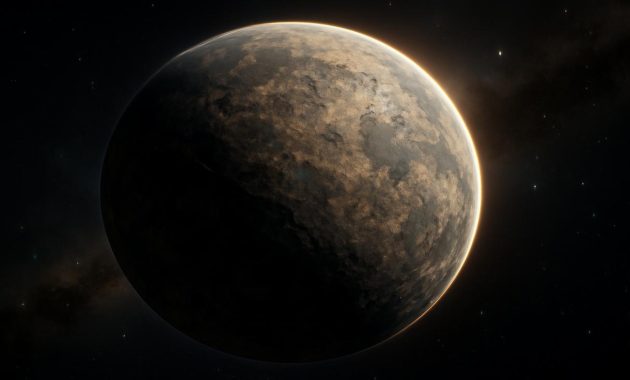
The first time the Webb telescope turned its unblinking gold eye toward the star HD 213885, no one expected the data to feel emotional. Yet when the numbers began to sketch out a thin, shimmering outline of an atmosphere around a scorched, ancient super-Earth, scientists describe the moment with words normally reserved for wilderness epiphanies: awe, disbelief, a sense of trespassing into somewhere very old, very far, and very unlikely. On paper, this world should not have an atmosphere at all. It orbits so close to its star that its “year” could fit inside a single Earth day. Its surface likely simmers at temperatures that would melt metal. For billions of years, stellar winds have been streaming against it like a sandblaster. And yet, against that furnace glow, Webb has spotted a whisper of air clinging on.
A Planet Too Close to Survive
Imagine standing on a shoreline at midnight, watching a storm approach. The wind rises, the waves turn white, and somewhere out beyond the breakers, a lone candle somehow stays lit. That, in cosmic terms, is what this planet represents.
The world in question, often referred to by its catalog label—a mouthful that sounds more like a password than a place—is a “super-Earth”: a rocky planet larger than Earth but smaller than the ice giants Uranus and Neptune. These planets are common in our galaxy, a kind of missing size class we don’t have here at home, but the one Webb has been studying takes “extreme” to a new level.
It hugs its star in an orbit so tight that the star would loom many times larger in its sky than our Sun does in ours. Daylight there is not just bright; it is a continuous white roar of radiation. The planet is likely tidally locked, always showing the same face to its star. One hemisphere is permanently seared in endless day, while the other shivers in eternal night. If rock can have seasons, they would be measured not in weather but in slow cycles of melting and re-freezing; oceans not of water, but of magma.
On such a world, the term “atmosphere” feels indulgent. Heat at the dayside could soar well above 1,000 degrees Celsius. Any light gases—hydrogen, helium—should have boiled away long ago, blown into space by the relentless stellar wind. Over billions of years, even heavier molecules should struggle to remain. And still, Webb’s instruments have traced patterns in starlight that whisper: there is something there, a veil, a boundary between rock and space.
The Art of Reading Starlight
To find something as fragile as an atmosphere on a world orbiting a distant star, astronomers rely on a kind of celestial eavesdropping. When this super-Earth passes in front of its star—as seen from our vantage point—the star’s light filters through whatever envelope of gas might surround the planet. Webb, with its exquisitely sensitive infrared eyes, breaks that filtered light apart into a spectrum, like sunlight spread out into a rainbow.
In that rainbow, certain colors go missing. Molecules in the planet’s atmosphere—if it has one—absorb very specific wavelengths of light. To a trained team, those tiny dips in the spectrum are less like a mystery and more like handwriting. Water vapor leaves one pattern, carbon dioxide another, sodium and potassium still others. Piece together these patterns, and you begin to sense the invisible air around a world you will never visit.
For this scorched super-Earth, Webb’s instruments delivered something strange. Instead of the flat, nearly featureless spectrum scientists expected from a bare rock or a faint haze, the data showed hints of structure—absorption features that likely correspond to heavy, high-temperature molecules. It wasn’t the lush atmospheric symphony of a temperate world, but it wasn’t the empty silence of a dead one either. It was something in between: a minimal, improbable, stubborn persistence.
The “Impossible” Atmosphere
Calling this atmosphere “impossible” is a kind of scientific shorthand. It isn’t that physics should forbid gas around a hot super-Earth. It’s that long exposure to a nearby star—billions of years of it—should have stripped any primordial atmosphere away. If the planet was born with a thick, puffy envelope of hydrogen and helium, that airy cloak should be long gone, boiled and blasted into interstellar space.
And yet, Webb’s view suggests there is still an atmosphere, of some kind, wrapped around this ancient stone. So where did it come from, and how does it survive in such a brutal neighborhood?
One possibility is that this is a “secondary” atmosphere—a world’s second breath. Instead of being leftover gas from the planet’s birth, it may be continuously recycled from the planet’s own interior. Volcanoes could be venting heavier molecules like carbon dioxide, sulfur dioxide, or even traces of metal-rich vapors into space, replacing what the star strips away. In this view, the atmosphere isn’t a relic; it’s an ongoing negotiation between rock and radiation.
Another possibility is more dramatic. If the surface is hot enough to melt rock, then the planet might be covered, at least on the dayside, by an ocean of magma. From that incandescent sea, minerals and volatile compounds can evaporate into a thin, exotic “rock vapor” atmosphere—think of steam, but made from stone. Above a churning, glowing surface, the air would be a mix of silicates and metal-bearing molecules, constantly escaping, constantly replenished.
Whichever story turns out to be true, the survival of this atmosphere suggests one thing definitively: rocky planets can be more tenacious, more dynamic, and more inventive than our old models allowed.
Listening for Molecules in the Noise
Webb’s detection didn’t arrive as a single “Eureka!” image. It came as a careful stacking of many faint signals, like listening for a whisper beneath the roar of a waterfall. Each time the planet crossed its star, Webb recorded the star’s spectrum with meticulous patience. Astronomers then combined those observations, subtracting out noise, correcting for instrument quirks, and comparing models until faint features emerged with enough certainty to trust.
There’s a kind of intimacy in that work. Webb never “sees” the planet as a disk. What it sees is change: the slight dimming when the planet passes in front, the even fainter shift when it slips behind. It sees the star’s light ever so gently altered by a thin shell of gas hundreds of light-years away. Turning those flickers into a portrait of an atmosphere is part science, part art, and part stubborn patience.
To help anchor how delicate—and yet how revealing—this is, it can be useful to imagine what Webb is up against when it does transmission spectroscopy on such worlds:
| Challenge | What Webb Has to Do |
|---|---|
| Blinding starlight | Measure changes in brightness of less than a fraction of a percent as the planet transits. |
| Tiny atmospheric signal | Detect absorption from a layer of gas that may be only a few tens of kilometers thick, across light-years. |
| Instrument noise | Calibrate out temperature shifts, detector quirks, and cosmic rays without erasing real signals. |
| Model ambiguity | Compare many atmospheric compositions and temperature profiles to find those that best match the observed spectrum. |
What emerges from this delicate process isn’t a pretty postcard. It’s a curve on a graph, a jagged line bumping up and down across wavelengths. But within that line, scientists read weather, chemistry, geology, and time.
A Window into the Early Galaxy
There is another layer to this story, one that stretches far beyond a single world: age. This super-Earth, like its parent star, is ancient. It was already old when Earth was forming its first continents. Some estimates suggest it has been orbiting in that same close, punishing path for billions of years—watching its star slowly evolve, surviving through epochs when our own planet was still molten, then microbial, then green and restless with life.
That age matters. It means that in the early galaxy, when stars were fewer and heavy elements scarcer, rocky worlds like this one were already assembling and locking themselves into orbits. It hints that atmospheres can endure not just intense heat, but deep time. And it gives planetary scientists something even more tantalizing: a living fossil of planet formation, preserved not in stone but in starlight.
On Earth, our atmosphere has been rewritten again and again—by volcanoes, by asteroid impacts, by the rise of oxygen-breathing and oxygen-making life. This faraway world’s atmosphere, by contrast, is likely shaped most strongly by raw physics: the balance between volcanic outgassing, escape to space, and chemical reactions on a broiling surface. It is a laboratory of extremes, showing what rock, gas, and radiation can do together when left alone for half the age of the universe.
Why Extreme Worlds Matter to Us
It might be tempting to store this planet in a mental box labeled “too hot, too weird” and move on. Yet each of these extreme worlds Webb studies is a crucial data point in a much larger puzzle. To understand which planets might be habitable, we first have to understand which planets are not—and why.
This “impossible” atmosphere helps refine the lines between categories. It tells us where simple rules—“close to star equals no atmosphere”—break down. It nudges our models to account for active interiors, magma oceans, and the way different molecules respond to heat and gravity. And those improved models ripple outward, informing how we interpret subtler, cooler signals on other worlds.
In a way, worlds like this super-Earth act as stress tests for our theories. If we can explain a thin, stubborn atmosphere clinging to red-hot rock around an old, bright star, we’re better equipped to interpret the softer signatures of air around planets more like our own. The strange helps us see the familiar more clearly.
The Quiet Drama of Survival
There is a certain drama in imagining this planet’s dayside sky. The star burns huge and fierce overhead. The ground may glow faintly, more kiln than crust. If clouds exist, they would not be water clouds but something stranger—perhaps plumes of mineral vapors, smudges of silicate dust rising from a molten plain.
Yet the planet endures. Every second, star-driven winds try to strip its gases away. Every second, the planet pushes back with its own resources: gases bubbling up from deep reservoirs, minerals evaporating, molecules recombining. Over unimaginable spans of time, this tug-of-war settles into a kind of uneasy balance. The atmosphere is thin, but not gone. Imperfect, but persistent.
Survival, in this context, does not mean comfort. It means simply: still here. Still holding on to a layer of air when, by our early expectations, it should have been naked to space. Still marking its presence in the spectrum of a star, a faint but undeniable note.
From our vantage point—one fragile, blue-green world orbiting a modest star—the story stirs a difficult question: how many times, across the galaxy, has rock found ways to wrap itself in gas and hang on? How many planets, in how many impossible places, are quietly running their own experiments in atmospheric endurance?
Webb as a Wilderness Guide
Modern nature writing often introduces us to landscapes that feel both alien and oddly intimate: ice caves glowing blue from within, deserts blooming overnight, rainforests murmuring with unseen life. In some sense, Webb is extending that tradition outward, becoming a guide to a cosmic wilderness we can’t walk through but can still experience in a different register.
Instead of boots and binoculars, we have infrared spectrographs. Instead of field notes, we have absorption lines. But the feeling—of stepping into a place that rewires your sense of what’s possible—remains remarkably similar. Scientists talk about these Webb detections with the same mix of precision and wonder that naturalists once brought to the first deep ocean trenches or high mountain plateaus.
There is humility in acknowledging that an atmosphere can exist, stubbornly, where our first calculations said it should not. There is delight in realizing that nature is constantly, quietly more creative than our models. And there is a kind of solace, too, in recognizing that the universe is not just expanding outward, but also deepening inward—becoming richer and stranger the closer we look.
Looking Ahead: From Impossible to Inevitable
The story of this ancient super-Earth’s atmosphere isn’t finished. Webb’s first glimpses are more like opening chapters than final verdicts. Additional observations, at different wavelengths and over more transits, will help scientists tease out exactly what molecules are present. Are we looking at a carbon-dioxide–dominated world? A sulfur-laced exhalation from an active interior? A rock-vapor haze born above a magma sea?
Each answer will carry consequences. If the atmosphere is dominated by volcanic outgassing, it suggests a hot but restless interior that has remained active for billions of years. If it is a rock-vapor mix, it pushes us to refine our models of how magma oceans evolve and how they sculpt the air above them. If, against expectations, traces of more complex chemistry appear, it will raise fresh, sharper questions about what can happen in such extreme conditions.
What seems likely is that what we once called “impossible” will, with time, become simply “rare but real.” As Webb continues to survey the skies, more hot super-Earths will pass in front of their parent stars. Some will be bare, some cloaked in thick, harsh atmospheres, some sheltered by delicate veils of gas and cloud. Patterns will emerge: which stars, which orbits, which planetary masses most often foster an atmospheric afterlife.
In that growing catalog, this first “impossible” atmosphere will stand as a landmark. A reminder that the universe is under no obligation to flatter our expectations, only to show us what is. And it will whisper, to anyone willing to listen in the thin, coded language of spectra, that even the harshest places can hold onto more than we think.
Frequently Asked Questions
What is a super-Earth?
A super-Earth is a type of exoplanet with a mass larger than Earth’s but smaller than that of the ice giants Uranus and Neptune. Most are thought to be rocky, like scaled-up versions of Earth, though some may have thick atmospheres or even shallow envelopes of volatile materials.
Why is the atmosphere on this super-Earth considered “impossible”?
The planet orbits extremely close to its star, enduring intense heat and strong stellar winds. Over billions of years, these conditions should strip away any atmosphere. The fact that Webb detects one suggests either continuous replenishment from the planet’s interior or more resilient atmospheric processes than expected.
How does the Webb telescope detect atmospheres on distant planets?
Webb uses a technique called transmission spectroscopy. When a planet passes in front of its star, some starlight filters through the planet’s atmosphere. Molecules in that atmosphere absorb specific wavelengths of light, leaving tiny fingerprints in the star’s spectrum that Webb can measure.
Does this discovery mean the planet could be habitable?
No. The super-Earth in question is far too hot for liquid water and likely has a surface of molten rock on its dayside. Its atmosphere, while scientifically fascinating, is probably composed of harsh, high-temperature gases, not the kind of air that could support life as we know it.
Why is studying such extreme planets important?
Extreme planets help test and refine our theories of how atmospheres form, evolve, and survive. Understanding where those theories break down improves our ability to interpret data from more temperate, potentially habitable worlds—and gives us a fuller picture of how diverse planets can be.