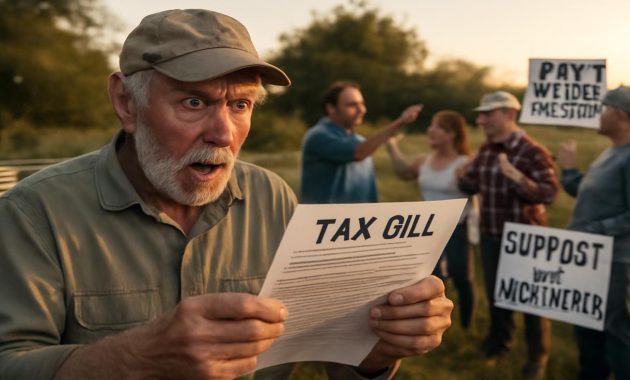
The first sign of trouble was a yellow envelope, the kind that makes your stomach drop before you even open it. It lay crooked in Harold Mendez’s mailbox, half-hanging out like it was trying to escape. The air smelled like ripe peaches and mower clippings that afternoon, a late-summer sweetness drifting up and down Maple Lane. But in Harold’s hands, the paper felt heavy. Inside was a notice from the county assessor’s office, telling him that a patch of earth he’d lent to a neighbor “for free” now counted as commercial agricultural use—and with it came an unexpected tax bill big enough to swallow his winter savings whole.
The Beekeeper of Maple Lane
Harold had always said retirement snuck up on him the way bees find clover: quietly, then all at once. For thirty-eight years, he’d worked as a mail carrier, memorizing doorbells and barking dogs and the subtle sound of families being built one utility bill at a time. When his knees finally insisted that enough was enough, he traded his blue satchel for a white bee suit and turned his backyard into a small kingdom of hum.
His place wasn’t grand. A one-story house with peeling green shutters, a tomato patch out back, and six wooden beehives lined up like tidy beige soldiers along the fence. The bees arrived the same week his pension checks did. Neighborhood kids called him “the Beeman.” He shared honey jars each fall, printed with crooked little labels his granddaughter made in her art class.
On warm evenings, Harold liked to lean on the fence and listen. His bees sounded like a sleeping neighborhood: not quite quiet, not quite loud, a constant, living murmur. Neighbors walked past with strollers and leashes, waving, sometimes pausing to ask about the bees, or to trade zucchini for honey. Maple Lane was that kind of place—where rhubarb appeared on doorsteps and somebody always had jumper cables.
That kind of place, too, where a simple “Sure, you can use my land” felt as natural as lending out a cup of sugar. Until the tax man came knocking.
The Free Field That Wasn’t Free
Across the street from Harold lived the Wongs, relatively new arrivals in a neighborhood where some families could point out trees they’d planted three generations back. Matt and Lin had moved from a cramped apartment over a laundromat in the city, eyes bright with the kind of hope you see in people who are finally convinced the world might have a little space for them.
It started with a conversation over the fence one early spring morning. The breath of the season was still cool, but the light had begun to feel more forgiving, sliding into yards and pulling up the first brave dandelions.
“Mr. Mendez,” Lin called, wrapping her cardigan tight as she crossed the street. “Can I ask you something a little… unusual?”
She told him about her dream: growing specialty heirloom flowers and herbs and selling them at weekend markets. Not a giant operation, just enough to pay off student loans faster, enough to feel like they were building something that was theirs. Their own yard was shaded by a towering maple and dominated by a swing set their kids refused to give up. But they’d noticed the weedy, unused stretch of Harold’s side lot—about a quarter acre of sun-baked soil the color of cinnamon, where grass never quite seemed interested in thriving.
“We can do all the work,” Lin said, hands fluttering as if already planting seeds. “We’ll maintain it, keep it tidy. You don’t have to lift a finger. We just… need a bit of space. We can’t really afford to rent land yet.”
Harold shrugged, almost offended she thought it was a big ask. “Land shouldn’t sit bored,” he said, a phrase he’d learned from his father. “If you can wake it up, it’s yours. No charge.”
Within weeks, the scruffy lot transformed. Rototillers chugged at sunrise. The air filled with the damp, mineral smell of freshly turned soil, dark and rich like cocoa. Wood chips were delivered in steaming piles. Raised beds sprouted like wooden rafts. The Wongs painted signs for their rows: “Thai Basil,” “Chocolate Cosmos,” “Bee Balm,” “Blue Poppies.”
Harold watched from his porch swing, bees drifting lazily between the hives and the new blossoms, as though his retirement hobby and their side hustle had always been destined to overlap. When the first glossy bunches of blooms appeared, Lin brought over a bouquet for his kitchen table, petals still cool from the morning air.
“You sure you won’t take anything?” she asked again and again. “A cut of the sales? A little rent?”
“You’re helping the bees,” Harold would answer, waving her off. “That’s worth more than money. Besides, neighbors don’t meter out kindness.”
When Goodwill Meets the Tax Code
The yellow envelope shattered that illusion.
The notice was written in a language that looked like English but felt alien. Words like “land-use reclassification,” “agricultural activity,” “assessed value increase,” and the kicker: “commercial purpose.” Harold brought it inside, laid it flat on the kitchen table, and read it three times until the lines blurred.
He poured himself coffee that went cold while he stared. The bees outside droned their usual song, oblivious. The letter explained that because part of his property was now being used for a business—no matter that he didn’t profit—his land no longer fit the simple residential classification he’d had for decades. A new agricultural tax bracket applied. The amount owed for the coming year was several times what he’d been paying.
“That can’t be right,” muttered his daughter Elena when he called her over. She worked in HR, used to deciphering paperwork designed to confuse. “You’re not running a farm, Dad. You’re feeding bees and being nice.”
Still, the county office phone line was firm. The neat-voiced woman on the other end sounded apologetic, but unyielding.
“The law doesn’t ask about intent,” she explained. “It looks at use. If someone operates a for-profit agricultural activity on your land—even at no rent—it shifts the classification. The system assumes the land is part of that business, whether or not you personally earn anything.”
“So I pay the price,” Harold said, rubbing his forehead. “For being helpful.”
“I understand this feels unfair,” she said gently. “But from a legal standpoint, the land is contributing to a commercial enterprise.”
That night, Harold barely slept. The glow from the streetlamp leaked through his curtains. Outside, the lot across from his bedroom window stood lush and orderly, rows of herbs rustling softly in the breeze. He could almost hear them whisper: You asked for this. You said yes.
Neighbors, Numbers, and New Lines in the Sand
By the end of the week, everyone on Maple Lane knew. News in a close-knit neighborhood moves at the speed of dandelion seeds—one gust, and it’s everywhere. What shocked Harold most wasn’t the tax bill, but the way an invisible line seemed to appear overnight between neighbors who used to share folding chairs and potato salad at block parties.
On one side were people like Mrs. Detweiler, who’d lived there since the town still had a single traffic light and the high school football team rode tractors in the homecoming parade. She marched up to Harold’s door gripping a tin of lemon bars and righteous indignation.
“This is what happens,” she said, tapping the notice with a finger mottled by age spots. “You give and give and the system punishes you. It’s not right. They should be taxing the business, not the kindness.”
On the other side were neighbors like Danny, the freelance designer who worked from his laptop at the café downtown and biked home with reusable grocery bags. He wasn’t unsympathetic, but he saw another angle.
“Local food businesses are fragile enough,” he told a cluster of neighbors gathered on the sidewalk. “If we start making it impossible for people to get creative with land use, we’re just handing everything to big corporations. Maybe the real question is why our tax code can’t accommodate shared community projects.”
Even among those who agreed it was unfair, there were disagreements over who should shoulder the burden. When the Wongs found out, they were horrified.
“We’ll pay the difference,” Matt said instantly, pacing their small living room, bare feet whispering against the worn hardwood. “All of it. We refuse to be the reason he loses money.”
But the Wongs’ side business was barely turning a profit; most of what they made went back into soil amendments, seeds, and the endlessly repeatable expenses of small-scale agriculture. Covering Harold’s new tax bill every year could wipe them out.
“We could move the operation,” Lin suggested quietly, eyes brimming. “Maybe someone outside town limits has land. But then your bees lose their flowers, and we lose this community. It’s not just dirt. It’s… all of this.”
In the swirl of frustration, guilt, and second-guessing, a practical question surfaced again and again in living rooms and over backyard fences: When a neighbor helps someone else’s business, where should the legal—and moral—responsibility land?
Who Really Owns “Community”?
The argument, many discovered, wasn’t just about Harold’s bill. It was about what “community” really means when governed by systems that see only owners, users, and taxable value.
On paper, the situation was simple enough: Harold owned the land. He had allowed its use for commercial production. Therefore, in the eyes of the tax code, that land had a new purpose and value. But in the hearts of the people living along Maple Lane, the story was knottier.
Some argued that any business should carry its own weight, even if it lives partly on borrowed generosity.
“Look, I love what the Wongs are doing,” said a neighbor named Ron at an impromptu gathering beneath the giant oak tree where block parties usually spilled out. “But if their business model depends on someone else taking a financial hit, then is it really sustainable? They should factor land costs in like any other overhead expense. Or at least cover the consequences.”
Others saw Harold’s offer as freely given, and therefore something he’d knowingly risked.
“We all sign invisible contracts when we say yes to things,” countered Danny. “Nobody forced him. He wanted to help. That doesn’t mean the tax law is fair, but it’s not the Wongs exploiting him. It’s the system failing to recognize the value of informal cooperation.”
This tension—between formal responsibility and informal generosity—isn’t unique to Harold’s street. Across towns and suburbs, similar questions surface whenever neighbors lend driveways to food trucks, spare bedrooms to yoga teachers, garages to woodworking shops, or yards to community gardens that occasionally sell surplus produce.
At what point does friendliness become infrastructure?
At what point does sharing become business partnership, at least in the cold eyes of regulation?
When Rules Meet Real Lives
Part of the strain came from the sheer mismatch in language: people like Harold thought in stories, not statutes. The law, meanwhile, dealt in definitions. A patch of soil bursting with chamomile, sage, and dahlias might look like abundance, hope, and resilience to the people tending and enjoying it. To the county, it looked like a line item.
“It’s not that the law is evil,” explained a local planner who showed up to a town hall meeting after hearing the fuss. “Zoning and tax classifications exist to keep some basic order. But they’re blunt tools. They don’t yet know how to handle these hybrid, in-between uses—where something is part community project, part microbusiness, part act of neighborly kindness.”
He talked about land-use categories designed decades ago, when the assumption was that homes were just homes, farms were just farms, and business happened in clearly marked commercial zones. But the modern landscape is messier. Retirees raise bees. Teachers run Etsy shops from spare bedrooms. Cooks test recipes in borrowed church kitchens. Families host pop-up farm stands in front yards.
“We’re trying to stitch 21st-century life into a 20th-century regulatory quilt,” he said, “and it keeps pulling in the wrong places.”
Harold sat in the back row, hands folded, listening to words like “pilot programs” and “mixed-use amendments.” He appreciated the planner’s honesty, but the abstract talk did little to calm the concrete math pounding at his temples. His tax bill didn’t care about nuance.
Yet the meeting did something important: it gave shape to a feeling many had been struggling to name. It wasn’t just about one envelope. It was about living in a world where the very acts that make neighborhoods feel like neighborhoods—sharing, helping, hosting—could carry unseen financial landmines.
Counting Costs, Seen and Unseen
One evening, a small group gathered at Harold’s kitchen table: the Wongs, his daughter Elena, and two neighbors who had quietly become the informal problem-solving committee for Maple Lane. The bees were settling in their boxes outside, the sound from the hives a sleepy whisper against the windowpanes.
They decided to write down what this “free” arrangement had actually cost and gained everyone, not just in money, but in everything else that mattered.
| Stakeholder | Benefits | Costs & Risks |
|---|---|---|
| Harold (Landowner) | Beautified lot, stronger bee forage, sense of purpose, closer ties with neighbors | Higher tax bill, legal risk, stress, potential impact on fixed-income budget |
| Wongs (Growers) | Access to land, launch of small business, community support, pollination boost from bees | Moral pressure, possible relocation, financial strain if covering extra tax |
| Neighborhood | Local flowers and herbs, ecological benefits, stronger social fabric, shared spaces | Community tension, precedent for hidden liabilities in “helping” arrangements |
The list of benefits sprawled beautifully. The costs, fewer in number, felt sharper, like stones under bare feet.
“If we’d known about the taxes, we could’ve made a plan from the start,” Elena said. “That’s the worst part. Not the money, but the surprise. Like finding out kindness has fine print.”
They tossed around ideas: a written agreement that named the Wongs responsible for any tax changes; a small community fund neighbors could chip into each year to buffer unexpected costs for shared projects; even the possibility of asking the town to create a special “community-agrarian” class for tiny, collaborative uses like theirs.
None of it was an instant fix. But the act of naming options, however imperfect, began to restore a thin thread of agency to a situation that had felt like a sucker punch.
Rewriting the Story, One Yard at a Time
In the weeks that followed, something quietly radical happened. Instead of retreating into suspicion—no more lending land, no more favors—Maple Lane leaned in. They became, unintentionally, a little experiment in what it might look like to navigate a world where systems lag behind values.
The Wongs insisted on covering a meaningful portion of the tax increase, even if it meant scaling back their expansion plans. “If our business can’t afford to exist without shifting our burden onto someone else, we need to slow down,” Lin said. “Growth isn’t worth eroding the very community we depend on.”
Several neighbors, including those who had never bought a single bouquet, offered to pre-purchase flower subscriptions, effectively fronting the Wongs money in a way that also brought more beauty into their own homes. Others quietly slipped cash or checks into Harold’s mailbox with notes that read, “For the bees,” or “For all the jars of honey over the years.”
At the next town hall, residents from other parts of the city showed up, curious and concerned. They’d had their own near-misses: a homeowner nearly fined for allowing a friend’s food truck to park on their property a few weekends a month; a choir teacher warned that hosting paid singing lessons in her living room could trigger a business-use reclassification.
“We don’t want to live in a place where every act of generosity has to be lawyered,” one resident said into the microphone, voice tight. “We’re not anti-tax. We’re not anti-regulation. We just want a framework that recognizes cooperation as an asset, not a liability.”
The city, to its credit, listened. There were no overnight miracles, but a working group was formed to explore micro-use categories, clearer guidelines for small-scale shared projects, and potential tax relief mechanisms when neighbors collaborate on endeavors that provide genuine community benefit.
Back on Maple Lane, the season rolled forward. Leaves yellowed at the edges, the first chilly dawns arrived, and the bees grew drowsier. Harold still winced when he thought about the envelope, but he also found himself oddly grateful for what it had surfaced.
“I said yes because it felt right,” he told his granddaughter one afternoon, as they labeled honey jars at the kitchen table. “I’d still say yes. But now I know that being a good neighbor sometimes means asking harder questions up front. Not to stop kindness—but to protect it.”
Should Helpful Neighbors Pay the Price?
In the end, the story of the beekeeping retiree and the “free” field isn’t about bees or basil, or even about one man’s tax bill. It’s about a changing world where the old lines between personal and commercial, private and public, me and we, are blurring faster than our rules can keep up.
Should helpful neighbors pay the price for others’ businesses? Most people on Maple Lane would now answer: not alone.
If a community benefits from shared projects, then communities—through both informal support and formal policies—have a role in absorbing the fallout when systems misinterpret generosity as profit-making.
That means a few things, in practical terms, for anyone tempted to say yes when opportunity knocks on the fence:
- Ask early about potential legal and tax implications, even if it feels awkward.
- Put agreements in writing, especially clarifying who covers what if classifications or costs change.
- Think beyond two parties: how might neighbors collectively share both the rewards and the risks?
- Pay attention to local zoning and tax conversations, and speak up when they ignore the reality of small, shared, community-rooted ventures.
Most importantly, resist the temptation to let stories like Harold’s harden into cautionary tales that end in slammed doors and fenced-off yards. Instead, let them be fuel for redesigning the rules so they finally match the lives people are trying to live—lives where land doesn’t sit bored, where bees and flowers and small dreams have room to unfold, and where the price of kindness isn’t paid in surprise bills and broken trust.
On a cool afternoon at summer’s end, Harold walked the border of the borrowed field, fingers brushing the tops of drying lavender. The hum around him was softer now, bees fat and slow, but steady. He paused, looked at the hives, the flowers, the houses beyond, and considered—for the first time in weeks—not the tax notice, but the symphony of interdependence he’d been lucky enough to be part of.
“Nothing here is really free,” he murmured, half to himself, half to the bees. “But maybe that’s the point. We’re all paying into something bigger. The trick is making sure the costs—and the benefits—are shared in a way that feels worth it.”
Frequently Asked Questions
Can letting a neighbor use my land for their small business affect my taxes?
Yes. In many places, if your land is used for commercial or agricultural activity, even without rent, it can trigger a change in how your property is classified and taxed. Local laws vary, so it’s wise to check with a tax professional or local assessor before agreeing.
If I don’t earn any money, why would I be taxed differently?
Tax and zoning systems often focus on how land is used, not who profits. If your property supports a for-profit activity, authorities may treat that portion as part of a business, regardless of whether you personally receive income.
How can neighbors protect themselves when lending space for community or business projects?
Have a clear written agreement that addresses responsibilities for taxes, utilities, and potential legal issues. Before starting, talk to your local zoning office or a qualified advisor to understand possible consequences.
Is there a way for communities to support shared projects without punishing volunteers?
Yes. Communities can create informal support systems—like cost-sharing funds—and push for formal changes, such as special classifications or exemptions for small, low-impact, community-benefit projects. Speaking up at local meetings can help drive those changes.
Does this mean I shouldn’t help my neighbors with land or space?
Not necessarily. It means going in with open eyes: ask questions, understand the rules, and make fair arrangements so that one person doesn’t shoulder all the hidden costs. Thoughtful planning can keep generosity alive without turning it into an unfair burden.