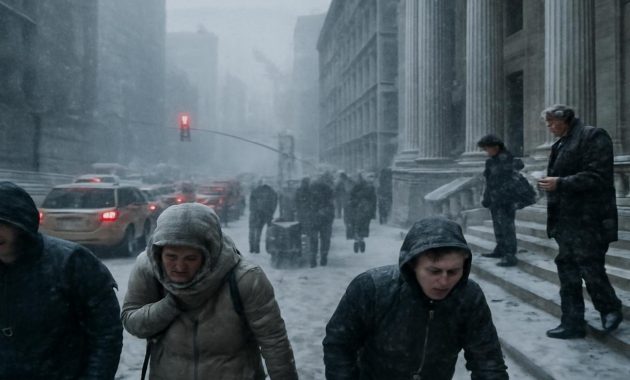
The cold arrived before the sunrise did. It slipped in through window frames and keyholes, a thin, invisible blade that found its way to the skin beneath your sweatshirt and made you suddenly, unreasonably awake. Outside, the neighborhood was still wrapped in that bruised, late-winter dark, but the air had already turned brittle, snapping at every breath. You reached for your phone. Overnight notifications bloomed on the screen: “Polar cold wave intensifies.” “Transport delays expected.” “Power grid under strain.” The weather app, usually a background character in your morning, suddenly felt like the lead in a disaster film.
You opened the curtains. The world looked almost ordinary—no blizzard, no apocalyptic sky, just a pale, flat light and a silence that rang in your ears. But there was something else too, something you could feel more than see: a kind of atmospheric tension, as if the clouds themselves were holding their breath. The forecast called it a polar outbreak, a surge of frigid air tumbling down from the Arctic like a slow, unstoppable avalanche in the sky. Scientists had warned it was coming. Officials had given statements. But as you watched your own breath fog the window glass from the inside, it was hard to shake the sense that this wasn’t just another cold day. This was a test—of infrastructure, of leadership, of how ready we actually are when chaos starts brewing in the clouds.
The Morning the Sky Turned Against the Routine
By 7 a.m., the city sounded different. Cars that normally purred to life with a quick turn of the key coughed and groaned. Somewhere in the apartment block, a smoke alarm chirped in that lonely, half-hearted way that means someone is trying to coax an ancient heater back from the dead. Pipes creaked like old ships. The radiators, forced into sudden overtime, thumped and hissed as if arguing with the cold pressing in from the outside.
On the street, every surface had taken on that matte, crystalline look that belongs to mornings far farther north. Metal railings burned cold to the touch. The air seemed to erase distance: sound didn’t so much travel as shatter, making each slammed car door ring out too sharply, too cleanly, against the towering quiet of the sky.
Weather reports called this a “polar cold wave,” a phrase that sounds almost poetic until your eyelashes start freezing together on the walk to the bus stop. In plain terms, it’s a tongue of frigid Arctic air pushed south by distorted jet stream patterns, a kind of atmospheric spillover that used to be rare and is now, according to climatologists, becoming disturbingly common. The northern sky has lost some of its discipline; the cold no longer stays politely where we mapped it on the globe.
And so your morning routine—coffee, commute, inbox—suddenly threads its way through a field of invisible tripwires. Will the bus come on time? Will the tracks be frozen? Will the school send that dreaded “closure due to extreme temperatures” message while you’re halfway to work? The clouds over your city look calm enough, like a gray blanket smoothed over the sky, but the systems built beneath them are already straining. It doesn’t take a howling blizzard to break a city. Sometimes it just takes a colder-than-expected Tuesday.
When Clouds Become a Stress Test
Weather, we like to think, is background noise. It’s the scenery to our plans: the thing you check on a screen, grumble about, and then ignore. But days like this peel back that illusion. In the span of a few hours, the cold wave quietly turns the atmosphere into a live stress test for everything we depend on but seldom see.
Power grids, for instance, aren’t abstract diagrams. They’re real wires and substations and transformers, all of them sitting out there in the wind, the ice, the snow that may arrive later today. Every degree the temperature drops, heaters roar louder, electric blankets click on, data centers draw deeper breath. Demand surges at the exact moment the hardware is at its most vulnerable. Frost makes metal brittle, ice lines weigh down cables, and older infrastructure—the kind stuffed into budgets as an afterthought—begins to complain.
Water systems don’t like this kind of cold either. Pipes that were laid decades ago, often without insulation built for this intensity, become glass tubes filled with expanding water. A single blocked valve can become a burst, a flood, a block-wide shutdown. Municipal workers get the frantic calls, then fight their way through the cold to tape, weld, thaw, and patch the veins of the city back together.
On the human level, every plan suddenly carries a footnote: air traffic dependent on de-icing capacity, road travel dependent on salt supplies and plow scheduling, healthcare delivery dependent on which side streets don’t freeze into impassable glass. That routine doctor’s appointment? Maybe. The grocery delivery? Who knows. The evening train home? Only if the tracks don’t crack, the switches don’t freeze, and the crews aren’t late.
In the right light, a polar cold wave is less a weather event and more an X-ray. It shows us, in real time, what’s solid and what’s all talk. Every flake of frost landing on a neglected transformer or a budget-stretched school heating system becomes a tiny, glinting critique.
The Uncomfortable Truth Written in Ice
For years, experts have warned that extreme weather—cold waves, heat domes, flash floods, monster storms—would stop being rare plot twists and start becoming regular characters in our yearly calendar. That future has officially clocked in, coatless and demanding attention. Yet on mornings like this, it’s hard not to feel as though our governments are still reading from an outdated script.
Budget hearings talk about “resilience,” “adaptation,” “preparedness.” Press conferences sound confident. Committees are formed, reports commissioned, timelines drafted. But go out into the streets on a day like today and listen closely. You’ll hear a different story: parents sharing texts about schools with broken boilers, bus drivers joking grimly about routes that turn into ice rinks, small business owners weighing whether to open at all because their heating bills now flirt with rent.
We like to imagine governments as towering, weatherproof entities. In reality, they’re networks of choices—some smart, some panicked, some kicked down the road until the road itself starts to crack. The polar cold wave sweeping over your city today didn’t arrive unannounced. Forecast models saw it days, even weeks, ago. Meteorologists sounded the alert. And yet, the practical question in living rooms and break rooms all over the map is the same: Why does it still feel like nobody is ready?
Part of the answer lies in infrastructure that was never really designed for this. Many regions built their grids, pipes, roads, and public buildings under climate assumptions that are now out of date. Extreme polar outbreaks in mid-latitude cities were rare enough to be shrugged off. The future would look like the past, more or less. So we built for “normal.” But “normal” has begun to slide out from under our feet.
The rest of the answer lies in priorities. Long-term resilience rarely wins elections. Shiny, short-term projects do. Hardening power lines against ice storms or insulating every public building isn’t splashy; it’s slow, grinding work with benefits that only show up on mornings like this—if the work was done. When it hasn’t been, the cold wave becomes a quiet indictment written in frost and broken pipes.
Cold on the Skin, Chaos in the Schedule
You can measure today’s polar cold wave in wind chill indices and negative numbers, but there’s another unit of measurement taking shape around you: disrupted lives. Weather rarely feels “extreme” as a headline; it feels extreme when it snarls your day, wrecks your plans, and chips away at your sense of safety.
Your neighbor may spend the morning waiting for a bus that never arrives, breath blooming in front of their scarf-wrapped face as an automated app insists it’s two minutes away, then five, then ten, then gone. Across town, an elderly couple might be sitting in a living room where the heating system failed at exactly the wrong hour, huddled around the one space heater that still works, watching their breath rise in the lamplight.
Delivery workers feel it in their fingers, the sting of metallic bike handlebars that seem to sap warmth straight from the bones. Nurses feel it in the ER, where cases of hypothermia, falls on black ice, and carbon monoxide poisoning from improvised heating solutions begin to tick upward. Teachers feel it when their classroom thermostat refuses to budge above “brisk” and too many children show up without proper winter coats because their families had to choose between utility bills and new clothes.
In this sense, the polar cold wave is not some distant, cinematic catastrophe; it’s deeply boring and incredibly disruptive at the same time. It’s the cancelled shift that bites into a paycheck, the flat car battery that derails childcare arrangements, the public service announcement that arrives in your inbox after you’ve already slipped on the frosted stairs.
Governments can talk about “maintaining essential services,” but if you want to understand how prepared we really are, you don’t start with the press release. You start with the text your friend sends you at 8:43 a.m.: “Power’s out here. Any idea how long?” Or the one from a parent thread: “School heating failure—kids being sent home early, again.” Or the quiet recalculations at the kitchen table when today’s chaos means tomorrow’s overtime, transport fees, or emergency repair costs.
What the Data Whispers Beneath the Frost
Behind the personal stories and fogged-up windows, there’s a quieter narrative unfolding in numbers—kilowatts drawn, outages logged, emergency calls tallied, pipes burst, flights delayed. Somewhere, in a control room lit by wall-sized screens, a grid operator is watching lines turn from green to yellow to red as demand climbs. In another office, transportation officials are scrolling through a list of closures that grows as quickly as their inbox fills with complaints.
Consider a simplified snapshot of how a day like this can ripple through systems:
| System | Typical Winter Day | Polar Cold Wave Day |
|---|---|---|
| Electricity Demand | Moderate evening peak, predictable load | Sudden all-day high load, risk of rolling blackouts |
| Public Transport | Minor weather delays, regular service | Frozen switches, cancelled routes, stranded passengers |
| Healthcare | Steady patient flow, predictable patterns | Spike in cold-related cases, staff commute challenges |
| Water & Plumbing | Occasional localized issues | Widespread pipe bursts, service interruptions |
| Schools & Workplaces | Normal operations | Heating failures, closures, remote arrangements |
On paper, this looks like a risk matrix that should have been planned for years ago. In practice, every cell in that table exposes the same tension: the gap between what experts say is coming and what has actually been built to handle it. It is here, in the disproportion between prediction and preparation, that the real story of unprepared government lives.
Because this isn’t the first cold wave with a name and a hashtag. It won’t be the last. Yet each time, we seem to talk about it as though it were an unlucky accident rather than a recurring exam we’ve seen the questions for in advance.
Learning to Read the Sky Differently
Stand outside for a moment today, if you can bear it. Listen to the way the wind moves between buildings, sharper and more insistent than usual. Watch how the exhaust from chimneys and vents doesn’t drift lazily but knifes upward, then snaps sideways in sudden gusts. The sky may be flat and featureless, but it is anything but gentle.
We have spent much of modern life learning to ignore this. Climate control has made indoor weather so consistent that outdoor weather became, in many minds, irrelevant. If you can move from heated home to heated car to heated office, the world can be minus fifteen and it’s just a number. Until the systems that make that comfort possible start to flicker.
On this polar cold wave day, we are being dragged back into a more honest relationship with the elements. For some, that honesty arrives as a minor inconvenience: a late train, a rescheduled meeting, a higher utility bill. For others, it arrives as anxiety, as real risk—a vulnerable body in an under-heated building, a worker forced onto treacherous roads, a family calculating whether they can afford both warmth and food until the next paycheck.
The sky is not “out to get us.” But it is changing, and it is not waiting for us to catch up. If we want to live well beneath it, we need governments that take the atmosphere as seriously as we take the stock market, that treat resilience not as a luxury add-on but as the central thread running through energy, housing, transport, and healthcare policy.
From Forecasts to Follow-Through
The science of forecasting has improved dramatically. Satellites, models, and data streams can see polar cold waves forming long before they slide across your local skyline. Meteorologists can warn, “In 72 hours, the temperature will plunge, demand will spike, systems will be stressed.” That part of the story is working.
What’s missing is what happens next. Accurate forecasts without robust follow-through are like fire alarms without exits. You can know the danger is coming and still be trapped by it.
Follow-through would look like this: power grids upgraded for both heatwaves and cold snaps, not just typical seasons. Building codes rewritten for a climate that lurches between extremes. Emergency communication that’s multilingual, accessible, and genuinely helpful days before, not hours into, an event. Transit agencies empowered (and funded) to winterize their fleets. Social safety nets that recognize staying warm is not a luxury but a life-preserving necessity.
Instead, many people wake up to a polar cold wave armed with nothing more than a push notification and a shrug from officials: “Expect disruptions.” If it feels like you’ve been left to improvise—layering up, hunting for extra blankets, rearranging your schedule while refreshing outage maps—you’re not wrong. Improvisation is a sign of resilience at the personal level. At the governmental level, when it’s the default mode, it’s a quiet admission of failure.
Holding Governments Accountable, One Frosted Window at a Time
As the day wears on, the cold settles into everything. The sun moves across the sky but never feels like it fully rises. Sidewalks harden into slick channels. The city’s soundtrack shifts to the crunch of boots, the low rumble of plows, the occasional wail of a siren knifing through the frigid air.
You go about your business as best you can. Maybe you’re working from home, wrapped in a blanket, watching the thermostat like a stock ticker. Maybe you’re out in it, a nurse crossing icy parking lots between shifts, a courier threading traffic with numb fingers, a maintenance worker coaxing life back into a frozen pipe. The polar cold wave is not an equal-opportunity disruptor; it hits hardest where there is least buffer, least backup, least political attention.
Tonight, officials may step up to microphones and declare, “We got through it.” They’ll point to the worst-case scenarios that didn’t happen: no grid collapse, no mass casualty event, no “historic catastrophe.” They will call that success. But your day—the missed wages, the unheated classroom, the broken pipe, the elderly neighbor you had to check on because the hotline never called back—tells a more nuanced story.
Chaos is brewing in the clouds more often now. Polar air spills south. Heat domes park over cities. Storms stall and dump rainfall where drainage systems are decades out of date. Each event is a messenger, and the message is brutally consistent: the atmosphere is changing faster than our policies, our budgets, and our imaginations.
If there is any quiet power in days like this, it lies in what we choose to remember once the temperatures climb back into the comfortable zone. We can let the inconvenience fade into small talk—“Remember that cold snap?”—and move on. Or we can treat every polar cold wave as a sharpened question pressed against the glass of government: What are you doing now, tangibly, so that the next one doesn’t look exactly like this, only worse?
You wipe a clear circle on the frosted window and look out one more time. The sky is a dull, heavy gray, the kind that makes afternoon feel like dusk. Somewhere above that flat ceiling of cloud, winds are roaring along invisible highways, jet stream lines bent into strange new shapes by a warming Arctic. Chaos is brewing up there, yes. But what it reveals down here—our uninsulated schools, our overloaded grids, our patchwork emergency plans—is not random.
The weather is not under our control. Our readiness for it is. And today, as the polar cold wave sneaks into every crack and corner of your life, the question isn’t whether the atmosphere is behaving. It’s whether the people in charge of your streets, your power, your safety are finally willing to behave as though the sky’s new moods are here to stay.
Frequently Asked Questions
What exactly is a polar cold wave?
A polar cold wave is a mass of extremely cold air that moves from polar regions into lower latitudes. It often forms when the jet stream weakens or becomes wavy, allowing frigid Arctic or Antarctic air to spill south or north into areas that are usually much warmer.
Why are polar cold waves happening more often?
Many climate scientists point to a warming Arctic, which can disrupt the usual temperature balance between the poles and mid-latitudes. This disruption can make the jet stream wobblier, increasing the chances of cold polar air plunging into regions not built for such extremes.
How can today’s cold wave disrupt my daily routine?
Disruptions can include delayed or cancelled public transport, power outages from overloaded grids, school or workplace closures due to heating failures, and increased risks on icy roads and sidewalks. Even small interruptions can cascade into missed work, childcare issues, or health concerns.
What does this have to do with government preparedness?
Cold waves expose how well—or poorly—governments have invested in resilient infrastructure, emergency planning, and social safety nets. If grids fail, pipes burst widely, and communication is confusing or late, it often reflects underfunded systems and a lack of long-term planning.
What can individuals do to prepare for events like this?
On a personal level, you can weatherproof your home where possible, keep basic emergency supplies (warm layers, blankets, non-perishable food, batteries, flashlights), stay updated through reliable local forecasts, and check in on vulnerable neighbors. Beyond that, pressing local leaders to prioritize climate resilience is one of the most powerful steps you can take.