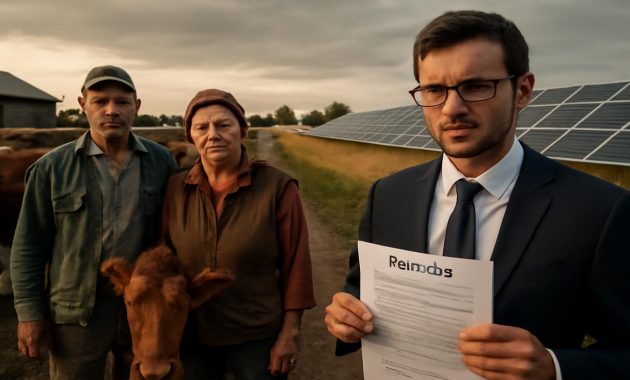
The first time Leo called it “ecocide,” his mother dropped the phone. It landed in a bowl of soaking pinto beans, the water rippling as if the word itself had weight. Out on the Oklahoma prairie, his parents’ 900-acre cattle ranch shimmered under a flat, pitiless sun, the grass brittle, pond levels drawn down like someone had pulled a plug. In Berlin, where Leo lived and pitched his oat milk start-up to venture capitalists and climate podcasts, his screen still showed the frozen frame of his mother’s shocked face, before the call cut off. The word hung there between them, across continents and generations: ecocide. A word big enough to break a family in half.
When the Soil Starts Keeping Secrets
The ranch had always smelled like Leo’s childhood: sun-baked hay, manure turned sweet by heat, diesel, and the faint iron tang of blood from the chute on shipping days. As a boy, he’d ridden shotgun in his father’s pickup at dawn, windows cracked open, watching mist lift off the stock ponds while NPR murmured in the background. Back then, the land felt eternal. The cattle—black Angus mostly—were just another wild element, like the wind.
But the land had been quietly keeping secrets. Rain came later each year, then not at all. Summer temperatures climbed, creeping past old records and then smashing them—105, 108, 111. Stock ponds shrank into muddy crescents. Grass got shorter, thinner, the soil revealing itself like ribs.
His parents, Hank and Marlene, were not climate deniers. They listened to the weather reports, complained about “this damn heat,” shook their heads at wildfire footage from other states. Hank had put in more shade structures and deeper wells. They had installed a few solar panels on the barn roof, mostly as a hedge against rising electricity costs. But at the core, the ranch stayed what it had always been: a place that turned grass into beef and beef into a living. It was their story, stitched into every fence post.
Leo’s story had forked somewhere along the old gravel driveway. He left for college, then climate science, then Berlin, where start-ups grew almost as fast as the summers stretched longer. Somewhere between a documentary screening on methane emissions and an internship with an NGO, he stopped being able to eat steak. Somewhere between his first oat latte and reading the IPCC’s reddest warnings, he stopped being able to think of his parents’ land as simply a home.
The Pitch That Started a War
The idea began, as these things so often do, on a napkin. It was winter in Berlin, the kind of gray afternoon when streetlights come on early and bicycle chains squeak in damp courtyards. Leo sat in a café where the milk options took up more menu space than the coffee beans. Oat. Soy. Almond. Pea. The barista rolled her eyes when someone dared whisper “cow.”
“You know,” his friend Maya said, tapping open a map on her laptop, “if we’re serious about scaling plant-based dairy, we can’t rely on tiny European farms. We need land. Big land. Sun. Space. Proximity to grain routes. The Midwest, the Plains… places like where you grew up.”
Leo laughed. Then he didn’t. By the time the café closed, he had a rough plan: transform his parents’ cattle operation into a vertically integrated, climate-positive, solar-powered oat milk empire. Fields of oats where cattle once grazed. A processing facility with a rooftop glinting silver-blue under a sea of photovoltaic panels. Batteries humming in the background. Tankers leaving the ranch not with live animals but with creamy, shelf-stable, organic oat milk labeled with a name he’d already trademarked.
He imagined his parents walking out to the back pasture and seeing acres of oats waving like water. He imagined his father driving the first electric tractor, grumbling at first, then secretly impressed. He imagined headlines about “A Family Farm’s Climate Redemption.” Investors, he knew, would eat it up.
“You realize,” Maya said, “that your biggest obstacle isn’t the grid or capital. It’s your dad.”
“I’ll convince them,” Leo replied, too quickly. “This is their shot at surviving what’s coming.”
The Offer on the Kitchen Table
The proposal arrived at the ranch in a thick, cream-colored envelope, heavier than a letter, lighter than a book. Inside was a carefully assembled pitch deck—printed, not digital, at his mother’s insistence. She liked things she could spread on the kitchen table, weigh down with a salt shaker.
They sat there under the buzzing fluorescent light: Hank with calloused, sun-baked hands; Marlene with her readers perched at the end of her nose; the windows open to catch whatever faint breeze might drift in off the pastures. On the cover: a rendering of their land from above, except the cattle were gone, replaced by glinting arrays of solar panels and neatly plotted oat fields. A logo in the corner: Prairie Oat Collective.
“He wants to turn the whole damn place into a cereal box,” Hank muttered, flipping through the pages. There were charts on methane emissions, water use, carbon sequestration. Projections of returns on investment, tax credits for renewable energy, government incentives for regenerative cropping. Photorealistic mockups of oat milk cartons with a stylized version of the ranch’s old cattle brand, repurposed into something like a sunburst.
In another envelope, there was the legal offer: a partnership structure giving them significant equity, lifetime housing on a preserved portion of the ranch, a generous cash payout to ease retirement, and jobs in the new operation if they wanted them. It was, by almost any business metric, a good deal.
But no spreadsheet had a column for the hum of flies over a summer stock tank. None of the graphs measured the sound of cattle lowing to their calves at dusk, or the flicker of their silhouettes moving like slow water against a setting sun.
“He’s saying our entire life’s work is a mistake,” Marlene said quietly, fingers pressed flat against the papers as if to stop them from blowing away.
“He’s saying we’re killing the planet,” Hank replied. He shoved the proposal away, the pages skidding across the table. “And now he wants us to help him plant the knife.”
From Family Feud to Climate Lawsuit
The calls after that grew brittle. At first, it was logistics—what would happen to the cows, the hands they employed, the neighbors whose ranches shared fence lines. But quickly, it became about belief, identity, blame.
“Dad, cattle are one of the biggest sources of methane. You know that. You see the weather. You’ve felt the droughts,” Leo would say, voice tight, maps and studies open on his laptop just out of frame.
“Son, we’re not some Brazilian outfit burning down rainforest,” Hank would reply. “We graze on grass that would just sit there otherwise. We’ve improved this land. Your granddad busted his back to keep it alive through worse than this.”
“It’s not just about you,” Leo countered. “It’s about systems. We can be part of the solution. You could be a model for transitioning away from carbon-intensive agriculture.”
“You want me to tell my neighbors I’m shuttering the herd to sell oat juice? They’d run me out of town. This isn’t Berlin, Leo.”
The word “ecocide” entered the conversation on a stormy night, static crackling in the phone line. Leo had just come from a conference where lawyers and activists were pushing to recognize ecocide—mass damage and destruction of ecosystems—as an international crime, alongside genocide and crimes against humanity. The concept electrified him. It named what he felt when he looked at climate graphs, at satellite images of shrinking lakes, at aerial shots of feedlots.
“Dad, continuing to raise cattle like this, at this scale, in this climate reality—it’s ecocide,” he said. “I’m not saying you’re a criminal. I’m saying the system is. And we have a chance to walk away from it.”
The silence on the other end was long and cooled his cheeks. “You watch your words, boy,” Hank said finally, voice quieter than a slammed door and far more dangerous. “You call what I do criminal again, and we’ve got more than a disagreement.”
Weeks later, when no compromise emerged, when they rejected not just the first offer but revised versions, Leo sent another envelope. This one smaller, meaner. It contained legal notice: he was suing them.
Ecocide Comes to the Courthouse
The lawsuit made headlines before it made sense. “Climate War on the Prairie,” one outlet called it. “Vegan Entrepreneur Sues Cattle-Farming Parents for Ecocide,” blared another, the word “ecocide” in grim, bold type. Talk shows debated it. Social media did what it does: memes of cows in sunglasses saying “See you in court,” fake oat milk brand names like “Betrayal Brew.”
At its core, the case was a kind of legal experiment. Ecocide was not yet a fully recognized crime in most jurisdictions, and certainly not in the rural county where the ranch lay. Leo’s lawyers argued that in light of overwhelming scientific consensus on climate change, continuing to expand or even maintain large-scale methane-emitting operations—when viable, less harmful alternatives existed—amounted to reckless harm to the ecosystem. And not just any ecosystem: one they, as a family, co-owned through an inheritance structure set up years ago.
He wasn’t just any activist, they noted. He was a stakeholder with a legal interest in the land, asserting that his co-owners were damaging a shared asset and contributing to a global crisis. The suit framed his proposal—not as a frivolous start-up dream—but as a mitigation plan reasonably aligned with emerging climate obligations.
His parents’ lawyers countered that ranching was not only legal but heavily subsidized and socially sanctioned. They pointed out that any policy tools punishing or redirecting such practices should come from legislatures, not from the strained bonds of a single family. They raised the specter of a world where children could sue parents for not buying electric cars, for heating with gas, for not installing enough solar panels on the roof.
In the courthouse hallway, the fight played out in quieter ways. Neighbors avoided eye contact with Marlene at the grocery store. Reporters loitered near the coffee machine, waiting to catch even a strained half-smile between mother and son. There were none.
Outside, a small crowd gathered some days: animal-rights activists with “Cows Are Not Commodities” signs on one side; ranchers and local business owners with “Save Our Way of Life” banners on the other. In the middle, a few bewildered townspeople held cardboard reading, simply, “We Need Rain.”
Two Futures on One Piece of Land
What made the case so oddly mesmerizing was not just its tabloid-friendly drama but how clearly it framed the climate crossroads. On a single stretch of prairie, two futures wrestled for the same soil.
| Aspect | Cattle Ranch Future | Solar Oat Milk Future |
|---|---|---|
| Primary Product | Beef for regional and national markets | Oat milk and oat-based products |
| Emissions Profile | High methane and associated CO₂ | Lower lifecycle emissions, powered by solar |
| Water Use | Higher water demand via feed and livestock | Moderate irrigation, potential for efficiency |
| Local Identity | Aligned with ranching heritage | Seen as disruptive, tech-driven change |
| Economic Risk | Vulnerable to drought, feed prices, policy | Dependent on markets, subsidies, tech costs |
From a satellite’s view, the choice might look simple: reduce methane, harness sun, move calories more directly from plants to people. But from a kitchen table, the choice felt like treason.
At trial, expert witnesses rendered the impersonal science in careful, almost mournful tones. A climatologist spoke of how ruminant methane, though shorter-lived than CO₂, packed a fierce punch in the near term—precisely the years when humanity needed all the breathing room it could get. An agricultural economist laid out the shifting subsidies, the projections of declining beef consumption among younger demographics, the growing flood of plant-based alternatives.
Then came the softer testimonies: a neighbor who described learning to rope on Hank’s land; a former ranch hand who now worked in wind energy, torn between gratitude for his old job and conviction about his new one; a local diner owner who wondered aloud if oat milk customers would tip as well as truckers ordering burgers.
Love, Loyalty, and the Language of Crisis
Underneath the arguments about parts per million and projected returns lay something far older: the question of what we owe the people who raised us, and what we owe the world we will leave behind. Climate change had finally done what politics and religion had failed to accomplish on that ranch: it had torn the family script in two.
In his quieter moments, away from cameras, Leo knew he had crossed a line most children never do. Suing your parents is not a symbolic gesture; it’s a live grenade rolled into the center of a shared history. But he also knew—viscerally, as someone who had shapeshifted from ranch kid to climate entrepreneur—that soft persuasion had done almost nothing to bend the emissions curve. The numbers kept rising. Wildfires grew larger. Heat waves grew longer. Somewhere, coral reefs bleached white.
“You taught me to fix what I see is broken,” he told the court, voice wavering but steady enough. “When a fence is down, you don’t just curse the wind. You mend it. Climate change is the biggest busted fence there is. I’m not bringing this case because I hate my parents. I’m bringing it because I love them—and I want there to be a world left where what they built still means something.”
Hank, when it was his turn, gripped the rail with those same hands that had delivered calves in blizzards and buried old ranch dogs on the hill. “I’m not a scientist,” he said. “I see the weather’s gone strange. I see ponds lower than they should be. But I also see a boy who grew up here come back and tell us that everything we are is poison. That the only way to make it right is to kill the very thing that kept food on our table and sent him to college so he could sit here and judge us.
“If the world wants us to change how we ranch, then the world can make rules and help us shift. Don’t make my own son the executioner.”
The Verdict That Never Fully Arrives
No matter what the judge decided about this particular case, the deeper verdict felt suspended, like dust motes in hot air over the prairie. Courts can rule on contracts and damages. They can’t make the rain return. They can’t undo decades of fossil-fueled growth or rewild the oceans.
Yet this case—half legal experiment, half family tragedy—offered a glimpse of where the climate story is heading: into our living rooms, across our dinner tables, and, yes, into our wills and land deeds. As the planet warms, more children will look at the industries that raised them and see not just heritage but hazard. More parents will feel ambushed by new moral languages—“ecocide,” “carbon budget,” “degrowth”—that frame what once was pride as, at best, a problem to be solved.
There is no tidy ending here, no clever moral wrapped around a glass of oat milk. Perhaps the ranch becomes a pilot project in just transition, with a scaled-down herd and experimental oat plots sharing the land. Perhaps it remains stubbornly bovine until drought or policy or markets force a different reckoning. Perhaps, like many families at the edge of great changes, they simply drift: phone calls growing rarer, holidays more strained, each side convinced the other worships the wrong god—Profit, Tradition, Progress, Earth.
But somewhere between Berlin’s cafés and the Oklahoma dust, one reality persists: the atmosphere does not care whether emissions come wrapped in love or legacy. It does not tally who meant well. It only counts molecules.
And so, across the world, versions of this argument will replay—between rice farmers and their climate-conscious daughters, oil engineers and their activist sons, airline pilots and their grounded nieces. Some will sue. Some will protest. Some will simply leave.
On certain evenings, just before the sun drops behind the mesquite, the ranch still glows the way it did when Leo was ten: light dusting the backs of cattle, insects buzzing, the sky wide enough to swallow doubt. In those moments, it is easy to pretend that this land, and the way it’s used, could stay this way forever.
But listen a little longer, and under the lowing of cows and the creak of windmills you might hear something else: the faint imagined hum of solar inverters, the rustle of oat fields in a hotter wind, the hinge creak of a world deciding, painfully, what to keep—and what to let go.
Frequently Asked Questions
Is “ecocide” really a legal crime?
Ecocide is an emerging legal concept proposed as a serious international crime, like genocide, but it is not yet widely codified in national laws. Some countries are exploring or adopting versions of it, and international campaigns are pushing for its recognition, but in many places it remains more a moral and political term than a formal criminal charge.
Can a vegan entrepreneur realistically convert a cattle ranch into an oat milk business?
Yes, in principle. Large ranches often have the land, sun exposure, and water rights needed to grow oats or other crops and host solar infrastructure. However, the transition requires significant capital, changes in expertise, shifts in local supply chains, and social acceptance. It’s technically feasible but socially and economically complex.
Are cattle ranches always worse for the climate than plant-based farms?
Generally, ruminant livestock like cattle produce much higher greenhouse gas emissions per calorie of food than plant-based systems, especially via methane. That said, there are important nuances: grazing practices, land types, and regional conditions can influence impacts. Some well-managed grazing can support biodiversity and soil health, but overall, shifting diets toward plant-based foods reduces emissions.
Why would someone sue their own parents over climate issues?
For some, legal action becomes a last resort after years of failed persuasion, especially when shared assets like land are involved. Younger generations facing a rapidly warming world may see urgent systemic change as a moral obligation, even at the cost of personal relationships. Lawsuits like this dramatize that tension between family loyalty and planetary responsibility.
Could cases like this change how farms and ranches operate?
Indirectly, yes. Even if such lawsuits fail, they can influence public debate, investor decisions, and policy discussions. They spotlight the climate impacts of certain industries and push questions of transition, responsibility, and support for farmers into the open. Over time, that pressure can contribute to shifts in subsidies, regulations, and market demand.