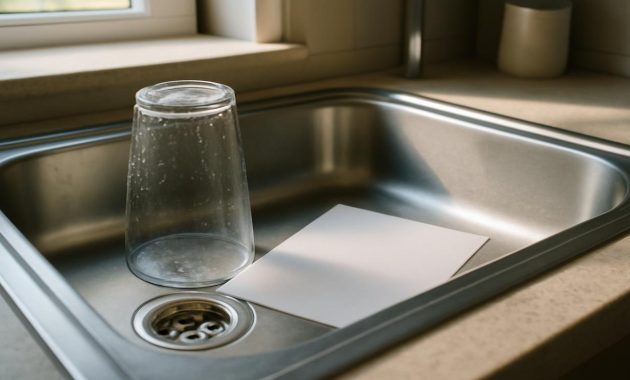
It started as a joke, really. One of those offhand lines you toss into a conversation and then promptly forget about—until it quietly rearranges your life. “When I leave the house,” my friend said, “I put a glass and a sheet of paper in the sink. It keeps me honest.” I laughed, nodded, moved on. But the image stayed with me: a lone glass, a single sheet of paper, waiting in a metal basin like a tiny, silent contract with yourself.
The next morning, on a day that promised nothing special, I tried it. I rinsed a clear drinking glass and set it in the deep side of the sink. Then I tore a sheet of paper from a notebook—lined, a little crinkled at the edges—and laid it beside the drain, flat and white. It looked silly. It looked almost ceremonial. Then I grabbed my keys, locked the door, and walked out into the sunlight.
The Quiet Psychology of a Glass in the Sink
By the time we leave our homes each day, we’ve already lived a dozen small lives: the groggy one who silences alarms, the hurried one who burns toast, the hopeful one who thinks, Tonight, I’ll come back to a clean place and cook something real. But then we get home, exhausted, hungry, scrolling our phones at red lights, cutting corners. That glass and sheet of paper in the sink? They’re not about tidiness. They’re a pause button.
Standing at the door that first day, I remember feeling a faint, odd resistance. I didn’t want to do it. Not because it was hard, but because it was intentional. A deliberate act before a chaotic day feels strange, like leaving a note to your future self in a language you’re not sure they’ll still understand: “Hey, I cared about you this morning. I hope you still care about you tonight.”
The glass was a promise of water I should drink before bed instead of collapsing dehydrated onto the couch. The paper was something else: a little, undefined space. I didn’t write anything on it—not yet—but the whiteness was loaded. Almost like a blank square of possibility I was placing in my own path. A reminder that there would be another chapter to this day, written later, by a slightly different version of me.
The Sink as a Stage: Why There, of All Places?
Every home has a stage where daily life gathers and clutters. For most of us, it’s the kitchen sink. It catches what we don’t want to look at: the hardened sauce, the coffee rings, the spoons that prove we said “just one more bite” three times. But it’s also where we wash, reset, and start over. It’s almost ritualistic: the sound of water, the steam, the squeak of sponge on plate.
Putting a glass and paper in the sink turns that stage into a kind of altar—simple, quiet, ordinary, but charged with intention. You’re not decorating for guests. You’re leaving a sign for the one person who will definitely come back: you. The sink is unavoidable. You will pass it. You will see it. You will hear the echo of your own decision waiting in the metal basin.
Think about how many habits fail because they’re tucked into hidden corners of our lives. Journals we keep in drawers. Yoga mats rolled behind couches. Phone reminders we swipe away. This habit sits in the one place nothing can avoid: the path to food, water, and comfort. Returning home, dropping bags, toeing off shoes, you look up—and there it is. The glass. The paper. The pact.
The Subtle Power of an Unfinished Action
In psychology, there’s a phenomenon called the Zeigarnik effect: we remember unfinished tasks more vividly than completed ones. Our minds hold onto the dangling threads. A glass and a sheet of paper in the sink are exactly that—a deliberately unfinished task. Not an emergency, not a burden, just an open loop.
Instead of nagging, it whispers: Notice me. You don’t need an app notification or a buzzing wrist. The half-done scene is enough. Over time, it gently tugs you toward a mini-ritual when you return home—one that can change the entire texture of your evening.
A Tiny Ritual with Surprising Ripples
The habit can be as literal or as symbolic as you want. For me, it grew into a three-part ritual that began in the morning and ended at night, bookending my day with something tangible and grounding.
Morning: I’d set the glass and paper in the sink before leaving, sometimes pausing just long enough to feel the coolness of the glass in my hand, notice the faint chemical scent of dish soap lingering at the edges. The kitchen light would be soft, the house still a little sleepy. It felt like closing a chapter rather than tumbling out the door mid-sentence.
Evening: The front door would thunk shut, the hallway light a little harsher, keys clattering in the tray. There’s always that moment right after you get home where time can go either way. You can dissolve into the couch or you can reclaim the day. That’s when I’d walk past the sink and see the glass and paper waiting.
I’d fill the glass with fresh water and drink it slowly, feeling the temperature slide down my throat, noticing how thirsty I actually was. Then I’d pick up the paper. Some days I’d write three things that went well. Other days, I’d scribble a few anxieties that had followed me home like insistent shadows. Occasionally, I didn’t write at all; I just crumpled the page up and started dinner, as if I were throwing away everything I didn’t want to carry into the night.
The magic wasn’t in what I wrote or even in the water itself. It was in the interruption. The signal that said: Before you disappear into autopilot, take one conscious breath. It’s astonishing how rare that is.
How a Glass and Paper Turn into a Story
Habits are essentially stories we tell ourselves with our bodies. “This is who I am.” “This is what I do when I’m tired.” “This is how I end my day.” Most of the time, those stories are driven by convenience, fatigue, old grooves we slide back into without question.
But when you place something tangible in your way—a glass, a page—you introduce a new line to the script. You invite a different story. Maybe in your story, you’re someone who always decompresses with a few deep breaths and a tall glass of water. Or someone who never lets a day end without noticing one beautiful, fleeting thing. Or someone who uses a single page as a gentle boundary between work and rest.
Over time, these stories accumulate. The pile of crumpled papers in the recycling bin. The faint water lines on your favorite glass. The way your hands begin to reach for the sink almost automatically when you walk in the door. This is how identity actually shifts: one small, repeated scene at a time.
Designing Your Own Simple but Smart Sink Ritual
You don’t have to copy my exact routine. The core idea is beautifully simple: before you leave the house, set a tiny, visible, unfinished action in the sink that your future self will complete on your return. That’s it. But what that action means—that’s yours to decide.
Here are a few ways people quietly turn this little habit into something personally meaningful:
- The Hydration Cue: The glass is for water, and the paper holds a simple one-line reflection before bed. A prompt, a pause, a drink.
- The Gratitude Anchor: Every night, write three small things that went well on the paper before you wash the glass. The paper becomes a soft landing for the day.
- The Brain Dump: Use the paper to unload worries, to-dos, and mental clutter. When you’re done, fold it, save it, or tear it up—whatever feels most freeing.
- The Creative Spark: Commit to jotting down one sentence of a story, a poem line, or a random idea. Over weeks, the sink becomes an odd little well of creativity.
- The Reset Button: The glass and paper signal a 5-minute reset routine: wash the breakfast dishes, wipe the counter, put on calm music. Nothing heroic—just a micro-reset.
To make the habit stick, keep it friction-free. Choose a glass you like to hold. Keep a small stack of paper near the sink. Don’t turn it into a perfectionist trap where “missing one day” means you’ve “failed.” This is not another productivity hack to optimize your life; it’s a gentle practice for reclaiming a sliver of it.
A Tiny Table of Tiny Habits
Here’s a simple comparison of how different people might adapt the same ritual to their own needs. On a small screen, each row is a neat little story of its own.
| Type of Person | Meaning of the Glass | Use of the Paper | Evening Outcome |
|---|---|---|---|
| The Overworked Professional | Pause and rehydrate before checking emails | Write one line about how the day felt, not what got done | Creates a boundary between work brain and home brain |
| The Parent in a Rush | A calm sip between “we’re late” and bedtime chaos | Jot one funny thing the kids said that day | A tiny archive of joy collected in the margins |
| The Creative Soul | A grounding ritual before opening the notebook or guitar case | Capture one image, metaphor, or lyric fragment | Slowly builds a bank of raw material for future work |
| The Anxious Mind | A moment to feel the body: cool glass, cold water, steady breaths | List today’s top three worries, then fold or tear the page | Teaches the nervous system a small, reliable way to let go |
What the Senses Remember
Modern life pulls us relentlessly into screens and abstractions. We live in calendars and notifications, in numbers and graphs. But the body still remembers the world in textures and temperatures, in sounds and weights. That’s part of what makes this habit unexpectedly grounding: it is stubbornly, charmingly physical.
The cool tap of the glass against the metal sink. The dry, faintly rough drag of paper under your fingers. The hush of water as it fills, the soft, hollow echo in the basin. The slight bend of your spine as you lean over, the smell of whatever soap you used that morning lingering in the air. These are not heroic moments. They’re so small that most days would swallow them whole if you didn’t choose to notice them.
But any ritual, no matter how humble, is really an invitation to pay attention. And attention is how ordinary days become something like a story worth living in.
The House That Feels a Little More Like a Home
Over weeks and months, a tiny habit like this has a way of subtly rearranging the atmosphere of your home. Not in a big, cinematic way, but in the gentle shift of what your space whispers when you walk in the door.
Instead of greeting you with the scattered leftovers of the morning—an unmade bed, a half-drunk coffee cup, a phone charger snake across the floor—the house greets you with a question disguised as an object: What kind of evening do you want this to be?
Sometimes, the answer is honestly “a sofa and a mindless show.” That’s fine. The glass gets rinsed, the paper lands in the bin, and you move on. But other nights, the ritual becomes the first stone in a quiet path: you drink the water, write a line, wash a pan, pull out something simple to cook. You put on music instead of television. Maybe you step onto the balcony or porch for two minutes and notice the sky. That’s it. Nothing Instagrammable. Just a house settling into itself around a person who is also, slowly, settling into themselves.
When Simple Is Smarter Than Grand
We are trained to think change must be dramatic to matter—new planners, big resolutions, color-coded systems. And yet, those flashy beginnings often fade under the weight of their own expectations. The glass-and-paper habit is the opposite: it’s almost embarrassingly small. It looks like nothing. It feels like nothing. But done often enough, it becomes a subtle lever, nudging the entire shape of your evenings.
It is smart not because it optimizes anything, but because it respects how humans actually work. We’re forgetful. We’re tired. We’re easily distracted. We respond to what’s in front of our eyes more than what’s written in our long-term goals. A glass and a sheet of paper in the sink don’t demand that you become a better person. They just wait. Patiently. Every time.
Someday, someone else might step into your kitchen at the end of a long day and notice that quiet little scene. They might ask, half-curious, half-amused, “Why do you always leave a glass and a piece of paper in your sink?”
And you may shrug, trying to explain something that is more felt than spoken. How it started as a silly trick, a friend’s throwaway comment. How it slowly became a ritual that doesn’t fix your life, but gently reminds you that it’s yours. How it’s one of the few promises you keep to yourself even on the days when everything else slides.
You might simply say, “It helps me come home.”
FAQ
Is there any “right” way to use the glass and paper?
No. The beauty of this habit is its flexibility. The glass and paper are just anchors. You can use them for water and a quick reflection, a gratitude list, a brain dump, or even a creative idea. What matters is that you see them when you return and complete some small, intentional action.
Do I have to do it every single day for it to work?
Not at all. This is not an all-or-nothing system. If you do it most days, it will still create a gentle rhythm in your life. Skipping occasional days doesn’t erase the benefits; it simply means you pick it back up the next time you leave the house.
What if I live with other people who use the sink?
You can either let them in on the ritual or quietly claim a small corner of the sink as your spot. If the glass or paper gets moved, it’s not a disaster. The habit is about your intention, not rigid control of the space.
Can I adapt this if I don’t have a traditional kitchen sink?
Yes. The “sink” is really just a visible, unavoidable place you pass when you come home. A bathroom counter, an entryway table, or a specific shelf can serve the same purpose, as long as you see it every time you return.
How long does it take before this feels natural?
For most people, a couple of weeks of gentle consistency is enough for it to stop feeling odd and start feeling like a quiet part of the day. You may notice that your body begins to “remember” the ritual before your mind does—your hands drift toward the glass and paper almost automatically.
Is this just another productivity trick in disguise?
It doesn’t have to be. You can certainly harness it to support focus, creativity, or better evenings, but at its heart, this habit is more about presence than productivity. It’s a way of saying, “I will meet myself at the end of the day,” and giving that meeting a physical shape.