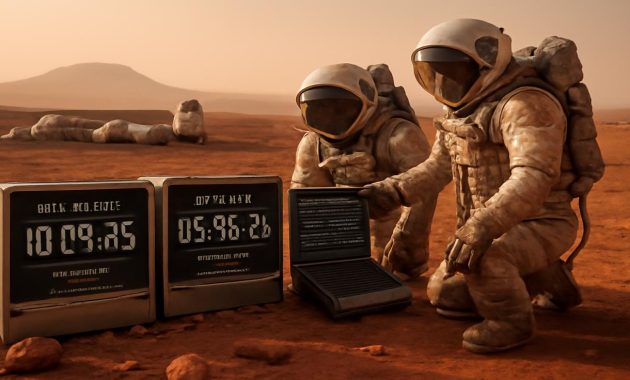
The first time you really notice that time is different on Mars isn’t when a clock tells you. It’s when the sky lies to you. The Sun is hanging low and swollen over the rusty horizon, the dust of another Martian evening curling upward like breath in cold air. Your body says it has been a long day. Your watch—carefully set to “Mars time” before you left Earth—disagrees. You are out of sync with the world beneath your boots. And strangely, so is the world itself.
When Einstein’s Thought Experiment Lands on a Real Planet
Albert Einstein never saw Mars with his own eyes. He never watched a sunrise over Olympus Mons or followed the crawl of a rover through a maze of boulders. Yet his equations have been quietly waiting here for more than a century, scribbled into the fabric of space-time long before steel and silicon ever reached the Red Planet.
In his theory of general relativity, Einstein proposed something that sounded almost mystical at the time: gravity bends not only light and space, but time itself. A clock closer to a massive object should tick more slowly than one farther away. Time, in other words, is elastic. It stretches and shrinks depending on where you stand in the universe.
For decades, this stayed in the realm of thought experiments and clever laboratory tests. We saw its fingerprints in the way starlight curved around the Sun during eclipses, or how GPS satellites had to be constantly corrected so our phones would not lead us astray. But now, with instruments humming on a dry and ancient planet tens of millions of kilometers away, Einstein’s prediction has stepped into the dust and red light of a real alien world.
Mars, it turns out, doesn’t just look different. It keeps time differently, too.
The Subtle Strange Rhythm of a Martian Day
On Earth, we live by a number that has become invisible from sheer familiarity: 24 hours. Our stories, our work, our sleep, our memories—everything is pegged to that clean, comforting loop of spin and sunrise. Mars, however, spins to its own slightly offbeat rhythm. A Martian day, or “sol,” is about 24 hours, 39 minutes, and 35 seconds long.
Those 39 extra minutes seem trivial, like a tiny smudge at the edge of a perfect circle. But on a human body, and on a mission schedule measured in seconds and watts of power, they add up quickly. After just a few days on “Mars time,” your midnight will have slipped two or three hours away from everyone on Earth. A week later, your workday starts in your personal pre-dawn. A month later, you are living at what feels like permanent jet lag, but with a planet as your time zone.
NASA engineers and scientists discovered this in a surprisingly visceral way. During early Mars rover missions, many operations teams on Earth shifted their lives to track the rover’s local solar time. Families put black-out curtains over windows. People ate dinner at what their neighborhood called breakfast. Mission calendars printed “sol numbers” instead of weekdays. The planet’s oddly stretched days tugged at their circadian rhythms like a slow, invisible tide.
And yet, the length of the sol is only one layer of strangeness. The deeper, quieter story lies in how Mars’s gravity and position in the solar system actually warp the flow of time itself—exactly as Einstein said they should.
The Gravity of a Red World
Compared to Earth, Mars is a lightweight: roughly half our diameter and just over a tenth of our mass. Stand on its surface, and you feel only about 38% of Earth’s gravity. Your steps are lighter. Dust hangs in the air longer. Rocks that seem too massive to move suddenly shift under your arms like awkward furniture.
But gravity isn’t just something you feel in your muscles—it’s something your clock feels in its pulse. According to Einstein, weaker gravity means time flows slightly faster. On the surface of Mars, where the gravity well is shallower than Earth’s, time is literally racing ahead—barely, subtly, but measurably.
Now add the fact that Mars orbits the Sun farther out than Earth. That greater distance places it slightly higher up the Sun’s gravitational well. Between the Sun’s diminished tug and Mars’s own lower mass, the combined effect is that a clock on Mars runs just a bit quicker than a clock on Earth, even if both are ticking in what we might call “seconds.”
For everyday life, those differences are microscopic. You wouldn’t watch a Martian sunset and suddenly feel the seconds stretching like taffy. But to the instruments we use to navigate spacecraft, sync orbiters, and coordinate rovers on the ground, the difference is real—so real that it can’t be ignored anymore.
How Mars Confirmed Einstein, One Tick at a Time
The proof didn’t arrive as a dramatic revelation beamed across the void. It came slowly, nested in the data of orbiters and landers and the disciplined patience of teams who spend their careers chasing tiny errors.
Ultra-precise clocks on spacecraft—so-called atomic clocks—are accurate enough that, over the span of a mission, even the faintest relativistic effects become visible. When orbiters circle Mars, their speeds, their altitudes, and their distance from the Sun and from Mars itself all affect how quickly time passes for their onboard clocks compared with clocks on Earth.
Navigation teams already use relativity to keep spacecraft where they’re supposed to be. Without these corrections, a probe could drift hundreds of kilometers off-course over time, like a car whose steering is misaligned. But as instruments have become more sensitive, and as multiple orbiters and landers must work together with millisecond precision, the fine print of Einstein’s equations has moved from “theoretical correction” to “daily operational concern.”
What Mars has given us is a field test: a whole world where Einstein’s rules quietly run the show. By watching how signals travel between orbiters and ground stations, how clocks drift relative to one another, and how navigation solutions line up with the landscape they see, mission planners have effectively confirmed—again, and with stunning clarity—that time’s flow on Mars is not a clone of Earth’s.
On paper, the change is measured in billionths of a second. In practice, it may define how future explorers live, work, and even sleep on the Red Planet.
When Your Calendar Must Choose a Planet
The next time humans go to Mars, they won’t just be crossing distance. They’ll be crossing a boundary between two subtly diverging timelines.
The first major choice will be philosophical as much as practical: whose time gets to be “official”? Does a future Mars base live by Earth’s clock—keeping 24-hour days, forcing local sunrise and sunset to drift across the schedule like slow-moving calendars? Or do they surrender to the Martian sol, letting their watches match the sky, but slowly drift out of sync with mission control back home?
Mission designers are already sketching systems that can handle both. They imagine “dual time” interfaces, where every event is stamped with Earth Coordinated Universal Time (UTC) and a local Mars standard—perhaps called Mars Coordinated Time (MTC), built around the planet’s prime meridian near the crater Airy-0. Some devices might carry triple time: Earth, Mars, and relativistic corrections for the specific altitude or orbit.
For early crews, this may feel a bit like living in a border town where two countries share a street. You glance at a wall clock: it says 15:30 MTC. Your tablet says 13:50 UTC. A message pops in: a call from Earth scheduled at “evening” for Houston, which might be Martian midnight where you stand. Over months and years, the slight relativistic offset in how quickly time runs could start to matter too—especially for automated systems that need exquisite timing.
That’s where timekeeping gets less romantic and far more unforgiving.
| Time Feature | Earth | Mars |
|---|---|---|
| Length of Day | 24 hours | ~24 hours 39 minutes 35 seconds (1 sol) |
| Gravity at Surface | 9.81 m/s² | 3.71 m/s² |
| Orbital Distance from Sun (average) | ~150 million km | ~228 million km |
| Relativistic Time Flow | Slightly slower (stronger gravity, closer to Sun) | Slightly faster (weaker gravity, farther from Sun) |
| Local “Civil Time” | UTC-based, globally standardized | Multiple proposed Mars time zones, not yet standardized |
The Future Missions That Must Bend with Time
Imagine it is a few decades from now. Mars isn’t just a barren outpost with a single habitat—there are small networks of research stations scattered like cautious footprints around the equator. Orbiters swarm overhead, relaying data and monitoring weather. Robotic cargo landers arrive seasons before each new crew, dropping life-support modules and supplies onto pre-selected plains.
Every one of those machines relies on precise timing to survive. Entry, descent, and landing sequences are choreographed down to fractions of a second: heat shield jettisoned here, parachute deployed there, retro-rockets fired at exactly this altitude and velocity. The higher the stakes—the heavier the cargo, the more fragile the human lives at the far end—the less tolerance there is for drifting clocks.
So future Mars missions will likely orbit around a new kind of infrastructure: a planet-wide time network, not unlike the role GPS plays on Earth. Instead of a few dozen navigation satellites above our heads, Mars might host a sparse constellation of “time beacons,” each carrying ultra-stable clocks. Orbiters and surface habitats would sync to these beacons, while ground-based clocks correct for tiny relativistic differences due to altitude or motion.
As explorers fan out—establishing bases at different elevations, from deep craters to high plateaus—the relativistic tapestry becomes even more complex. Time at the bottom of Valles Marineris, Mars’s immense canyon, would flow ever so slightly slower than time on a summit near Olympus Mons. The difference is so minute that a human could never perceive it, but an autonomous drilling rig, a survey drone, and a remote surgical robot might care very much.
And it won’t just be the machines that adapt. Humans, too, will feel the tug-of-war between clocks.
Living Inside Elastic Time
Close your eyes and picture life in a Martian habitat. Air recyclers murmur behind the walls. Dust freckles the windows. A low Sun pours long shadows across the regolith outside. An overhead screen quietly lists environmental data: pressure, oxygen levels, outside temperature—and local time, counted in sols and fractional sols.
Your days might be scheduled in “sol segments” instead of hours: 0.00–0.33 for sleep, 0.33–0.50 for morning routines, 0.50–0.75 for field work, and so on. The human brain can adapt, but it will always carry the ghost of Earth’s 24-hour rhythm. Doctors working with Mars crews are already thinking about what those extra 39 minutes mean for long-term health. Will some people thrive, their inner clocks delighted by the slight extension? Will others struggle with chronic fatigue, their bodies never quite catching the rhythm of a world that runs just off-beat?
Layered on top of that is the subtle, almost poetic knowledge that your aging itself is out of sync with those back home. Technically, living on Mars with its weaker gravity and greater distance from the Sun means you experience time a tiny bit faster than your twin on Earth. Over a lifetime, the difference amounts to microseconds—a sliver of a blink—but the symbolism is hard to ignore. To live on Mars is to slide, however gently, onto a slightly different temporal track than the one you were born into.
For future Mars-born generations, this won’t feel strange. Their holidays and anniversaries will tick by in sols. Their childhood stories will be framed by dust storms and polar seasons, not Earth’s months and school years. When they talk to someone on Earth, they’ll be speaking across not only distance and delay, but across subtly different flows of time.
Rewriting Our Relationship with Time and Place
When you step back, something remarkable comes into focus. For the first time in human history, we are designing civilizations—however small—in places where time does not quite match the home that shaped us. The clocks are forcing us to see what was always mathematically true but easy to ignore: time is not universal. It is local. It is stitched into gravity, motion, and landscape.
Einstein saw this from his desk, turning thought experiments into equations over a century ago. Mars is now turning those equations back into lived experience. Missions must bake relativistic corrections into their software. Engineers must choose which planet’s seconds to prioritize. Psychologists must ponder the effect of living where days do not line up with the sky you grew up under. Philosophers will surely step in, wondering what it means for human identity when “now” depends on which world you are standing on.
In the end, Mars is not only stretching our rockets or our budgets. It is stretching our intuition. It is reminding us, gently but firmly, that our tidy human inventions—hours, days, calendars—are just local agreements with one particular world. Change the world, and the agreement must be renegotiated.
Somewhere, in that thin Martian air, the ghost of Einstein’s smile might be hiding. He predicted a universe where time bends, twists, and dances to the tune of gravity. Now, far from the patent office where those ideas were born, a red planet is confirming the dance step by step, tick by tick.
And the future explorers of Mars, waking up in habitats dusted with ancient sand, will do more than acknowledge it. They will live inside it. Their watches, their work, their very sense of a day well spent will be shaped by the simple, profound truth that on Mars, time itself runs differently—and that to belong there, we must learn to follow its rhythm.
Frequently Asked Questions
Does time really move faster on Mars than on Earth?
Yes, but only by an extremely tiny amount. Because Mars has weaker surface gravity and is farther from the Sun, general relativity predicts that time there flows slightly faster than on Earth. The difference is measurable with precise instruments but far too small for a human to notice directly.
Is the longer Martian day the same thing as relativistic time dilation?
No. The longer Martian “sol” (about 24 hours 39 minutes) is simply due to how long Mars takes to complete one rotation. Relativistic effects are separate; they change how fast clocks run because of gravity and motion, not how long a planet takes to spin.
How will astronauts keep time on Mars?
Future crews will likely use a dual system: a local Martian time standard based on the sol for daily life and operations, and Earth-based Coordinated Universal Time (UTC) for communication and coordination with mission control. Systems will also include relativistic corrections for precision navigation and synchronization.
Will people on Mars age differently than people on Earth?
Technically yes, but the effect is incredibly small. Because time flows very slightly faster on Mars, a person living there would age a few microseconds more over many years compared to an identical twin on Earth. Biologically, this difference is meaningless; it’s mainly of scientific and philosophical interest.
Why do future Mars missions need to “adapt” to different time flow?
As missions become more complex, timing errors of even microseconds can affect navigation, data synchronization, and automated landing or docking procedures. Future Mars infrastructure—like communication networks, habitats, and robotic systems—must account for both the longer sol and the relativistic differences in time flow to operate safely and efficiently.