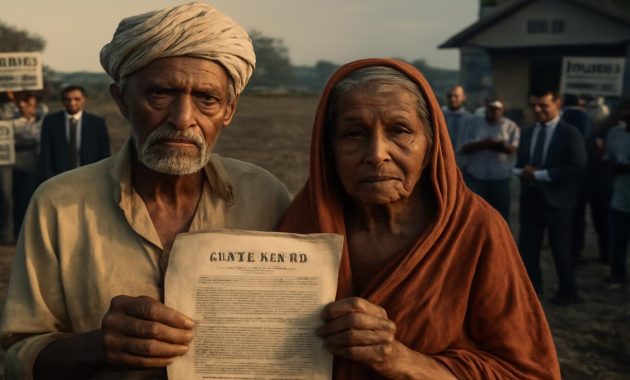
By the time the auctioneer cleared his throat, the sun had already turned the village square into a sheet of white fire. Dust rose in slow, lazy spirals as men shifted on their plastic chairs, sandals scraping the baked earth. Near the neem tree at the edge of the crowd, an old man in a crumpled white dhoti pressed his palm against the rough bark as if to steady himself — or maybe to keep from falling apart. Beside him, his wife clutched the end of her faded sari so tightly her knuckles blanched. On a wooden board nailed to the tree, someone had pinned a notice: the ancestral land of Ramprasad and Meera Devi, 3.2 acres, to be repossessed and sold.
The Day the Earth Slipped Away
The land lay just beyond the banyan-lined road, a patchwork of browns and a surprising green, like a tired but stubborn old quilt. For generations, this soil had carried the family: it was where their fathers and grandfathers had coaxed grain from dust, buried their dead, and celebrated their harvests. The boundaries weren’t marked by GPS coordinates, but by memory and story: “From that mango tree to where the canal bends, that’s ours,” Ramprasad used to tell his grandchildren.
On the morning the bank officials first came, the fields had been knee-deep in mustard, yellow flowers quivering in the winter breeze. Meera remembers the sound of their shoes first — city shoes, hard and urgent, not the soft shuffle of village chappals. She had looked up from cutting fodder to see a white SUV nosing its way into the narrow mud lane, nervous and too clean for this dusty geography.
Inside the house, papers were spread out on the charpoy: stamped forms, loan agreements, notices with red seals. The bank manager, sweating under his well-cut shirt, had worn an expression of professional regret. “Aunty-ji, we have given you so much time,” he said, not quite meeting her eyes. “We cannot help it now. It is policy. It is the law.”
For Ramprasad, who had never signed his name in English and still pressed his thumb to official documents, “the law” used to mean the panchayat elders under the tamarind tree. Now, the law had become something mailed from a city, written in paragraphs too dense for his calloused fingers to untangle. The micro-loan that had once seemed like a lifeline — a modest sum to buy seeds, a second-hand pump, and repay an older debt — had swollen into a monster he no longer recognized.
“We missed two payments during the drought,” he would later say, as if confessing to a crime. “The canal came dry. The tubewell failed. How do you pay the bank when even the sky closes its fist?”
The Smallest Loans, the Heaviest Chains
In policy documents and conference halls, the story of India’s micro-loans is often told as a triumph: tiny amounts of credit unlocking entrepreneurial dreams, empowering women, greening the countryside with prosperity. But down at the level of cracked mud and blistered palms, the story sounds different.
For families like Ramprasad and Meera, the micro-loan was less an invitation to dream, and more a desperate patch on an already torn life. The first loan had come a decade earlier, offered by a smiling field officer who promised, “Bas thoda sa interest hai, uncle. You’ll be free in no time.” It had seemed almost friendly. Repayment schedules, compounding interest, and penalty clauses hid in the folds of language they did not fully understand.
Over the years, crop failures, a medical emergency when their eldest son broke his leg in a tractor accident, and a niece’s wedding had all demanded money. Each time, a new loan paper, a reshuffling of numbers, a signature for a future that seemed distant and abstract. Their land — “just as formality” the officer had said — was pledged as collateral.
When the rains failed two years in a row, nothing remained abstract. Yields shrank. Prices dipped. And suddenly, the gentle tone at the branch office hardened into reminders, then warnings. “If you can buy a mobile for your grandson, why not pay your installments?” a junior officer snapped once. Meera had swallowed her pride and sold her gold nose ring; it paid only the accumulated interest.
By the time the legal notice arrived by registered post, the couple had already sold their two buffaloes, mortgaged Meera’s last pair of bangles, and borrowed from relatives who themselves were tied to smaller, quieter debts. Yet the numbers on the paper — the outstanding amount — kept growing, like a creeping shadow that fattened at their expense.
A Case That Reached Beyond the Village
When the dispute finally reached the court, it slipped out of the village’s dusty lanes and into a realm of air-conditioned corridors and polished floors. For the court, it was one more case in an endless stream of loan default disputes; for Ramprasad and Meera, it was the thin line between survival and erasure.
A local activist convinced a city-based lawyer to take on the case, framing it not just as a matter of debt, but of rights — the right of small farmers to fair treatment, to transparent contracts, to protection from what he called “predatory micro-finance practices.” At the heart of the argument was a single question: When an elderly couple with limited literacy signs a complex loan agreement, how meaningful is that consent? And what responsibility does the bank bear when climate, market volatility, and medical emergencies collide to trap them?
The courtroom air was cool, smelling faintly of floor disinfectant and old files. Ramprasad, sweating in his best kurta, struggled to follow the rapid-fire exchanges in English and clipped Hindi. Words like “non-performing asset,” “secured debt,” and “contractual obligation” flew over his head like a flock of birds he could neither name nor catch.
The bank’s lawyer, tall and precise, argued that the institution had followed every rule to the letter. “My Lords, the respondents were given ample notice, multiple restructuring opportunities, and clear explanations of the terms. A loan is not charity. If we begin to excuse non-repayment at this scale, the entire agricultural credit system will collapse. The bank also has duties — to its depositors, to its shareholders, to the integrity of the market.”
The farmers’ counsel spoke of history, of unequal power, of institutional insensitivity. “We cannot treat a multinational bank and a semi-literate elderly farmer as equal parties in a contract,” he said. “When the playing field is this uneven, insisting on the sanctity of paper alone is an injustice wearing legal robes.”
Outside, news channels pounced on the story. An image of the frail couple standing before the imposing courthouse gates became viral, floating across social media with captions that alternately mourned, mocked, and politicized their fate. Suddenly, this small patch of land in a forgotten district was no longer just a field; it had become a battleground in a national argument over what justice should look like in an India racing toward modernity while its farmers sink deeper into debt.
The Verdict That Split a Nation
On the day the judgment was delivered, the courtroom was fuller than usual. Students, activists, journalists, and a few curious lawyers from other benches squeezed into the wooden pews. Outside, beat reporters rehearsed their live segments: “A landmark judgment today that could have far-reaching consequences for rural credit…”
The judge’s voice was calm, almost gentle, as he read from the order. The court, he said, recognized the hardship faced by the couple. It acknowledged the asymmetry in knowledge and resources between rural borrowers and formal financial institutions. But, he continued, the contracts had been lawfully executed. Procedures had been followed. Notices sent. Time given. The bank, therefore, was within its rights to seize and auction the land to recover dues.
The ruling, in essence, sided with the bank.
“We cannot rewrite contracts on the basis of sympathy,” the judgment read. “To do so would undermine the stability of the credit system that sustains not just farmers, but the entire economy.” The court advised the government to consider policy measures and relief schemes for vulnerable farmers, but it refused to convert an individual dispute into a systemic exemption.
Within hours, television debates erupted. One panel called it a “painful but necessary affirmation of financial discipline”; another a “judicial blind spot that privileges paper over people.” On one side were economists, bankers, and urban professionals who argued that without strict enforcement, no lending ecosystem could survive — and that disciplined repayment is what differentiates a functional economy from chaos.
On the other were farmer unions, rural activists, and social scientists who saw the verdict as proof that the system was stacked against the poorest. “We socialize the losses of corporations and privatize the risks of farmers,” an economist tweeted, pointing to loan write-offs for big defaulters contrasted against the ruthless pursuit of tiny rural debts.
In WhatsApp groups and tea shops, in faculty lounges and roadside dhabas, people picked their sides. Was the court simply doing its job by interpreting the law as written? Or had it missed a chance to expand what justice means in a country where land is not just property, but identity, memory, and often the only buffer between a family and hunger?
More Than Numbers: What the Land Meant
Back in the village, the debate felt distant and oddly sterile. For Ramprasad and Meera, the verdict wasn’t a policy signal or a legal precedent; it was the moment their entire life lurched out of orbit.
On the evening after the ruling, they walked their fields one last time. The soil, still warm underfoot, crumbled between their toes. The irrigation channel, choked with algae, glinted faintly in the fading light. A pair of mynas quarreled in the peepal tree where their children had once built makeshift swings from jute rope.
“This is where your father taught you to sow in straight lines,” Meera whispered, more to herself than to anyone else. “Here is where we buried the placenta of our firstborn, so his life would always be tied to this earth.” In many parts of rural India, land carries not just economic weight but spiritual and emotional gravity. It is where rituals are anchored, where seasons are measured, where time itself feels stitched to the turning of the soil.
To the bank, the land was an asset, a line on a balance sheet. To the court, it was collateral securing a contract. To the couple, it was the floor beneath their memories. Losing it felt like being uprooted from themselves.
As neighbours drifted by, some offered murmured condolences, others awkward silence. A few, privately, wondered if the couple hadn’t been “careless” — if they had taken too many loans, trusted too easily, failed to keep up with the times. But most simply understood, in the quiet way of people who live close to the edge, that drought, illness, and interest can turn anyone’s life inside out.
How a “Micro” Loan Grows Into a Landslide
The story of this elderly couple is painfully specific, yet it also maps onto a wider, repeating pattern. Across India’s vast rural landscape, millions of small and marginal farmers balance their lives on the thin ledge between subsistence and collapse, often propped up by micro-loans that are meant to help, but can swiftly end up hurting.
Part of the tragedy lies in the arithmetic of vulnerability. When a farmer with two or three acres borrows a small sum, there is little room for error. A single failed monsoon, a pest attack, or a medical emergency can disrupt the fragile calculation that assumed good weather, stable prices, and perfect health. Interest doesn’t wait for rain. Penalties don’t pause for healing bones.
The loans themselves are structured around regular, rigid repayments — monthly or even weekly — a rhythm that makes sense in urban micro-enterprises where cash flows daily, but clashes with agriculture’s seasonal heartbeat. A harvest comes once or twice a year; the debt knocks on the door twelve times.
To make sense of how tiny debts can swell, imagine a typical micro-loan timeline for a small farmer:
| Stage | Farmer’s Reality | On Paper |
|---|---|---|
| Initial Loan | Need seeds, fertilizer, maybe repay an older debt | Small principal, “affordable” interest |
| First Setback | Drought or illness cuts income; one or two payments missed | Penalties added, interest continues to accrue |
| Restructuring | Farmer breathes easier briefly, but new terms are longer, costlier | Old dues rolled into new loan, higher effective burden |
| Second Shock | Another bad season, or a wedding, or hospital bills | Account tagged “risky” or “non-performing” |
| Enforcement | House visits, public pressure, fear and shame grow | Legal notices, recovery proceedings begin |
From a distance, the system can look efficient, even fair: terms are mentioned, signatures taken, procedures followed. Up close, you can smell the fear in a farmer’s sweat as an officer flips through a ledger on his verandah, hear the faltering voice of an old man trying to explain why the monsoon’s betrayal should count for something in the bank’s arithmetic.
It is here, in this gap between legal form and lived experience, that the nation finds itself divided.
Whose Responsibility Is This Harvest of Sorrow?
The court’s ruling did one thing clearly: it placed the weight of responsibility for repayment squarely back on the farmer’s shoulders. But outside the strict lines of legal interpretation, the question refuses to sit still. Who, really, owns this failure?
Is it the couple who signed what they did not fully understand? The bank officer who glossed over the harsher clauses to meet his targets? The policymakers who pushed micro-credit without building robust safety nets against climate shocks? Or all of us, who enjoy cheap food and urban comforts while the people who grow that food absorb the volatility of weather, markets, and policy?
In the days after the land auction, commentators tried to make sense of the larger picture. Some argued that without strong enforcement, banks would withdraw from rural lending altogether, pushing farmers back into the arms of informal moneylenders who charge far higher interest and wield even crueler methods. Others countered that “access” to credit means little if it becomes a one-way journey into dispossession.
The truth is more tangled. The story of Ramprasad and Meera reveals a system where every actor — banks, courts, governments, even consumers — is following a logic that makes sense from where they stand, yet the sum of those logics produces outcomes that feel profoundly unjust.
The judge protects the sanctity of contracts. The bank guards its balance sheet. The consumer wants affordable food. The politician fears setting a precedent that might spook investors. And somewhere in the middle, an old couple folds up their last bedding and steps off land that will soon bear someone else’s name on a new piece of paper.
After the Auction: What Remains
When the auction finally ended, the land went for less than what the couple believed its true worth to be — but enough to cover the bank’s claim and costs. A local businessman, already owner of several plots nearby, nodded once, businesslike, as he completed the formalities. There were no cheers, no dramatic gestures. Just the swift, quiet transfer of a family’s past into another’s portfolio.
Weeks later, when a reporter returned to the village, he found Ramprasad and Meera living in a small rented room at the edge of town, near a cluster of brick kilns. Their few remaining belongings — a trunk, two steel plates, a bundle of clothes, an old radio — crowded the corners. Outside, trucks rumbled past in a haze of red dust, carrying away baked bricks formed from someone else’s earth.
“We go back sometimes,” Meera said, eyes fixed on the stained wall. “We stand on the road and look at the boundary. We don’t go inside. My feet don’t agree to step on it like that. The land knows we failed her.”
Her words carry a quiet, devastating inversion: in her mind, it is they who betrayed the land, not the other way around. It is a kind of loyalty that legal categories cannot account for, a relationship to earth measured not in acres and rupees, but in shame and longing.
Their grandchildren, now in a government school six kilometres away, speak of wanting jobs “in the city,” work with fans and chairs and IDs hanging from lanyards. “No khet-khalihan,” their eldest declares. No fields. No farms. For them, the bitter harvest their grandparents reaped may yet become a reason to abandon the soil entirely.
In that sense, the impact of the court’s ruling spreads far beyond the confines of one plot, one couple, or even one case. It writes itself into the decisions of a new generation who are quietly stepping away from the vocation that has fed the country for centuries. Each such step is an invisible footnote to the judgment, an unintended consequence rippling outward.
Frequently Asked Questions
Was the bank legally wrong to seize the land?
Based on the court’s ruling as described, the bank followed the required legal procedures: it had a valid loan agreement with land as collateral, issued notices, allowed time, and then moved to recover dues when payments repeatedly failed. Legally, the court found no fault with the bank’s actions, even though the outcome was harsh for the farmers.
Why did this particular case become so controversial?
The combination of an elderly, semi-literate couple, a tiny micro-loan, and the loss of ancestral land made the story emotionally powerful. It highlighted the imbalance between powerful financial institutions and vulnerable small farmers, and raised questions about fairness, informed consent, and the social costs of strict contract enforcement.
Are micro-loans always harmful for farmers?
No. Micro-loans can help when they are transparent, fairly priced, and aligned with agricultural realities. Problems arise when repayment schedules ignore harvest cycles, interest and penalties compound aggressively, or borrowers don’t fully understand the terms. In such cases, even small loans can turn into traps, especially when shocks like drought or illness strike.
Could the court have ruled differently?
The court’s role is to interpret existing law, not make policy. It might have used doctrines like unconscionable contracts or unequal bargaining power to offer relief, but that would have stretched current legal norms. Instead, the judgment largely upheld the letter of contract law while suggesting that policymakers address structural issues affecting farmers.
What broader issues does this story reveal about Indian agriculture?
The case exposes a web of challenges: dependence on uncertain monsoons, volatile crop prices, inadequate social safety nets, and a credit system that often places the burden of risk on farmers. It also shows how land, for many rural families, is not just an economic asset but a core of identity and dignity — something current financial and legal frameworks struggle to fully recognize.