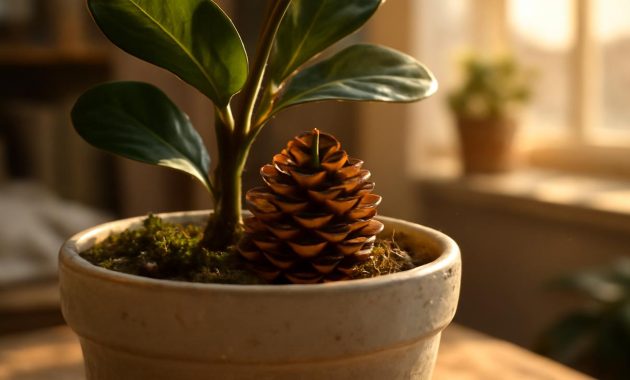
The first time I noticed it, I was eight years old, standing in my grandmother’s living room in late December. The radiator hissed by the window, the glass was fogged from the difference between inside and outside air, and her spider plant sat in its chipped terracotta pot — with a single brown pine cone resting like a tiny forest monument on top of the soil. It looked deliberate, important somehow. I asked her why it was there. She just smiled and said, “Helps the plant in winter. You’ll understand when you’re older.”
The quiet wisdom in a simple pine cone
Years later, I realized that same pine cone appeared every winter, like clockwork. It moved from plant to plant as the seasons turned cold. At my great aunt’s house, there were three of them tucked into her geranium pots. At a neighbor’s place, I spotted a perfectly symmetrical cone nestled into a pot of wintering basil, like a tiny sculpture. Different homes, different generations, same quiet ritual.
It’s one of those small, almost invisible habits older generations carry without much explanation. They don’t give a lecture about it; they just do it. A pine cone goes onto the soil when the days shorten, the heaters come on, and the houseplants start looking a little tired. To a modern eye, it might seem purely decorative — a rustic, “grandma core” detail that Instagram would love.
But there is more going on than nostalgia and aesthetics. Somewhere between instinct and observation, older generations figured out that this humble forest artifact can actually help houseplants survive the long, dry months of indoor winter.
The winter struggle happening in your plant pots
To understand why the pine cone trick works, you have to picture what winter is like from your plant’s point of view. Not the romantic version — the real one. The radiator is blasting, the air is dry enough to crack your lips. Sunlight doesn’t so much pour in as scrape weakly across the room for a few short hours. The soil in your plant pots dries out fast on top, while the lower layers can stay stubbornly damp for days.
You water the plant — maybe a bit nervously, because you’ve heard people say “overwatering kills more plants than underwatering.” The top crust of soil quickly becomes compacted, like a hard miniature desert floor. You check it with your finger: dusty on the surface, cool and clumpy deeper down. Confusing, isn’t it? The roots get uneven conditions: dry here, soggy there. It’s the perfect setup for both stress and root rot.
This is exactly the moment a grandmother somewhere would walk over, pick up a pine cone from a bowl near the door, and gently place it on the soil. Not as an ornament, but as a tool.
The pine cone as a tiny climate manager
A pine cone sitting on the surface of a pot looks simple, but functionally it’s doing several things at once:
It shades the soil slightly, so moisture doesn’t evaporate quite as quickly as it would from bare compost. Air can still move around it — this isn’t an airtight cover like plastic — but the direct blast of dry indoor air doesn’t hit the soil surface so aggressively. That means more even drying.
The cone itself is a textured, layered object. Air swirls around its scales and through its gaps. That slow movement of air over the soil, rather than straight-on drafts, helps maintain a gentler microclimate. Think of it as a tiny, rustic, natural “air baffle.”
And then there’s the pine cone’s party trick — the one older generations may not have described in botanical language, but absolutely noticed over time: it opens and closes depending on humidity.
When pine cones “breathe” with your houseplant
If you bring a pine cone in from a damp forest floor and leave it on a warm windowsill, you can watch a slow, almost animal-like transformation. The cone’s scales spread and flare open as it dries. Bring that same cone into a steamy bathroom or mist it heavily, and over time the scales pull inward, clamping tightly shut.
This movement is nature’s engineering at work. Pine cones evolved to protect seeds and only release them when conditions are dry enough for dispersal. But on a windowsill, long past the point when any seeds matter, that sensitivity to humidity becomes a relay system. Older generations noticed: when the air was very dry for days, their cones sat wide open. After watering or on humid days, the cones would close a little, or at least lose that sharply flared look. Without readings or graphs, they had a simple visual cue: the pine cone was a tiny, silent hygrometer living in the pot.
Imagine a line of plants in a cold city apartment in January. The radiators are on full blast, the windows are old and drafty. Week to week, the air swings between dry and slightly less dry. A quick glance: the cones are all flared open and a little brittle. Time to check the plants. Not necessarily to drown them in water — but to notice. To pay attention.
The science beneath the superstition
The pine cone tradition might seem like folklore, but its usefulness is rooted in some fairly straightforward plant-care science. Let’s take those half-remembered explanations from older relatives (“keeps them from rotting,” “protects the soil,” “keeps the air right”) and translate them into what’s actually happening.
| Old-fashioned Observation | What’s Probably Going On |
|---|---|
| “The soil doesn’t crust over as fast in winter.” | The cone breaks up airflow over the surface, reducing rapid drying and compaction at the top layer of soil. |
| “The plant doesn’t rot as easily.” | Because evaporation is slowed but not stopped, moisture distribution can be more even, discouraging soggy pockets that lead to root rot. |
| “You can tell if the air is too dry.” | The cone’s scales open and close in response to humidity, offering a rough visual cue about air moisture. |
| “It keeps drafts off the soil.” | The cone acts like a tiny windbreak, softening the impact of heater currents or cold window drafts on the soil surface. |
| “It makes the pot feel more alive in winter.” | The visual presence of a natural object can subtly remind us to observe, tend, and interact with the plant more often. |
None of this turns a pine cone into some kind of miracle device. It’s not a substitute for proper watering, a good soil mix, or giving your plant enough light. But it is a surprisingly effective assist — especially in homes where central heating dramatically changes the air every winter.
A natural mulch, perfectly sized for a pot
Gardeners talk about mulch all the time: straw around cabbages, bark chips under shrubs, leaves layered in flower beds. Outdoors, mulch keeps soil temperatures more stable, slows evaporation, and protects the structure of the topsoil from pounding rain or glaring sun. Indoors, we rarely think to “mulch” houseplants — but the principle is just as relevant.
A pine cone is, in many ways, a miniature, tidy, pot-friendly mulch. It covers part of the soil, but not enough to seal it off. It encourages gentle, rather than harsh, air movement. It slightly insulates the surface, keeping the top layer from cycling through extremes of bone-dry and over-wet in quick succession. For a plant trying to rest through winter or simply maintain itself with less light, that bit of extra stability matters.
And unlike many indoor mulches, a single pine cone is easy to remove when you want to check the soil or give it a good deep watering. It’s movable, adjustable, and reusable from year to year. No packaging, no instructions — just a simple object put to work.
How to use a pine cone on your houseplants (the way they did)
If you want to borrow this quiet trick from older generations, the process is straightforward, but a few small choices make a difference — the kind of details someone notices only after decades of doing it.
Choose the right cone
First, look for clean, fully opened pine cones that are thoroughly dry. If you pick them up outdoors, bring them inside, shake them out, and let them sit somewhere warm and airy for at least a week. You want any hidden moisture or small insects to vacate before that cone meets your pot.
A medium cone is usually ideal for a standard houseplant pot — big enough to do its job but not so large that it smothers the entire surface. For small pots, a tiny cone or half a cone works fine. You can even group a few small cones in a larger container if you like the look.
Place it with intention, not just decoration
When older folks set a pine cone into a pot, they didn’t usually bury it. They placed it gently on top of the soil, often closer to one side than dead center. This leaves part of the soil clearly visible and accessible. Think of the cone as a partial cover, not a lid.
After watering, you can temporarily lift the cone and set it aside, especially if you water from the top. Once the extra water has drained away and the soil surface is no longer glossy wet, place the cone back. Over time, you’ll get used to the look and feel of the soil under and around the cone — slightly darker, more even, less crusted than bare winter soil.
Use the cone as a cue, not a command
Perhaps the most subtle wisdom in this tradition is this: the pine cone doesn’t tell you what to do, it reminds you to look. Older generations used it as a nudge to notice patterns. The cone looks drier, more brittle, more flared? Maybe the air has been particularly dry, and it’s time to check not just that plant, but all the plants near that radiator or drafty window.
Conversely, if the cone remains tight and the soil under it feels cool and damp several days after watering, that might be a sign that you should wait longer before the next drink. It encourages you to check beneath appearances — literally picking up, peeking under, and touching the soil instead of relying only on the color of the surface.
More than a trick: a way of paying attention
There’s another layer to this habit that doesn’t quite fit into plant science charts: the emotional, almost ritual quality of it. Winter can be a hard season for people who love green things. Outdoors, everything is bare or sleeping. Indoors, houseplants can look tired, leggy, or pale. A pine cone on the soil is a small, symbolic tether to the forest, to the memory of walks under tall trees when the air was scented with resin and needles.
Older generations often had closer contact with those landscapes. They gathered cones from real walks, pockets filled with the day’s finds. To place one on a pot of soil in January was to say: the world outside is still alive, even if you can’t see it from your frosted window. The plant isn’t just décor; it’s part of that wider, cyclical story.
And that mindset matters, because plants grown by people who are paying attention — really watching, feeling the soil, noticing the color of the leaves, adjusting their care with the season — tend to do better. Not because of magic, but because observation is the quiet superpower of any good gardener. The pine cone is like a little flag planted in the pot saying: this living thing is being looked after, even in the hard months.
Seeing with older eyes in a modern home
Today, with moisture meters and smartphone reminders and humidity monitors, it’s tempting to think we’ve outgrown such small, improvised tools. But there is something disarming and grounding in adopting a practice that asks you to look, touch, and remember instead of just check a number on a screen.
You might notice, once you start, that your winter watering routine softens. You stop drenching your plants on a strict weekly schedule and instead begin to respond to what you see and feel. The cone sits there, scales slightly parted, a little talisman of observation. You might move it from one plant to another as you experiment. You might realize some plants like a bit more shelter for their soil in winter, while others, like succulents, are happiest with mostly bare, quickly drying surfaces.
In that way, the pine cone is less a hack and more a teacher. It brings a bit of older wisdom — the kind learned by years of trial, error, and quiet winter afternoons — into your modern living room. And the reward is not just healthier houseplants, but a deeper, more tactile relationship with them.
Bringing the forest into the pot
So why did older generations always put a pine cone on the soil of their houseplants in winter? Because it helped, in small but real ways. It shaded the soil from harsh indoor air, slowed erratic drying, signaled changes in humidity, and nudged them to pay closer attention. It was a natural mulch, a microclimate manager, a visual gauge, and a keepsake from the world beyond four walls — all rolled into one quiet, woody spiral.
And why does it still work today? For the same reasons. The physics of evaporation and air movement haven’t changed. Pine cones still respond to humidity. Houseplants are still dealing with the shock of winter heating systems and dim days. What has changed is how rarely we allow ourselves to notice subtle shifts in our environment.
Placing a pine cone on your houseplant’s soil this winter is an invitation to slow down and see the tiny worlds inside your home with clearer eyes. To inherit not just the gesture, but the kind of attention that made it worthwhile in the first place. And as your radiator hisses, the window fogs, and the days grow short, that small, quiet cone might begin to look less like a quaint tradition and more like a piece of living wisdom — one that still, quite simply, works.
FAQ
Does a pine cone really help my plant, or is it just decorative?
It’s both. A pine cone provides a light, natural form of mulch, slightly slowing evaporation, softening drafts across the soil, and offering a simple visual cue about humidity. It won’t transform a struggling plant on its own, but it genuinely supports more stable winter conditions.
Can a pine cone cause pests or mold in my pots?
If you bring in a damp or dirty cone straight from outside, it could carry insects or spores. Let cones dry thoroughly indoors for at least a week, shake them out well, and avoid cones that feel soft, crumbly, or have visible mold. A clean, dry cone is usually safe.
Will the pine cone stop me from watering properly?
It shouldn’t, as long as you treat it as removable. Lift the cone when you water, then replace it once excess water has drained and the surface is no longer glossy wet. You can still test the soil with your finger near the edge of the pot.
Is this trick suitable for all types of houseplants?
Most foliage plants and many flowering houseplants tolerate or benefit from a pine cone on the soil in winter. For succulents and cacti, use it more sparingly or not at all, as they prefer very fast-drying surfaces and excellent airflow.
How many pine cones should I put in one pot?
Usually one medium cone in a standard pot (around 12–18 cm wide) is enough. In large containers, you can use two or three small cones, leaving some soil exposed. The goal is partial coverage, not sealing the surface completely.