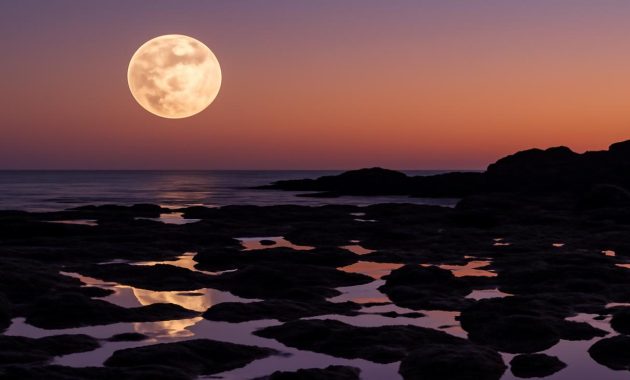
The night I first learned that the Moon is slowly leaving us, I went outside to look for proof in the sky. Of course, there was none. The Moon hung there as always—bright, a little smug, silvering the roofs and treetops, pulling at the tide I couldn’t see. Nothing in its calm, ancient face betrayed that it is creeping away from us, year by year, like a friend with one foot already out the door. Yet the measurements are clear: the Moon is drifting, Earth is slowing, and our days—quite literally—are getting longer. The change is small, yes, but it is real, and it has been happening for billions of years. You can’t feel it on your skin the way you feel wind or rain, but it’s there, woven into the deep physics of our planet, written in the timing of tides and the heartbeat of life itself.
The Slow Goodbye in the Sky
Stand on a quiet beach at night and the world feels timeless. Waves roll in and slide back with hypnotic patience. The Moon climbs, grows brighter, trails a glittering path across the dark water. It all appears eternal, locked in some perfect, repeating loop. Yet beneath that calm rhythm is a slow cosmic negotiation, a transfer of energy, a gentle tug-of-war that the Earth is secretly losing.
The Moon is currently drifting away from Earth at about 3.8 centimeters per year—roughly the rate at which your fingernails grow. In human terms, it’s laughably small. In planetary terms, given hundreds of millions or billions of years, it’s enormous. When the Moon formed, probably from the detritus of a colossal impact between the young Earth and a Mars-sized body, it orbited much closer—perhaps only 20,000 to 30,000 kilometers above the surface instead of today’s 384,000 kilometers. Picture a Moon looming many times larger in the sky, tides roaring much higher and faster, days racing by in a blur of only a few hours.
We no longer live in that wild, newborn world. The Moon has steadily migrated outward, and as it does, it steals a tiny bit of Earth’s rotational energy. Like an ice skater extending their arms to slow their spin, Earth is slowing down as the Moon moves farther away. Day length stretches, tide patterns shift, and the quiet clockwork of our planet subtly rewrites itself.
The Invisible Dance of Gravity and Tides
To understand why the Moon is drifting away, you have to imagine the Earth not as a rigid sphere but as something more alive and flexible—water sloshing, rocks flexing, crust creaking. The Moon’s gravity pulls on the Earth and its oceans, creating bulges of water: one facing the Moon, one on the opposite side. These bulges are what we experience as tides: the slow breathing of the sea, in and out, twice a day along most coasts.
But Earth is spinning faster than the Moon orbits. That means the tidal bulges don’t sit neatly under the Moon; they’re dragged a bit ahead by Earth’s rotation. And here’s where the story turns from simple to almost poetic: those off-center tidal bulges tug forward on the Moon, giving it a little gravitational nudge, like a parent pushing a child on a swing. Over time, that push adds up. The Moon gains orbital energy and slides outward, slowly, endlessly.
Energy, of course, has to come from somewhere. The cost is paid by Earth’s rotation. The friction of water dragging along the seafloor and continents—called tidal friction—acts like a universal brake. Every day, Earth spins just a tiny bit slower. Our day grows longer by roughly 1.7 milliseconds per century. You will never notice it in the rhythm of your own life, but if you zoom out far enough, the difference is staggering. Hundreds of millions of years ago, days were only about 21 or 22 hours long, and a year contained more than 400 of them.
The dance of tides and gravity, then, is a kind of quiet cosmic barter: Earth’s spin in exchange for the Moon’s distance, rotational speed traded for orbital space. It has always been this way since the Moon’s fiery birth. It will continue long after every human footprint has smoothed from the sand.
| Time Period | Approx. Day Length | Moon’s Distance (Approx.) |
|---|---|---|
| Present Day | 24 hours | 384,000 km |
| ~400 million years ago | ~22 hours | Closer by tens of thousands of km |
| ~1.4 billion years ago | ~18 hours | Significantly closer, much stronger tides |
Changing Days, Changing Worlds
It’s one thing to talk about milliseconds per century and centimeters per year. It’s another thing to imagine what that means over the full sweep of Earth’s history. If you could flip through time like the pages of a book, the changes in day length would be obvious. The spin would be faster, shadows would race across the ground more quickly, the Sun would appear to leap up and dive down in a shorter arc.
Fossil corals and shell-forming creatures carry a fossilized record of this accelerated past. Some ancient corals form daily growth rings, much like trees. Counting the daily and annual patterns locked in those rings, scientists infer that hundreds of millions of years ago, there were more days in a year. The year itself—the time Earth takes to orbit the Sun—hasn’t changed much. But when the planet spins faster, you can fit more days into each orbit. It’s as if the cosmic calendar has the same number of months, but the days kept getting shorter the farther back you go.
Life, of course, pays attention to the clock. Plants open and close their leaves and flowers with the light. Animals migrate, mate, eat, and rest according to cycles of day and night, tide and season. Our own internal clocks—the circadian rhythms that make us sleepy or alert—are deeply tuned to the 24-hour day. If Earth were spinning faster, if dawn came a little sooner, if the Sun burned overhead a bit more briefly, everything from the way trees grow to when birds sing might be different.
This doesn’t mean the small changes we’re experiencing now will suddenly throw life into chaos. The shifts are far too slow for that. Evolution has had billions of years to keep up with the gently lengthening day. Instead, it’s like a subtle, background metronome, ticking just a hint more slowly with each passing age, setting the tempo for life’s grand symphony.
Tides as the First Timekeepers
Long before humans built clocks or carved calendars into stone, tides were one of Earth’s earliest, most reliable timekeepers. For shore-dwelling creatures—and later, for coastal human communities—tides told you when to feed, when to fish, when to travel safely, when to return to high ground.
Walk through a salt marsh at low tide and the mudflat gleams like a mirror, pocked with the dimples of crab burrows. Herons stalk along the edge of shallow pools, hunting among exposed snails and small fish trapped in temporary basins. A few hours later, the water returns, creeping around reeds and grasses, swallowing the bare earth, silencing the mud with a silver surface. The transformation is dramatic and rhythmic, happening with an almost musical regularity, guided by the pull of the Moon and Sun.
But the pattern is not perfectly steady; it changes as the Moon drifts away. That outward migration and the slowing of Earth’s rotation subtly reshape the tides. Over immense stretches of time, continents move, ocean basins open and close, and tidal resonance shifts. Some ancient coastlines probably experienced tides far more intense than anything we see today; others may have known gentler rises and falls.
For early life crawling out of the sea, those tides may have been crucial. Imagine the shallow pools left behind by a retreating tide—warm, rich in nutrients, concentrated with organic molecules and tiny creatures. These temporary ponds might have served as experimental laboratories for life, testing new ways of living between water and land. A slightly different Moon, a slightly closer orbit, a slightly different pattern of tides, and that entire evolutionary story might have unfolded another way.
Moonlight, Culture, and Memory
It’s easy to talk about the Moon in purely scientific terms—gravity, orbits, millisecond drifts. But the Moon is also deeply human territory. Lovers’ promises, farmers’ planting guides, navigators’ charts, poems whispered on quiet nights: all have been pinned, in some way, to that bright, wandering disc. Every culture on Earth has wrapped stories around it, given it names, moods, and meaning.
When we say the Moon is leaving, we’re not just describing a physical fact; we’re tugging at a thread tied to myth and memory. In practice, the Moon’s outward drift is so gradual that for tens or hundreds of thousands of years to come, it will remain our familiar companion, rising and setting with reassuring predictability. The full Moon will still wash snowy fields in blue-white light, still hang over city skylines, still be the quiet witness to rooftop conversations and late-night walks.
Yet, zoom the timescale far enough forward and the poetic picture bends into something stranger. Eclipses, for instance, rely on a beautiful coincidence: the Sun is about 400 times larger than the Moon, and also about 400 times farther away. That’s why the Moon can perfectly cover the Sun during a total solar eclipse, haloing it with a ghostly corona. As the Moon recedes, that perfect fit will fail. In the distant future, Earth’s sky will no longer host total solar eclipses—only annular ones, where a ring of Sun blazes around a smaller Moon. A particular form of human awe will quietly vanish from the universe.
Looking Far Ahead: When Day and Night Grow Apart
If you extend this slow physics into the very distant future—billions of years from now—the Earth and Moon will eventually reach a state called tidal locking. You can see an example of tidal locking already: the Moon always shows the same face to Earth because its rotation period matches its orbit. From our perspective, the Moon never turns its far side fully toward us; it keeps one hemisphere forever in view, one forever hidden, like a person choosing to present only one profile.
Given enough time, Earth will also slow until one side permanently faces the Moon. Day and night, as we know them in relation to the Moon, will become geographically fixed. One hemisphere will always see the Moon hovering overhead, fixed in the same patch of sky; the other will never see it at all. In this far-off scenario, the length of an Earth day will match the length of a lunar month.
But there is a twist: the Sun is not patient. Long before that double locking fully plays out, the Sun will be evolving, brightening, and eventually swelling into a red giant. The story of the Earth–Moon system is thus nested within an even larger, more dramatic tale of stellar life and death. The slow drift of the Moon, the incremental change in our days and tides, is just one chapter in a much thicker cosmic book. We live in a page somewhere in the middle, where the Moon still pulls hard enough to stir our oceans and poets alike.
Feeling Small, Feeling Connected
There is something humbling, almost tender, in the thought that the length of our day and the shape of our tides are not fixed but evolving. We often imagine Earth as a finished product: a blue marble, a stable home. But in reality, we are living on a world still in motion, still adjusting, still engaged in long conversations with its Moon and Sun.
Step outside on a clear night and try this: watch the Moon for a moment, and then imagine it ever so slightly closer, ever so slightly larger. Imagine ancient tides thunderously sweeping across early continents; imagine a shorter, faster day, the Sun zipping across a younger sky. Then picture another future, unimaginably far ahead, when days are longer, tides gentler or stranger, the Moon a bit smaller and more distant. Realize that somewhere between those two visions sits you, and everyone you know, and everything you care about, balanced on a time-slice so thin it might as well be a single breath.
We can’t stop the Moon’s departure, and we have no reason to. This is simply how gravity works, how energy moves, how worlds grow up. But we can notice it. We can fold that awareness into our understanding of what it means to live here, now, on this rotating planet that is ever so slowly catching its breath.
In the end, the idea that the Moon is drifting away does not feel like a story of loss. Instead, it feels like a reminder: that nothing in the universe stands perfectly still, that even the most familiar things are changing, that we are part of a vast, ongoing dance. Our days lengthen, our tides shift, our Moon recedes—but in those changes is a quiet beauty, a sense of time so deep it almost escapes language.
FAQs
Is the Moon really moving away from Earth?
Yes. Precise measurements, including laser beams bounced off reflectors left on the Moon by Apollo astronauts, show that the Moon is receding from Earth at about 3.8 centimeters per year. This is caused by tidal interactions between Earth and the Moon.
Why does the Moon’s drift make Earth’s days longer?
The Moon’s gravity raises tides on Earth. Because Earth rotates faster than the Moon orbits, the tidal bulges are pulled slightly ahead of the Moon. These bulges tug on the Moon, pushing it outward, and the resulting friction in Earth’s oceans and crust acts like a brake, slowing Earth’s rotation. A slower rotation means longer days.
Will humans ever notice the change in day length?
Not directly. The change is about 1.7 milliseconds per century—far too small for any single person to experience as a difference. However, over hundreds of millions of years, this adds up to hours of change, which scientists can detect through geological and fossil records.
Will the Moon eventually leave Earth’s orbit completely?
No, it is not expected to escape Earth’s gravity under normal conditions. Instead, over billions of years, Earth and the Moon are projected to become tidally locked to each other, with one side of Earth always facing the Moon. Other cosmic events, especially the Sun’s evolution, will likely dominate the long-term fate of the system before complete separation could ever occur.
How does the Moon’s drift affect tides today?
Right now, the effect is extremely gradual. Tides are influenced not only by the Moon’s distance but also by the shape of coastlines, ocean depths, and Earth’s rotation. Over very long timescales, as the Moon moves farther away and Earth’s rotation slows, the timing and strength of tides will continue to evolve, but the changes are imperceptible on human timescales.
Will total solar eclipses eventually stop happening?
Yes, but not for a very long time. As the Moon moves farther away, it will appear slightly smaller in our sky. Eventually, it will no longer cover the Sun completely during an eclipse, ending the era of total solar eclipses and leaving only annular (ring-like) eclipses. This change will unfold over hundreds of millions of years.
Did ancient life experience shorter days and different tides?
Yes. Hundreds of millions of years ago, Earth rotated faster, so days were shorter, and the Moon was closer, producing stronger tides in many regions. Fossil evidence and geological patterns suggest these conditions likely influenced coastal environments and could have played a role in how early life evolved and adapted along shorelines.