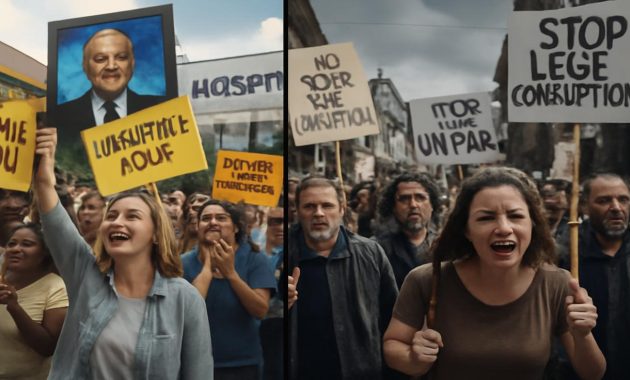
On a bright Saturday morning, the city feels like it’s humming on borrowed magic. The park fountain sprays arcs of water into the air, children weave between benches on wobbling bicycles, and a new wing of the public hospital gleams just across the street—its glass façade still smelling faintly of fresh paint and optimism. There’s a bronze plaque by the entrance with a familiar billionaire’s name stamped into it, each letter chiselled as if into the conscience of the nation. People pass under it without slowing down; some smile with quiet gratitude, some barely notice, and a few glance up and mutter under their breath. Because everyone knows the rumor: the man whose name crowns this hospital hasn’t paid anything close to his “fair share” in taxes for years.
The Strange Warmth of Billionaire Generosity
Walk through any major city and you’ll feel it—the quiet, reassuring presence of private money propping up public life. A billionaire funds an arts center that fills a neglected neighborhood with music and laughter. A tech founder bankrolls scholarships that send thousands of students to college. A hedge fund titan donates to vaccine research that may save millions of lives. Press releases glow; ribbon-cuttings make the nightly news; mayors shake hands for the cameras and talk about “public–private partnerships” as if saying the phrase can conjure balance out of thin air.
For many people, these acts of concentrated generosity feel like proof that the system is working, or at least, limping along in the right direction. “Who cares how they did it,” someone will say at a dinner table, nodding toward the television as a philanthropist unveils a new library. “It’s their money. We should be grateful they’re willing to share it.” You can’t deny the emotional power of these moments. A parent standing in a free clinic doesn’t feel like they’re shaking hands with structural inequality; they feel relief, even awe. Their child will see a doctor today. That feels real in a way that tax code clauses never will.
But that same story looks very different if you step just a block away—into the overburdened public school with leaky ceilings, the understaffed social security office, the trashed playground with its broken swings. There, the conversation changes from gratitude to a tight, simmering question: why does a society wealthy enough to mint billionaires still need billionaire charity to do what taxes are supposed to do?
The Legal Magic Tricks of “I Owe Nothing”
To understand the anger, you have to peer—just for a moment—into the maze of legal creativity that allows extreme wealth to glide almost untouched past the tax collector. It’s not usually a brown envelope stuffed with cash changing hands in a smoky back room. It’s smarter than that, cleaner, and much harder to pin down. Most of the time, it’s absolutely, impeccably legal.
Take a typical ultra-wealthy entrepreneur. On paper, they may earn a modest salary, sometimes less than their own senior managers. Their real wealth sits in assets: company shares, real estate, investment funds, offshore holdings with names that sound like tiny islands because many of them are. As long as they don’t sell, what they “earn” isn’t counted as income the way your paycheck is. Their wealth swells silently as markets rise, but the taxman mostly looks the other way.
When they do need cash, they borrow against those assets at rock-bottom interest rates that ordinary workers could only dream about. Loan proceeds aren’t income, so no income tax is due. Estate planners and accountants build elaborate structures so that, when these fortunes are handed down, they skim lightly over inheritance taxes too. Entire industries exist just to ensure that the number on the official tax return bears little resemblance to the true magnitude of a life’s accumulation.
It is a masterpiece of design—from the perspective of those who benefit. From the outside, though, it feels like walking into a rigged carnival game, the kind where you keep tossing rings, knowing in your bones you are never meant to win. You pay taxes on your wages, on your car, on your groceries, your utilities, the gas that takes you to work. Meanwhile, people whose names appear on skyscrapers and hospitals contribute proportionally less, but stand in front of microphones to describe themselves as “partners in progress.”
When “Legal” Starts to Feel Like “Corrupt”
The word corruption usually conjures images of envelopes, bribes, backroom deals. But what happens when the rules themselves are written to ensure that certain people always find the exit doors? Is that still corruption—or simply the natural shape of power in a wealthy society?
In many countries, tax loopholes and preferential treatment for capital didn’t appear by accident. They grew from decades of lobbying, campaign donations, revolving doors between government and finance, and the quiet, relentless logic of influence. Over time, the system began to resemble a house with two sets of keys: one for everyone, and a second, gold-plated one handed out to those rich enough to commission a locksmith.
On paper, nothing illegal happens. The hearings are public, the bills are debated, the votes are counted. But for the teacher in a crumbling school or the bus driver who just watched their local route get cut because of “budget constraints,” the result feels indistinguishable from corruption. Rules that always seem to tilt upward, even when they’re ratified by a legitimate parliament, begin to look like a more polite cousin of the brown envelope. Legal, yes—but fair? That word catches in the throat.
The Double Vision of the Grateful and the Furious
This is how you end up with a nation split down the middle, living in parallel realities. In one, a billionaire’s donation to build a children’s hospital wing is an act of heroism. In the other, it’s proof that the tax system has failed so thoroughly that basic public goods now require the personal benevolence of the ultra-rich.
Picture two people encountering that hospital plaque at the same moment. The first is a father whose child has been in and out of emergency rooms for months. For him, that billionaire is almost a guardian angel. Without this new facility, without these machines, his child might not get the treatment they need. He stands in the lobby and whispers, “Thank you,” to a stranger he will never meet.
The second person works the night shift at a warehouse. She knows exactly what percentage of her paycheck goes to taxes. She has watched her rent go up, her benefits shrink, and her bus route disappear. Her public library closed last year; the playground her kids loved is half-ruined because the city can’t afford to maintain it. She knows, because she’s read just enough to be dangerous, that the man whose name stands above the door probably moved money through half a dozen shell companies and trusts to ensure that the tax bill for his empire is little more than a rounding error. She stares at the bronze letters and feels her hands ball into fists. “If he just paid what he owed,” she thinks, “would we have needed him to ‘donate’ anything at all?”
Both reactions are real. Both make sense. And together, they define the strange emotional weather of our age: admiration and resentment, gratitude and rage, swirling around the same small group of people who can, with a signature, move billions.
The Quiet Swap: Taxes Out, Naming Rights In
One reason the anger runs so deep is that many people sense a kind of unspoken trade happening beneath the surface. When the wealthy sidestep taxes but give generously to chosen causes, something important is exchanged without ever being openly discussed: democratic control over priorities.
Taxes are messy, boring, and blunt—but they are, in principle, collective. We fight over them in elections, argue in town halls, shout on talk shows, and then, however imperfectly, we vote. That process decides whether money goes to elder care or highways, art museums or flood defenses, mental health services or stadiums.
Philanthropy, by contrast, is precise, glamorous, and deeply personal. It follows the desires, interests, and sometimes whims of individual benefactors. A billionaire loves opera? A grand opera house rises. Another cares about elite universities? Endowments swell. In a world where mega-donations can dwarf the budgets of public agencies, decisions about what gets built, studied, or supported start drifting away from parliaments and city councils and into private boardrooms.
To many, this looks like generosity wrapped around a quiet power grab. The public gets the benefit—a hospital, a park, a research lab—but loses a little bit of its voice about what the community actually needs. The trade is rarely acknowledged out loud. But you can feel it every time someone says, “Well, the government would never have funded this,” as if that is the end of the conversation rather than the beginning.
How the System Teaches Us to Cheer
Of course, none of this would work so smoothly if it didn’t resonate with something deep in the culture: the storytelling habits that tell us who deserves what. For decades, we’ve been fed a steady diet of heroic billionaire narratives. The genius founder. The visionary disruptor. The rugged individual who pulled themselves up by sheer willpower and skill. In those stories, taxes are often painted as obstacles or penalties, something that threatens to slow the march of innovation.
When those same heroes turn around and announce a gigantic donation, the story clicks into place. Here is the self-made savior, stepping in where clumsy government fails. Headlines gush, documentaries are made, podcasts fawn. The person who quietly hired a legal army to pare down their tax burden becomes, once again, the protagonist of a redemptive tale. The story is so compelling that even those who are being shortchanged by the system may find themselves clapping along. It’s hard to resent the hand that just built your kid’s school science lab, even if you suspect that same hand helped empty the public coffers that were supposed to pay for it.
The Numbers Beneath the Feelings
Strip away the emotions and the narratives, and you’re left with some stark arithmetic. In many wealthy countries, effective tax rates for the ultra-rich have fallen dramatically over the past few decades. Capital gains are often taxed at lower rates than wages. Corporate tax rates have dropped as governments compete to attract investment. At the same time, the share of government revenue coming from consumption taxes and payroll taxes—things ordinary workers cannot escape—has increased.
| Group | Main Source of Income | How It’s Mostly Taxed |
|---|---|---|
| Typical Worker | Wages & Salaries | Payroll & Income Tax (with every paycheck) |
| Comfortable Professional | Salary + Small Investments | Income Tax + Some Capital Gains Tax |
| Ultra-Wealthy | Assets & Capital Gains (often unrealized) | Deferred, Sheltered, or Minimally Taxed |
When people learn even a little of this, fury is almost inevitable. They start to see that the cheering and the seething are two sides of the same coin: a society that has quietly shifted from “we build this together” to “we hope someone rich decides to build it for us.” That realization lands like a stone in the stomach.
Is There Another Way to Build a Hospital?
So what would it feel like to walk into a shining new hospital and see, instead of a single billionaire’s name, a different kind of plaque? One that simply reads: “Built by the people of this city, through their taxes, for one another.” No heroic savior, just a quiet acknowledgment of shared effort.
In some places, that still happens. Robust, progressive tax systems can and do fund world-class hospitals, universities, transport systems, and research. They are not perfect; they rely on honest administration, strong institutions, and the constant, grinding work of democratic oversight. But they offer something billionaire-funded systems never can: legitimacy grounded in consent rather than charisma.
Moving in that direction would mean rethinking almost everything about how we treat wealth: closing loopholes that have become yawning chasms, taxing capital more like labor, beefing up enforcement so that sophisticated schemes face real scrutiny. It would also mean reimagining the social stories we tell: less worship of individual saviors, more appreciation for the slow, unglamorous heroism of institutions that quietly work when you need them.
Why the Fight Feels Existential
For those invested in the current arrangement, such changes are not just technical tweaks; they are existential threats. A world where billionaires pay far more in taxes and receive far less public adoration for targeted gifts is a world in which their symbolic power shrinks. They would still be rich—spectacularly so—but their ability to shape the public realm according to personal taste would fade.
For others, that prospect is precisely the point. They look at societies where a handful of individuals can redirect the flow of public life through donations and see something fundamentally undemocratic, even when it is dressed in the language of generosity. To them, building a hospital with properly taxed wealth feels not only fairer, but more dignified. It says: you don’t have to be grateful to a stranger in order to have your basic needs met. You belong here. You already paid for this.
Living in the Tension
Until that conflict is resolved—if it ever is—we will go on inhabiting a strange in-between world. We will walk through billionaire-funded parks and libraries and museums, enjoying them sincerely while a low-grade discomfort hums underneath. We will watch televised galas that celebrate philanthropy and feel, perhaps in the same breath, both touched and suspicious. We will keep arguing online—some defending the wealthy as job creators and benefactors, others insisting that no amount of charity can wash away systemic injustice.
Meanwhile, the day-to-day reality continues: parents bring their kids to hospitals, commuters ride on aging trains, elders wait for appointments in under-resourced clinics. They are the ones who live with the consequences of how we choose to fund our shared life, whether through carefully designed tax systems or the unpredictable kindness of the very rich.
In that sense, the real question lurking beneath the cheers and the seething is disarmingly simple: what kind of relationship do we want to have with one another? One based on entitlement to basic dignity, or one based on hoping that someone at the top of the pyramid continues to feel generous?
If you stand quietly for a moment in that hospital lobby, under the glow of fluorescent lights and the soft beeping of monitors, you can almost hear the answer. It’s in the way people look not at the plaque, but at one another—as if, in spite of everything, they still believe that a society is something you build together, not something you wait to have handed down from above.
Frequently Asked Questions
Are billionaire tax strategies actually legal?
Most of the time, yes. The techniques that allow the ultra-wealthy to reduce their tax bills—using trusts, shell companies, borrowing against assets, shifting profits across borders—are typically legal under current laws. The controversy is less about criminal behavior and more about whether those laws themselves amount to “legal corruption” because they so heavily favor those with the money and expertise to exploit them.
Isn’t philanthropy better than nothing?
Philanthropy often produces real benefits: hospitals, scholarships, research, and cultural institutions that might not otherwise exist. The concern is that it can’t substitute for a fair tax system and democratic decision-making. Private giving is driven by individual priorities, not collective needs, and can reinforce the power of the wealthy to shape public life according to their preferences.
Why do some people strongly defend billionaire donors?
Many people see billionaire donors as proof that success and generosity can go hand in hand. They focus on the visible outcomes—new facilities, programs, and opportunities—and may distrust government as inefficient or wasteful. Cultural narratives that celebrate “self-made” individuals also make it easier to view taxation as punitive and philanthropy as noble.
Can we realistically fund public services without relying on billionaire generosity?
Yes, if tax systems are designed and enforced to collect adequate revenue in a fair way. Many countries successfully fund high-quality healthcare, education, and infrastructure primarily through taxes rather than large private donations. Doing so requires political will to close loopholes, tax wealth and capital more effectively, and invest in competent public administration.
What would a fairer system look like in practice?
A fairer system would likely include more progressive tax rates, fewer special exemptions for capital income, stronger rules against profit shifting, and better resourced tax authorities. It would also involve a cultural shift: valuing reliable, democratically governed public services over the glamour of high-profile donations, and recognizing that basic social goods should come from shared obligations, not occasional acts of private generosity.