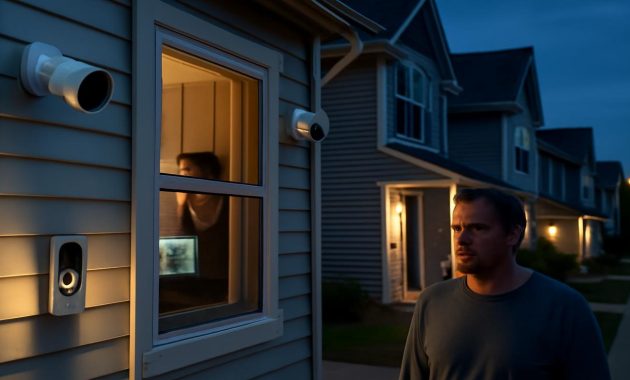
The first time I realized my neighbor’s doorbell camera could see straight into my living room, I was standing in my pajamas, cradling a bowl of cereal, watching the morning light pour across the floor. It was early, quiet, the kind of peaceful silence that makes you feel like the world hasn’t quite woken up yet. Then a notification chimed from my phone: “You were spotted.” Not by my own device—by theirs. Somewhere, across the street, a tiny lens had blinked awake, logged my movement, and filed away a clip of my sleepy shuffle past the window. I hadn’t consented. I hadn’t even known.
When the Neighborhood Becomes a Network
Walk down a suburban street today and you can feel it: the invisible lattice of cameras stitched between front porches, garages, driveways, and backyards. The houses may look familiar—porches, mailboxes, kids’ bikes sprawled messily in the grass—but the neighborhood itself has changed. It’s no longer just a cluster of homes; it’s a network of sensors, microphones, and motion alerts, quietly turning ordinary life into footage.
Modern smart home surveillance systems hum along constantly. Doorbell cameras watch the sidewalk. Floodlight cams blink on with the soft rustle of a passing cat. Tiny black dots in eaves and windows track packages, visitors, dog walkers, and kids riding scooters. The comforting narrative is that all this tech keeps us “safe”—from package thieves, from trespassers, from the vague, looming idea of crime.
But stand on a typical block at dusk and imagine all those feeds running simultaneously: dozens of video streams capturing every passing jogger, every teenager cutting across a yard, every delivery worker scanning a barcode. Most of these people never signed any agreement, never clicked “I accept.” Still, their faces might be backed up to the cloud, stored who-knows-where, watched by who-knows-who.
The smart home, it turns out, isn’t just about comfort. It’s about control. And when that control extends past the front door, your privacy might quietly become someone else’s entertainment.
The Quiet Shift From Safety to Spectacle
We tell ourselves a simple story: I installed cameras to protect my home. It’s honest enough. Maybe there were packages stolen, a car break-in, or just the ambient anxiety that hums through the news cycle. The solution seems clear: add eyes. More eyes. Better eyes.
Yet somewhere along the way, many of these systems stop being purely functional and start becoming recreational—something to check out of habit, to scroll for curiosity, to share for fun. A rustle at 2 a.m.? Rewind the footage. Kids racing past the driveway? Save that clip; it’s cute. A stranger slips on the ice on the sidewalk? That video might get a laugh in a neighborhood group chat.
And there it is—the subtle line where safety blurs into spectacle.
In countless online communities, people post snippets from their home cameras: delivery mishaps, neighbors arguing on the street, a wandering raccoon rummaging in bins. Some of it is charming, sure. But woven into those clips are real people who never asked to be captured, much less uploaded, replayed, and dissected in the comments. Their awkward fall, their bad day, their unguarded moment becomes content. “You won’t believe what my camera caught,” the caption says. Millions do believe, watch, and share.
When private surveillance turns into casual entertainment, the neighborhood stops feeling like a shared space and starts feeling like a stage. Only, not everyone knows they’re in the show.
The Subtle Ways We Forget Boundaries
Part of the problem is that cameras normalize themselves. The first doorbell camera on the block feels strange, maybe even intrusive. The tenth? It fades into the background, another blinking blue dot in a world of LEDs. After a while, checking your motion alerts can feel as routine as checking the weather.
And so we grow used to noticing people as “events.” A neighbor cutting across the lawn registers as a motion alert, not a human doing something ordinary. A group of teens hanging out near the curb becomes “suspicious activity” viewed through a fisheye lens at 11:37 p.m. The camera does not know context; it only knows movement. But our brains, fed on a steady diet of notifications, start to forget context, too.
We might not mean any harm. Yet harm can seep in slowly—accusations in local forums based on misunderstood footage, kids labeled as troublemakers because they like to linger and laugh where the camera can see, delivery workers mocked for the way they walk or what they wear. What starts as a security feed can become a highlight reel of other people’s lives, narrated by the biases of whoever’s watching.
Comfort, Control, and the Invisible “Guests” in Your Home
Inside the house, the story feels different. Smart surveillance is sold alongside smart bulbs, smart speakers, and smart thermostats, bundled into an ecosystem of frictionless living. Tap your phone and you can see who’s at the door. Ask your voice assistant and it shows you the backyard. You can be at work, on a beach, or in another country and still peek into the rooms you left behind.
On a winter evening, the scene can feel almost magical: lamps turning on by schedule, the soft glow of a screen showing a sleeping baby, the reassuring notification that the front door just locked. There’s a sense of mastery, of having pulled the strings tight around your life so that nothing slips through unnoticed.
But the line between watching and being watched gets blurry fast.
Every camera that makes you feel more secure is also a set of eyes inside your private world. Often, those eyes don’t just belong to you. They might belong to your partner, your landlord, your roommate, or your employer in a “company apartment.” They might belong, indirectly, to employees at tech companies who can sometimes access clips for “quality control” or machine learning. They might even belong, one day, to a hacker who guessed your password and is quietly browsing the architecture of your living room.
Even when there’s no bad actor, surveillance at home can shift the social temperature. A spouse might check in a little too often “just to see what’s happening.” A parent might track a teenager’s comings and goings down to the minute. A landlord might watch the driveway to see who visits and how often. The camera’s gaze can turn affection into suspicion, curiosity into control.
All in the name of comfort.
When You Don’t Control the Camera Watching You
What if you’re the person in the frame, but never the one who owns the device?
Imagine renting a small guesthouse behind a larger home. There’s a camera facing the shared driveway, another above the side gate. The homeowner assures you it’s “just for security,” nothing personal. Still, every time you come home late, you feel the invisible click of a recording starting. Every visitor you bring over passes beneath the unblinking eye. You start to wonder: Are they counting? Are they judging? Are they saving clips?
Or imagine being the nanny, the cleaner, the contractor, the food delivery driver. You move through a patchwork of eyes every day—some obvious, some hidden in smoke detectors or decor. Maybe you signed a contract that mentioned cameras. Maybe you didn’t. Either way, the feeling can settle in your body: the sense that you are not quite alone, not quite unobserved, anywhere.
We rarely talk about how that feels—the way your shoulders tighten, the way you rehearse your behavior in case someone rewinds the footage. That subtle self-editing is what constant surveillance does best. It doesn’t just record life; it reshapes it.
Your Street, Their Feed: When Privacy Becomes Content
The strangest thing about smart home surveillance isn’t that it records so much. It’s what happens to that river of data afterward.
Your neighbor’s backyard BBQ, half-visible from an upstairs cam, might be laughed about in a group chat. A stranger tripping over a loose brick on the sidewalk might end up on a compilation of “doorbell fails.” A kid knocking over a trash bin could be looped, zoomed in, and posted with a caption calling them a vandal. Each clip slices off a moment in time, stripped of nuance, polished for reaction.
Once a video is shared, control evaporates. It can be downloaded, reposted, edited, and stitched into something completely different from the original context. The person stumbling, arguing, dancing, or crying in the frame may never know they are visible to thousands—maybe millions—of people. They may not recognize themselves in the pixelated blur beneath some stranger’s commentary. But the internet never really forgets.
What began as your neighbor’s sense of “security” becomes a pipeline for accidental spectacle. Neighborhood disputes play out through clips. Suspicions are built on incomplete stories. People become characters more than neighbors, strangers more than citizens.
A Quick Look at Who’s Watching What
To make this more concrete, here’s a simplified snapshot of how everyday footage from smart home surveillance might be used—and by whom.
| Who’s Watching | Type of Footage | Possible Use |
|---|---|---|
| Homeowner | Doorstep, driveway, indoor cams | Checking visitors, monitoring packages, watching kids or pets |
| Neighbors | Shared sidewalks, yards, street | Neighborhood watch, gossip, evidence in disputes |
| Online communities | Clips posted from home cameras | Entertainment, outrage, viral content |
| Companies & platforms | Stored cloud footage, metadata | Service improvements, analytics, training algorithms |
| Law enforcement (in some regions) | Footage shared voluntarily or via legal request | Investigations, identifying suspects, reconstructing events |
Each row represents another layer of gaze, another potential branch in the storyline of a single captured moment. The more layers, the more opportunities for misinterpretation, misuse, or just plain overexposure.
Drawing the Line: Being a Neighbor, Not a Warden
Amid all this, it’s easy to slip into extremes—either embrace the cameras completely or reject them outright. But the truth is more complicated. Technology isn’t going away. Nor is our desire to feel safe at home. The question isn’t cameras or no cameras. It’s: What kind of community do we become when we watch each other this much?
Start with something simple: standing on your own front step and looking at your cameras the way a stranger might. Do they capture the sidewalk? Your neighbor’s windows? The narrow side yard your dog walker uses? If so, could you reposition them, narrow the field of view, or use privacy zones that blur out certain areas? Small tweaks can mean that your security doesn’t come at the cost of someone else’s comfort.
Then there’s how you use the footage. Ask yourself, every time you’re tempted to share: Would I want this online if I were the person in the clip? Not the best version of you, not the one having a great hair day—the real, tired, distracted, human you. That pause can be a quiet act of respect in a time where sharing is nearly frictionless.
Talk to your neighbors. Tell them where your cameras point and why. Invite questions. Ask them, too, if they feel comfortable. There’s something disarming, in the best way, about making the invisible visible in conversation. It turns the abstract idea of “privacy” into something personal: How does this make you feel?
If you live with others, especially kids or teens, make the surveillance in your home explicit, not secretive. Explain what’s being recorded and when. Decide, together, where the line is. A camera watching the front door might feel fine; a camera watching the living room sofa might not.
Reclaiming Spaces That Feel Like Home
Maybe the most radical thing you can do in a world of smart surveillance is protect real pockets of unobserved life—on purpose.
For some, that might mean declaring the backyard a camera-free zone, a place where sunlight and shadows can move across grass without being turned into data. For others, it might mean refusing to post or share any footage of other people without clear consent. Or choosing devices that store footage locally rather than streaming it to distant servers. Or pushing for building-wide policies that limit how landlords use cameras in common areas.
At the neighborhood level, communities can rethink what safety looks like. Cameras are one tool, but they’re not the only one. Well-lit streets, strong social ties, trusted local networks, and actual human presence can all contribute to feeling secure without turning every corner into an observation deck.
We can choose, in small daily ways, not to treat the lives passing in front of our lenses as content and not to assume that more watching always equals more safety. Sometimes, safety is knowing that you can walk down your own street, laugh with a friend, or fumble for your keys at the door without becoming a clip titled “Look at this…”
Living With Eyes Open—Not Always On
The future neighborhood is here already: part home, part sensor grid, part stage. We’re still writing the script. Each decision—to install a new camera, to angle it just so, to share or not share what it captures—shapes the kind of story we tell about what it means to live together.
There will always be moments when smart home surveillance feels undeniably useful. A missing pet spotted on a feed. A hit-and-run solved thanks to a single clip. A parent, thousands of miles away, watching their toddler totter across a sunlit rug. These stories matter. They’re real.
But so are the quieter stories: the neighbor who stops gardening in her front yard because she feels watched; the teenager who starts avoiding one side of the street at night; the delivery worker who forces a smile, performative and brittle, for every glowing doorbell camera.
Somewhere between those stories lies a choice—not about technology itself, but about how we see each other. We can treat every passerby as a potential intruder, every doorstep as a broadcast studio, every misstep as content. Or we can recognize that privacy is not just a personal preference; it’s a shared resource. The less we turn each other into entertainment, the more room we leave for ordinary life to unfold, unrecorded.
Maybe the next time your phone pings—“Motion detected at your front door”—you’ll still look. Curiosity is human. But maybe you’ll also remember: on the other side of that lens is a human, too, just trying to move through their day without becoming a story they never chose to tell.
FAQ
Are smart home cameras always bad for privacy?
Not necessarily. They can genuinely improve safety and peace of mind when used thoughtfully—angled toward your own property, with limited sharing, strong passwords, and clear boundaries at home. The risk comes when cameras overreach into shared or private spaces and when footage is treated casually, as entertainment instead of sensitive information.
Can my neighbor legally record me on their home cameras?
In many places, it’s legal to record video of public areas like streets or sidewalks from private property. Recording audio often has stricter rules, and pointing cameras directly into someone else’s home can cross legal or civil boundaries. Local laws vary, so if you’re concerned, it’s worth checking regulations where you live and starting with a calm conversation with your neighbor.
What can I do if I feel watched in my own neighborhood?
Begin by talking to your neighbors about where their cameras are pointed and how they use the footage. Many people simply haven’t considered the impact on others. You can also work with local community groups or housing associations to create guidelines for respectful camera use. If you believe a camera is targeting your private spaces, seek legal advice based on local privacy laws.
How can I use smart cameras more ethically in my home?
Limit your cameras to areas where they’re genuinely needed, avoid pointing them at neighbors’ spaces, disable unnecessary audio recording, and use privacy zones or narrower fields of view. Be transparent with anyone who lives with you or visits regularly, store footage securely, and think twice before sharing any clip that includes other people.
Is storing footage in the cloud risky?
Cloud storage is convenient but can introduce additional risks: data breaches, unauthorized access, or broader use of your footage for analytics. If privacy is a priority, look for options that allow local storage, robust encryption, multi-factor authentication, and clear, restrictive privacy policies. Whatever you choose, use strong, unique passwords and enable available security features.