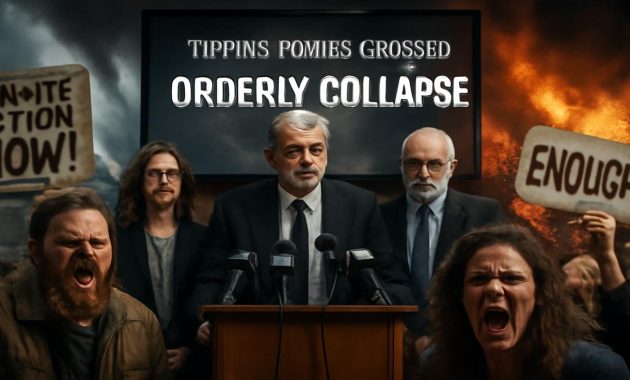
The news didn’t arrive with sirens or breaking banners across the sky. It came in a PDF, dense and quiet, like a confession whispered through gritted teeth. A team of scientists, some of the very same people who’d spent their careers insisting there was still time, had finally admitted what many feared and a few had long suspected: a hidden climate tipping point had been crossed years ago. The tone of their language was clinical, but the implications were anything but. Suddenly, the conversation was no longer about “avoiding collapse,” but about “managing an orderly collapse” of the systems we’ve built our lives around. And outside their conference halls and press briefings, the public backlash hit like a wave.
“Orderly Collapse”: The Phrase No One Wanted to Hear
The phrase slipped into the public conversation almost by accident, in a Q&A segment at the end of a scientific panel. A climatologist, face lined with the strain of too many late nights over too many grim datasets, used it as if it were ordinary language: “At this point, an orderly collapse of certain systems may be our best option.”
Orderly collapse. The words were replayed, clipped, slowed down, turned into headlines and hashtags and furious comment threads. For some, it sounded like surrender. For others, like a quiet, devastating honesty that had been withheld for too long. Either way, the phrase lodged itself into the global imagination.
Part of the shock came from the contrast. For years the dominant narrative was still about “keeping warming below 1.5°C,” “staying within safe planetary boundaries,” “bending the emissions curve.” We were promised a narrow window, not a locked door. Yet behind the scenes, models had been drifting in one direction: warmer seas absorbing less carbon, ice sheets thinning faster than predicted, forests—once our great carbon sponges—starting to cough up more CO₂ than they took in.
It turns out the tipping point in question wasn’t some easily visualized, singular moment like an iceberg cleaving in two. It was a tangled web of thresholds: in the Arctic, where permafrost melt quietly exhaled methane; in the Amazon, where drought and fire reclaimed once-humid ecosystems; in the oceans, where warm currents rearranged themselves like furniture in a burning house. Individually, each trend was troubling. Together, they formed something far more unsettling: a self-accelerating slide.
The Hidden Tipping Point We Crossed in the Rearview Mirror
Imagine driving along a winding mountain road in the fog. Somewhere behind you, out of sight, you crossed an invisible line where the road surface turned to black ice. You didn’t notice. The steering wheel still felt solid in your hands, the engine still hummed, your passengers still scrolled their screens in the back seat. Only later, when the car begins to fishtail near the cliff’s edge, do you understand you’ve been on ice for a while.
This is how the scientists describe it now. The hidden tipping point wasn’t known in real time. There was no flashing indicator on a dashboard, no alarm that went off the moment we crossed it. Instead, the evidence accumulated like frost on a window, obscuring the view of a stable future bit by bit.
In private, a handful of researchers admit they suspected the threshold had been passed years before the formal papers were published. They saw it first in anomalies—heatwaves that strained statistical language, storms that broke “once in a century” records twice in a decade. Coral reefs that didn’t just bleach but failed to recover. Wildfire seasons that left behind not scar tissue, but something closer to permanent loss.
The scientific culture, careful and conservative by design, resisted dramatic pronouncements. The norms demanded cautious phrasing, error bars, more data. But while they waited for sufficient certainty, the Earth’s systems shrugged off their old patterns and slid into new ones.
When the updated models finally aligned with what front-line communities and ecosystems had been feeling for years, the conclusion was sobering: some climate feedback loops—especially those involving heat, ice, and carbon sinks—were now strong enough that merely cutting emissions would not restore the older, more stable climate. We had not fallen off a cliff into instant apocalypse, but the road ahead no longer included any route back to the world we once knew.
Public Fury Meets Scientific Fatalism
When the admission became public—when the phrase “orderly collapse” began surfacing in official reports instead of only in off-the-record conversations—the response was immediate, visceral, and deeply human.
In city squares and small-town halls, in comment sections and radio call-ins, people asked versions of the same question: How long have you known? The anger wasn’t just about the content of the admission, but its timing. Parents who’d been told for years that there was “still a decade to act” wondered whether that clock had always been an illusion. Youth organizations pointed out that they had grown up organizing climate strikes and petitions under the belief that their future was still negotiable.
Scientists, for their part, pushed back against the idea of a conspiracy. Many were themselves grieving, not only for the changing planet, but for the collapse of the hopeful narratives they had been attached to. They spoke of professional norms, of the need to avoid overstating risk. They reminded the public that even if a tipping point had been crossed, how we travel through the coming decades is still very much in our hands.
But none of that fully soothed the outrage. For those already living on the frontlines—subsistence farmers watching rains wander unpredictably, coastal families measuring sea level rise in bricks added under doorframes—it felt as if the world’s most powerful institutions were only now catching up to what had been daily life for years: a slow-motion loss of normal.
Protest signs began to shift in tone. Alongside calls for “climate action now” appeared a new, raw question: “Action toward what, exactly?” If the future no longer contained a stable climate, people wanted to know what they were being asked to fight for.
What Does an “Orderly Collapse” Actually Mean?
Buried in the policy language and academic citations, the concept of orderly collapse is less apocalyptic than it sounds, and more practical—though no less unsettling. It does not mean giving up. It means acknowledging that many of our current systems cannot be preserved in their existing form, and then choosing, deliberately, how they will wind down instead of letting them shatter chaotically.
Orderly collapse is the difference between a power grid that fails all at once during a brutal heatwave and one that is gradually redesigned so that, when it strains, it trips off in manageable sections, supported by local backups. It is the difference between millions of people becoming climate refugees overnight and a decades-long, planned relocation supported by resources, consent, and dignity.
To make the idea more tangible, some researchers and planners are now using a simple, if stark, comparative framework:
| Area of Life | Chaotic Collapse | Orderly Collapse |
|---|---|---|
| Food Systems | Sudden crop failures, price spikes, hunger, hoarding | Planned shift to resilient local crops, rationing if needed, food sharing networks |
| Energy | Blackouts, fuel riots, stranded communities | Managed demand reduction, microgrids, prioritized access for essentials |
| Migration | Unregulated mass displacement, unsafe travel, border violence | Coordinated resettlement, legal pathways, shared responsibility |
| Economy | Market crashes, unemployment spikes, social unrest | Deliberate slowing of high-emission sectors, support for workers, new local economies |
In planning circles, you hear a new kind of vocabulary emerging: “de-escalation of risk,” “graceful degradation,” “managed retreat,” “degrowth with dignity.” These phrases don’t exactly sing. They don’t fit on posters or in stirring speeches. But they are attempts to do something rare in human history—step down from a peak of consumption and complexity without tumbling headlong into chaos.
And still, for the average person, the question persists like a stone in the shoe: How do you live your everyday life—buy groceries, pay rent, raise kids, text friends about weekend plans—under the shadow of something as abstract and enormous as “managed collapse”?
The Emotional Weather of a Collapsing World
Beyond the science and the policies, there is another, quieter dimension to all this: the emotional weather people carry inside their chests as the outer climate spins further from its old patterns.
Some respond with denial, not out of ignorance but as a form of self-defense. They change the channel when floods appear on the news, scroll past headlines about heat records, joke about “enjoying the warm winters while they last.” Denial, after all, is not always a lack of information. Sometimes it is the only way a nervous system can remain functional while holding down a job and caring for a family.
Others swing toward a harder edge of activism, fueled by anger at delayed truths. They occupy pipelines, sue governments, block traffic to shake loose an apathetic public. Among them, the idea of orderly collapse is sometimes seen as a dangerous softening, a bureaucratic euphemism that might sap urgency from the movement to cut emissions as fast as humanly possible.
Then there are those who drift into a quiet, bone-deep grief. Not just for polar bears or coral reefs, but for their own childhood winters that no longer arrive on schedule, for the hummingbirds that used to visit the same week every spring, now out of sync with blossoming plants. Their sorrow isn’t cinematic. It shows up in small ways: lingering longer at a shoreline, feeling a lump in the throat during a hot, smoky sunset.
Mental health professionals report increases in what is now called “climate anxiety,” especially among the young. But anxiety is only part of the story. There’s also climate disorientation—the sense that the basic story you were told about your life (study, work, build, retire) no longer quite fits the shape of the century you’re living in.
Here, paradoxically, some people describe relief in hearing scientists speak openly about tipping points and collapse. The truth, even when bleak, can be more bearable than the tension of mixed messages—optimistic slogans on one hand, and apocalyptic images on the other. Naming the reality is the first step in learning how to inhabit it.
Choosing How We Fall: From Control to Care
If the grand project of the last two centuries was to seize control—of rivers, of soils, of energy, of time itself—the project of the coming decades may be very different: learning how to let go, selectively and intelligently, of forms of control that are killing the very stability we rely on.
Orderly collapse, at its most humane, is really about choosing what we’re willing to release so that something essential can be preserved. It might mean letting go of the idea that every trip needs to be fast and far, in exchange for mobility that is slower, more local, but more reliable. It might mean surrendering the dream of infinite growth so that our economies can be re-centered on sufficiency and repair.
In villages perched on eroding coasts, this work has already begun in painfully literal ways. Entire communities have voted—sometimes reluctantly, sometimes defiantly—to relocate inland. Elders walk the line between old and new settlements, telling stories that stitch the two places together in memory so that when the sea finally takes the last house, something of the culture survives.
In cities, planners experiment with “cool corridors” of shade and vegetation to channel people safely during heatwaves that now kill thousands. Some neighborhoods form mutual aid networks to check on elders when the grid flickers. Rooftop gardens and community tool libraries aren’t just lifestyle trends; they’re small rehearsals for a different kind of society, one where fewer things are owned individually and more are shared.
On a policy level, the shift is no less profound. Governments that once measured success almost entirely through GDP are experimenting—in fits and starts—with indices of wellbeing, resilience, and ecological health. These tools are imperfect and often co-opted, but they signal a dawning recognition: in a world past certain climate thresholds, a narrow focus on profit is not only morally threadbare, it is strategically suicidal.
There is no single blueprint for how to descend together. Every region, every community, every household will face its own mixture of threat and possibility. But the underlying question is universal: If we cannot avoid all forms of collapse, can we at least choose a form that is slower, more equitable, and gentler on the vulnerable—human and nonhuman alike?
Living Well on a Planet Past the Turning Point
So here we are, in the long after of a tipping point that slipped by mostly unnoticed. The scientists’ admission has not brought clarity so much as a new kind of complexity. The old binary—either we “solve climate change” or we don’t—no longer holds. Instead, we face a spectrum of futures, all altered, some far less violent than others.
It helps, perhaps, to remember that stability was never the norm over deep time. Forests have come and gone, seas have advanced and retreated, climates have swung from ice to heat and back again. What is different now is the speed, and the fact that we are the agents of it—and also the witnesses, the ones who must learn to love and care and build meaning in the midst of it.
In this light, the idea of orderly collapse can be reframed not as an admission of defeat, but as a hard-won maturity. We are being asked to grow up as a species: to stop believing in endless expansion, to acknowledge the damage we’ve done, and to orchestrate, with intention and compassion, a soft landing where a hard crash is otherwise waiting.
That won’t happen from scientific reports alone. It will happen in the choices of city councils and tribal councils, in the math teachers who weave climate literacy into their lessons, in the farmers who dare to change crops and methods, in the neighbors who turn apartment rooftops into shared gardens. It will happen in how we talk to children—not pretending their world will be the same as ours, but also not surrendering their future to fear.
On an evening walk, you can already feel the new world pressing in at the edges: the October air too warm for the jacket you’re wearing, the birdsong arriving in confused bursts, the sky streaked orange by wildfire haze from hundreds of miles away. It is tempting to look away, to shut the door and turn up the fan. Yet somewhere, in that same air, is another possibility—the chance to turn toward one another instead of inward, to plan not only for survival but for the kind of tenderness that makes survival worth the effort.
The tipping point is behind us. The kind of world that lies ahead is still, in many crucial ways, our choice.
Frequently Asked Questions
What do scientists mean by a “hidden climate tipping point”?
A hidden tipping point is a threshold in the Earth’s climate system that is crossed without immediate, obvious effects. Only later, as feedback loops strengthen—such as accelerated ice melt, permafrost thaw, or forest dieback—do we realize the system has shifted into a new, largely irreversible trajectory.
Does crossing a tipping point mean all climate action is pointless?
No. Crossing certain tipping points means some changes are now locked in, but the scale and speed of future damage are still highly dependent on our actions. Reducing emissions, protecting ecosystems, and redesigning societies can still prevent far worse outcomes and save countless lives.
What is the difference between “orderly collapse” and “adaptation”?
Adaptation usually implies adjusting systems so they can continue to function in a changing climate. Orderly collapse acknowledges that some systems—like fossil-fuel-based economies or certain coastal settlements—may not be fully maintainable, and focuses on managing their decline in a controlled, just, and humane way.
Is “orderly collapse” just a way for governments to avoid responsibility?
It can be misused that way, but in its more honest form, it increases responsibility. It requires governments and institutions to plan transparently for difficult transitions, protect vulnerable groups, and avoid chaotic breakdowns that would be far more harmful.
What can individuals realistically do in the face of these changes?
While no individual can “fix” the climate crisis alone, people can influence outcomes by pushing for systemic changes, supporting vulnerable communities, reducing personal and local dependence on fragile systems, and building networks of mutual aid and resilience. Just as collapse is collective, so is the work of making it as orderly, just, and humane as possible.