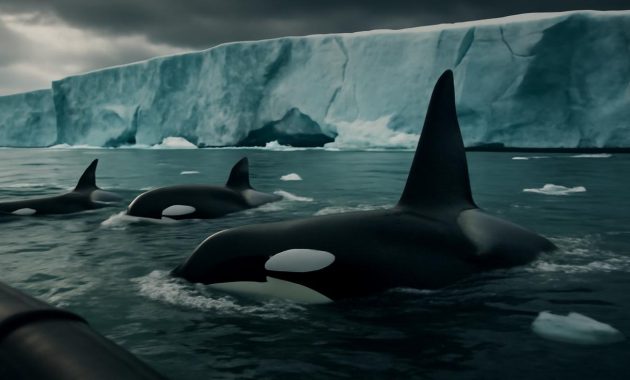
The first fin appeared where there should have been only ice and sky—a black blade cutting through pewter water, framed by the fractured edge of a Greenland ice shelf. The fisherman on the trawler stopped mid‑gesture, his gloved hands hovering over the net. Orcas, this close, this early in the season, and in these numbers, were as wrong as a thunderstorm in deep winter. He pulled out his phone with cold‑stiff fingers, trying to film as the sea around the boat seemed to darken and come alive. Later, that shaky video would be replayed in government offices, in research labs, and on news broadcasts around the world, an eerie prelude to the words no one expected to hear so soon: “Greenland has declared an emergency.”
When the Sea Changes Its Story
By the time the emergency declaration came, people along Greenland’s western coast were already whispering to each other in the dim light of late summer: Something is wrong with the whales.
In coastal villages where humpbacks, narwhals, and belugas are familiar seasonal presences, orcas—top predators known locally, respected and feared in equal measure—had always been rare visitors. They skirted the ice edges, favoring open water further south, at least according to the unwritten calendar generations had trusted.
This year that calendar tore itself up.
Hunters began seeing orcas much farther north, patrolling close to the thawing lips of ice shelves that, until recently, formed solid white fortresses against the open sea. Instead of brief appearances, they lingered. Pods that usually travelled in fives or sixes were now appearing in groups twice that size. Their stark black‑and‑white bodies rolled through the grey water, cutting arcs so close to the ice that their dorsal fins sometimes seemed to scrape the blue‑white underside of new cracks.
Out on the water, the air tasted of salt and silt, with a faint, metallic tang that rides in when old ice releases ancient air. The usual soundtrack of creaking floes and distant bird calls was drowned out by exhalations—sharp, misty blows from orca lungs—and the sudden, panicked splashes of seals and narwhals trying desperately to stay hidden.
“They’re hunting along the ice like wolves on a fence line,” one hunter told a local radio station, his voice tight. “The ice they use to hide is gone. The whales know it before we do.”
Emergency in a Warming North
In Nuuk’s government buildings, the decision to declare an emergency didn’t come from a single moment of panic, but from a steady accumulation of unease. Marine biologists had been submitting reports for weeks, their language slipping from careful to urgent. Satellite images were showing fractures in ice shelves at times of year when they should still have been locked and quiet. Orca sightings were increasing, and not only in number—but in behavior.
Pods appeared to be testing the new boundaries of the thawing ice, pushing into inlets previously blocked by thick, multi‑year ice. They were shadowing narwhal migration routes, herding panicked prey into dead‑end bays where the retreating ice left them with nowhere to hide. Hunters reported finding seal carcasses torn apart in unfamiliar places, the water around them churned with more blood than they’d ever seen on a normal summer hunt.
For Greenland’s authorities, the emergency wasn’t only about whales behaving strangely. It was about what their behavior revealed—a shifting ecological map, redrawn by accelerating climate change. Orcas are apex predators, barometers of marine upheaval. When they move, it often means something else has already moved beneath the surface: currents, prey, temperatures, the invisible threads of the ecosystem.
The declaration allowed for rapid coordination: local councils, scientific teams, coast guards, and hunting associations suddenly linked in a single, hastily built response network. Helicopters were diverted for aerial surveys. Research vessels already in Arctic waters rerouted to critical zones. Communities were asked to report all orca sightings in real time, down to the color of the water and the shape of the ice.
Greenland, already living with the visible scars of thawing glaciers, recognized that this was not an isolated anomaly. It was another sign that the old pact between ice, sea, and human life was being renegotiated—whether anyone agreed to it or not.
The Orcas at the Edge of the Ice
To understand why this behavior sent such a chill through scientists and communities alike, you have to picture the geography that’s changing beneath the orcas’ sleek bodies.
For millennia, thick sea ice and massive floating ice shelves formed something like a defensive wall around Greenland’s coastal ecosystems. Narwhals and other Arctic specialists evolved to use this fortress. They slipped under slabs of ice, used cracks and pressure ridges as camouflage, and navigated narrow leads as if following familiar hallways in a house they knew by heart.
Orcas, with their tall dorsal fins and need for breathing room, usually couldn’t follow for long. Solid ice pinned them to the outskirts, limiting how far north they could go and how deeply they could intrude into the intimate, icy havens of narwhals and seals.
But now, with warming air and water temperatures, those havens are collapsing—not in cinematic, instant avalanches, but in a long, grinding surrender. Shelves thin. Edges rot from beneath. What was once a continuous white sheet becomes a puzzle of drifting plates and blue water, broken lines where predators can slip through.
And the orcas, highly intelligent and opportunistic, are learning fast.
Researchers watching from the decks of small ships describe orcas moving like scouts along fracture lines, turning and circling where ice used to block their path. In some places, they’ve been observed using cooperative hunting tactics perfected elsewhere—creating waves to wash seals off remnant ice floes, or surrounding narwhals and forcing them into shallow coves, a deadly game of aquatic funneling.
One marine biologist, leaning over the rail of a research vessel on a calm, echoing afternoon, recorded a scene that still haunts her: narwhals crowding close to a remaining tongue of ice, packed so tightly their bodies rubbed against each other, their long tusks clacking like wind chimes. Beyond them, black fins carved circles in the water. Predators and prey, both betrayed by vanishing ice geometry.
New Routes, Old Instincts
Orcas are not invaders in a moral sense. They are animals following their instincts, expanding into new habitat because climate change has quietly opened the door. Their movements are not malicious. They are logical, even inevitable.
Yet for the communities that share these waters, the orcas’ new routes slice directly through cultural memory. Hunters report narwhals arriving thinner, more skittish, diverging from their traditional paths as they try to outrun their pursuers. Places once known as reliable hunting grounds are now sites of eerie silence or sudden chaos.
It’s as if someone has taken an old, trusted story and rearranged the pages, leaving familiar characters trapped in scenes they were never meant to inhabit.
Lives on the Line: People, Whales, and Food Security
The emergency declaration is not just about scientific curiosity or worrying trends on climate graphs. It reaches into kitchens, communal freezers, and the quiet calculations of families wondering if this year’s stored meat will be enough.
In many Greenlandic communities, marine mammals are more than symbols of wildness. They are food, income, history, and identity. Narwhals, seals, and other Arctic species are woven into the fabric of life—into ceremonies, storytelling, nutrition, and local economies.
As orcas push further north and closer in, they’re not only putting pressure on prey populations; they’re also disrupting the rhythm of local hunting. Some hunters report having to travel farther, using more fuel, only to find that the animals they seek are scattered or highly stressed. Others speak of encountering orcas in places where small boats were never expected to share the water with such large, fast predators.
The concern is not hypothetical. If narwhal and seal populations decline or are driven away from traditional bays, food security could sharpen from a worry into a crisis. The emergency measures include monitoring programs aimed specifically at estimating how much predation is occurring, how migration routes are bending, and whether key species are showing signs of long‑term decline.
Below is a simplified snapshot of what some observers have begun to notice this season, compiled from field notes and local reports:
| Observation Area | Change in Orca Sightings | Impact on Local Wildlife | Community Concerns |
|---|---|---|---|
| West Greenland coastal bays | Significant increase; larger pods closer to ice | More seal carcasses, fewer resting seals on ice | Reduced access to traditional seal hunting areas |
| Northern fjords near thinning shelves | First‑time orca presence reported | Narwhals observed bunching near remaining ice | Fear of long‑term disruption to narwhal migrations |
| Offshore hunting routes | More frequent encounters with orca pods | Prey species appear more skittish and dispersed | Higher fuel use, uncertain catch, safety worries |
These shifts are still being mapped and understood, but their emotional weight is already clear in community meetings: a blend of worry, anger, and a familiar North Atlantic resilience—an insistence on adapting, even when the ground (or in this case, the ice) keeps moving.
Safety on an Uncertain Sea
There’s another layer to the emergency: human safety. Orcas are not known for attacking people in the wild, but boats are another matter. In other parts of the world, orcas have recently been recorded bumping, spinning, or even damaging small vessels, perhaps out of curiosity, perhaps teaching each other new behaviors we barely understand.
Greenland’s fishermen and hunters steer open boats and small craft through narrow passages and along ice edges, places where an unexpected close encounter with a powerful pod could quickly turn from awe to danger. Authorities are now issuing guidelines about how close to approach, when to cut engines, and how to report incidents, treating orca behavior almost as a new kind of maritime weather—unpredictable, needing constant updates.
Scientists, Storytellers, and the Race to Understand
On board a research vessel anchored near a thinning shelf, the deck smells of diesel and salt, mingling with the faint, sweet‑rancid scent of old ice. A group of scientists huddle around laptops in the glow of the cabin, watching drone footage as it streams in.
Overhead, the drone’s camera reveals a set of patterns that are both mesmerizing and unsettling: black commas of orcas looping around bright white scraps of ice; the ghostly outlines of narwhals beneath the surface, clustered like question marks; a sweep of open, dark water where sea ice charts from just a decade earlier showed a solid, reliable mass.
Biologists tag what animals they can, trying to build a clearer picture of where the orcas are coming from and where they go when they leave these new hunting grounds. Oceanographers drop instruments to measure temperature, salinity, and currents, tracing the shifting routes of Atlantic water as it presses further into the Arctic. Data streams back to shore, each number a tiny flare in the widening story of change.
And alongside those measurements, another kind of evidence is being carefully collected: the stories of hunters, elders, and coastal residents. In community halls and on cluttered decks, researchers listen as people describe, in vivid detail, when the first orca was seen in their bay, how the seals began to “act wrong,” how the ice’s sound changed—from a slow, deep groaning to quick, irregular snaps as it thinned.
These accounts are not mere anecdotes; they are long‑term observational records from people who have watched the sea, season after season, for most of their lives. Their words carry a different kind of authority, one born not from sensors and satellites, but from the unbroken habit of looking closely.
Emergency as a Signal, Not Just a Status
Declaring an emergency can sound like a bureaucratic act, a technical change in funding or response protocols. In Greenland’s case, it is also something quieter and more profound: an official admission that the rhythms of ice and water no longer match what anyone can reasonably call normal.
It’s a signal to the world that what is happening here—the orcas, the thawing ice shelves, the disrupted migrations—is not a niche, local oddity. It is a tremor along a fault line that runs through global climate systems. The Arctic does not simply record our planetary changes; it amplifies them.
And so the emergency becomes both a practical tool—unlocking resources, coordinating research—and a kind of moral statement. It says: We recognize that something fundamental is shifting, and we will not pretend it is business as usual.
What the Orcas Are Telling Us
Stand on a Greenlandic shoreline on one of these strange new evenings and you might feel a layered kind of silence. There is the ordinary quiet of remote places: distant bird calls, the gentle lick of waves on rock, the occasional slap of ice rolling in the water. Then there is the deeper, listening silence that comes when you know that just beyond your field of view, something is moving differently than it has for centuries.
When orcas appear near thawing ice shelves, they are not just hunting. They are drawing new lines on maps we thought were fixed. They are revealing how quickly a marine world can be rearranged when the scaffolding of ice that once set its boundaries begins to fail.
For some, the sight is thrilling—raw wilderness flexing its muscle, nature in motion. For others, especially those whose livelihoods and cultures depend on the old patterns, it is a slow‑motion disaster. For scientists, it is both a warning and an opportunity to understand, in real time, how top predators respond to climate‑driven change.
Yet beneath all those perspectives runs a shared, uneasy recognition: the orcas are not the problem. They are the messengers. Their unusual presence near Greenland’s thawing ice shelves is the visible tip of a much larger transformation—a signal that heat absorbed in distant oceans, emissions released far from these quiet coasts, are now being cashed in as altered lives, altered risks, altered futures.
The fisherman who filmed that first startling pod close to the ice shelf did not have the language of policy or climate models at hand. What he did have was instinct. Looking through his phone at the black dorsal fins knifing through the frigid water, he muttered something under his breath that the microphone barely caught: “They shouldn’t be here.”
In those four words lies the essence of Greenland’s emergency. The world is changing so fast that even the whales are out of place.
FAQ
Why did Greenland declare an emergency over orca behavior?
Greenland declared an emergency because unusually frequent and northern orca sightings near thawing ice shelves indicate rapid ecological change. Orcas are entering areas they rarely used before, putting new pressure on species like narwhals and seals, disrupting traditional hunting, raising safety concerns for small boats, and signaling accelerating ice loss and warming seas.
Are orcas new to Greenland’s waters?
Orcas are not completely new to Greenlandic waters, but they were historically less common and stayed farther south or closer to open water. What is new is how often they are being seen, how far north they are traveling, and how closely they are operating along thinning ice shelves and into fjords that used to be blocked by thick ice.
How is climate change connected to the unusual orca behavior?
Climate change is warming the oceans and the atmosphere, causing sea ice and ice shelves around Greenland to thin, fracture, and retreat. As ice barriers disappear, orcas gain access to previously protected or hard‑to‑reach habitats. They follow prey like narwhals and seals into these newly opened waters, altering predator‑prey dynamics and exposing deeper shifts in the Arctic marine ecosystem.
What does this mean for local communities in Greenland?
For local communities, the changes bring practical challenges: traditional hunting grounds are disrupted, prey species may become scarcer or harder to reach, and encounters with orcas in small boats can pose safety concerns. Since many communities rely on marine mammals for food, income, and cultural practices, the shifting behavior of both predators and prey could affect food security and cultural continuity.
What are scientists doing to study this situation?
Scientists are combining satellite data, drone footage, tagging programs, underwater instruments, and community observations to track orca movements, monitor ice conditions, and assess the health and behavior of prey species. The emergency declaration helps coordinate this work, providing resources and structure so researchers and local observers can share information quickly and build a clearer picture of how the ecosystem is changing.
Should people be worried about orcas attacking humans?
Wild orcas rarely attack humans, and there are no widespread reports of direct attacks in Greenlandic waters. However, their increasing presence around small boats and nearshore areas means authorities are taking precautions, issuing guidelines on how to behave around orcas and how to report unusual encounters. The main concern is ecosystem disruption, not deliberate aggression toward people.
Is this just a local issue, or does it affect the rest of the world?
While the immediate impacts are felt most strongly in Greenland, the underlying drivers—warming oceans, melting ice, shifting species distributions—are global. The unusual orca behavior is one visible symptom of broader climate change. What happens along Greenland’s thawing ice shelves is closely linked to worldwide sea‑level rise, ocean circulation, and the health of the global climate system that all nations depend on.