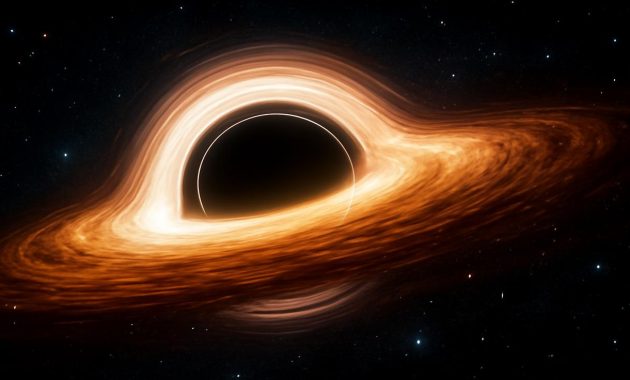
The stars above the Australian desert looked almost painfully sharp, as if someone had pinched holes in a sheet of velvet and pushed light through from the other side. Inside the low-lit control room, half a world away from the city’s orange glow, a young astronomer cradled a mug of coffee gone lukewarm hours ago. On the wall, a graph twitched—a wavering trace of numbers that, to most eyes, would mean nothing. But to this small team watching in real time, it meant they were seeing something almost absurd: a black hole twisting spacetime itself, curling reality into a slow, invisible whirlpool, just as a German physicist had scribbled into equations more than a century before.
The Day Einstein’s Thought Experiment Turned Into Footage
Albert Einstein never saw a black hole. He doubted they could even exist in the way we talk about them today. To him, they were mathematical ghosts—curious, unsettling side effects of the strange geometry hidden inside his general theory of relativity. In 1915, he proposed that gravity wasn’t a force in the usual sense, but the bending of spacetime by mass and energy. Heavy things like stars and planets dented the cosmic fabric; light and matter followed those dents.
But the story didn’t stop at “dents.” If a massive object spins, Einstein’s equations say it doesn’t just curve spacetime—it drags it. Like honey in a jar stirred by a spoon, spacetime should swirl around a rotating mass. This phenomenon has a wonderfully tactile name: frame-dragging. For decades, it was an elegant prediction, a whisper inside a forest of equations, mostly confined to textbooks and blackboard discussions.
Fast-forward to the twenty-first century, where our tools have finally caught up with Einstein’s imagination. We’ve already seen gravitational waves—tiny ripples in spacetime—from colliding black holes. We’ve seen, in silhouette, the fiery ring around the black hole at the center of the galaxy M87. But now, astronomers have watched a more subtle dance: a star’s path corkscrewing through space, not quite in the orbit Newton would have drawn, but in the skewed, twisted track that Einstein described.
And the place where this drama unfolds is as dramatic as the physics itself: the very heart of our Milky Way, where a supermassive black hole four million times the mass of the Sun lurks in the dark, known as Sagittarius A*.
Inside the Gravity Well of the Milky Way
Imagine standing on a dark, dry plateau under a sky so full of stars that the Milky Way doesn’t just look like a band—it looks like spilled milk, thick and luminous. Somewhere behind that glowing band, hidden by clouds of dust and gas, lies the galactic center. We can’t see it with normal light; the dust is too thick. But with infrared telescopes, which see heat rather than visible light, astronomers can pierce the veil.
For more than three decades, teams of astronomers have watched the orbits of stars that dart dangerously close to Sagittarius A*. These stars are like test particles in a grand experiment, zipping around an invisible mass that tugs on them with ferocious gravity. One of the most famous of these stars is called S2. It swings around the black hole on a highly elongated orbit, coming closer to the monster than Neptune is to our Sun, and then flinging itself back out again.
To the public, S2 looks like just a dot on a series of time-lapse images. But to the scientists, that dot is a needle drawing on spacetime’s skin. Its path can reveal whether gravity works the way Einstein said it should. When S2 makes its closest approach to Sagittarius A*, it moves at a few percent of the speed of light. At that speed, Newton’s gravity—the kind we learn in school—starts to fail. Einstein’s version, with its spacetime curvature and time dilation, has to take over.
Over years of observation, astronomers watched S2’s orbit precess: instead of returning to exactly the same path with each cycle, its orbit rotated slightly in space, tracing something more like a rosette than a perfect ellipse. This was a huge test of general relativity. But that still wasn’t enough to confirm that the black hole was twisting spacetime, only that it was warping it.
The Subtle Signature of a Cosmic Whirlpool
Frame-dragging is more elusive. If spacetime is like a fabric, then a spinning black hole is like a massive hand twisting that fabric as it turns. This twist should gently tug on the orbiting star, causing tiny deviations from the path we’d expect even after accounting for regular relativistic effects.
These deviations are minuscule. Detecting them is like trying to see if the track of a long-distance runner has been shifted by the weight of a small bird landing on the stadium bleachers. You need patience, a lot of data, and instruments that can measure positions on the sky with almost impossible precision.
In recent years, astronomers with access to some of the world’s most sensitive instruments—particularly arrays of telescopes using adaptive optics and interferometry—have been quietly accumulating that data. They watched S2 and other stars, frame by frame, year by year, building up a map not just of where the stars were, but of how their paths subtly warped over time.
When they finally teased out the signal, the conclusion was stunning but also strangely serene: the black hole at the center of our galaxy appears to be spinning, and its spin is dragging spacetime along with it, twisting the very arena in which the stars move. The measured effect fits astonishingly well with what Einstein’s equations predicted over a hundred years ago.
| Feature | Description |
|---|---|
| Object Observed | Sagittarius A* (supermassive black hole at the Milky Way’s center) |
| Mass | ≈ 4 million times the mass of the Sun |
| Key Test Star | S2 (fast-moving star in a tight, elongated orbit) |
| Relativistic Effects Seen | Orbital precession, gravitational redshift, and frame-dragging (spacetime twisting) |
| Why It Matters | Provides direct evidence that a spinning black hole drags spacetime, confirming a key prediction of general relativity |
Listening to the Geometry of Reality
One of the most disorienting parts of this discovery is that there’s nothing to “see” in the ordinary sense. No spiral of light, no glowing vortex, no cinematic swirl of stars. The twisting of spacetime is written in numbers and angles, in shifts of spectral lines, in the slow drift of a star’s trajectory on astronomers’ screens.
Yet the data tells a very physical story. Picture spacetime around the black hole not as a static bowl, but as a kind of spinning funnel. A star like S2 is trying to follow the natural curve of that funnel, but the funnel itself is rotating. That rotation nudges the star’s path. Over the course of an orbit, this effect accumulates. Over many orbits, it starts to reveal a pattern: a small but persistent skew that only makes sense if the very stage on which the drama unfolds is turning.
Astronomers cross-checked this pattern against other possibilities. Could a swarm of unseen dark objects be altering the orbit? Could measurement errors mimic the effect? With better instruments, more observations, and more refined models, the twisted signature remained. For the scientists involved, it felt a bit like learning to hear a new instrument in an orchestra they’d been listening to for decades.
It’s tempting to frame this moment as “Einstein was right—again.” But there’s more to it than confirmation. These observations go beyond verifying an old prediction; they open a door to measuring something we’ve only theorized about: the spin of a supermassive black hole. Spin isn’t just a fun detail. It shapes how black holes grow, how they devour matter, how they launch jets that can stretch for thousands of light-years and sculpt entire galaxies.
What It Feels Like Near a Twisting Black Hole
Of course, no one will ever stand near Sagittarius A*, but our minds can wander. Imagine, for a moment, a spaceship capable of hovering close to the black hole, well outside the event horizon but deep within its gravitational well. Out the window, the sky would be a broken mirror of distorted starlight. Time on the ship would tick sluggishly compared to clocks in the quiet suburbs of the galaxy. As you and your crew looked out, the patterns of stars would slowly twist, not just because of your motion, but because the very coordinates of space around you were being wound like yarn around a spindle.
If you tried to orbit the black hole in the same direction as its spin, you’d find you could get closer than if you tried to go the other way. The twisting spacetime would help you along or push back, depending on your direction. This isn’t science fiction; it falls straight out of the mathematics being probed by those distant telescopes. Frame-dragging is not just an abstract effect — it defines what “around” means near a spinning black hole.
Even here on Earth, we’ve measured a faint version of this effect. Satellites like Gravity Probe B have detected the tiny drag that Earth’s rotation exerts on the fabric of spacetime. But near Sagittarius A*, the effect is millions of times stronger, an extreme version of a subtle phenomenon, magnified by a cosmic heavyweight in violent rotation.
Einstein’s Shadow and the Edges of His Theory
Einstein would probably be baffled by the technologies used to examine his ideas: vast mirror arrays, adaptive optics smoothing out the blur of our atmosphere in real time, supercomputers turning light into simulations of celestial mechanics. Yet he might feel oddly at home with the questions his theory still leaves unanswered.
Relativity has passed every experimental and observational test thrown at it so far, from Mercury’s orbit to GPS corrections to gravitational waves. The twisting spacetime of Sagittarius A* adds another gemstone to that crown. Still, physicists know relativity is incomplete. It doesn’t include quantum mechanics—the rules that govern the smallest scales of nature. Inside a black hole, at the singularity where general relativity predicts infinite density, our current mathematics falls apart.
This is where the new observations become more than a victory lap. By mapping spacetime around a black hole with ever finer precision, astronomers are also mapping the places where relativity might one day fail. Any deviation from Einstein’s predictions, however tiny, could hint at new physics. For now, everything lines up. The orbits, the precession, the frame-dragging: they all hum in tune with the old equations. But as instruments sharpen and new stars near the black hole are discovered, scientists will keep listening for discordant notes.
There’s a certain humility in this. The universe keeps saying, “Yes, that’s how I behave,” while we suspect there must be an “until…” at the end of that sentence. Until the energies get too high. Until we look too closely. Until we find a place where the fabric tears instead of bends.
Why This Matters to You, Standing Under Your Own Night Sky
It’s easy to file this discovery under “cool space stuff” and move on, but there’s something deeper here. When scientists talk about spacetime twisting, they are describing the stage on which your entire life takes place. Your heartbeat, your breath, the orbit of the Moon, the glow of your smartphone — all of it is unfolding within this flexible, responsive geometry.
The black hole at the center of the Milky Way feels remote. Light takes about 26,000 years to travel from there to here. But its gravity, its presence, and now its spin are woven into the history of this galaxy. The way it dragged in gas, the way it may have launched jets in the distant past, the way its pull gathered and sculpted matter — all of that helped shape the environment in which the Sun was born, and in which you’re reading this sentence.
When astronomers talk about watching a black hole twist spacetime, they are really talking about a simple, radical fact: reality is not as rigid as it feels. The distances that seem fixed, the time that feels constant, the directions that feel obvious—up, down, around—are all part of a dynamic medium that can stretch, ripple, and, yes, twist.
A Human Story Written in Starlight and Equations
In the end, this is also a story about people. About the patient teams who return to the same patch of sky year after year, refusing to be bored by the barely perceptible creep of stellar dots on a screen. About the engineers who wrestle with instruments so sensitive they can feel the flicker of a star’s position by the width of a human hair seen from thousands of kilometers away. About theorists, leafing through century-old papers, still finding them fertile ground for tests made possible by telescopes orbiting above the atmosphere and observatories perched on impossibly high mountains.
The arc from Einstein’s chalk dust to a modern observatory’s glowing displays is long and decidedly non-linear. There were false starts, abandoned ideas, and decades when some of these concepts lived mostly in the minds of mathematicians. There were times when black holes were dismissed as overly fanciful, too extreme to be real. And yet here we are, not only acknowledging them as actual objects in the universe, but measuring the ways they knead spacetime itself.
Maybe the most poignant part of this whole saga is that the universe could have been less interesting. Gravity could have been a straightforward force, tugging on masses in a simple, predictable way. There could have been no black holes, no warped light, no twisted spacetime. But that’s not the world we got. We inhabit a cosmos where the fabric of reality is active—shaped by matter, reshaped by motion, sensitive to every whirling star and spinning galaxy.
On quiet nights, when the sky is clear enough to see the Milky Way as a smeared band overhead, you can look toward Sagittarius, the constellation that hides our galactic center. Somewhere in that direction, behind curtains of dust, our central black hole spins silently, dragging the coordinates of space around with it. You won’t see it with your eyes. You won’t feel it curling the ground under your feet. But astronomers have watched its influence in the dance of nearby stars and, through them, have watched spacetime itself being twisted into shapes Einstein once only calculated in solitude.
It’s a reminder that even in the deepest darkness, under physics so extreme it bends our intuition, the universe still follows patterns that human minds can trace. A person with paper and ink, a century ago, imagined a cosmos where mass tells spacetime how to curve and spin tells it how to twist. Today, standing under the same sky, we’ve learned how to see that twist unfolding in the starlight itself.
Frequently Asked Questions
What does it mean that a black hole “twists spacetime”?
It means that the rotation of a massive object—like a spinning black hole—drags the fabric of spacetime around with it. This effect, called frame-dragging, causes nearby objects and light paths to be slightly twisted compared to what they would be in a non-rotating spacetime.
How did astronomers actually detect this twisting?
They tracked the orbits of stars very close to the Milky Way’s central black hole over many years using extremely precise telescopes. Tiny deviations in these orbits, after accounting for other relativistic effects, matched the predictions of frame-dragging around a spinning black hole.
Is this the first time frame-dragging has been observed?
No. A weaker form of frame-dragging has been measured around Earth using satellites like Gravity Probe B and LAGEOS. What’s new here is seeing the effect in the intense gravitational field of a supermassive black hole, where the twisting of spacetime is far stronger.
Does this discovery change Einstein’s theory of relativity?
It doesn’t change the theory; it confirms it. The observations are consistent with general relativity’s predictions. However, pushing these tests into such extreme environments helps define where and how future theories that go beyond relativity—like a full theory of quantum gravity—will need to work.
Why should non-scientists care about black holes twisting spacetime?
Because it reveals that reality is much stranger and more dynamic than everyday experience suggests. Understanding how spacetime behaves near black holes shapes our picture of how galaxies form and evolve—and ultimately how the environment that allowed life to arise in our own galaxy came to be.