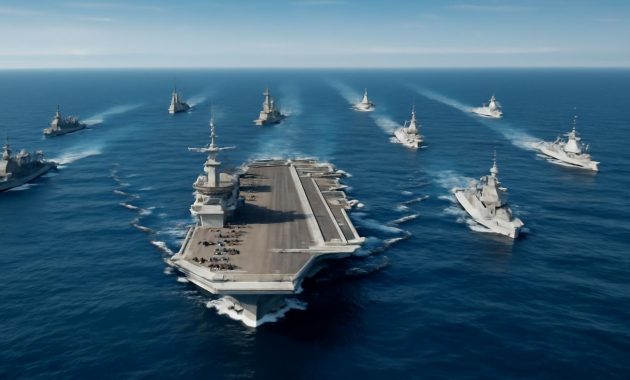
The sea is calm only on the surface. Far below, steel and saltwater meet in a constant, grinding negotiation, and on the horizon a grey shape slips forward like a moving island. This is the French aircraft carrier Charles de Gaulle, and for once, she is not steaming out alone to flash her power for a quick photo-op or a ceremonial flypast. This time, France is taking a far bigger risk: placing its only aircraft carrier at the heart of a massive, weeks-long joint exercise where the goal is not to shine for a single day, but to endure, adapt, and sometimes fail in full view of allies.
A Floating City Steps into the Spotlight
On the carrier’s flight deck, the air smells of jet fuel, hot metal, and the faint tang of the ocean. Sailors in color-coded jerseys move with the odd, choreographed rhythm of people who work inches from jet intakes and spinning rotor blades. Rafale fighters crouch under the open sky, their matte grey skins drinking in the morning light. Somewhere in the metal labyrinth below, a nuclear reactor hums, feeding energy into the arteries of this floating city.
France has only one aircraft carrier. It is both symbol and tool, a national statement of strategic independence and a very real piece of hardware that can project firepower hundreds of miles from its hull. Putting this single, irreplaceable asset at the center of an extended, complex multinational exercise is not the sort of choice a cautious country makes lightly.
In peacetime, warships often train in ways that are neat, controlled, and—if we’re honest—highly staged. A scripted scenario here. A day or two of exercises there. Cameras rolling, admirals observing, politicians visiting long enough for a handshake and a well-timed speech. Everything polished. Everything safe. But the oceans of the 21st century are not tidy, and in the back rooms of France’s naval headquarters, planners know it.
This new exercise—stretching over weeks, involving dozens of ships, submarines, aircraft, and thousands of sailors from multiple countries—is built around a different premise: stress the system until it creaks. See what breaks. Learn in time, while the missiles are simulated and the casualties imaginary. That means exposing the Charles de Gaulle not as a flawless icon, but as a living, fallible machine in the middle of a vast, shifting team.
A Risk Written into Steel and Strategy
There is a certain kind of silence that falls in combat information centers at sea. It isn’t quiet in the usual sense—radars ping, consoles beep, the ventilation roars—but voices become more clipped, more precise. Screens fill with symbols that represent aircraft, ships, potential threats. During a major joint exercise, that silence is joined by many more: the quiet of foreign officers listening on headsets, the hush of interpreters leaning in, the pause before a French commander approves or refuses a request from an allied unit he has never met before.
From the outside, it might seem a simple thing: allies work together; navies talk; jets fly; everyone learns. But to put an aircraft carrier at the very center of such an effort is to accept a harsh truth—your weaknesses will be visible. For France, this is no small gamble. It is betting that the long-term benefit of real, shared learning outweighs the short-term risk of showing every flaw, every delay, every misstep.
Consider the stakes. An aircraft carrier is not just a warship; it is a national flagship, a statement of industrial capacity, political will, and strategic reach. Many countries never manage to build or operate one. France does—and does so with a nuclear-powered vessel capable of staying at sea for long stretches. To admit that such a symbol might jam communications with an allied destroyer, or struggle with replenishment timings during a stormy night exercise, is to strip away some of the mythic aura surrounding it.
Yet, this is precisely where the risk turns into value. A carrier that only shines in carefully curated moments is like a race car that only looks fast parked in a garage. The true test is whether it can coordinate complex air operations after three weeks of fatigue, mechanical wear, and the subtle frictions that build up when different nations’ procedures, languages, and expectations collide.
Why Endurance Beats a Perfect First Impression
France’s decision reflects a deeper shift. In the age of precision weapons, cyberattacks, and long-range surveillance, no nation’s navy can realistically expect to fight alone. Coalitions are no longer a possibility; they are almost a certainty. That changes what matters. A dazzling single-day display is good politics. But military reality is about sustainability, interoperability, and trust that holds under pressure.
Endurance is a strange thing to train for. It doesn’t photograph well. Fatigue does not look heroic; long nights in the operations room produce no parades. But it is precisely this slow grind that determines whether a coalition can keep flying, keep refueling, keep sharing information accurately on day seventeen, not just on day one. For Charles de Gaulle and her escorts, this exercise is essentially an open-ended question: can you stay sharp, relevant, and integrated not for a moment, but for a month?
Life Aboard: The Human Edge of a National Gamble
For the 1,500 or so men and women aboard the carrier, the big strategic risk feels very personal. Endurance, for them, is measured in coffee, sleep, and the weight of headphones pressing against sore ears. It’s in the constant pivot from English to French on the radio, the hurried gestures on the flight deck when an allied helicopter is guided in, the careful politeness at joint briefings where no nation wants to admit confusion but everyone senses it in the room.
The air has its own flavor on a carrier during a big exercise. The metallic tang of the hangar. The diesel breath of support ships that sometimes come alongside. The smell of paper, coffee, and sweat in the planning rooms where maps are unfurled and digital displays flicker with complex flight paths. Every few minutes, the ship shudders slightly under the impact of a catapult launch, a reminder that planning is only half the story; the other half lives in roaring engines and the white scars of wake stretching off behind the ship.
In these cramped spaces, the idea of “jointness” becomes very concrete. A French radar operator receives a call from a foreign frigate about a contact on the edge of the exercise zone. A coalition air mission is re-planned on the fly because of imaginary enemy jamming. A logistics officer worries about fuel consumption curves while watching the weather deteriorate on satellite imagery. Everyone is adapting, improvising, gauging how far they can push each other’s systems and nerves.
When Cultures and Procedures Collide
Behind the screens and uniforms, there are different military cultures meeting each other. Varying levels of comfort with risk. Different ways of giving orders. Divergent interpretations of what “urgent” actually means. In a short, highly scripted exercise, those differences can be hidden or glossed over. In weeks of constant cooperation, they cannot.
That is part of the risk France is taking: the possibility that misunderstandings, delays, or minor failures will be traced back, in the debrief rooms, to the carrier sitting in the middle of the formation. Did the French system share data quickly enough? Was the air wing flexible enough? Did the command team respond in time? These questions will be asked, and they will be asked in front of allied counterparts—and that is exactly the point.
In many ways, the carrier is entering something akin to a long-distance relationship boot camp. Trust is no longer a slogan; it is tested daily, in small moments. An allied pilot trusting the French deck crew signaling him into a tight landing in rough seas. A French controller trusting a foreign destroyer’s tracking data more than his own radar for a simulated threat. Every time those leaps of faith work, the alliance becomes a bit more real. Every time they falter, there is a chance to fix the fault line before it cracks in combat.
The Hidden Architecture of Endurance
To understand what France is really testing, it helps to picture the exercise not just as a cluster of ships, but as a web of invisible threads: fuel lines, data links, voice circuits, planning cycles, spare parts inventories, even the emotional stamina of crews. A long joint operation is less about one big dramatic moment and more about managing these threads so they don’t tangle or snap.
Resupplying a carrier group at sea, for instance, is a delicate dance. A replenishment ship glides in alongside, separated by what feels like a sliver of ocean. Fuel hoses snake across the gap. Pallets of food, ammunition, and spare parts rise on swaying cables, crossing the wind-streaked space between grey hulls. Now add allied ships to that choreography, each with its own safety rules, expectations, and ways of doing the math on what is “safe enough.” Every variation must be negotiated, practiced, refined.
Then there is the data. Modern navies run on information as much as on fuel. Over weeks, the test is whether France’s systems can keep up the pace of fusing, sorting, and sharing that data without drowning operators in noise. Does a contact detected by a French radar appear quickly and clearly on an allied ship’s screen? Can language barriers and software differences be overcome before the next simulated missile strikes?
| Endurance Factor | What It Looks Like at Sea | Why It Matters in a Joint Exercise |
|---|---|---|
| Logistics | Repeated refueling, resupply, and maintenance over weeks | Shows if the carrier group can actually stay on station with allies, not just visit briefly |
| Interoperability | Shared data links, compatible procedures, mixed formations | Determines whether different navies can truly fight as a single force |
| Human Stamina | Long watches, constant drills, language switching, mental strain | Reveals how people, not just machines, perform under prolonged pressure |
| Command & Control | Coordinating air, surface, and subsurface operations across nations | Tests whether decisions can be made quickly and clearly with many voices involved |
| Adaptability | Responding to unexpected “injects” in the scenario | Shows if the force can adjust in real time when the plan inevitably breaks |
Failure by Design
The most uncomfortable part of such an exercise is that failure is not an accident; it is a feature. Scenario designers deliberately overload systems, throw in surprise threats, jam communications, simulate damage. For France, this means accepting that the Charles de Gaulle might be pushed to the edge of her capabilities in ways that are publicly obvious to partners.
A planned air mission may collapse under the weight of a sudden, scripted “enemy” strike. A replenishment operation might be halted to test how the group copes with scarcity. Data links could be cut to mimic cyber interference. Watching a flagship struggle in these conditions is not flattering—but neither is discovering, years later, in real war, that such struggles were quietly ignored.
A Statement to Friends and Rivals Alike
Beyond the technical lessons, there is a more subtle message radiating from the wake of the French carrier during this exercise. To allies, France is saying: we are serious about being part of a coalition that can last, not just one that can show up for the opening ceremony. We are willing to expose our best asset to stress and scrutiny because we expect to stand beside you in circumstances that will be far harsher.
To potential rivals, the signal is different but just as clear. A carrier that can operate for weeks at the core of a multinational maritime force is not just a lonely ship with flashy jets; it is a node in something larger, more resilient. A force that trains to endure is harder to intimidate, harder to exhaust, and harder to isolate.
There is also a domestic audience. In an era of tight defense budgets and cynical debates about military waste, an aircraft carrier can be a tempting target for criticism: expensive, vulnerable, perhaps too tied to 20th-century visions of power. By sending the Charles de Gaulle into a demanding, modern, coalition-based exercise, French leaders are crafting a counter-argument: this is not a relic, but an evolving centerpiece of how France intends to act with partners in a tense world.
Risk as a Form of Leadership
Leadership at sea rarely looks like the movies. There are no heroic speeches on open decks in the middle of a storm. Instead, it appears in much quieter forms: a captain agreeing to shift his ship’s routine to match allied needs, an admiral choosing a complex joint scenario over a simpler solo victory, a watch officer asking for clarification rather than pretending to understand an ambiguous order in a foreign language.
By placing its carrier at the exercise’s heart, France is practicing a leadership that does not depend on perfection. It depends on presence, humility, and the willingness to walk into a room—or sail into a formation—where one might not always look the best, but will still be essential. In alliance politics, as at sea, the nations that count are not always those that shout the loudest, but those that show up when it is hard and stay when it is harder.
The Long Wake Left Behind
When the exercise finally ends, the Charles de Gaulle will turn her bow toward home. The decks will be quieter, the pace slightly less frantic. A layer of salt will crust along handrails and ladders. The crew will feel the strange mix of relief and emptiness that comes when a long, intense period of work stops suddenly.
But the real mark of these weeks at sea will not be on the paintwork. It will be in the memories and muscle memory of the people and institutions involved. Pilots will remember the subtle differences in how allied controllers talk. Logistics officers will tweak spreadsheets and stockpiles based on small shortages or near-misses. Programmers and engineers will return to shore stations with lists of software glitches discovered only when systems were pushed to the edge, in real saltwater conditions, alongside real partners.
And in distant headquarters, quiet adjustments will be made. Doctrine rewritten. Future budgets nudged. Perhaps a new emphasis on certain sensors, or on extra linguistic training for crews. Maybe a changed approach to how quickly information is shared, and with whom. These invisible ripples are the real outcome of the risk France is taking—not headlines or glossy photos, but gradual changes in how an entire naval culture thinks about operating with others.
The gamble, ultimately, is that all of this will matter one day far more than a perfect single-day demonstration ever could. When the seas are less friendly, when the threat is not scripted but brutally real, what will count is not who looked best in peacetime, but who learned the most from having the courage to be imperfect together.
Out on that wide, moving blue, the Charles de Gaulle is learning in public. For a nation that guards its prestige carefully, that is no small risk. But as the carrier carves a white path through the water, ringed by allied ships and cluttered airspace above, it is also a quiet promise: in the long game of endurance, France is willing not just to appear strong, but to become stronger—one hard, honest exercise at a time.
FAQ
Why is it risky for France to place its only aircraft carrier at the center of a long exercise?
It is risky because any weakness—technical, logistical, or human—will be exposed in front of allies. Mechanical issues, communication problems, or coordination failures can’t easily be hidden over weeks of operations. With only one carrier, France is putting its most visible strategic asset into a situation where it may not always perform flawlessly.
What is the main goal of this kind of extended joint exercise?
The primary goal is to test endurance and interoperability, not to achieve a perfect one-day display. It aims to see whether different navies can sustain operations together over time, manage logistics, share data, and maintain cohesion under fatigue and complex, evolving scenarios.
How does a long exercise differ from typical short naval drills?
Short drills are often highly scripted and focused on specific skills, such as a single air-defense scenario or a brief anti-submarine hunt. A long exercise layers multiple missions, logistics challenges, and “stress tests” over weeks, revealing how systems and people cope with cumulative pressure, not just a single event.
What does France gain by taking this risk?
France gains realistic feedback on its carrier operations, deeper trust with allies, and a clearer picture of how its doctrines, technologies, and crews perform in coalition conditions. The lessons can drive improvements in training, equipment, and procedures that would be difficult to achieve in isolated national exercises.
Why is endurance so important for future naval operations?
Modern conflicts are unlikely to be decided in a single day. Naval forces must sustain operations over long periods, often far from home, and almost certainly with allies. Endurance—logistical, technical, and human—determines whether a force can remain effective when crises drag on, rather than just looking impressive at the start.