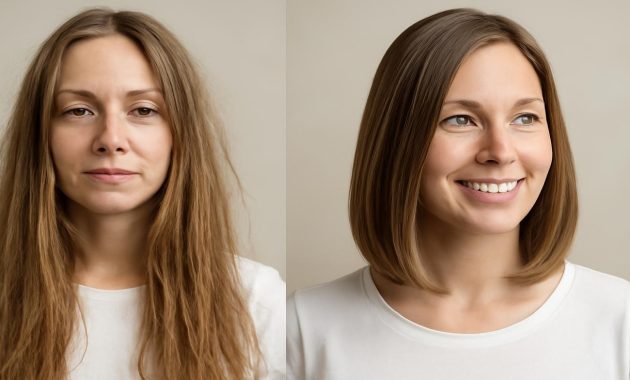
The woman in the salon chair is trying not to cry. Her brush is clutched in one hand like a defeated weapon, the other buried in a dense knot at the nape of her neck. “I swear I brush,” she tells the hairdresser, her voice part apology, part plea. “But the tangles just keep coming back. I wake up and it’s like a bird built a nest in there overnight.” The stylist smiles—the kind of patient smile that comes from hearing this story a hundred times—and reaches for her comb. “You’re not doing anything wrong,” she says calmly. “You just have hair that tangles easily. But we can fix how it behaves. It starts with the right cut.”
The Quiet Struggle of Tangle-Prone Hair
Maybe you know this woman. Maybe you are this woman. Or man. Or teenager standing in a bathroom mirror, wincing through another pass of the brush. You condition, you detangle, you apply serums that promise “slip,” you sleep on a satin pillowcase, and still: your hair tangles if you look at it the wrong way.
It’s not just a vanity problem. It’s a sensory one. You feel the little snags and catches when you turn your head, the drag of your fingers when you push your hair behind your ears, the reluctance of your ponytail to gather smoothly in one go. Your morning routine stretches from minutes into half an hour as you carefully negotiate your way through a maze of knots, trying not to break any more strands than absolutely necessary.
Most people assume tangles are about “bad brushing habits” or “lack of care.” Hairdressers quietly know better. Some hair types are simply born to tangle. Fine hair that flies around in every breeze. Wavy hair that flips and wraps around itself. Curly hair whose spirals interlock like velcro. Long hair that rubs constantly against collars, scarves, and pillowcases. Even thick hair can be tangle-prone when the top looks smooth but the underlayers live in a hidden chaos.
And this is where the conversation in the salon so often turns in a new direction. Because yes, products help. Technique helps. But when your hair tangles easily, hairdressers quietly agree on one thing: the cut you choose can be the difference between a daily battle and a daily truce.
The Cut Hairdressers Secretly Love for Tangle-Prone Hair
Every stylist has a moment when they run their fingers through a client’s hair and feel it: the resistance, the catching, the invisible snarl beneath the surface. They see the broken baby hairs sticking out like static, the frazzled ends clinging to one another, the flat roots and frayed lengths. In those moments, they start mentally sketching a certain shape—a kind of haircut that comes up in conversation again and again when tangles are the problem.
It isn’t the dramatic pixie cut (though that certainly solves tangles). It isn’t the ultra-layered shag that looks dreamy on social media but can become a labyrinth of knots in real life. The cut hairdressers keep circling back to is far more practical, quietly elegant, and surprisingly versatile:
A medium-length, blunt or softly blunt cut with minimal, strategic layering and clean, healthy ends.
It’s not a trendy name so much as a philosophy: remove what tangles, reduce what causes friction, and keep what behaves. Hairdressers might call it a “long bob,” a “lob,” a “one-length cut with light shaping,” or a “soft blunt cut with face-framing layers.” The words change, but the intent is the same—create a shape that lets the hair lie together instead of fight itself.
Imagine your hair like a flock of birds in flight. When their path is clear, they move together, smooth and synchronized. But if the air is choppy, some dip, some rise, some collide. A good cut for tangle-prone hair is about smoothing out that sky so the strands can glide past each other instead of crashing into snags and split ends.
Why Long, Layered, or Razor-Cut Styles Make Tangles Worse
To understand why this simpler, cleaner shape works so well, it helps to look at what usually goes wrong. Many people with tangle-prone hair are drawn to long, flowing styles. There’s something romantic about hair that brushes the waist, catches the light, and moves poetically in the wind. But the reality of living with very long, easily tangled hair can feel less like a romance and more like a full-time job.
Longer lengths mean more surface area for friction. Each strand rubs against your clothes, your bag strap, your seatbelt, your pillow, other strands. Over time, tiny cuticle scales on each hair—microscopic shingles—lift and roughen. Rough cuticles act like hooks, catching onto each other and forming tangles that begin as small snags and grow into determined knots.
Then come the layers. Layers, when overdone or cut too short and choppy on tangle-prone hair, can behave like different personalities in one head of hair—each with its own agenda. Shorter pieces spring out, twist around longer ones, and poke through ponytails. When the wind blows, they wrap and tighten. Razor cuts, which can look beautifully airy on some hair types, literally shred the ends into finer pieces, increasing the likelihood of fraying and catching.
In a quiet consultation, many hairdressers will admit: “Your layers are tangling you.” It doesn’t mean layers are forbidden. It means they need to be strategic, subtle, and supportive rather than the star of the show. For hair that tangles easily, too much movement can turn into too much chaos.
By contrast, a medium length—somewhere between the collarbones and the top of the chest—strikes a sweet spot. The hair is long enough to feel feminine or full, to still be pulled into a ponytail or clipped up, but short enough that it’s not constantly sitting in the high-friction zone of your mid-back. A mostly one-length base gives strands a sense of unity, so they fall together instead of into separate, colliding directions.
What This “Tangle-Safe” Cut Actually Looks and Feels Like
Picture this: your hair grazing your collarbones or just below, like a soft curtain. The line at the bottom looks clean, not ragged. When you run your fingers through it, you feel it glide rather than hesitate. The ends have a quiet weight to them, enough to line up together instead of drifting into wispy, separate directions.
At the very bottom, the cut is either blunt—straight across—or softly blunt, where a stylist has gently rounded or micro-texturized the edges so they don’t look harsh. The bluntness is your friend here. It keeps the ends even and stronger, less likely to fray, less likely to form that telltale net of tiny, stubborn knots you meet every morning at your hair’s halfway point.
Layers do exist, but they’re subtle and usually longer. A hairdresser might quietly carve out a few internal layers to remove bulk from thick hair, or to help waves and curls fall with a little shape. Around your face, they might add delicate pieces that curve into your cheekbones or jawline, softening the outline when you tuck your hair behind your ears.
The result isn’t stiff or helmet-like. It moves. It breathes. But it does so as though every strand knows roughly where it’s meant to go. When you flip your hair over one shoulder, it lands in a smooth sheet instead of a cloud of scrambling ends. When you brush before bed, the comb passes through with just a few minor protests, not a full revolt.
Ask a hairdresser who sees a lot of tangling clients and you’ll hear versions of the same story: “We cut off a few inches, evened out her layers, cleaned the ends, and she came back saying, ‘I didn’t realize how much my haircut was working against me.’” The transformation isn’t just visual; it’s tactile, audible. There’s less tearing, less snapping, fewer sighs in front of the bathroom mirror.
The Daily Difference: Trimming Time, Not Just Length
What surprises many people isn’t just how their hair looks, but how their day feels different. You start brushing your hair in the morning and finish in two minutes instead of ten. Your shower detangling session turns into a simple comb through with conditioner instead of a strategic, deep-breath operation. You pull out your hair tie at night and fewer strands come out with it.
In the salon, stylists talk about “maintenance” not as a punishment but as a protective rhythm. For tangle-prone hair, this usually means trimming that medium-length, softly blunt cut every 8–12 weeks. Not a reinvention, just a quiet preservation. Clean ends matter more for you than for almost anyone else. Once split ends start, they fray, cling, and knot, and suddenly your haircut is no longer your ally.
Over time, you might notice something else. Your hair feels thicker even if it’s actually finer. That’s because instead of living with scraggly, thinned-out lengths, you’re keeping the weight where it’s strongest—toward the ends, where it can hang together instead of flying apart in a dozen directions. Your brush glides with a soft hiss instead of a stop-and-go scrape.
How Hairdressers Gently Adjust This Cut to Your Hair Type
Within this general “tangle-safe” shape, hairdressers still personalize. The point isn’t to give everyone the same haircut; it’s to use the same principles—less friction, cleaner ends, strategic layers—to support different textures.
For fine, straight hair that tangles easily, stylists may lean toward a very clean, one-length lob, maybe just brushing the collarbones. Too many layers here would create flyaways that wrap and knot. The cut stays sleek, with maybe a few soft, face-framing pieces and a careful avoidance of razor tools. A sharp pair of scissors, clean lines, and smooth edges matter.
For wavy hair, the stylist might keep that same length but open up a touch of internal layering, invisible from the outside but helpful to relieve weight. They may cut the ends with a slightly softened blunt line, so the wave can curve without looking boxy. The goal is simple: waves that stack and flow instead of tangling into their neighbors.
For curls, the conversation gets more precise. Curls already intertwine; tangling is part of their language. Here, a hairdresser might work with a medium length but allow for more careful, curl-based layering, cut either on dry curls or with attention to curl pattern. They’ll still be cautious with overly choppy ends. Even in curls, too many uneven, frayed tips create micro-knots. The stylist aims for curls that coil, not snarl—each spring allowed space without being sliced into fragile wisps.
Even coily or kinky hair, which can be deceptively prone to single-strand knots, can benefit from this philosophy: keep ends healthy and clean, avoid shredding them, and shape the overall cut so the coils can shrink into themselves instead of constantly rubbing past overlapping, jagged tips.
Small Choices, Big Payoff: Lengths, Ends, and Edges
In the stylist’s chair, the practical magic often lives in tiny decisions. One inch shorter or longer changes where your hair rests on your collars and jackets. A slightly rounder line at the front can prevent those delicate front pieces from constantly catching inside scarf fibers. Choosing scissors over razors protects fragile ends. Snipping away the most damaged two or three inches can dramatically reduce knots, even if it feels like a big step at first.
Hairdressers think about these details all day long. They watch how your hair moves when you turn your head, how it responds to being brushed, how it falls back after being lifted. In your consultation, you might hear them say, “See how it grabs here?” as their fingers find that zone where tangles are born. Then they plan your cut to calm that zone down—shortening, smoothing, or subtly redirecting the hair around it.
| Hair Type | Common Tangle Triggers | Stylist-Recommended Cut Tweaks |
|---|---|---|
| Fine & Straight | Friction from clothing, split ends, over-layering | One-length or soft-blunt lob, minimal layers, sharp scissor cut |
| Wavy | Uneven layers, dryness, mid-back length rubbing | Collarbone to upper-chest length, light internal layers, soft edges |
| Curly | Fragile ends, heavy triangle shape, single-strand knots | Medium length with curl-conscious layering, no razored ends |
| Thick or Coarse | Bulk at the nape, rough cuticles, friction from constant movement | Soft-blunt base, invisible internal layers, regular dusting of ends |
Living With Less Tangle: The Sensory Shift After the Cut
The first morning after getting a haircut like this, many people instinctively brace themselves. Old habits don’t vanish overnight. You pick up your brush or comb and prepare for the usual resistance. But as you start from the ends and work upward, something is different. Instead of the familiar tug-tug-snap, you hear a soft, continuous whisper of bristles slipping through.
Your neck feels lighter, your shoulders a little less encased. When you pull your hair into a bun, it wraps neatly rather than exploding into loose, wandering strands. When you take that bun down, the hair falls in a smoother curtain, fewer surprise knots hiding at the base of your skull.
Walking outside, you still feel the wind, but you don’t dread what it’s doing back there. You can run your fingers through your hair while you’re waiting at a bus stop, not to fix chaos but to enjoy the way it falls back into place. You might even touch the ends absentmindedly, noticing that they feel almost… blunt. Solid. Less like cobwebs, more like silk ribbon.
This is the subtle power of a cut built for tangle-prone hair: it doesn’t just change what you see in the mirror; it changes how your hair feels to live in all day. That nagging awareness of “my hair is a mess back there, isn’t it?” fades. In its place comes something quieter, gentler—trust.
Working With the Cut, Not Against It
A haircut isn’t a magic spell. It’s more like a really good map. It shows your hair where to go and makes the path easier, but you still walk it. For tangle-prone hair, this means a few simple habits that, combined with the right cut, dramatically shift the daily story.
You might brush gently before bed, especially focusing on the nape where hair twists during sleep. You gather your hair loosely above the head or in a low, soft braid if it’s long enough, so it rubs less against sheets. You use a wide-tooth comb in the shower with conditioner, starting from the tips and easing upward. You towel-dry with a squeeze instead of a rough rub, preserving those newly clean ends.
Yet with the right cut, these actions feel like light maintenance, not crisis control. You’re no longer detangling in order to undo damage; you’re just supporting what the haircut already set in motion. The friction is smaller, the knots fewer, the whole relationship less adversarial.
Most noticeably of all, you begin to trust that when you walk into your stylist’s chair, you’re not at the mercy of trends that weren’t made for your hair type. You can say: “My hair tangles easily. I’m okay losing some length. I want something medium, mostly one length, not too many layers—something that makes detangling easier.” And your stylist will likely nod with recognition, already picturing that soft, clean outline and those stronger, smoother ends.
FAQs About Cuts for Tangle-Prone Hair
Does cutting my hair shorter always reduce tangles?
Not always, but going from very long to a medium length usually reduces friction and wear on the ends. Extreme short cuts like pixies almost eliminate tangles, but many people prefer to keep some length. A collarbone-to-upper-chest length is a strong middle ground for most tangle-prone hair.
Are layers bad if my hair tangles easily?
Layers aren’t automatically bad; they just need to be controlled. Subtle, longer layers that support your hair’s natural movement can help. Overly short, choppy, or heavily razored layers on tangle-prone hair often create more snags and knots.
How often should I trim to keep tangles under control?
Most hairdressers suggest every 8–12 weeks for tangle-prone hair. Even tiny “dustings” of the ends prevent split ends from spreading and catching on neighboring strands, which is a major cause of knots.
Is a blunt cut too heavy for thick hair that still tangles?
A completely blunt cut can feel heavy on very thick hair, but a soft-blunt base with hidden internal layers is ideal. It preserves smooth, clean ends while removing bulk from the inside so the hair moves without puffing or tangling as easily.
Can I keep my curls or waves with this kind of cut?
Yes. The aim isn’t to flatten or fight your texture, but to organize it. A medium length with thoughtfully placed layers—cut with your curl or wave pattern in mind—can let texture bounce while keeping the ends strong and less prone to knotting.
Will this type of haircut make my hair look thinner?
Generally, no. In fact, because the ends are cleaner and more solid, your hair often looks fuller. Wispy, split ends create the illusion of thin, tired hair. A soft, blunt edge makes the hair appear denser and healthier.
What should I tell my stylist to get this kind of cut?
Try something like: “My hair tangles very easily. I’d like a medium length, around my collarbones or a bit longer, mostly one length or softly blunt, with minimal layers—just enough for shape, not lots of choppy pieces. And I’d like the ends to be clean and strong, not razored.” This gives your hairdresser a clear starting point to tailor the cut to your texture and lifestyle.