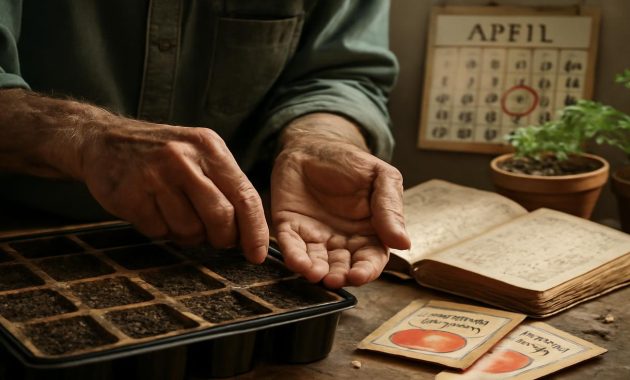
The old men on the village benches always said there was one day—one exact date—when you sowed your tomato seeds if you wanted to beat everyone to the first ripe fruits. Not a week, not a vague “around then,” but a day you could circle on a calendar, a day that felt like a secret handshake with the season. As a kid, I thought it was superstition. As an adult standing in a chilly shed in late winter, seed packet in one hand and steaming mug in the other, I started to understand: the old-timers weren’t just sowing tomatoes, they were sowing time itself.
The Day the Season Quietly Begins
The date in my valley was written in pencil in the margin of my grandfather’s almanac: March 10. Others swear by the first Friday after the full moon in March, or St. Joseph’s Day, or the spring equinox. The actual number on the calendar shifts from region to region, but for each old-timer, that date is as solid as oak. When it came, they didn’t hesitate. They didn’t check ten websites, debate varieties for hours, or get stuck in analysis; they simply knew: it’s tomato day.
The world outside on that date rarely felt ready. The soil was still cold and heavy, the hedges dull, and the wind cutting enough to sting your ears. The idea of tomatoes—sun-warmed, red, bursting with juice—seemed almost rude in such a grey landscape. But that contrast is part of the magic. Tomato sowing, the way the elders did it, isn’t about reacting to warmth you can feel on your skin, it’s about anticipating warmth that only exists in your memory and your faith.
They’d shuffle out to their sheds or tiny glasshouses, boots scratching on concrete, breath visible in the air. Seed trays—reused again and again, their corners whitened by age and sun—would be lined up like little empty stages waiting for the actors to arrive. On that exact date, winter finally had a crack in it, and the crack was just wide enough to slip tomato seeds through.
The Rhythm Behind the “Exact Date”
Ask an old grower why they sow on that particular day and they might grin and say, “Because my father did.” But beneath the shrug is a kind of slow, field-tested science. Behind the superstition sits a rhythm measured not in laboratory data but in decades of watching skies and soil.
The logic is simple, once you trace it. From seed to transplant-ready seedling, tomatoes need about six to eight weeks under protection. From transplant to first fruit, they need another seven to ten weeks, depending on the variety and the warmth of the season. Start too early, and your seedlings stretch into pale, leggy straws, starved for light, sulking in small pots while the ground outside still bites with frost. Start too late, and you’ll be chewing store-bought tomatoes while your vines are still a tangle of hopeful green.
The old-timers figured out, year after year, where that sweet spot lay—the one where your seedlings hit their stride at precisely the moment the soil begins to lose its winter memory. They didn’t call it “back-calculating from your last frost date,” but that’s exactly what they were doing, in a kind of quiet, embodied arithmetic.
In many temperate regions, that perfect sowing window falls somewhere between late February and late March. In colder zones, it can be early April. The exact date became lore: the day you’d start your tomatoes if you wanted your vines weighed down in July while your neighbors were still offering polite compliments to their first blossoms.
Sowing Tomatoes the Old-Timers’ Way
If you could stand in one of their sheds on that special date, you’d notice how unhurried it all feels. There’s no sense of panic or performance, just a practiced ritual, every motion worn smooth by repetition.
The seeds themselves are tiny, dry flecks—unimpressive if you judge them by size. But in the weathered hands of an old gardener, they’re treated with a sort of dignified respect usually reserved for heirlooms. A thumb runs along the fold of the packet, tapping them gently into a cupped palm. No seed is wasted; each one is a future story.
Let’s walk through the process as they would, with the same unshowy attention to detail:
- The soil: A light, fine-textured seed compost, never heavy garden soil. It’s usually sifted by hand, crumbly and slightly damp, like cake flour that’s remembered rain.
- The containers: Old seed trays, shallow boxes, or re-used pots washed sometime in winter when snow was at the door and there was nothing else to do.
- The sowing: Seeds scattered thinly—never in a clump. A whisper of compost over the top, just enough to hide them from the light, not enough to bury them alive.
- The warmth: A place that stays between 18–22°C (64–72°F), if possible. In the old days that might mean a spot near the kitchen stove, on top of a warm cupboard, or inside a cold greenhouse with a little extra insulation.
- The water: Not a drenching, just a careful mist or a trickle along the tray, so the seeds feel moisture without shock.
They didn’t fuss with grow lights or heat mats (though there’s nothing wrong with those). They relied on sheltered windowsills and sun-warmed glass. The rhythm was slower, less controlled, but in a way that taught patience as much as it produced food.
The Invisible Countdown
From that sowing date, an invisible clock begins to tick. Every day, even before the first green hook breaks through the soil, time is shifting inside those seeds. Enzymes wake, cells divide, a thousand tiny processes spark into motion. The old-timers knew that by sowing on their date, they’d set this invisible machinery in sync with the year outside.
That’s the real magic of the exact date: it aligns biology and calendar, daylight and soil temperature, seedling growth and the softening of spring. By the time the world opens its doors to warmth, your tomatoes are already dressed and waiting at the threshold.
Why They Harvested Before Everyone Else
Neighbors used to marvel: “How is it that his tomatoes are ripe when mine are still a tangle of flowers?” The answer was rarely a miracle variety or expensive equipment. It was mostly timing, layered with care.
Starting on a fixed, optimal date meant their young plants spent their earliest weeks under reasonably steady conditions instead of bouncing between extremes. That single choice had a cascade of benefits:
- Stronger roots: Not rushed but not stalled, seedlings developed dense root systems primed to explode into growth once transplanted.
- Less transplant shock: Because the soil had just reached that subtle “ready” point, roots didn’t sulk after planting; they explored.
- Early flowering: Plants hit their reproductive stride faster, producing blossoms as soon as daylength and warmth would sustain fruit set.
- Longer season: An early, well-timed start gave an extra few weeks of harvest at the front end—often the sweetest weeks of the entire year.
There’s also something almost psychological about it—for both plant and person. When you sow late, you tend to rush everything else: you overfeed, you overwater, you crowd plants, pushing them to make up lost time. The old-timers weren’t rushing. They’d already made their quiet leap of faith on that special date. From then on, they simply walked beside the season instead of trying to sprint ahead of it.
A Mobile-Friendly Snapshot of the Old-Timer Strategy
Here’s a simple, compact way to think like the old-timers, laid out so it reads cleanly on a phone screen:
| Step | Old-Timer Insight | What It Does For You |
|---|---|---|
| Pick an exact sowing date | 6–8 weeks before last frost, same date every year | Creates a repeatable rhythm; avoids guessing and rushing |
| Sow lightly in fine compost | Thin sowing, shallow covering | Prevents crowding and weak, leggy seedlings |
| Provide steady warmth | Bright, protected place; not too hot, never cold drafts | Ensures even germination and sturdy early growth |
| Pot on only when needed | Move up in stages as roots fill the pot | Builds strong root systems and compact plants |
| Transplant after danger of frost | Plant out when nights are reliably mild | Minimizes setbacks, speeds flowering and fruiting |
Choosing Your Own “Old-Timer Date”
You might not have a grandfather’s notebook with a penciled-in date, but you can still claim one for yourself and treat it with the same reverence. Instead of copying someone else’s calendar, listen to your climate the way the elders did.
Start by finding your average last frost date—the rough point in spring when temperatures usually stop dipping below freezing. Then count backward six to eight weeks. That’s your window. Within that window, choose one day that feels right to you. Maybe it’s the first Sunday of March so you’ll never forget it, or the spring equinox for its poetic neatness. Maybe it’s your birthday, or your child’s, or a date that marks something you want to remember with sunlight and flavor.
The crucial thing isn’t whether it’s March 10 or 21, or April 5; it’s that you choose a date and stick with it, season after season. Over time, you’ll watch how your plants respond. If they’re always leggy by planting-out time, nudge the date a week later. If they seem to sit sulking after transplanting, consider moving your sowing date forward or improving your protection outdoors.
The old-timers were unapologetic experimenters. They only looked stubborn because by the time you met them, their experiments were already over and their habits were finely tuned. You’re allowed to iterate. In fact, you’re supposed to.
Tomatoes as a Measure of Your Year
There’s another reason these calendar dates became so sacred: they anchor you. Life can feel abstract and digital, unmoored from weather and soil. But when you say, “This is the day I sow tomatoes,” you tie your year to something living and visible.
By midsummer, you won’t remember every email you answered in March. But you’ll remember the day you pressed those seeds into soil while it still felt mad to be thinking of summer. You’ll remember watching the first leaves unfurl, that delicate shade of green that exists nowhere else but in newborn plants. You’ll remember the first time you caught the smell of tomato foliage on your fingers—sharp, green, almost resinous—hinting at sauce and salads and sunlight long before fruit appears.
That exact date becomes a private holiday, a quiet ceremony. It doesn’t show up in anyone else’s calendar app. Yet year after year, it will mark the moment when you gave the season a little nudge forward and said, “I’m ready. Let’s begin.”
Carrying the Tradition Forward
You don’t need inherited land or a crumbling glasshouse to sow tomatoes like the old-timers. A sunny balcony and a few pots will do. A city kitchen windowsill will do. What you’re inheriting isn’t their tools or even their climate; it’s their way of paying attention.
On the date you choose, treat the act of sowing as more than a chore. Feel the compost between your fingers. Hear the soft patter of seeds as they leave the packet. Notice the smell of damp soil—a quiet, earthy promise that something will happen here, unseen at first.
Label your trays, not just with variety names but with the date. That small act of writing it down is your handshake with the future. A month later, when you’re easing your seedlings into bigger pots, you’ll see that date and remember the cold light of that morning, the way the wind rattled the window while you dreamed of warm evenings and red fruit.
By early summer, if you’ve chosen well, your plants will be ahead of the curve. While others are posting photos of their first blossoms, you may already be tying up stems heavy with green fruit, checking each morning for that first blush of color. The satisfaction isn’t just in being “first”; it’s in knowing that a simple, faithful act on an ordinary late-winter day has unfolded into this abundance.
Somewhere, an old gardener who swore by their exact date would nod in approval—not because you copied their day, but because you found your own.
FAQ: Tomato Sowing and the Old-Timers’ Exact Date
How do I find the right tomato sowing date for my area?
Look up your average last frost date, then count back six to eight weeks. That gives you a good sowing window. Choose one specific day within that window and use it every year, adjusting slightly over time based on how your plants perform.
Is it really that important to use the same date every year?
Consistency helps you learn. By using the same date, you remove one variable and can clearly see if changes in weather, varieties, or your growing methods are helping or hindering your crop. Over the years, that fixed date becomes a reliable anchor.
What happens if I sow tomatoes too early?
Seeds will usually germinate, but seedlings can become tall, spindly, and weak due to low light and cramped conditions. You may end up potting them on multiple times before it’s safe to plant them outside, which stresses the plants and you.
What if I’m late—can I still sow tomatoes?
Yes, within reason. You can sow a bit later and still get a decent crop, especially if you grow smaller or early-ripening varieties. You might harvest later than early starters, but you’ll still enjoy homegrown fruit, just with a shorter season.
Do I need special equipment like grow lights or heat mats?
They help, especially in colder climates or dim houses, but they’re not essential. A bright windowsill and a room that stays reasonably warm can be enough. The old-timers worked with what they had: sun, glass, and timing.
How deep should I sow tomato seeds?
Very shallowly—about 0.5 cm (a quarter inch) deep, or just covered with a fine layer of compost. Too deep and they struggle to emerge; too shallow and they can dry out. Think of it as tucking them in rather than burying them.
When do I move seedlings from trays into individual pots?
Once they have their first true leaves (the second set of leaves after the initial seed leaves) and are big enough to handle, transplant them into individual cells or small pots. Bury the stem slightly deeper each time you pot up to encourage strong root growth.
How can I tell if my chosen date is working well?
By the time your outdoor temperatures are reliably mild and frost has passed, your seedlings should be sturdy, 15–30 cm (6–12 inches) tall, with thick stems and healthy green leaves. If they’re much smaller, consider sowing a little earlier next year. If they’re leggy and overgrown, sow a bit later—or provide more light.