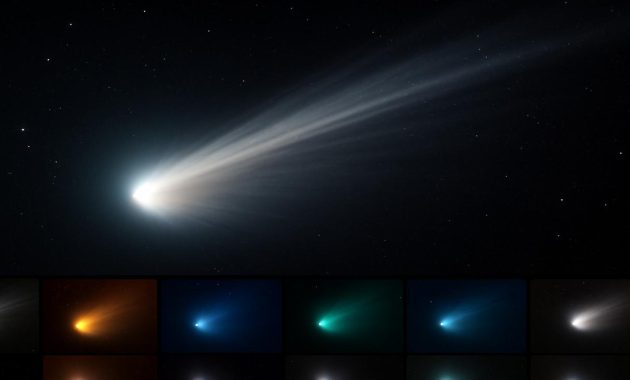
The first time you see it, you don’t think “science.” You think: ghost. Hanging in the blackness beyond our familiar planets, the comet 3I ATLAS looks less like a rock and more like a slow-burning thought—thin veils of dust and gas etched in light, caught by a set of spacecraft that, until now, have never shown us an interstellar wanderer in such raw, piercing detail. Eight new images, stitched from distances where sunlight is little more than a pale whisper, have given us our clearest glimpse yet of a visitor from another star. And that visitor looks, above all, like a question made visible.
The Moment the Images Came In
The data didn’t arrive with fanfare. It pulsed down through the Deep Space Network, quiet streams of numbers from a spacecraft so far away that radio signals need hours to reach us. Somewhere in a mission control room, a team watched grids of pixels coalesce on their screens—faint smudges at first, then sharp edges, then unmistakable structure: the nucleus of 3I ATLAS, haloed by a coma that seemed to breathe.
Everyone knew this was coming. Observers had planned for it, simulations had run for months, and instruments had been tuned almost obsessively. But preparation never quite blunts the moment when the universe sends something truly new. The eight images—captured at slightly different times, angles, and wavelengths—brought the comet into focus with a clarity that made people lean closer instinctively, as if getting physically nearer might squeeze more detail from the light.
On the screens, 3I ATLAS was no longer a tracking dot in a database, not just a spike in a spectrum. It was a textured, dimensional object, streaming dust in a long, ghostly tail that hinted at a journey lasting millions of years. It had come from somewhere far beyond the soft blue shell of our solar system, from the cold suburbs of another star—or perhaps the thin, lonely spaces between stellar neighborhoods. No one knows exactly. That uncertainty hangs over every pixel.
The Second Interstellar Interloper
Just by existing, 3I ATLAS already belongs to an exceedingly rare class. It is only the third known interstellar object and the second confirmed interstellar comet, after 2I/Borisov, to pass through our solar system. It wears that designation—3I—like a quiet badge of strangeness. The “I” stands for “interstellar,” a label astronomers have been waiting to use more often, hoping for a crowd of such visitors. For now, it’s still a tiny, exclusive list.
Most comets are homegrown: icy bodies from the distant Oort Cloud or the Kuiper Belt, wandering inward on elongated paths, shedding material as they warm under the Sun’s radiation. 3I ATLAS is different. Its trajectory slices through the solar system at an angle and speed that simply don’t fit the gravitational patterns of anything that formed here. That hyperbolic path—open, never looping back—marks it as a migrant from another stellar story.
Even before these new spacecraft images, telescopes on and above Earth had tracked its motion, teased apart its spectrum, and confirmed that this was no local fragment. But those earlier observations left 3I ATLAS looking like a soft blot of light. The newly released set of eight high-resolution images has changed that. Now we see subtle structure: the way the coma thickens on one side, the layering in the dust tail, the faint suggestion of jets—thin plumes of gas and dust spraying from active patches on the nucleus.
Seeing an Alien Comet Up Close
It’s one thing to know that a comet is interstellar in origin. It’s another to peer at it so closely that you can almost imagine tracing the scars on its surface. The instruments that captured these views weren’t originally designed for a perfect portrait of an alien comet; they were multi-purpose cameras and spectrometers, bolted to a spacecraft that had its own main mission. But flexibility and a bit of bold planning allowed them to act, in effect, as an interstellar wildlife photographer—lying in wait, pointing just so, and clicking at the exact right moment.
In visible light, the images show a nucleus so small that even at this resolution it’s more a bright knot than a resolved sphere. Around it swirls a faint, grainy glow—the coma, a cloud of gas and dust released as sunlight sublimates ices from the surface. Even on a screen, the coma has a kind of tactile feel, as if you could reach out and stir it with your fingers. You can almost sense the slow boil of molecules flying off into the void.
In some of the eight frames, the tail spreads out like a river of fog, narrowing with distance, streaked with fine striations that mark where different sizes of dust grains have been pushed and sorted by the pressure of sunlight. In others, the spacecraft switches filters, and the comet turns ghostly, lit not by reflected sunlight but by specific gases fluorescing—water fragments, cyanogen, carbon compounds glowing faintly as they’re energized by radiation.
The level of clarity is startling because of the comet’s sheer distance and speed. 3I ATLAS is racing through space at tens of kilometers per second, slipping past the Sun just once before it’s gone for good, never to return. Capturing it with such precision is like photographing a speeding bullet from the far side of a football field—at night, with the only light coming from a distant streetlamp.
The Subtle Colors of an Interstellar Visitor
When the images are combined into color, 3I ATLAS takes on subtle tints: a slightly bluish cast in the outer coma, a warmer, more neutral tone near the nucleus. These are not the exaggerated, false-color palettes you sometimes see in space imagery; they’re careful composites, designed to reflect how real materials scatter and emit light. That faint blue rims the comet’s atmosphere where ionized gases dominate, while dust closer to the nucleus gives off a softer, whiter glow.
It’s easy to forget that these colors hint at chemistry. The spectrum of 3I ATLAS suggests a composition broadly familiar—water ice, carbon monoxide, carbon dioxide, various organic compounds—but their relative proportions may diverge from those of comets that formed alongside our Sun. Interstellar comets are like bottled samples from foreign laboratories, carrying clues about the conditions in disks of gas and dust that surrounded other, long-distant stars.
How 3I ATLAS Compares to “Our” Comets
We tend to imagine interstellar objects as fundamentally alien, utterly unlike anything close to home. The new images of 3I ATLAS complicate that story. In many ways, it looks like a local comet. It grows a tail as it approaches the Sun. It sheds material in characteristic patterns. It behaves, outwardly, like the comets we’ve been watching for centuries.
But when astronomers place its observed properties side-by-side with more familiar comets, differences begin to whisper through the data. To make those contrasts easy to visualize, imagine a quiet comparison chart—a snapshot of how this newcomer stacks up against our well-known icy travelers.
| Feature | Typical Solar System Comet | Interstellar Comet 3I ATLAS |
|---|---|---|
| Origin | Oort Cloud or Kuiper Belt around our Sun | Formed around another star or in interstellar space |
| Orbit Shape | Elliptical; many return periodically | Strongly hyperbolic; one-time flyby |
| Speed Through Inner Solar System | Typically 10–70 km/s | On the higher end; faster than most local comets |
| Appearance in High-Res Images | Well-studied; structures tied to known activity patterns | Similar overall shape, but with subtle, possibly unique jet and coma structures |
| Scientific Value | Reveals history and chemistry of our own solar system | Offers a physical sample of conditions in another planetary system |
In other words, 3I ATLAS is not an inscrutable stranger. It’s like meeting someone from a very distant country who still laughs, cries, and dreams in ways you recognize. The physics of ice and sunlight, of dust and radiation, is the same no matter where a comet is born.
The Story Written in Scars and Jets
Look closely at the images—really sink into them—and you can start to read into the fine details. Some of the brightness is smooth and diffuse, but other portions clump into knots and streaks. Those patterns suggest jets: localized eruptions where volatile ices find a crack to escape, blasting out into space and dragging dust along for the ride.
The way those jets are angled, the way they fall off with distance, can hint at the comet’s spin. Is 3I ATLAS rotating quickly or lazily turning end over end? The brightness variations from one image to the next, as the spacecraft sees the comet from slightly different angles, begin to paint a three-dimensional, time-lapse portrait. These are the clues mission scientists pore over late at night, tracing lines and curves, hunting for the rhythm of an object that’s never before been under such scrutiny.
The Long Journey Before the Snapshot
None of this is happening in isolation. Before 3I ATLAS ever brushed past the outskirts of our planetary system, it lived a long, cold life elsewhere. Perhaps it formed in a dense disk of gas and dust swirling around a newborn star, billions of years ago. Maybe it was part of a crowded cometary cloud, nudged and jostled by growing planets. At some point, a gravitational encounter—maybe with a gas giant, maybe with a passing star—gave it a kick hard enough to escape its home entirely.
From then on, it traveled alone. No sunlight warm enough to melt even its most delicate ices, no planetary magnetospheres to brush past. Just the thin, steady drizzle of cosmic rays and the incredibly slow erosion of micrometeoroid impacts. Over millions, maybe hundreds of millions of years, that quiet bombardment would have left its mark: darkening the surface, altering the top few meters of its crust, building up a skin of processed material over more pristine layers below.
When 3I ATLAS finally drifted into the Sun’s sphere of influence, our star’s gravity didn’t capture it. The comet was moving too fast, riding a trajectory too open. Instead, the Sun merely curved its path, bending it into a sharp arc that will eventually lead it back into the deep dark. The time it spends in our inner solar system—where our instruments can see it best—is laughably short compared to the age of the universe.
The new spacecraft images, then, are not just close-ups; they’re interruptions. For a brief window, we step into the comet’s journey, shine light on its surface, measure its breath as it responds to a star it has never felt before. And then we step back out, letting it continue on its way, changed slightly by this flyby but largely indifferent to our astonishment.
What the Images Can’t Tell Us—Yet
As sharp and revealing as these eight images are, they’re also a reminder of limits. We don’t see individual boulders rolling down slopes, as some close comet missions have shown us with local objects. We don’t get the scent of alien volatiles; chemistry comes only as lines and bands in a spectrum, translated into numbers, then into models, and finally into stories we tell one another about what might be true.
There will be debates. Are the brightness variations due mostly to activity or to changes in viewing geometry? Does the profile of the tail suggest any unusual grain sizes? Are the jets mapped in these frames consistent with a simple rotation model, or is something stranger at work? Science thrives on those questions, and 3I ATLAS, in its quiet way, is provoking many.
Why These Images Matter So Much
In the age of constant imagery—of planets photographed in exquisite detail, of rovers sending back panoramas from Mars—it’s tempting to shrug at another set of space pictures. But this is different. Most of our solar system photography has been of things that belong to our own cosmic backyard. 3I ATLAS is, literally, from somewhere else. That alone electrifies each frame with an extra layer of meaning.
The new images give us more than beauty. They tighten constraints on models of how comets form in other systems. They help us understand how common certain types of ices and organic compounds might be across the galaxy. They let us test our assumptions about how sunlight, dust, and gas interact—even under conditions slightly outside our homegrown norms.
There’s also a practical future embedded in these pictures. If, someday, we send a dedicated mission to rendezvous with an interstellar object—maybe even to return a sample—these early, high-resolution glimpses will be the trail markers. They show that it’s possible, with planning and a bit of luck, to catch visitors from the stars in the act of passing through, and to see them clearly enough to learn real, detailed physics from the encounter.
A Practice Run for Meeting the Galaxy
In a sense, every image of 3I ATLAS is a rehearsal. We live in a galaxy filled with stars that likely host planets, moons, and clouds of unused building blocks. Most of that diversity is, for now, abstract—a set of exoplanet catalogs, some atmospheric spectra, a growing list of candidates. But an interstellar comet is tangible. It is a piece of another planetary system arriving on our doorstep, no invitation necessary.
By learning how to spot these objects early, how to predict their paths, how to turn our instruments to them with precision and speed, we’re preparing for a future in which such visits become more than rare surprises. As our surveys become more sensitive, we’ll likely find many more interstellar travelers. Each will be unique; each will carry its own textures, chemistries, and histories.
3I ATLAS happens to be the one we are seeing now, in this particular decade of human curiosity. Its eight newly released images are, for our generation, a first clear handshake with the wider galaxy’s small, icy citizens.
Holding a Moment of Interstellar Light
In one of the late images from the set, the comet is already pulling away, its path bending outward, the Sun whispering behind it. The tail thins, the coma dims; the whole structure seems to fade back into the starfield. If you didn’t know better, you might lose it among the background galaxies—other islands of light that have no idea a tiny snowball from far away just brushed past this modest star we call home.
Somewhere on Earth, someone will print one of these frames and pin it above a desk, or tape it to the inside of a notebook. Not because it’s the most colorful or the most dramatic picture space has ever given us, but because of what it represents: proof, etched in photons, that our solar system is not sealed off. Objects from other stars drift through here. They leave chemical and gravitational fingerprints. They let us, very briefly, hold up a candle to the wider dark and see a few inches farther.
When we look at 3I ATLAS now, we see an icy body unraveling under a new Sun, spring thaw arriving after an interstellar winter that lasted longer than any human language. We see a traveler passing through, unaware of the civilizations watching, measuring, imagining. And in eight sharp, luminous images, we see ourselves, too—small, curious, and suddenly aware that the distance between stars is not empty after all.
Frequently Asked Questions
What is 3I ATLAS?
3I ATLAS is an interstellar comet—an icy body that originated outside our solar system and is passing through only once on a hyperbolic trajectory. It is the third confirmed interstellar object and the second known interstellar comet.
Why are the new spacecraft images of 3I ATLAS important?
The newly released set of eight images shows 3I ATLAS with unprecedented clarity, revealing detailed structure in its nucleus, coma, and tail. This allows scientists to study its activity, rotation, and composition in ways that weren’t possible with Earth-based observations alone.
How is 3I ATLAS different from typical comets in our solar system?
Unlike most comets that follow elliptical orbits and can return periodically, 3I ATLAS follows a hyperbolic path and will pass through the solar system only once. Its speed and trajectory show that it was not formed around our Sun but in another stellar environment—or possibly in the space between stars.
Do these images show anything truly “alien” about the comet?
The images show that 3I ATLAS behaves much like solar system comets—developing a coma and tail as it approaches the Sun. However, subtle differences in its activity patterns and inferred composition hint at a slightly different formation history and environment compared with local comets.
Will 3I ATLAS ever return to our solar system?
No. Because it follows an open, hyperbolic orbit and is moving very fast, the Sun’s gravity cannot capture it. After its brief passage through the inner solar system, 3I ATLAS will head back into interstellar space and will not return.
Could we ever send a spacecraft to an interstellar comet like this?
Reaching an interstellar comet is extremely challenging due to its high speed and unpredictable arrival time. However, missions that capture rapid-response flybys or use advanced propulsion may be possible in the future. The detailed observations of 3I ATLAS help lay the groundwork for planning such missions.
What do interstellar comets tell us about other planetary systems?
Interstellar comets are physical samples of material formed around other stars. By analyzing their composition and behavior, scientists can compare them with our own comets and learn how common certain ices and organic compounds are across the galaxy, giving clues to how planets and possibly life might form elsewhere.
Originally posted 2026-03-05 00:00:00.