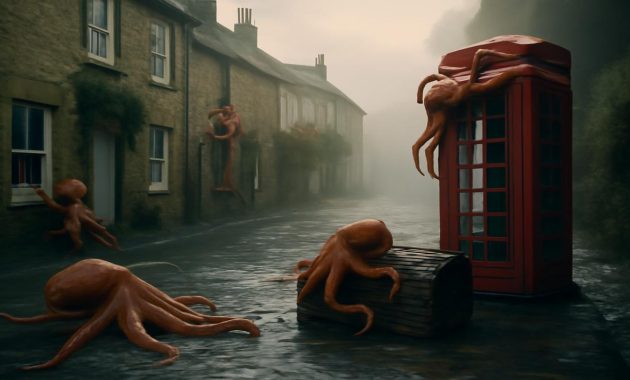
The first time it really hit anyone that something was wrong was when the chips disappeared.
Not the mysterious kind of disappearance that involves gulls dive‑bombing seaside tourists and snatching their lunch, or the slow decline of a dying fishery. No, this was overnight. One blustery Tuesday in late September, Mrs. Turner of Whitby trundled down to the harbour to open her little white‑painted food truck, just as she had for thirty‑seven years. The air smelled of diesel and kelp and the sweet‑sour perfume of old vinegar on weathered wood. By half past ten, the oil was hot, the potatoes peeled, and the first fishing boats were nudging into their berths.
And then they saw the pots.
Every creel, every lobster pot strung like punctuation marks along the harbour wall, every net and crate and bucket was crawling – actually, boiling – with octopuses. Not a few, not one misplaced cephalopod that lost its way in the tide. Dozens. Then hundreds. Gray‑mauve arms and white‑suckered limbs slopping over each other, sliding up wet stone, testing the air, tasting the paint on the boats with questing, gelatinous fingertips. In the cold North Sea light, the harbour looked alive, as if the sea itself had stood up and climbed ashore.
By the time lunchtime came, Mrs. Turner had lost an entire sack of potatoes, two cod fillets, and one heroic octopus that launched itself from the harbour wall, splatted on the deck of her truck, and made straight for the bubbling fryer like a gourmand running to a buffet.
England’s strangest invasion
England is facing an invasion, but not the sort schoolchildren learn about in textbooks. There are no armadas on the horizon, no foreign flags beating in the wind. The threat is quieter, softer, slipping in on the tide, ghosting beneath piers and through rockpools, pressing itself into the cracks of sea defences and harbour steps.
It’s octopuses. And they’re devouring everything.
Not in a single cinematic wave, not a biblical plague blotted across the sky, but in the persistent, unnerving way that groundwater rises unseen until one day the road simply buckles. Fishermen along the Yorkshire coast were the first to really mutter about it. Then it was divers off Cornwall, comparing notes about how many arms had brushed past their gauges that week. In Dorset, rockpoolers began to notice that their usual suspects – shrimps, crabs, little fish that flicker like silver sentences across the pools – were thinner on the ground. In their place: more octopuses, tucked under slabby stones, eyes like copper coins watching carefully from the shadows.
At first, it sounded like another one of those stories the British coastline collects: ghost ships, singing sands, the sea that glows at midnight. But the data, when it began to trickle in, said something else. Catches shifted. Survey lines pinged back blips and shadows like tangled fireworks. Tanks in marine labs around the country started to brim with twitchy little octopus arms, caught in places they rarely turned up before.
What’s happening offshore is even stranger. Cameras lowered over sandy bottoms that once scrolled past in a beige, monotonous blur now show fields of movement: suckered limbs probing, arms coiling, animals shifting their colours and textures in impossible origami folds as they stalk crabs, fish, shellfish – and occasionally each other. If invasion has a texture, it might be this: a soft, relentless, eight‑armed exploration of every gap in the food web.
A nation of rockpools waking up
To see it up close, you have to kneel. You have to get your jeans wet and smear the mint‑green algae off a rock and lean over until your breath dimples the skin of a January‑cold rockpool. At first, there’s nothing. Brown weed, limp and silky. Empty barnacle shells like tiny dead volcanoes. A beadlet anemone clenching itself into a glossy red fist.
Then the rock moves.
The octopus was there all along, masquerading as barnacle‑flecked stone, every pigment cell – chromatophore – ironclad in its deception. Now, with an irritated ripple, it acknowledges your presence. The rough rock blurs into liquid velvet. The mottled brown brightens into rust, cream, storm‑cloud grey. A front arm uncurls, tasting the water with its suckers, and something about the way the pool’s entire atmosphere shifts tells you: this is not a passive creature. This is intent wrapped in flesh.
This particular octopus, no larger than a curled hand, will eat almost anything it can overpower. Crabs are the obvious staple, scuttling Caledonian cavalry that they are, but small fish, molluscs, and even other octopuses are all on the menu. Multiply that by hundreds, thousands, perhaps millions more individuals scattered along England’s ragged skirt of coastline, and the idea of an “invasion” stops feeling like hyperbole and starts feeling like a slow‑motion siege.
For beachcombers and day‑trippers, it’s thrilling. Rockpools are suddenly full of drama. Children shriek as an arm latches onto a fingertip, suckers tasting alien and faintly sticky. Dogs pull away from the water’s edge, confused by the flesh that moves like water. Instagram fills with strangers’ shaky videos captioned “Look what we found!!” For now, it’s a delight. For now, the sea’s secret geniuses have simply stepped a little closer to the stage lights.
But for the animals those octopuses eat, and for the people whose livelihoods depend on those animals, the mood is shifting.
The clever predator in a changing sea
Octopuses have always been here, of course. They are not new arrivals in English waters, only newly abundant, newly bold, newly everywhere. To understand why they’re flourishing, you have to peer past their theatrics – the jet‑propelled escapes, the colour‑changing, the jar‑opening party tricks – and look at the quiet mathematics of their lives.
They grow fast. A common octopus can balloon from the size of a pea to that of a small dog in a year or two, sucking in proteins and lipids with a single‑minded ferocity that would make any gym bro weep. They breed young, and most species lay thousands of eggs. Most of those babies will die, ghost‑food for other mouths in the plankton soup, but if conditions are right, “most” is suddenly less. More survive. More slip down, tiny parachutes of flesh, into rock crevices and weed beds and empty crab burrows.
They are, in ecological terms, opportunists: the kind of species evolution designs for chaos. When the world tilts – when waters warm, when some populations crash and others boom, when humans reshuffle the deck by overfishing top predators – octopuses are ready. Their short lives mean natural selection hums at double speed; their brains, strange as they are (most of their neurons are in their arms), give them an edge in the experimental business of staying alive.
England’s seas are warming. Not in a warm‑bath way you’d feel immediately while paddling, but by small, relentless increments. Each fraction of a degree is an invitation written in salt: a longer growing season here, a successful breeding event there. At the same time, some of the octopus’s main enemies – large fish, sharks, even seals in some cases – are either fewer or pushed around by the same shifts in temperature and food. What’s left is a wide ecological stage with fewer bouncers at the door.
So the octopuses step up. They press into the gaps, exploiting every unguarded niche. They hunt at night and in the murk, feeling their way along the seabed like thieves in a jewellery store. They steal from pots, crack open shellfish farms, and tug fish out of nets with uncanny dexterity, leaving behind only scraps, empty shells, and bewildered fishermen.
What the octopus eats, the coast feels
The trouble with charismatic villains is that they make it easy to pick sides. On social media, the narrative almost writes itself: “Octopus army ravages British coast.” It’s seductive, painting eight‑armed marauders as conscious agents in some slow‑rolling eco‑horror film. The truth is more mundane and more unsettling: octopuses are simply doing what octopuses do, only more, and faster, in a sea that we have quietly reshaped for them.
Consider the humble crab. Along many stretches of the English coast, crabs are the economic backbone of small harbours. Brown crab, velvet crab, spider crab – the names ring through auction rooms and kitchen menus. These animals graze on everything from carrion to algae and, in turn, are food for many larger creatures. They are mobile knots tying parts of the food web together.
Now drop a boom of octopuses into that web. Each one is a specialist lock‑picker, slipping into the shells and crevices where crabs hunker down, injecting them with paralysing saliva, drilling neat holes in their armour when needed. What used to be a stable dance of predator and prey starts to tip, just a little. Fewer crabs escape to breed. Pots come up lighter. A quiet gnawing anxiety begins in the bellies of those who set the pots before dawn.
Next, shellfish beds. Mussel farms and oyster leases lie like secret gardens just offshore, their ropes and trestles thick with bivalves fattened for market. They are, to a roaming octopus, an all‑you‑can‑eat buffet. Why chase fast fish in uncertain waters when entire strings of motionless, protein‑rich animals hang politely in rows? Farmers have started finding the evidence: shells prised open, meat siphoned out with surgical neatness, ropes smeared with the faint, salty tang of octopus slime.
None of this is catastrophic in a single season. But ecosystems, like economies, have tipping points that are easy to see only in hindsight. The more octopuses there are, the more mouths to feed. The more they feed, the more they reshape what lives – and dies – along England’s coasts. In some places, that might mean crab populations wobble. In others, perhaps shellfish recruitment falters. Perhaps certain fish larvae find less shelter in weed beds now haunted by suckered arms.
And always, in the background, there are people. Harbour towns where every empty pot feels like an omen. Coastal restaurants writing menus in pencil, hedging their bets. Conservationists and scientists arguing gently in echoing meeting rooms about whether an octopus boom is a “problem” or simply a symptom.
Between fear and fascination
Spend a little time with an octopus, and it becomes harder to cast it solely as an invader. In a dimly lit tank at a public aquarium on the south coast, a common octopus named – with weary inevitability – Ollie hovers like a question mark. Children press their noses to the glass, leaving ghostly face‑prints. Ollie flows towards them, arms trailing like a gown, skin flushing from mottled brown to peach‑soft cream. One arm reaches out, suctioning the glass with a row of pale, exploratory kisses.
Behind the scenes, keepers mutter about how often he escapes, how he unbolts latches, how he rearranges the objects in his tank overnight. There are stories – always delivered with that half‑exasperated, half‑adoring tone used for clever dogs and recalcitrant toddlers – of octopuses memorising feeding schedules, singling out favourite staff members, squirting water with what looks very much like irritation at people they don’t like.
How do you “manage” an invasion led by animals that seem to look back at you?
Historically, when humanity feels overwhelmed by a wild population, we reach for three tools: we hunt it, we fence it, or we poison it. None fits comfortably here. Culling octopuses en masse is neither simple nor necessarily wise; their population dynamics are tightly woven into the changing conditions of the sea. Build barriers, and you’ll likely trap and harm far more than the intended targets. Poison the water, and the word “devouring” would take on a far bleaker meaning.
There is another option, less dramatic and harder to tweet about: understand. That means better surveys, tagging studies, and long, patient trawls through data to map where octopus numbers are rising, what they are eating, and how that intersects with fishing grounds and marine protected areas. It means asking messy questions about what a “healthy” modern North Sea or English Channel should even look like in an age of rapid climate change.
Above all, it means acknowledging that our actions – from carbon emissions to fishing pressure – have set the stage on which these eight‑armed actors now perform.
Learning to live with the eight‑armed tide
If you stand on a clifftop anywhere along England’s ragged coastline and look out, you might expect invasion to be obvious: dark lines of ships, monstrous shapes breaching the surface. Instead, the sea looks the same as it ever did – grey, green, slate‑blue, dimpled by wind and tide. The invasion hides in the spaces between waves, in the feathery forests of kelp, under the ledges pocked into chalk and sandstone.
So how does a nation built on centuries of uneasy truce with the sea respond to a surge of octopus life?
One part of the answer comes from fishermen themselves, who are nothing if not inventive. Some are experimenting with pot designs that are harder for octopuses to raid. Others are quietly landing more octopus, selling it into an international market where the animal has long been a delicacy. There’s a certain grim symmetry in turning the invader into a resource, though not everyone is comfortable with eating a creature whose intelligence we are only just beginning to grasp.
Scientists talk in the cool, careful language of models and projections, but behind that there is a humbler truth: much of this is new. We have never seen exactly this combination of warming seas, altered food webs, and octopus booms before. Any response – protective, exploitative, or somewhere in between – will be a kind of live experiment.
And then there are ordinary people, flocking to the coast on those rare, bright days when English weather forgets itself. Children are now more likely than their parents ever were to meet an octopus in a rockpool or see one displayed in a local fishmonger’s window. Fear and fascination mingle in those encounters. An animal once relegated to mythology, horror films, or distant documentary footage is suddenly here, close enough to touch.
It is possible that ten years from now, this will all look like a strange blip: a few warm winters, a spike in numbers, followed by a gentle settling back down. It is also possible that we are witnessing a longer‑term re‑writing of what our seas are like, with octopuses playing a more central role than ever before.
Either way, an invasion is not always an army marching onshore. Sometimes it is a tide of small, quiet decisions made by animals simply trying to survive in a world whose rules keep changing.
A glimpse beneath the surface: key changes at a glance
Here is a simple snapshot of what coastal communities and scientists are observing as octopus numbers rise:
| Change Observed | Who Notices It | What It Might Mean |
|---|---|---|
| More octopuses in rockpools and shallow waters | Beachgoers, rockpoolers, coastal guides | Shifting habitats and warmer nearshore waters favouring octopus activity |
| Increased damage to crab pots and shellfish gear | Inshore fishermen, shellfish farmers | Higher predation pressure on crabs and farmed shellfish, economic uncertainty |
| More frequent octopus sightings on seabed cameras | Marine scientists, conservation groups | Potential re‑shaping of food webs on reefs and soft sediments |
| Octopus turning up more often in markets and menus | Fishmongers, chefs, consumers | A new commercial species emerges, raising ethical and management questions |
Questions from the tide: living with an octopus future
Stand again in Whitby, or Hastings, or Padstow, anywhere that boats nose in and out with the tide. The air smells of salt and diesel, of old rope and new frying oil. Somewhere beneath that, beneath the slap of waves on hulls and the cries of gulls, there is another sound entirely, one you can only hear if you imagine it: the faint, wet whisper of suckers on stone.
England’s octopus invasion is not a war to be won or lost. It is a story we are still learning to tell, a slow, sensory unfolding of cause and effect in a sea that remembers everything we have done to it. The octopuses are here because the conditions, for now, suit them. They are both symptom and sculptor, reshaping the underwater world with every meal, every egg laid, every arm stretched into a new crevice.
We can choose to see them as enemies, to cast their intelligence as malice, their hunger as a threat to be crushed. Or we can recognise them as mirrors, reflecting back our own influence on the ocean in a language of colour changes and curling arms.
On the harbour wall in Whitby, Mrs. Turner tells the story of the octopus that tried to steal her chips at least once a day now. She has learned to store her potatoes in sealed crates. Sometimes, when the tide is high and the water laps at the stone, she leans over and peers down. Somewhere in the swaying weed, an eye peers back. For a second, the two of them – land mammal and sea alien, fryer and predator – simply regard one another through a sheet of moving glass.
Call it invasion if you like. The octopus, busy tasting the current, does not care what we name it. It is only doing what it has always done: exploring, adapting, eating, surviving. The real question is whether we can learn to live with this eight‑armed tide we helped call in, without trying to crush it back out to sea.
Frequently Asked Questions
Are octopus numbers really increasing around England?
Reports from fishermen, divers, and marine surveys suggest that octopus sightings and catches have risen in several regions around England, especially along parts of the south and east coasts. Exact numbers vary by area, but there is a consistent pattern of more frequent encounters than in previous decades.
Why are octopuses becoming more common?
A combination of factors is likely involved: gradually warming seas, changes in the abundance of prey and predators, and the octopus’s own fast growth and high reproductive rate. Together, these conditions create windows of opportunity in which octopus populations can boom.
Are octopuses dangerous to people?
Most octopuses encountered around England are not dangerous to humans. They may grab fingers or hands out of curiosity, but serious injuries are extremely rare. The best approach is to watch them without handling or harassing them, for both your safety and theirs.
How are octopuses affecting fisheries?
Octopuses are skilled predators of crabs, shellfish, and fish, and they can also raid fishing gear. Some fishers report more damaged pots and lost catch. Over time, high octopus numbers could change the balance of local fisheries by increasing predation on key commercial species.
Should we be eating more octopus to control their numbers?
Harvesting octopus can provide income for coastal communities, but relying on consumption as “control” is risky. Octopus populations can fluctuate naturally, and their intelligence raises ethical questions about how they are caught and handled. Any fishery needs careful, science‑based management.
Is climate change responsible for the octopus boom?
Climate change is likely a major contributing factor, as warmer waters can favour octopus growth and reproduction. However, it interacts with other human impacts, such as fishing pressure on predators and habitat changes. The boom is best seen as part of a wider pattern of climate‑driven shifts in marine life.
What can ordinary people do about this “invasion”?
While you cannot directly manage octopus numbers, you can support healthier seas overall: reduce your carbon footprint, choose seafood from well‑managed, sustainable sources, back marine protected areas, and treat marine wildlife with respect when you visit the coast. A resilient ocean is better able to absorb and adapt to natural population booms like this one.