The lights never really went out that night on the edge of Longyan City. From a distance, the construction site glowed like an island of daylight in the dark, a tight knot of white halogen beams, crane silhouettes, and the soft orange halo of welding arcs. The air tasted of metal dust and damp earth. Engines hummed, walkie-talkies crackled, and a thousand footsteps moved in a choreography so precise it felt less like a construction project and more like a live experiment in what human coordination can do when it’s set on fast‑forward.
Nightfall on the Tracks
If you had arrived just before midnight, you might have thought you were late to the story. The highway was already blocked off, excavators parked like giant steel insects along the embankment. Yellow-vested workers in hard hats filed into their positions, leaning over blueprints spread on the hoods of trucks, sipping from thermoses that steamed in the chill air. The deadline loomed: nine hours to lift an entire highway section out of the way and lay new high-speed railway tracks that would slice a seven-hour journey down to just 90 minutes.
This was not a gradual, years-long construction saga with ribbon-cutting ceremonies scheduled sometime in the distant future. This was a meticulously timed, overnight transformation in southern China—a logistical feat that would sound like exaggeration if the drone footage didn’t prove otherwise. More than 1,000 workers, scores of heavy machines, and an invisible army of planners and engineers converged to pull off something that, in older eras, would have required shutting down a region for days or even weeks.
The site itself sat at a crossing where a highway met the path of a planned high-speed rail line. That crossing, like so many others, was a knot in the system: slow, congested, and difficult to upgrade without creating chaos. Instead of accepting that disruption, planners opted for another route: compress the chaos. Do all of it at once, in one night, with surgical precision and a stopwatch ticking in the background.
At 11 p.m., final vehicles were cleared, barriers rolled into place, and the work began. Excavators lunged forward, their buckets scooping asphalt and soil. On the margins, engineers monitored, checked calculations, and quietly recalculated tolerances while the ground itself changed shape in front of them. The soundscape was industrial but strangely rhythmic: thudding tracks, reversing alarms, bursts of shouting in Fujian-accented Mandarin, and the steady rumble of diesel engines that barely idled for the entire night.
The Nine-Hour Window
When people talk about “infrastructure miracles,” it’s easy to fall back on grand numbers—kilometers of track laid, bridges spanned, budgets spent. The more intimate truth lies in the clock. Nine hours is the length of an overnight flight, a workday for an office employee, or the time between dusk and dawn in southern China in early spring. For this project, nine hours was the full, stubborn limit of what the public would tolerate. Any more and commuters, truck drivers, and nearby communities would feel their lives pinched by closure and delay.
That time frame didn’t appear out of thin air. It was reverse-engineered. Engineers ran simulations that asked a simple but merciless question: How little time can we give ourselves and still do this safely? How much work can human beings and machines do in parallel without tripping over one another? Instead of a simple linear schedule—first demolish, then clear, then build—they layered tasks on top of each other, like chords in a song.
While one team carved out the old roadbed, another stood by with prefabricated rail components that had been staged off-site weeks in advance. Surveyors had already mapped every centimeter of elevation and curve, so when the earthmovers stepped back, tamping machines rolled in almost instantly. Concrete segments that would normally be poured and cured on-site over days were swapped for modular elements lowered into place by cranes in a sequence that had been rehearsed on paper dozens of times.
It helps to think of the night as a kind of living assembly line, except the “factory” itself was outdoors, under a sky flecked with stars and construction dust. Teams moved in waves, each group scheduled to the minute. If you had a bird’s-eye view, you’d see the choreography: bright clusters of activity blooming and fading across the site as each crew finished their piece and retreated, making space for the next wave.
In those nine hours, the balance between speed and caution was constantly negotiated. Workers wore reflective vests and helmets, but more importantly, they moved according to an exact plan. The margin of error was slim. A misaligned segment could ripple into delays, which would push into dawn, which would spill into morning traffic. Everyone on-site knew it. That urgency didn’t manifest as panic, but as deep focus: short, clipped sentences, shared glances, and the unspoken promise that whatever fatigue came, it would be held at bay until the first train someday passed overhead.
The Table of Transformation
Even for those who thrive on narrative, a few numbers help anchor the scale of what transpired that night. Compressed into a pocket of time, the project looks like this:
| Aspect | Detail |
|---|---|
| Project Window | 9 hours overnight |
| Number of Workers | 1,000+ on-site |
| Heavy Machines | Dozens of cranes, excavators, pavers & tampers |
| Travel Time Before | About 7 hours by conventional rail/road |
| Travel Time After | Around 90 minutes on the new rail line |
| Method | Prefabricated components, parallel workflows, precision scheduling |
On a smartphone screen, those numbers sit neatly, a small grid that compresses the chaos of the night into clean rows. But behind each box is a messy, human story: night-shift meals eaten in four rushed bites, a crane operator adjusting his angle by millimeters, someone double-checking a bolt under the harsh glare of a handheld lamp.
How a Seven-Hour Journey Shrinks to 90 Minutes
The overnight operation was one dazzling scene in a larger narrative: the construction of a high-speed rail line designed to pull distant cities into the same time radius. On the map, this line looks like a simple arc through the landscape. On the ground, it is a thread stitching together scattered lives—students, grandparents, entrepreneurs, tourists—who until recently had to budget an entire day just to move between city centers.
Before the line, travel meant compromise. Seven hours is a negotiation with time: you have to plan meals, maybe an overnight stay, accept the drag of slow curves on aging track or the steady stop‑and‑go rhythm of highway traffic that bunches up around toll booths and construction zones. Distance is not just measured in kilometers; it’s felt in lost hours and missed opportunities.
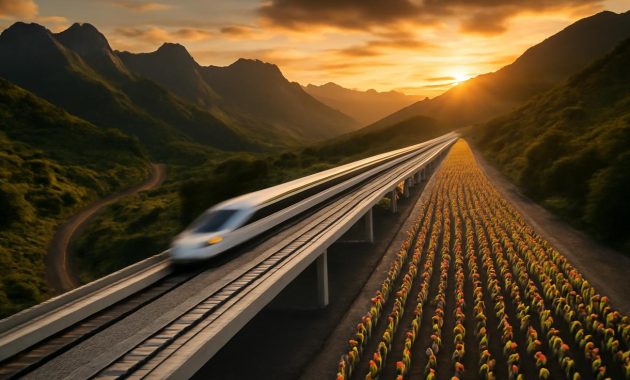
High-speed rail rewrites that equation. At 250 or 300 kilometers per hour, the landscape changes from a place you inhabit to a panorama that flows past your window. Rice paddies flatten into green streaks, hillsides blur, small towns flash into view and then vanish before you can read their names. Stations become portals, not endpoints. In 90 minutes, you can leave home after breakfast, arrive in another city before lunch, and return the same evening with enough time to cook, meet friends, or tuck a child into bed.
This is the quiet revolution of travel time compression. Where seven hours once enforced psychological distance—“that city is far away, not really part of my daily orbit”—90 minutes pulls it into your inner circle. Job searches widen. Weekend plans change. Universities and hospitals, once functionally remote, move into reach for people who might never have considered them before.
In the abstract, it’s about connectivity. In practice, it’s more intimate. Picture a grandmother in a small town along the route, once resigned to rare visits from her children working in a larger city. Overnight, the cost of visiting, in time if not money, shrinks. Instead of saving for a long holiday, they can come for a single afternoon, catch an early train in, share a meal, and leave on a late‑evening departure. The relationship softens, loosens, warms, all because the journey between them has been folded tighter.
Machines, Maps, and Human Hands
For all the talk of speed and precision, the nine-hour rail construction window is anchored to something stubbornly human: the way people move, decide, and improvise under pressure. Modern Chinese infrastructure projects are often showcased through their machinery—towering cranes, laser-guided survey rigs, track‑laying trains that work like steel spiders spinning out perfectly aligned rail.
But machines do not coordinate themselves. Behind the synchronized motion lies an invisible web of planning that starts months, sometimes years, before a single excavator touches soil. Engineers run simulations that look almost like weather models, except instead of storms, they forecast risk: what if a crane fails, what if the concrete mix behaves unexpectedly in lower temperatures, what if a delivery truck arrives an hour late? Every “what if” spawns contingency plans, call trees, backup equipment lists.
Then there’s the human choreography. Rotating shifts are drawn up to keep workers fresh. Safety briefings are repeated, sometimes to the point of boredom, because no one wants a moment of fatigue to spiral into tragedy. Local officials coordinate traffic diversions so that when the highway is shut, the disruption ripples out gently rather than bursting into full-blown gridlock.
On the ground, team leaders walk the site in the afternoon before the shutdown, squinting at landmarks, quietly mentally overlaying the blueprints onto the landscape they’ve seen in sunlight and rain. They know that at 3 a.m., under artificial light, this familiarity will help when the site feels like a different planet. When the work starts, they become the translators between plan and reality, adjusting sequences in quiet conversations over the roar of engines.
The most striking thing, if you talk to people involved in projects like this, is how rarely anyone claims heroism. Instead, they talk about process. They talk about what went smoothly, what almost didn’t, and how, next time, they’ll shift a delivery window or change the angle of a temporary ramp. The culture is iterative: each nine-hour miracle is built on the exhaust and lessons of the ones before.
What This Says About a Country in Motion
Stories like this are more than engineering anecdotes; they are signals about how a country understands time, distance, and its own future. China’s high-speed rail explosion over the past decade and a half has been so rapid that, from the outside, it can feel abstract: kilometer counts increase every year, and colorful maps fill with new lines, like veins on a growing leaf. But on the ground, in the soft hours after midnight with a thousand workers swarming beneath floodlights, it’s very tangible.
The decision to cut a seven-hour journey down to 90 minutes is, on its face, economic. Faster connections stimulate trade, tourism, and investment. Land near new stations is revalued, sometimes dramatically. Construction itself creates jobs, contracts, and careers. Yet the symbolic layer is just as important: a demonstration that the state can rearrange the geography of everyday life, compressing space with steel and electricity.
There is another, more subdued layer: the environmental one. High-speed rail, especially when powered by increasingly cleaner grids, carries the promise of moving hundreds of people with a smaller carbon footprint than short‑haul flights or private cars. When a new line opens, some highways go a little quieter, some regional airports a little less busy. The dividends of that shift don’t shout; they whisper in particulate counts and emission curves.
But no story about large-scale infrastructure is complete without acknowledging its trade‑offs. Building a new line, no matter how efficient, reshapes landscapes. Hills are cut, tunnels driven, villages nudged aside or re-routed. The people whose houses stand in the path of progress experience the project not as a sleek train flashing past rice paddies, but as paperwork, negotiations, relocations, and the ache of leaving a place that once seemed permanent.
The night the tracks were laid in that nine-hour sprint, some locals watched from a distance, their homes echoing with the hum of machinery instead of the usual crickets and late‑night television. For some, it was a promise—a new era of convenience and opportunity. For others, it was a farewell to an old way of life. Both truths exist side by side, as surely as the rails themselves now run alongside older roads and slower branch lines.
The Morning After
Dawn arrived almost shyly. The floodlights faded as the eastern sky paled from black to gray to a soft wash of pink. Workers, smeared with dust and sweat, looked different in this gentler light—suddenly more tired, more human, less like moving parts in a colossal machine. Some clustered around insulated jugs of tea, steam curling up into the cooling air. Others stood alone for a moment, staring at the new tracks with an expression somewhere between pride and disbelief.
The highway, temporarily severed so the rails could pass, was already being stitched back together. Fresh asphalt gleamed dark and tacky, bordered by new barriers and painted lines that would be dry by the time the first vehicles returned. Traffic teams began to peel back cones and fences. The city around them, which had slept through most of the night’s drama, stirred awake, oblivious that its geography had just quietly changed.
On that first day, no high-speed trains thundered through. There were still systems to test, signals to calibrate, emergency drills to run. But the physical fact of the line was now undeniable: steel on ballast, stretching into the distance, promising a coming season in which the phrase “it’s too far” would lose a bit more of its weight.
Somewhere down the line, a child will take their very first train ride on this route, nose pressed against the glass, watching mountains and rivers streak by. They will not think about the nine hours of overnight labor that made their 90-minute trip possible. To them, this speed will feel normal, almost ordinary. That is, perhaps, the quiet legacy of nights like this one: to push the boundary of what feels possible just far enough that the next generation doesn’t see it as a boundary at all.
FAQs
How could so much construction be done in just nine hours?
The nine-hour window was possible because most of the work happened long before that night. Components were prefabricated, logistics were scheduled down to the minute, and tasks were carefully layered so multiple teams could work in parallel instead of one after another. The overnight period was the final, high-intensity stage of a much longer process.
Was safety compromised to achieve such speed?
Projects like this rely on strict safety protocols, rehearsed sequences, and heavy use of simulation and planning to keep risk within acceptable limits. While speed always adds pressure, the goal is to compress idle time and overlaps, not safety checks. Multiple inspection steps are built into the process, even during the nine-hour window.
How does cutting a trip from seven hours to 90 minutes change daily life?
Reducing travel time makes distant cities feel local. Commuting, visiting family, accessing better jobs, universities, or hospitals all become more feasible. What used to demand a full day can become a manageable round trip, reshaping routines, relationships, and economic choices.
Is this kind of rapid construction unique to China?
Other countries also use prefabrication and tightly timed shutdowns, especially for rail and highway upgrades, but China’s scale and frequency of such projects stand out. The combination of high-speed rail expansion, centralized planning, and large on‑site workforces has made this style of rapid transformation particularly visible there.
Does building new high-speed rail always benefit local communities?
High-speed rail can bring economic opportunity, better access to services, and improved connectivity. However, it can also lead to land acquisition, relocation, and shifts in local economies. Some residents benefit directly, while others experience disruption. The overall impact depends on how planning, compensation, and local development are managed alongside the new rail line.