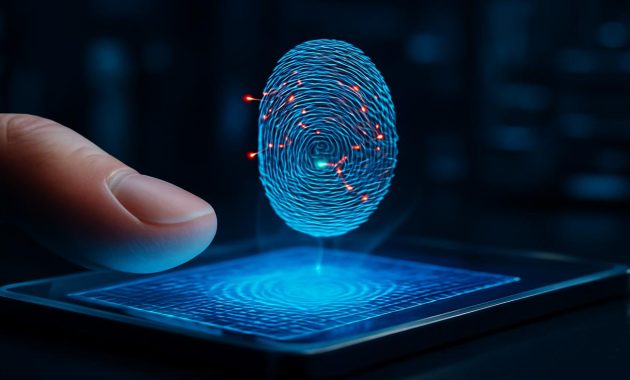
The man in the lab is wearing blue gloves, but he still moves like someone who has spent a lifetime handling fragile things—ancient manuscripts, crime scene swabs, a broken wristwatch pulled from the bottom of a river. On the stainless steel table in front of him lies something so mundane that it barely seems worth a second glance: a clear glass, smudged with the faint swirl of a fingerprint. Under the light, the ridges look like a ghost of someone’s touch, delicate and almost shy. But what’s about to happen to that smudge is anything but shy. A machine the size of a toaster hums softly, a panel flickers, and a cascade of numbers begins to pour across a screen. The fingerprint is about to tell a story it has never told before—and that story could change everything we think we know about security and investigations.
When a Fingerprint Stops Being Just a Pattern
For over a century, fingerprints have held this almost mythic status in forensics. You leave them on doorknobs, on phone screens, on the handle of your favorite mug. Each swirl and loop is yours alone, supposedly unchanging from childhood to death. When investigators talk about “prints,” they usually mean one thing: a visual pattern, a unique design that can be matched to a person, like a barcode stamped on your skin.
But recently, artificial intelligence has started to look at fingerprints with a different kind of gaze—less like an identification card and more like a dense, layered dataset. Instead of stopping at what a pattern looks like, AI is starting to ask: What else is hiding in there? Age. Sex. Health hints. Environmental traces. Even behavioral patterns. The kinds of things that never made it into the old fingerprint manuals gathering dust on police station shelves.
Imagine this: a partial, low-quality smudge recovered from the frame of a window after a break-in. No clear loops, no neat whorl—just a smear. For years, that kind of mark was almost worthless, a forensic dead end. Now, AI systems trained on millions of prints are being taught to infer who might have left that smear, not by reading explicit details, but by recognizing hidden statistical signatures embedded in the chaos.
The fingerprint is no longer just a lock-and-key identity marker. It’s turning into a story-rich landscape—and we’re only just learning to read it.
The Lab Where Your Skin Becomes Data
Step into one of these new AI-driven labs and you notice the silence first. Not the dramatic hum of science fiction movies, but a muted quiet broken by the click of keyboards and the occasional distant whir of a server rack cooling system. The action isn’t in the room; it’s in the models that sit behind simple screens, consuming absurd amounts of data and spitting out predictions in the time it takes to blink.
In front of one researcher, there’s a split-screen: on the left, a grayscale fingerprint image, blown up so large you can see the tiniest pores breaking the ridges like minuscule craters. On the right, a dashboard of metrics, graphs, and probability bars. She adjusts a slider, switching between classical ridge analysis and the strange new world of “latent traits”—features the human eye doesn’t see, but an algorithm has learned to detect.
It starts with training. AI models are fed massive datasets of fingerprints, each one tagged with bits of information: age brackets, biological sex, sometimes even lifestyle factors or medical data collected in volunteering studies and controlled environments. Slowly, patterns start to emerge—microscopic differences in how ridges fork and end, how pores distribute, how pressure affects the print structure. No single ridge reveals the truth, but millions of them, layered and compared, begin to whisper it.
Within that whisper, the AI begins to say things like: “This print was likely made by a person in their 20s to 30s.” Or: “There is a high probability this fingerprint belongs to a biologically female individual.” Or, in more experimental research: “The pattern suggests some correlation with certain health conditions or environmental exposures.” None of it is magic. It’s statistics, relentlessly refined.
| What AI May Infer | How It’s Learned | Potential Use |
|---|---|---|
| Approximate age group | Subtle changes in ridge shape, elasticity, and pore patterns over time | Narrow suspects, identify missing persons profile |
| Likely biological sex | Statistical differences in ridge density and structure | Guide investigations when identity is unknown |
| Lifestyle/occupation clues (experimental) | Correlations between micro-abrasions, pressure patterns, residue traces | Context about the person’s daily environment |
| Health-related hints (highly experimental) | Links between certain medical conditions and ridge development | Future medical screening, risk profiling (with serious ethical concerns) |
Suddenly, your fingertip isn’t merely a password. It’s a profile.
The New Crime Scene Question: Who, But Also What Kind of Who?
Picture a crime scene at night. The house is quiet now, the chaos over. A doorframe dusted with powder reveals a lonely partial print, maybe two ridges here, three there. It’s the sort of thing that used to make forensic techs sigh: distinctive enough to know there was a hand, but not detailed enough to know whose.
With AI, that same smudge might now answer more layered questions. Maybe it can’t say “This came from John Doe,” but it might say, “This likely came from a young adult, probably male, with a ridge pattern statistically more common in certain populations.” It might cross-reference that with other faint prints elsewhere in the room, linking them together as belonging to the same unknown individual. The print stops being a dead end and starts becoming a sketch of a person, built from skin alone.
Investigators could combine that sketch with security camera footage, neighborhood demographics, or records of recent visitors. The fingertip’s whisper suddenly joins a chorus of digital and physical clues. Even when a culprit has no record in fingerprint databases, the AI might still outline a silhouette around them—rough, imperfect, but better than blindly stumbling through the dark.
There’s another twist too: reconstruction. Traditional fingerprint matching suffers badly when the print is partial or distorted. AI, trained on oceans of sample patterns, can attempt to “fill in the gaps,” predicting what the missing ridges might look like, a bit like restoring a torn photograph. That doesn’t mean it magically knows the exact original print, but it can create a plausible reconstruction that improves the odds of matching to a database entry.
For investigators, these tools could feel like suddenly turning on a brighter flashlight. For suspects, they may feel like the shadows shrinking.
Security Systems That Know Too Much
Not all fingerprints live on crime scene walls. Most reside quietly on your phone, your laptop sensor, your workplace door reader. Every day, billions of fingertips press against tiny scanners, trading convenience for trust: “Recognize me, and only me. Let me in.”
As AI starts decoding more from a fingerprint, the idea of using it only as a simple yes/no key begins to feel outdated. Why should a device just ask, “Is this the right finger?” when it could also ask, “Does this finger belong to the approximate person I expect?” A child trying to unlock a parent’s phone with some elaborate replica, a silicone mold, or a stolen 3D-printed copy might trick a naive sensor. But if the system is running a model that evaluates age, microtexture, and living tissue signals, even near-perfect fakes become harder.
Future security systems might layer in factors like:
- AI checking whether the fingerprint texture matches a living, blood-fed fingertip rather than a cast.
- Subtle changes in how you press the sensor over time, like a behavioral signature layered on top of the physical one.
- The predicted age or sex of the finger as a silent second factor for high-security contexts.
In that world, the fingerprint reader stops being a simple lock. It starts becoming a tiny, silent interrogator.
But there’s a darker possibility too: if systems are silently inferring more from you than simply “match” or “no match,” what happens to all that extra information? Who stores it? Who has the right to know that a device decided your finger “looks older than last year,” or statistically fits a certain demographic? When biometric security becomes biometric analysis, the line between “safe” and “surveilled” frays very quickly.
From Identification to Prediction: The Slippery Slope
There’s a subtle but critical shift happening here. For decades, fingerprints have been about identification: proving you are who you say you are. AI is stretching them toward prediction: suggesting what sort of person you might be, or what traits you may possess.
Prediction is a risky game. Even when models are highly accurate on average, they can be disturbingly wrong for individuals. An algorithm that says there’s an 80% chance a print came from someone in a certain age group is still wrong one time in five. If those guesses start guiding who gets questioned, searched, or watched more closely, the stakes are no longer academic.
Investigations thrive on leads, but justice demands more than good guesses.
The Uneasy Feeling of Leaving Your Story Everywhere
Walk through your day for a moment in your mind. You push open a café door, sign a receipt, rest your hand on a bus pole, tap your way through a security turnstile, scroll your phone. Each touch leaves behind quiet, swirling signatures. You’ve probably gotten used to the idea that your phone can read that signature, that a government might have copies if you’ve ever applied for certain visas or jobs, that police might care about your prints if something terrible or strange happened nearby.
But how does it feel to know those same traces might one day be mined for more intimate detail? Age drift. Possible health conditions. Probabilities about your body or background that you never consented to share. Unlike your location data, you can’t really “turn off” your fingerprints. Unlike a password, you can’t just change them once they’re compromised or overexposed.
There is a peculiar vulnerability in realizing your body itself is a constant broadcast, and that the receivers are getting smarter.
These concerns aren’t just about governments or police work. Private companies, from security vendors to advertising giants, are always hungry for deeper, more granular data about human beings. The richer the fingerprint becomes as a data object, the more tempting it will be to treat it as a gold mine rather than a locked key. Even if laws restrict certain uses, the pressure to push those boundaries will grow alongside the technology.
Bias in the Ridges
AI models are only as fair as the data they’re raised on. If training data skews more heavily toward one region, ethnicity, or age group, the model’s confidence will be uneven, its errors biased. In medicine, that can mean misdiagnosis. In policing, it can mean misdirected suspicion—and communities already under pressure might feel that tightening further.
We’ve seen this before with facial recognition: systems that work better on some faces than others, with consequences that play out in traffic stops, airport lines, and city streets. Fingerprints feel more “neutral,” less expressive than a face. But the data beneath is just as sensitive to imbalance.
Once fingerprints are interpreted not just for who you are but for what you’re like, any skew in the model can become a skew in opportunity, in freedom, in how much doubt or trust greets you at checkpoints and border crossings.
What Comes Next: Choice, Regulation, and a New Kind of Awareness
The science is still early, but it’s racing forward. As models improve, the temptation will be strong to adopt them quickly—faster investigations, stronger security, smarter access control. The benefits are real and compelling. A world where missing persons can be profiled more quickly from tiny fragments, where deepfake fingerprints have a harder time fooling a system, where investigators can make sense of chaotic scenes with fewer dead ends—that world is hard to argue against.
Yet running alongside those promises is a tangle of questions: Who owns the “extra” information extracted from your fingerprint? How transparent should systems be about what they’re inferring? Should there be strict guardrails that limit fingerprint AI to identification only, banning trait prediction for law enforcement or commercial use? And how do we ensure that people truly understand what they’re giving away when they rest a fingertip on glass?
We’ve been here before, in other ways. When GPS first crept into our pockets, it felt like a miraculous convenience. Only later did we begin to understand the cost of being constantly locatable. With fingerprints, the stakes are different—not where you are, but what you are. Not your movements, but your biology and the fine-grained map of your body’s surface.
There is time, right now, to decide how far we’ll let this technology reach before laws and norms and ethics catch up. Time to ask whether every possible insight is worth extracting, or whether some parts of our bodies should remain, in a sense, unknowable except to ourselves.
In that quiet lab, the researcher removes the glass from the scanner. On her screen, the fingerprint’s ridges have become a forest of vectors and weights and probabilities. Somewhere, behind those numbers, is a person who once just wanted a drink of water. They didn’t know that this simple act would be converted, one day, into a stack of machine-readable clues about who they are.
We leave these little echoes of ourselves everywhere. With AI, those echoes are getting louder. The question is not whether they’ll be heard, but who will be listening—and what they’ll be allowed to do with what they learn.
FAQs
Can AI really tell my age or sex just from my fingerprint?
Current research suggests AI can often make statistically informed guesses about age groups and biological sex by analyzing subtle features in fingerprint patterns. These are probabilities, not certainties, and accuracy varies depending on the quality of the print and the training data used.
Does this mean my fingerprint is no longer safe as a password?
Fingerprint security is still strong for everyday use, especially compared to weak or reused passwords. However, as AI makes fingerprints more revealing, there is growing concern about how that data is stored, who can access it, and whether extra information is being inferred without your knowledge.
Can AI-powered fingerprint analysis be used in court?
Traditional fingerprint matching is already used in court, with varying standards. AI-based trait prediction (like age or sex) is newer and more experimental. Whether it becomes acceptable legal evidence will depend on how accurate, transparent, and well-regulated these systems become—and how courts judge their reliability.
Could companies use fingerprint AI to profile customers?
In theory, yes. If companies collect fingerprint data for authentication, AI could be used to infer additional traits. Whether they are allowed to do so depends on privacy laws, regulations, and their own policies. Many privacy advocates argue for strict limits on such uses.
How can I protect my fingerprint data?
You can minimize where you share your fingerprints by limiting enrollment on unnecessary devices or services, using strong passwords and hardware keys where possible, and paying attention to privacy policies. Supporting clear regulations around biometric data can also help ensure that, when fingerprints are used, they’re handled with care and legal protections.