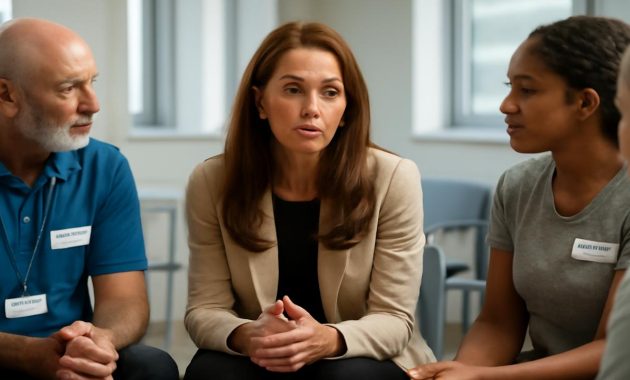
The room was small, sun-warmed, and smelled faintly of coffee and hand sanitizer. Chairs had been pulled into a loose circle, the sort of imperfect ring that happens when strangers are trying to sit close without getting in each other’s way. Nobody quite expected that when the Princess of Wales sat down among them, she wouldn’t hover at the edges of conversation, or stick to neat, rehearsed lines. Instead, she leaned forward, elbows on her knees, and simply said, “Some days, it just knocks you flat, doesn’t it?”
When Royalty Sits at Eye Level
It was that sentence—plain, almost whispered—that seemed to crack the air open. No trumpets, no speeches, no glassy smiles. Just a woman talking to other people whose lives had been quietly rewired by cancer. The volunteers around her, many of them survivors themselves, exhaled at once, shoulders loosening, as if they’d been given permission to stop pretending this journey can be endured with constant grace.
There is something deeply human about watching someone whose life has been built on composure dare to be fragile in public. The Princess did not arrive to deliver comfort from a safe distance; she arrived to trade stories. She asked about first diagnoses and last rounds of chemotherapy, about the taste that lingers at the back of the throat, about the way the night feels longer when you’re waiting for scan results.
As she listened, the typically polished mask she wears at state banquets and red-carpet events slipped, revealing what everyone in that sunlit room already knew: illness does not care about titles. It makes equal strangers of us all. And on that particular day, she chose not to be the figure on the balcony waving down to the crowd, but the woman sitting cross-legged in the circle, speaking the language of fatigue, fear, and quiet hope.
The Quiet Brutality of Chemotherapy
She spoke of chemotherapy in a way that made people shift in their seats—not because it was inappropriate, but because it was real. “You think you’ll be brave every day,” she said softly, hands loosely clasped, “and then the treatment reminds you that bravery can be very small. Sometimes it’s just getting out of bed. Sometimes it’s letting yourself stay in it.”
There is a particular honesty in describing chemo not as a singular battle but as a weather system: days when the storms pass quickly, days when the sky seems permanently low and heavy. The Princess described mornings when she woke up surprised by a pocket of energy, and others where even lifting a hairbrush felt like a negotiation. Her words weren’t a plea for sympathy; they were an acknowledgment of a shared terrain.
She admitted to feeling blindsided by the loss of rhythm—how the treatment carved strange patterns into her weeks. Appointments, drips, consultations. Long afternoons when the body was too heavy to move but the mind was too restless to rest. “You begin to live between blood tests,” one volunteer said, nodding, and she laughed gently in recognition. “Exactly that,” she replied. “Life in little windows.”
The volunteers listened, but they also offered their own hard-earned wisdom in return—small, practical compass points for a landscape that never quite feels navigable. Some spoke of learning to accept help without apology. Others talked about the art of lowering the bar: celebrating half-loads of laundry, short walks to the corner, surviving another difficult night. In their stories, the Princess found versions of her own, and in hers, they heard their experience reflected back with an unfamiliar kind of visibility.
Small Acts of Survival
There is a strange intimacy in sharing the tiny, unglamorous details of illness. One volunteer admitted that, for weeks, her greatest daily triumph was making toast and not crying over it. Another talked about the phone calls she avoided because she couldn’t bear to give one more “update.” The Princess nodded, smiling with the tired amusement of someone who knows exactly how that feels. “You start to measure your day in teaspoons, not hours,” she said. “And every teaspoon counts.”
For people accustomed to seeing her in sweeping gowns and immaculate tailoring, it might seem jarring to imagine her in old socks on the sofa, binge-watching something forgettable while nausea hums beneath the surface. Yet this juxtaposition is part of what made her words land with such weight. Here was a woman whose image has been curated to near-mythical levels of composure, gently pulling back the curtain on slow, private unravelings.
She described the mental tug-of-war between wanting to stay positive and needing to admit that some days are simply awful. “I thought I had to be strong for everyone else,” she said, “and then I realized that telling the truth about how hard it is… that’s also a kind of strength. It makes room for others to tell the truth, too.” Around her, heads nodded. This, more than any ceremonial ribbon-cutting, was the work: not inspiring people with polished slogans, but granting them permission to be fully human in the midst of something terrifying.
Candor in a World of Carefully Chosen Words
The Princess’s world is one of scripts and schedules, of carefully phrased statements and predetermined talking points. Yet in that room, her language was closer to that of a friend on the phone at midnight—simple, unvarnished, and occasionally raw. “I was frightened,” she admitted. “Not just of the word ‘cancer,’ but of what treatment would do to my family, to the children’s sense of normal.”
It’s easy to forget that every public figure has a private life that continues when the cameras are gone: homework spread across the kitchen table, shoes abandoned by the door, unanswered text messages. Chemotherapy runs roughshod through all of that. It doesn’t pause for school runs or royal duties or family birthdays. Instead, it demands a reshaping of everything—time, energy, even identity.
One volunteer, a father of two, told her how his children became unofficial experts in hospital lingo, how they learned which days would be “quiet days” and which might be “Dad’s grumpy days.” The Princess listened with a pinched softness in her expression, as if recognizing her own household in his. “Children notice everything,” she said. “You can’t hide it. So you try to be honest in ways that still feel safe.”
This was the thread running through her reflections: the choice to move away from polished invincibility and toward something more delicate, but perhaps more durable—truth. Not the grand, cinematic kind, but the everyday sort that fits into the corners of real life: “I’m tired today.” “I’m scared but hopeful.” “I don’t know what next week will look like.”
When Vulnerability Becomes a Bridge
In the circle, that vulnerability did not shrink her; it expanded the space around her. Volunteers who had walked similar paths seemed less intimidated by her title and more drawn to her very ordinary fears. Their conversations tumbled past the expected questions into messier territory: the anxiety that arrives at 3 a.m., the guilt of leaning too hard on loved ones, the odd sense of relief when someone finally admits, “This is awful,” instead of insisting, “I’m fine.”
One woman, who had finished treatment a year before, described feeling erased by her own survival—people saw her as “better now” and stopped asking how she truly was. The Princess listened, then asked, “Did you feel like you’d lost a version of yourself along the way?” The woman’s eyes filled, and she whispered, “Yes.” Around them, the room quieted. This was not a media sound bite; it was a moment of shared recognition between two people who understood that illness does not simply end when the final round of chemo does.
Vulnerability, in that instant, was not a performance. It was a shared language, one that turned a royal engagement into something closer to a group therapy session—honest, imperfect, and quietly sacred.
Tracing the Landscape of Recovery
If illness is a storm, recovery is that muddy, uneven ground afterward. The Princess spoke of it not as a neatly defined “after” but as a crossroads. There is the body learning to trust itself again, the mind adjusting to new limits, the calendar tentatively filling with things that once seemed simple: family outings, early-morning meetings, trips beyond the hospital walls.
Several volunteers talked about the strange suspension that follows treatment, that liminal state between gratitude and fear. “You’re relieved it’s over,” one said, “but now you live with the echo of it.” The Princess responded with quiet nods, describing how every ache or wave of fatigue can briefly trigger an old dread. “You become hyper-aware of your own body,” she said. “You’re listening for things you used to ignore.”
To make sense of this shifting ground, the group shared the small strategies that had helped them reclaim themselves—journals filled not just with symptoms, but with tiny joys; walks taken at half-speed through familiar parks that suddenly felt new; recipes simplified to essentials. In the give-and-take of this exchange, the Princess was not merely collecting stories; she was adding to them, offering up her own attempts at stitching her life into a new, gentler shape.
Finding New Measures of Strength
Strength, in these conversations, was redefined. It was no longer the cinematic image of defiance but the quieter humility of listening to one’s limits. The Princess admitted that learning to rest without guilt was one of the hardest lessons—especially when the public expects visibility, presence, performance. “You feel like you’re letting people down when you disappear to heal,” she said. “But you’re also learning that vanishing for a while can be an act of trust—trust in your body, and in the people who can step in when you can’t.”
That recalibration is not unique to royalty; it is the daily work of anyone negotiating life after chemotherapy. The volunteers nodded vigorously. They spoke of workplaces that adapted, friendships that deepened, and also of the disappointments—people who drifted away, employers who could not or would not understand. The Princess listened carefully, visibly absorbing the human cost beyond hospital walls.
In that exchange, a pattern emerged: strength became less about enduring pain in silence and more about asking for what you need, even when your voice shakes. The Princess’s own reflections—brutally honest, if still carefully measured—contributed to that shifting definition. She was no longer just a symbol of public resilience, but a participant in a communal reimagining of what it means to survive.
The Shared Currency of Stories
As the conversation wound on, a quiet intimacy settled over the room. The line between “royal visit” and “shared gathering” blurred until it was almost impossible to see. Laughter rose and fell in gentle waves—sometimes bright and sharp, sometimes frayed at the edges. There were pauses too, the kind in which people look down at their hands because looking up would mean crying.
In the middle of it all, the Princess’s candor functioned as a kind of catalyst. Each time she revealed another piece of her experience—how she dreaded certain hospital corridors, how a particular smell could churn her stomach, how she struggled with the question, “How are you really?”—someone else answered with their own mirror image. Stories became a shared currency, a way of paying for the right to be fully seen.
To capture the texture of those exchanges and the practical rhythms beneath them, it helps to see how patients and volunteers often describe their experience in small, lived details:
| Experience | How It Feels | What Helps |
|---|---|---|
| Chemotherapy days | Time slows; the body feels heavy, metallic, invaded. | A familiar voice nearby, warm blankets, small talk that doesn’t demand energy. |
| Waiting for results | Every phone ring is a possible turning point. | Routines, walks, distractions, someone to sit quietly beside you. |
| Talking to family | Balancing honesty with protection; words feel too small. | Simple language, age-appropriate truth, being willing to say “I don’t know yet.” |
| Life after treatment | Grateful but unsettled; waiting for normal to return, unsure what “normal” means now. | Gentle routines, follow-up support, spaces where ongoing fears are taken seriously. |
The Princess’s reflections fit comfortably inside this table, not above it. She, too, waits for results. She, too, measures days in milligrams and minutes. She, too, is trying to knit together a life that acknowledges the enormity of what happened without letting it be the only story.
Why Her Honesty Matters
For those in the circle, her revelation wasn’t shocking so much as relieving. To hear someone at the center of relentless public attention admit to being undone by the same invisible weights they carry—that the treatment is brutal, that it unmoors identity, that it tests every relationship—felt like a rebalancing of the scales.
Her honesty sends a quiet signal beyond that room: that it is acceptable, even necessary, to speak plainly about illness and its aftermath. To admit that bravery often looks like wobbling, not marching. To recognize that there is no single correct way to navigate chemotherapy, only the next most honest step you can take.
In an era of curated lives and polished updates, such candor acts almost like a balm. It doesn’t erase the pain, but it does puncture the isolation. If someone whose days are normally choreographed down to the minute can stand in public and say, “This has been harder than I ever imagined,” then perhaps others will feel licensed to say the same, without apology.
Leaving the Room, Keeping the Conversation
Eventually, the visit had to end. The circle relaxed, chairs scraped softly against the floor, and that familiar choreography of handshakes and thank-yous resumed. Yet something lingered in the air—a sense that, for an hour or two, titles and roles had been briefly set aside in favor of something far more elemental: shared humanity.
The Princess walked to the door a little slower than she had come in, pausing here and there to clasp a hand, to repeat a name, to ask a last question. Outside, cameras waited; inside, the room held the echo of her words: “Some days, it just knocks you flat.” It was not a triumphant quote for the highlight reel, but it was honest. And perhaps that made it more powerful than any polished statement could have been.
Cancer, chemotherapy, recovery—these are not neat stories with tidy endings. They are ongoing negotiations between fear and hope, between fragile bodies and stubborn spirits. What the Princess of Wales offered that day was not a solution, but solidarity. A reminder that even in the most gilded lives, the hard things still hurt, the medicine still burns, the nights are still long.
For the volunteers, her presence validated the work they do quietly, between hospital corridors and kitchen tables, holding space for others to tell their truths. For her, their stories surely served as both mirror and map—showing her where she had been, where she might be headed, and most importantly, that she does not walk alone.
And for anyone watching from a distance, her brutally honest reflections may open a small crack in the silence that still surrounds serious illness. In that crack, light arrives: the light of ordinary courage, shared burdens, and the radical notion that telling the truth about our pain is not weakness, but the first, tentative step toward healing.
Frequently Asked Questions
Why is the Princess of Wales speaking so openly about her chemotherapy treatment?
She is using her public platform to normalize honest conversations about cancer and its treatment. By sharing the emotional and physical reality of chemotherapy, she helps reduce stigma, encourage empathy, and remind others going through similar experiences that they are not alone.
How does her experience reflect what many chemotherapy patients go through?
Her reflections echo common themes: overwhelming fatigue, disrupted routines, fear of test results, the strain on family life, and the struggle to balance positivity with brutal honesty. While everyone’s journey is unique, many patients recognize their own experience in what she describes.
Why are volunteers and support groups so important for people undergoing cancer treatment?
Volunteers—especially those who are survivors themselves—offer lived experience, practical advice, and emotional grounding. Support groups provide safe spaces to share fears and frustrations, ask questions, and feel seen without judgment or pressure to be endlessly “strong.”
What impact can a royal figure’s vulnerability have on public attitudes toward illness?
When someone highly visible speaks candidly about illness, it can shift cultural expectations. It helps challenge the myth of effortless resilience, encourages more nuanced media coverage, and may inspire others to seek help, ask questions, and speak openly about their own health.
How can friends and family best support someone going through chemotherapy?
Show up consistently, listen more than you speak, and offer specific, practical help—meals, childcare, rides, or simply a calm presence. Avoid pushing relentless positivity; instead, make room for the full spectrum of feelings. As the Princess’s conversation with volunteers showed, genuine, nonjudgmental connection is often the greatest comfort.