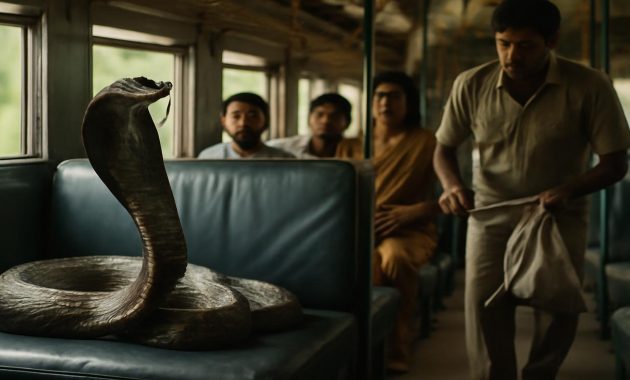
The train doors slid open with a tired sigh, and a wave of hot, late-afternoon air spilled into the carriage. People jostled and shuffled, clutching steel handles, hanging on to sleepy children and sloshing cups of chai. The smell of metal, dust, and fried snacks drifted in from the platform. No one noticed the other passenger at first—the one slipping silently under the vinyl seat, scales whispering against torn luggage and fallen peanut shells. Only when a man leaned down to retrieve his dropped ticket did he see it: a hooded head lifting, eyes like polished obsidian, staring back without blinking. The carriage erupted in a chorus of shouts. Someone yelled the word that unites fear across languages: “Cobra!”
An Unlikely Passenger on the Tracks
It sounds like the opening scene of a wildlife thriller, but over the last few years, incidents of king cobras on or near railway lines in parts of Asia have become strangely common. Videos circulate: a glossy brown serpent gliding alongside a sleeper train, a snake rescue team pulling a king cobra from beneath a railway seat, another found coiled inside an open carriage at a rural halt. It’s as if the world’s longest venomous snake has decided that rail travel is an acceptable part of its home range.
But the truth, as it often is with wildlife, is more complex—and more unsettling. These snakes are not seeking a ticket to somewhere new. They are following age-old instincts through a landscape that has been redrawn with steel, timber, and concrete. The result is a quiet, uneasy coexistence: humans thundering past in trains, and king cobras threading through the same corridors in search of food, mates, and escape from the press of human expansion.
Before we board this story fully, it helps to know who our scaly protagonist is. The king cobra (Ophiophagus hannah) is not just any snake. Stretching up to 5.5 meters (around 18 feet), it is the longest venomous snake on the planet, a reptile that can raise a third of its body off the ground and look a standing adult in the eye. Its very name, “Ophiophagus,” means “snake-eating,” and that diet—other snakes, often highly venomous ones—is a key to understanding why railway lines, embankments, and scrubby station edges sometimes become part of its hunting ground.
The Railways That Slice Through a Forest
Picture a king cobra’s home not as a single tidy forest, but as a patchwork: fragments of woodland, bamboo thickets, rubber plantations, rice fields, and, threading through them like scars, roads and rail lines. In countries such as India, Thailand, and parts of Southeast Asia, railways frequently cut across or skirt what used to be continuous forest. To a snake, these are not “transport systems.” They are warm, open corridors running like ribbons through its territory.
A railway line brings several irresistible features from a king cobra’s point of view. First, the embankment itself: raised earth scattered with rocks, brush, and drainage ditches. Frogs make use of the damp edges. Rodents tunnel into the softer sides. And wherever rodents and frogs thrive, other snakes—especially rat snakes—follow. A king cobra, being a specialist predator of snakes, does the logical thing: it follows its food.
It doesn’t know or care that a metal serpent roars down these tracks several times a day. The train is just another thunderous disturbance in a world already full of monsoon storms, falling trees, and the random violence of life in the wild. So the cobra moves as it always has, nose sampling scent trails, tongue flicking, body coiling through grass and ballast stones, across sleepers, sometimes beneath parked carriages where shade and the ghost of warmth from old engines linger like an invitation.
The Warmth, the Shadows, and the Smell of Food
Ask a herpetologist why a king cobra might slip into a train coach or settle near a platform, and you’ll usually get a list of reasons that sound mundane to us but essential to a snake: temperature, shelter, prey. Steel carriages that have rumbled all day in the sun hold heat well after sunset. The underside of a parked train can feel like a gentle thermal blanket on a cool evening. For a cold-blooded animal, that’s the reptile equivalent of a heated bench.
Then there’s shelter. Railway stations, especially smaller rural ones, are cluttered places: stacks of discarded sleepers, piles of gravel, drain covers, tool sheds, derelict corners where weeds push through concrete. These are perfect hideouts for snakes. Rats dart among them, drawn by dropped food and unsecured grain. Other snakes—prey for our king—follow. Where there are snakes, the king cobra soon arrives, moving with a purposeful slowness that seems unfazed even by human commotion.
To us, the smell of a station is a mix of diesel, sweat, dust, and street food. To a cobra, the air is threaded with scent molecules we barely register: mouse urine, the slither of a rat snake, the musk trail of another cobra, perhaps a potential mate, perhaps a rival. The train, to this animal, is a temporary extension of the landscape—a moving, noisy, sometimes tempting structure offering shadowed gaps and warm wheels.
When Worlds Collide in a Train Carriage
If you’ve never watched a train carriage react to the sudden revelation of a snake, especially a king cobra, imagine a flock of starlings startled into a murmuration—except inside a steel box. People leap to seats, scramble onto luggage racks, clutch bags to their chests. Children are yanked away by their arms. The air thickens with fear and the sharp, bitter scent of adrenaline.
Meanwhile, the king cobra usually does not rear up in cinematic fury. More often, it freezes, head lifted slightly, hood partially flared, trying to decide whether this vibrating, shrieking metal cave is a place to defend, a place to flee, or a very bad decision it needs to undo immediately. The myth of the cobra as an aggressor tends to fall apart when you see one in such a moment: it is deeply aware of how badly outnumbered it is.
In many regions, news of a “snake on a train” travels faster than the train itself. Suddenly there are people running along the platform with hooks, tongs, and sacks: local snake rescue volunteers or forest officials accustomed to pulling cobras from village houses, wells, and, increasingly, from public transport. With surprising calm, they coax the snake from under seats, careful hands guiding coils into a reinforced bag as curious commuters angle their phones for a better video.
A Quick Glance at the King Cobra at a Glance
To appreciate how odd this encounter is, it helps to step back and compare the king cobra to its venomous cousins. Far from being a creature that “belongs” in human spaces, it is, by preference, a forest animal—shy, secretive, and more at home among bamboo and leaf litter than steel and vinyl.
| Feature | King Cobra | Typical Viper/Other Venomous Snake |
|---|---|---|
| Average Length | 3–4.5 m (up to ~5.5 m) | 0.6–1.5 m |
| Preferred Habitat | Forests, bamboo thickets, forest-edge plantations | Varied: forests, fields, rocky areas, human dwellings |
| Main Diet | Mostly snakes (ophiophagous) | Rodents, frogs, birds, small mammals |
| General Temperament | Shy, avoids conflict when possible | Highly variable by species |
| Notable Behavior | Builds nests, exhibits parental care of eggs | Generally no nest-building; minimal parental care |
This is a reptile that, in intact habitat, might go its entire life without needing to cross a man‑made structure larger than a footpath. Yet as forests grow thinner and human structures denser, it finds itself threading through a man-made maze: culverts, canals, roads, and yes, rolling railways that bisect what used to be seamless jungle.
Do King Cobras Really “Like” Trains?
When we say king cobras “have a taste for train travel,” we’re leaning into a metaphor that our storytelling brains love. It’s the same instinct that makes us talk about foxes “raiding” dustbins or leopards “stalking” city streets, as if they were mischievous urban bandits. In reality, a king cobra is not curious about our schedules, our seats, or our destination boards. It is following gradients of temperature, scent, and shelter.
That said, railways unintentionally create micro-habitats that can be unusually attractive to wildlife. Embankments act as linear grasslands. Drainage channels hold water long after nearby fields dry out. Culverts under the tracks form dark, safe passageways between fragments of forest. A king cobra moving along such features might “surf” the edges of rail infrastructure for kilometers, seldom needing to plunge back into hotter, barer farmland. To a snake, that’s not public transport—it’s an ecological corridor.
Occasionally, curiosity—or simply a wrong turn—does kick in. A carriage door left open at a quiet rural station; stacked bags on the floor creating a tempting set of hidey-holes; an inviting strip of darkness under the lowest berth. A king cobra slipping along a platform edge may sample the air, detect the musky scent of another snake that had taken refuge there earlier, and follow it right up the steps. That’s how accidents and viral headlines happen.
Snakes, Stories, and the Human Imagination
Once a king cobra appears in a railway context, the story mutates rapidly. Someone posts a grainy video with a dramatic caption. A local newspaper turns it into a several-paragraph drama. Details blur. Was the snake actually a king cobra or a smaller, harmless species with a superficial resemblance? Did it truly “board” the train with passengers, or was it trapped there while workers shunted carriages at a yard?
Snakes have always had a special hold on human imagination. Across cultures in Asia, cobras in particular occupy a space somewhere between fear and reverence. They are associated with protectors of water, with gods who shelter ascetics, with powerful omens of both danger and blessing. Put a cobra into a modern machine—a train, a bus, even a motorbike’s engine compartment—and the collision of symbols becomes irresistible. Ancient reptile, modern technology. Forest spirit, public infrastructure. No wonder such stories spread.
Lost in the retelling is a quieter truth: each such incident is a symptom of habitat under pressure. Snakes on trains are not nature becoming more daring. They are nature running out of places to go. The forest is thinning, and the matrix of human structures, including railways, is thickening.
Railway Lines as Unintentional Wildlife Corridors
Conservation biologists increasingly talk about “connectivity”—the ways animals move between fragments of their habitat. Picture a map with green patches of forest like islands, separated by seas of fields and townships. Most animals don’t do well stranded on islands. Genetic diversity drops, populations become fragile. Corridors—strips of relatively suitable habitat linking these patches—act as lifelines.
Railway lines, paradoxically, can play both villain and accidental hero in this story. On one hand, trains cause direct mortality: animals hit on the tracks, nests destroyed when embankments are cleared, pollution along busy routes. On the other hand, the narrow strip of semi-wild land alongside many railways can serve as a rough, linear refuge, especially in parts of Asia where every other edge is crowded with houses, fields, or roads humming with traffic.
For big animals like elephants and leopards, this dual role is obvious—they are sometimes seen walking along the tracks or crossing them, with tragic collisions making headlines. For a king cobra, the effect is quieter and more hidden. It may hunt along a rail edge at night, only a faint sinuous trace left in dust. It may use a culvert to pass under the tracks unseen. It may, every once in a long while, make the mistake of slipping inside the very metal machine that dominates its newly altered landscape.
Recognizing this, some railway administrations and conservation groups are beginning to experiment with better designs: leaving vegetated strips, building more underpasses, training staff in how to respond to wildlife encounters without panic or cruelty. These measures are rarely framed as “for snakes,” but serpents, shy experts at remaining unseen, benefit all the same.
Sharing Space Without Sharing Fear
The unavoidable question is: what should a person do if they find themselves unexpectedly sharing a carriage or a platform with a king cobra? The instinct to scream, run, or attack is deeply wired, but it is rarely the safest response—for either party.
From the snake’s point of view, every large, fast-moving object is a potential threat. Sudden vibrations can trigger defensive postures: the iconic hood spread, body lifted, a low hiss. Despite their fearsome reputation, king cobras usually strike only when they feel cornered or provoked. Give them a clear path to escape, and they will almost always take it.
The calmest advice from snake experts is disarmingly simple: create distance; stay still or move slowly; alert authorities. In a train, that might mean stepping onto a seat, not to loom over the animal but to get feet away from the floor; keeping movement minimal; and calling the guard or conductor. Many railway networks in snake-rich countries now have local contacts for trained rescuers. These individuals are adept not only at handling reptiles but also at talking down a frightened crowd, turning chaos into a tense but manageable stillness.
Over time, as videos of careful rescues spread alongside the more sensational clips, a subtle change begins: snakes become not just horrors in the dark, but animals that others can handle with skill and respect. The king cobra on the train is no longer a curse or omen, but a wild neighbor tragically out of place.
Why These Encounters Matter More Than We Think
The image of a king cobra on a train lingers because it feels like a glitch in the matrix, a sign that the lines we draw between “nature” and “human world” are thinner than we like to believe. We like our forests elsewhere: on documentaries, in remote reserves, behind the reassuring glass of screens. Yet here is the forest, scaled and hooded, gliding under your seat as you check messages and drift into a half-sleep to the clatter of wheels.
Each such encounter forces a small reckoning. The king cobra, animal of legend, eater of snakes, slow guardian of a clutch of eggs hidden in a forest nest, is not invading our realm for pleasure. It is navigating the squeezed margins of a landscape we have reshaped. The railways it touches are arteries of human ambition; to the snake, they are just another line to cross, another band of heat and shadow along its route.
If we watch closely, these moments offer something beyond shock value. They invite us to imagine the journey of that snake before it arrived under the seat: the forest fragment it emerged from at dawn, the plantation it skirted, the canal it crossed, the village dogs it avoided, the rat snake trail it followed right up to the platform. Sudden appearances, when rewound in the mind, become long stories.
In that sense, it’s not that king cobras have developed a taste for train travel. It is that trains have cut through their lives so completely that our paths now intersect in ways our grandparents would have found astonishing. The question is no longer whether these meetings will happen, but how we will respond when they do—and whether we can learn to see, in the hooded silhouette framed by a train doorway, not just danger, but a powerful reminder that the wild is still here, still moving, still trying to find a way.
Frequently Asked Questions
Do king cobras really board trains on purpose?
No. King cobras do not intentionally seek train rides. They usually end up in or near trains while following prey, seeking warmth and shelter, or navigating along railway embankments that cut through their habitat.
Are king cobras more dangerous than other venomous snakes?
King cobras have potent neurotoxic venom and can deliver large quantities, making them very dangerous if provoked or cornered. However, they are generally shy and try to avoid conflict. Many bites from other, smaller venomous snakes are more common in rural areas.
What should I do if I see a king cobra on a train or platform?
Stay calm, keep a safe distance, avoid sudden movements, and do not attempt to handle or scare it away. Inform train staff or local authorities, who can contact trained snake rescuers to remove the animal safely.
Why are king cobras found more often near human structures now?
Habitat loss, fragmentation of forests, and expansion of agriculture and infrastructure push wildlife into closer contact with humans. Railway lines, roads, and canals all cut across traditional snake territories, increasing the chances of encounters.
Are railway authorities doing anything to protect both people and wildlife?
In some regions, railway departments work with forest and wildlife agencies to create underpasses, maintain vegetated strips, train staff in handling wildlife encounters, and coordinate with local snake rescuers. These efforts aim to reduce dangerous interactions and help animals move more safely through altered landscapes.