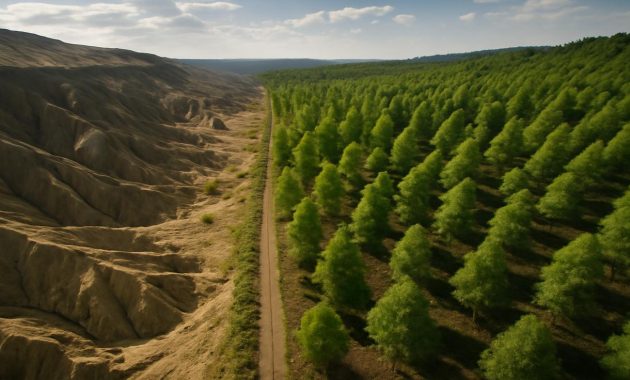
The first time the land tried to breathe again, no one noticed. The hills were still mostly gray and raw then—a patchwork of gullies, exposed rock, and dust that clung to your throat. Wind scraped along bare ridges without meeting resistance, and in the hot months the ground radiated a heat that made the horizon dance and shimmer. Standing there now, twenty-five years later, it’s hard to imagine what this place used to be. The air feels heavier, cooler, as if the landscape has grown a new pair of lungs. You inhale, and it smells of resin, damp soil, and the faint sweetness of flowers you cannot see. Somewhere above, a bird you don’t recognize calls out, clear and bright, and the sound echoes against a canopy that did not exist a generation ago.
The Land That Forgot How to Breathe
Back then, locals had a phrase for these hills: “the dead side.” Not because nothing moved here—there were still insects and the occasional desperate shrub—but because the land no longer seemed to participate in life. The soils were exhausted from decades of overgrazing and firewood collection. Seasonal rivers had retreated so deeply underground that children grew up only with stories of their former flow, as if they were rivers from myth instead of memory.
On summer afternoons, dust storms rolled in like a second sunset. They blotted out the sky, scraped paint from doors, and left a thin grit on everything. When it rained, the water could find no roots to slow it down. It tore across the bare slopes, carrying away the last fragments of fertile soil, carving deeper scars into the land. Old photographs show hillsides that look like unmade beds: furrowed, messy, and strangely intimate in their degradation.
“Nothing grows here,” people would shrug, as if it were a law of nature. Trees were things that happened somewhere else, in wetter, kinder countries or in the small, stubborn orchards clinging to irrigation canals. This place had been written off—by policymakers, by investors, even by many who lived beside it. At best, it was a cautionary tale; at worst, it was a blank on the map.
What no one could see then—what almost no one believed—was that the land was not dead. It was waiting. It was storing its last reserves of possibility in a handful of seeds lying dormant just beneath the dust, in the faint memory of a forest held in the DNA of local species, in the patience of people who refused to believe that “barren” meant “beyond repair.”
The First Saplings and the Longest Years
The reforestation effort did not arrive with fanfare. There was no grand declaration that the hills would be reborn. Instead, it started with an unremarkable-looking nursery—plastic trays, damp soil, flimsy shade cloth, and a few thousand hopeful seeds. To walk through that nursery now, people say, is like touring a museum of futures that almost didn’t happen.
In those early years, the young saplings were heartbreakingly fragile. Thin green stems trembled in the slightest wind. Their leaves, still tender and new, sometimes burned to a crisp under scorching suns that did not yet have the mercy of shade. Volunteers and local workers hauled water in plastic jugs, day after day, hands blistered, feet caked in mud and dust. They staked each sapling carefully into the soil, carved tiny crescents in the ground to catch every possible drop of rain, and wrapped the roots in a quiet sort of hope.
It wasn’t romantic. It was exhausting and repetitive. In some areas, goats chewed through months of careful work in a single wandering afternoon. Fires set to clear crop residues sometimes jumped the lines and licked at the edges of new plantations. Not every species survived. Some plots failed entirely—rows of dry sticks pointing accusatory fingers at the sky.
But each year, a few more trees lived.
And with each surviving tree, something subtle began to shift. Shade patches formed—small, irregular islands of coolness where the soil stayed damp for a little longer after rain. Under these first canopies, seeds that had waited for decades began to wake up: native shrubs, grasses, and herbs quietly reclaiming their old addresses. The reforestation teams started to notice self-sown seedlings appearing in places they hadn’t planted. Nature, slowly, was beginning to take over the work.
From Scattered Green to Living System
Year by year, the saplings pushed upwards. What had been scattered dots of green on a brown canvas began to link together like stitches, forming corridors of shade, then continuous bands of canopy. Rainfall patterns, once furious and brief, started lingering a little longer in the air above these new forests. The first mists returned—thin veils that caught on leaves and dripped quietly to the ground, feeding the soil without ever appearing in a weather report.
The land stopped shrugging off the rain. Instead of rushing straight into gullies, water seeped down between roots and along fungal threads. Small springs that had gone dry began to reappear as damp patches, then puddles, then trickles of running water. Dragonflies followed. So did frogs. So did birds that older villagers remembered from their childhoods but had not seen in twenty years.
This was no longer a plantation project. It was a recovering ecosystem, a living, shifting fabric of life. With that shift came something harder to see, but just as real: a change in the invisible chemistry of the sky above these hills.
The New Forest’s Invisible Work: Trapping Carbon
If you stand beneath the forest canopy on a still afternoon, you can almost feel it—the air thick with the quiet industry of leaves. Sunlight slants through layers of green, catching in the waxy sheen of foliage, warming bark and branches. Inside every leaf, armies of chloroplasts are busy performing the oldest magic there is: turning light into life. To do it, they pull carbon dioxide out of the air, molecule by molecule, and stitch the carbon into sugars, wood, roots, and bark.
For the first few years, the carbon story is modest. Young trees are small, their trunks a child’s-width at most. But as the forest grows, as root systems deepen and canopies widen, that work scales dramatically. A sapling might weigh only a few kilograms and hold a whisper of carbon. A twenty-five-year-old tree can hold hundreds of kilograms. A forest of millions of trees can hold millions of tons.
Across these revived landscapes, scientists now estimate that the young forests are absorbing several million tons of CO₂ every year—carbon that would otherwise hang in the atmosphere, trapping heat, thickening the invisible blanket that warms the planet. The numbers vary from valley to valley, from species mix to rainfall pattern, but the broad story is the same: what was once a source of carbon—through erosion, burning, and degradation—has become a sink.
It’s not just locked in trunks and branches. Carbon is lying hidden in the forest floor, bound up in roots and fungal networks, woven into the slowly deepening soil. Each layer of leaf litter that falls and decomposes becomes part of a growing underground bank account, storing the memory of past seasons in dark, crumbly humus. When you scoop up a handful and crush it gently between your fingers, you’re holding years of captured sky.
How a Healing Landscape Shows Up in Numbers
Behind these poetic images, there are spreadsheets and field notebooks, satellite images and soil cores. Technicians hike through the forest with measuring tapes and calipers, circling trunks and recording their girth. Drones map the height and density of the canopy. Soil samples, dark and rich, are shipped to labs to quantify how much carbon lies hidden beneath your feet.
Summarized, some of the key changes look like this:
| Indicator | 25 Years Ago | Today |
|---|---|---|
| Tree Cover | < 5% scattered shrubs | 40–60% continuous canopy in restored zones |
| Annual CO₂ Balance | Net source (degrading soil and biomass) | Net sink, millions of tons CO₂ absorbed per year |
| Soil Organic Carbon | Severely depleted topsoil | Significant increase in carbon-rich soil layers |
| Biodiversity | Few hardy species dominate | Return of native trees, birds, insects, and understory plants |
| Local Climate | Hotter, drier, frequent dust storms | Cooler under-canopy temps, reduced dust, more stable moisture |
These numbers tell a story of a landscape shifting its role in the planetary equation. Where there was once a bare, eroding hillside contributing to atmospheric carbon, there is now a breathing, growing forest quietly sequestering it.
The Forest That Changed Its Neighbors’ Lives
For the communities living around these reforested hills, the most noticeable changes are not in the abstract language of carbon accounting. They are in the small, daily textures of life.
Women who used to spend half a day walking to gather firewood now step into managed woodlots, drawing sustainable fuel from carefully pruned branches rather than cutting whole trees. Children who coughed through dust storms can now walk to school beneath lines of roadside shade. Farmers at the foot of the hills talk about how the rains feel “kinder” now: less violent runoff, more soaking showers that linger and sink in.
In some villages, new jobs have emerged. Young people are employed as forest guards, nursery managers, restoration technicians. They monitor wildlife cameras, track seedling survival, lead visiting students through trails that used to be nothing but rock and dust. Eco-tourism, still modest, brings in visitors who come not only to see wildlife but to witness a rare thing in the age of climate anxiety: a big problem getting a little bit better.
There are quieter social shifts too. Older residents find themselves in the strange position of sharing stories not just of how bad things got, but of how they changed. They talk about the first years of planting, the skepticism, the arguments over land use, the days when it seemed pointless. They tell these stories with a kind of proud humility—as if to say, we did not save the world, but we did something that mattered here.
And beneath all this human activity, the forest continues its steady labor, each leaf a tiny pump pulling in CO₂ and pushing out oxygen, each tree a column of stored carbon that might otherwise be hovering in the air.
Lessons Written in Bark and Time
Walking through these regenerated landscapes, you quickly realize that reforestation is less about planting trees and more about repairing relationships—between soil and water, between people and land, between climate and local weather. It is slow work, deeply unglamorous most days, and yet its effects ripple outward in ways that are hard to measure on a single chart.
One of the clearest lessons etched into the bark of these twenty-five-year-old trees is that time is both the problem and the solution. Climate change is often described in urgent, countdown terms—twelve years left, eight years left, tipping points approaching. Forests, by contrast, move on a different clock. A year is a shrug. A decade is a deep breath. Twenty-five years is the span between a newborn and a grown adult.
Looking back, those who started this work often talk about a particular moment when the balance tipped. Not a single day, but a period—somewhere around year ten to fifteen—when the forests became self-protecting. The canopy knit together enough to shade out invasive grasses. The new microclimate became cool and damp enough to reduce the risk of catastrophic fire. The soil recovered enough structure to cradle seeds and guide their roots downward. After that, the human role felt less like constant rescue and more like careful companionship.
Another lesson is about humility. These reborn forests are not perfect replicas of the ecosystems that once stood here. Some original species are gone or still struggling to return. Climate patterns have shifted; what grew here a century ago might not thrive in the same way now. The landscape is improvising, finding new combinations that can endure under altered skies while still offering their crucial service of drawing carbon back into living tissue.
Scaling Hope Without Oversimplifying It
It would be tempting to end this story with a single, soothing conclusion: plant enough trees, and we will solve climate change. The truth, etched in the rings of these twenty-five-year-old trunks, is more complicated and more honest.
Forests are powerful allies in the fight to stabilize the climate. These rejuvenated hills, now absorbing millions of tons of CO₂ annually, prove that landscapes we have broken can be coaxed back into healing the atmosphere. Multiply that across the many degraded regions of the world—abandoned farmland, eroded slopes, burned-over forests—and the potential is enormous.
But trees cannot cancel out everything. They cannot indefinitely keep pace with an ever-rising tide of emissions from fossil fuels, deforestation elsewhere, and industrial processes. They are vulnerable themselves to the very changes they are helping to slow: intensifying heat waves, shifting rainfall patterns, new pests. They need protection, thoughtful planning, and above all, time.
What this landscape offers, then, is not so much a silver bullet as a proof of possibility. It shows that with persistence, local leadership, and patient investment, places declared “lost” can become part of the solution. It reminds us that the atmosphere’s excess carbon is not just a curse; in the right context, it is also raw material for building forests, soils, and futures.
As you leave the hills at dusk, the air cools quickly beneath the trees. Bats flicker into view, darting between trunks. The ground smells alive. You think of the people who planted the first fragile saplings here, twenty-five years ago, when this was still a dead side of the landscape. They could not have known exactly what the forest would look like now, or how much carbon it would hold, or how the air would feel heavier and kinder. They only knew that doing nothing was unacceptable.
Somewhere between then and now, between barren and breathing, the land remembered how to live. And in doing so, it learned how to help us, too.
Frequently Asked Questions
How do reforested areas absorb millions of tons of CO₂?
Trees pull CO₂ from the atmosphere through photosynthesis and store the carbon in their trunks, branches, leaves, roots, and surrounding soil. Over decades, as forests grow denser and soils recover, this storage adds up to millions of tons of CO₂ removed from the air.
Why did the land become barren in the first place?
Most barren landscapes are the result of combined pressures: overgrazing, deforestation for fuel or agriculture, repeated burning, and poor soil management. Over time, vegetation disappears, soils erode, and the land loses its ability to hold water and support life.
How long does it take for reforestation to show real climate benefits?
The first visible changes—shade patches, returning shrubs, cooler soil—can appear within a few years. Significant carbon storage typically becomes noticeable over 10–20 years, and keeps increasing for decades as the forest matures.
Is planting trees always good for the climate?
Not always. Tree planting works best when it restores native or well-adapted species on degraded land, respects local communities, and avoids replacing natural grasslands or wetlands. Poorly planned projects can harm biodiversity or even release more carbon than they store.
Can reforestation alone solve climate change?
No. Reforestation is a powerful part of the solution, but it cannot replace rapid reductions in fossil fuel use and other emissions. Forests are a crucial ally, not a substitute, in the wider effort to stabilize the climate.