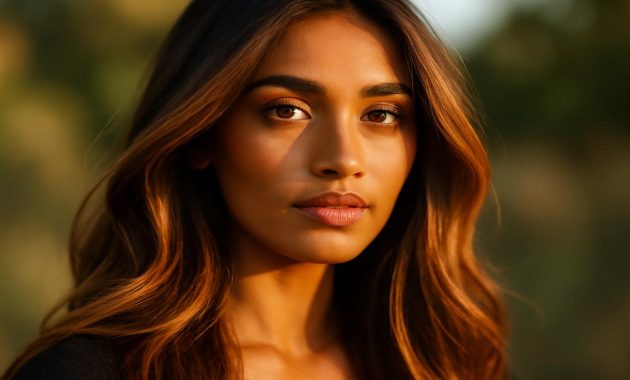
The first time you notice it is never in the salon chair. It’s in the way the sun sneaks up on you—maybe while you’re crossing a bustling street in Mumbai at golden hour, or leaning out of a train window somewhere along the Konkan coast. Suddenly, your hair isn’t just “brown” or “black” or “dark.” It’s lit from within, streaked with honey and copper and the faint glimmer of a long, slow summer. That sun-splashed, story-soaked glow is exactly what the “Indian sun” balayage trend is trying to capture—and this spring/summer 2026, it might just be the most effortless way to look like you’ve spent weeks on holiday without ever leaving your city.
The Quiet Magic of “Indian Sun” Balayage
Imagine this: you’re standing by a window on a warm May afternoon. The light tumbles through dusty glass and lands on your hair. It doesn’t lighten every strand uniformly; instead, it picks favorites. A few pieces at the front catch fire, a section near your crown warms to cinnamon, the tips soften to toasted caramel. No harsh lines, no clear beginning or end—just a slow fade from deep shadow to sun-kissed brightness.
That’s the spirit of the “Indian sun” balayage. It’s less of a color and more of an atmosphere. Think of it as the visual equivalent of the time between 4:30 and 6:00 pm: not quite day, not yet night, everything dipped in molten light.
Unlike the blockbuster balayage trends that burst out of European or Californian salons—cool, ashy blondes like sea foam and smoked beige—“Indian sun” is tuned specifically to the richness of Indian hair and skin. It leans into warmth: golden umber, burnt sugar, tamarind, sunset copper, cocoa, and chai-latte browns. It’s not trying to erase your natural color; it’s trying to translate it into sunlight.
If you’ve ever worried that lighter hair might wash you out, or that high-contrast highlights would look too “done,” this is where “Indian sun” quietly changes the rules. The color is painted on in freehand sweeps, like strokes on a canvas, placed where the sun would naturally fall. Nothing looks stripy, nothing looks hard or blocky. It’s that soft-focus filter you wish you had in real life—baked right into your hair.
Why This Trend Fits Spring and Summer 2026 So Perfectly
Spring and summer are already seasons of lightness: cotton kurtas, linen shirts, the particular brightness of mango season, late-evening chai on the balcony. In 2026, we’re seeing fashion and beauty pivot more toward health, tactility, and authenticity—less contour, more skin; less heavy glam, more glow-from-within. “Indian sun” balayage slips neatly into that mood.
It doesn’t scream new hair! from across the street. Instead, it asks people to look twice. Your friends might not immediately guess you’ve colored it; they’ll just notice that something about you feels more awake, more lit up. A soft apricot veil around your face can lift your complexion the way a good blush does. Delicate ribbons of caramel in your lengths can give your hair movement even when it’s tied up in the world’s laziest bun.
Most importantly, “Indian sun” balayage is designed to be practical. Roots are intentionally soft and shadowed, which means you’re not signing up for a lifetime of retouch appointments. The color melts from your natural base into lighter ends, so as your hair grows, it still looks intentional and organic—like the light is moving with you, not fighting you.
In the heat and humidity of an Indian summer, where straightening and heavy styling feel like a punishment, the trend is all about enhancement instead of control. Curls, waves, and even stubborn frizz catch the light and show dimension. That little halo of baby hair at your temple? Now it’s a soft glow instead of a nuisance.
The Color Story: Shades That Mirror Indian Light
To understand why this trend looks so flattering, it helps to think less like a color chart and more like a landscape painter. Indian light isn’t cold and blue like a northern winter; it’s warm, dense, often golden, sometimes smog-softened, sometimes razor-sharp on a dry May afternoon. “Indian sun” balayage borrows from this entire palette and pours it into your hair.
Colorists typically work with a gradient that echoes how the sun hits you in real life. The roots stay close to your natural color—espresso, black coffee, deep cola, or rich chestnut. From there, things gradually open up into tones like burnt sienna, rosewood, caramel, and golden cocoa toward the mids and ends.
| Base Hair Color | “Indian Sun” Highlight Tones | Overall Effect |
|---|---|---|
| Natural black | Deep caramel, dark amber, soft bronze | Subtle sun-glow, high shine, gentle warmth |
| Dark brown | Honey brown, golden mocha, light cocoa | Beachy dimension with natural depth |
| Medium brown | Toffee, chai latte, apricot brown | Soft, radiant, “holiday hair” effect |
| Light brown | Peach caramel, golden beige, light copper | Bright, luminous, but still low-maintenance |
What keeps it from veering into brassy or “too yellow” territory is the undertone. These shades are chosen with Indian skin tones—olive, golden, neutral, deep, and red-brown—in mind. Rather than fighting your warmth, they echo it. A wheat-gold highlight might look stark against very warm skin, but a honey-amber vein running through your lengths looks like it belongs to you.
And then there’s placement. Classic balayage often concentrates lightness at the ends, but “Indian sun” pays special attention to the pieces that frame your face: those soft strands that tuck behind your ears, the delicate curves around your jawline, the bits that fall forward when you tie a ponytail. These are your “sun windows”—the places where even a small lift in color can make your eyes look brighter and your skin more alive.
How “Indian Sun” Balayage Is Done (Without Killing Your Hair)
The real beauty of this trend lies in its method. Balayage, at its core, is a painting technique. No foil parcels crinkling around your head, no sharp horizontal lines marching across your strands. Your colorist reads your hair like a map: where it bends, where it falls, where it thickens and thins. Then they paint light into it.
For “Indian sun,” there’s usually a three-step approach:
- Mapping your sun zones: You sit down, and your colorist studies your hairline, parting, and natural texture. Do you always tuck your hair behind one ear? Do you flip your part? Do you wear it tied up most days? They decide where sunlight would naturally hit—around the crown, the mid-lengths, the face-framing pieces—and mark those zones, sometimes literally with a comb, sometimes mentally.
- Soft lifting, not aggressive bleaching: Instead of forcing your hair several levels lighter all at once, they lift it gently—especially crucial for dark Indian hair, which tends to pull orange and red when over-processed. The goal isn’t platinum; it’s one to three levels of lift, max, in most cases. Enough to catch light, not enough to strip your hair of its health.
- Toning with sunrise shades: Once the lift is complete, a toner is applied to coax the highlights into the right undertone. This is where “Indian sun” gets its signature glow: peachy-gold, amber, cinnamon, rose-brown. The toner blurs any remaining edges, blending your natural base into the newly lightened sections so everything feels like one seamless story.
What makes it ideal for 2026’s focus on hair health is the flexibility. Your colorist can decide to:
- Keep the lightness subtle and minimal for extremely damage-prone or previously colored hair.
- Use bond-building additives in the lightener to protect fragile strands.
- Leave some parts of your hair completely untouched so your overall density and strength remain intact.
The result? Hair that still feels like hair—soft, touchable, movable—instead of that brittle, over-processed texture that whispers, I’ve been through things.
Finding Your Own Version of the “Indian Sun” Glow
By Skin Tone, Lifestyle, and Personality
“Indian sun” isn’t a one-size-fits-all formula. It’s more like a spectrum of possibilities, and your ideal version depends on who you are and how you move through the world.
If your skin has olive or golden undertones: Honey, caramel, and amber shades usually look most natural. Think of the warm sheen on a cup of masala chai when light hits it from the side. Ask for a soft halo of brightness around your face, particularly near your cheekbones and jawline, to add lift and structure.
If your skin is deeper or richer: Go for dark toffee, burnished copper, and deep bronze. Concentrate lightness slightly lower—starting from mid-lengths rather than right at the front hairline—so the dimension feels like a gentle gradient instead of stark contrast. The effect is like late-evening sun catching the tops of waves on a dark sea.
If you’re low-maintenance (or just busy): Choose a “barely there” version. A few painted sections around your face and toward the ends are enough to shift your entire look without committing to heavy upkeep. The grow-out will be soft and forgiving; you can stretch touch-ups six to nine months if needed.
If you love experimenting: You can push the brightness a bit more at the ends, flirt with peachy or rose-gold toners, or add a few strategically placed lighter pieces near your temples. The key is still warmth and softness, but you get to play nearer the edges of the palette.
Talking to Your Colorist So You Get What You Actually Want
Instead of walking into the salon with just celebrity photos (which you absolutely can still bring), try describing the feeling you’re after:
- “I want it to look like I came back from a beach week, not like I changed my entire hair color.”
- “I want my face to look brighter even when I’m not wearing makeup.”
- “I don’t want harsh lines; it should still look good when it grows out.”
Pair that with specifics:
- How often you’re willing to come back for maintenance.
- How much styling you typically do (air-dry vs blow-dry vs always heat-style).
- Any past color history, especially bleach or dark permanent dyes.
This gives your colorist the raw material they need to design a version of “Indian sun” that’s yours, not just a copy of a reference picture.
Keeping the Glow: Low-Drama, High-Health Hair Care
Once you’ve walked out of the salon with your personal patch of bottled sunlight, the goal is to keep it glowing without turning your routine into a part-time job. The good news: this trend is naturally low-maintenance. The better news: a few small habits can stretch the life and health of your color dramatically.
1. Switch to a gentle, sulfate-free shampoo and a nourishing conditioner.
Lightened hair loses moisture more easily, especially under summer sun and in salty or chlorinated water. A hydrating, color-safe shampoo paired with a conditioner rich in oils or ceramides keeps strands supple and less prone to frizz.
2. Add a weekly or bi-weekly mask.
Think of it as a tall glass of water for your hair. Look for masks that mention “bond repair,” “strengthening,” or “color protection.” Focus them on your mids and ends—the areas that were lightened.
3. Treat the sun like a styling tool, not a threat.
A little sunlight enhances the shimmer in your highlights, but too much can fade and dry them. When you’re out for long periods, especially near midday, consider a hat, scarf, or leave-in product with UV protection. You’re not hiding from the sun; you’re just negotiating with it.
4. Be kind with heat tools.
Blow-dryers, straighteners, and curling irons can slowly dull your “Indian sun” shine if overused or used without protection. If you must style, use a heat protectant spray and lower heat settings. Or lean into the 2026 mood: glossy air-dried waves, brushed-out curls, or sleek low buns that let your color speak for itself.
5. Refresh, don’t redo.
When your highlights start to feel a little faded, you don’t necessarily need to re-lighten. Sometimes all it takes is a quick gloss or toner session at the salon—no bleach, just a wash of warmth to revive the sunlit tones and add a mirror-like sheen.
The Emotional Glow: Why This Trend Feels So Right, Right Now
Amid all the debates about aesthetic trends—clean girl, latte girl, tomato girl, old money, and everything in between—it’s easy to forget something basic: a lot of us just want to look like ourselves on our best, most rested day. Not like a character, not like a filter, but like the version of us that appears on holiday when the stress lines have softened and the light hits right.
“Indian sun” balayage speaks to that craving. It doesn’t demand a full-face of makeup to make sense. It doesn’t rely on heavy styling to show off. It’s the kind of hair that looks beautiful when you’ve just rolled out of bed, stood on your terrace for five minutes, and let the early light find you. It harmonizes with heritage jewelry and modern athleisure, cotton sarees and denim shorts, boardroom blazers and temple visits.
There’s also something quietly radical about a color trend that doesn’t treat Indian hair as a problem to fix. Historically, darker hair and warmer undertones have often been pushed toward extremes: either left completely untouched or dragged into cooler, ashier territories to mimic Western ideals. “Indian sun” says, what if the very things that make your hair and skin uniquely yours are the starting point for beauty, not the compromise?
It treats your natural shade as the hero, not the background. The painted light works like a handwritten note in the margins, not a rewrite of the story. The result isn’t “look at my hair color”; it’s “look at how alive I look.”
As spring softens into summer in 2026—ceiling fans spinning lazily, iced nimbu pani sweating on tables, late-evening walks lengthening by a few minutes each day—this is the kind of trend that doesn’t feel like a costume. It feels like permission: to glow a little more without trying a lot harder, to claim sunlight as part of your aesthetic instead of something you survive.
Maybe you’ll notice it first in a bathroom mirror under harsh white lights, or in the reflection of a café window, or in a blurry phone photo your friend snaps when you’re mid-laugh. Your hair will look as if the sun has been telling it secrets all season—and now, whenever you move, it can’t help but let them slip out in flashes of gold and amber and warmth.
That’s “Indian sun” balayage: not just a color, but a quiet, wearable glow that makes every day feel a little bit like golden hour.
Frequently Asked Questions About “Indian Sun” Balayage
Is “Indian sun” balayage suitable for very dark or jet-black hair?
Yes. In fact, it was imagined with very dark Indian hair in mind. Your colorist will likely keep the lift subtle—one to three levels lighter—so your hair stays healthy and the highlights look like natural sun rather than dramatic streaks. The key is warm, caramel-to-amber tones and soft placement, not aggressive lightening.
Will this color look good on deeper or very warm skin tones?
Absolutely. The entire philosophy behind “Indian sun” is to complement Indian undertones. Deeper skin tones pair beautifully with richer highlight shades like bronze, deep toffee, and dark honey. Because everything leans warm and glowing, it enhances instead of competing with your complexion.
How often will I need touch-ups?
Because the technique keeps the roots soft and close to your natural shade, you can usually go 4–9 months without major maintenance, depending on how bright you go and how fast your hair grows. Many people return only for an occasional toner or gloss to refresh the warmth and shine rather than redoing the lightening each time.
Can I get “Indian sun” balayage if my hair is already colored or has henna?
If your hair has been chemically colored, it’s usually possible, but your colorist may need to work in stages and adjust expectations about how light you can safely go. Henna is trickier; it can react unpredictably with lightener. Always tell your stylist your full color history—especially henna use—so they can perform strand tests and plan a safe approach.
Will it damage my hair?
Any lightening involves some level of stress on the hair, but “Indian sun” is specifically designed to minimize this by focusing on selective, gentle lifting rather than an all-over transformation. Using bond-building products, protein and moisture treatments, and a color-safe routine at home will help keep your hair strong, soft, and healthy-looking.
Is this trend only for wavy or curly hair?
No. It looks beautiful on straight, wavy, coily, and curly textures. On straight hair, it creates a mirror-like sheen and soft ribbons of light. On curls and waves, it adds depth and dimension, making each coil or bend catch the sun differently. Your stylist can adapt the placement to your specific pattern.
What should I ask for at the salon to get this look?
Use the words “warm, sun-kissed balayage” and mention that you want something that looks like natural summer light on Indian hair—subtle, glowy, and low-maintenance. Bring a few reference photos that show warm caramel, honey, or amber highlights on darker bases, and tell your stylist how often you’re willing to come in for touch-ups so they can customize the intensity for you.