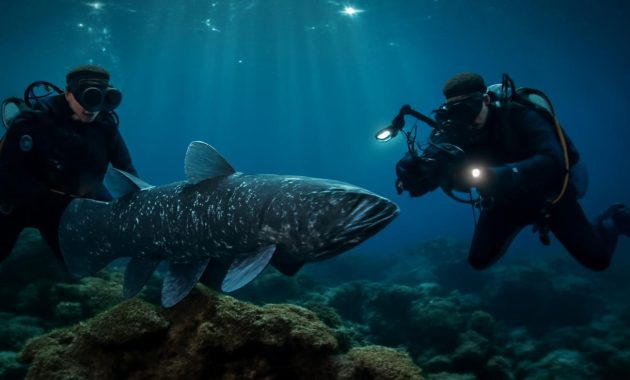
The first thing they saw were eyes—two pale, glassy moons hanging in the darkness, reflecting the sweep of their torchlight like distant headlights on a midnight road. The water around them was thick with night, the kind that swallows sound and color and replaces it with a slow, thudding heartbeat in your ears. The French divers had been drifting along the steep wall of an Indonesian reef, 120 meters down where sunlight is only a rumor, when the beam of a light found something that should not have been there. Something ancient. Something legendary.
A Creature That Slipped Through Time
At first, it didn’t move. It seemed almost sculpted into the shadowed rock, its blue-gray scales patterned like cracked stone and starlight. It was only as one diver shifted his fin and a swirl of current brushed against it that the animal turned—slowly, smoothly—revealing the unmistakable outline of lobed fins, thick as a human arm and jointed like limbs.
A coelacanth.
That word has a weight to it among people who know the ocean. It’s less a name and more a spell, conjuring images of textbooks and museum displays, of fossils pressed into rock hundreds of millions of years old. For most of modern history, a coelacanth was something you studied, not something you met. It was a symbol of extinction, of time’s ruthless march. And then, in 1938, a living one appeared in a South African fishing net and rewrote everything.
Since that day, coelacanths have occupied a strange place in our collective imagination: half ghost, half miracle. They are called “living fossils,” a phrase used so often that it almost feels cliché—until someone actually meets one in the dark belly of the sea.
Now, for the first time, French divers have captured clear images of one of these animals in Indonesian waters, an emblematic species making a rare, almost mythic appearance in a place where few expected it, and even fewer had proof.
Into the Twilight: French Divers on a Deep Quest
The story began on land, the way ocean stories usually do—with rumors. Local Indonesian fishers along a remote stretch of coast had been talking about a strange, big-scaled fish from deep nets and longlines, occasionally turning up as bycatch. The descriptions were fragmentary: “Old fish,” some said. “Stone fish.” Others mentioned glowing eyes, strange fins, a body that looked like it had been pulled from the bottom of time.
For years, scientists had known about a second coelacanth species in the region: Latimeria menadoensis, first scientifically described in the late 1990s from specimens near Sulawesi. But seeing one alive in its natural home, especially in some parts of Indonesia, remained maddeningly out of reach. The ocean here is deep, complex, and unforgiving. Most documented records came from dead animals hauled up by accident.
The French team that arrived was not made up of casual holiday divers. These were technical divers, trained in mixed-gas rebreather systems, people who are comfortable descending to depths where a simple mistake can become a slow-motion tragedy. They carried cameras instead of harpoons, scientific curiosity instead of spears.
Their goal was ambitious but simple to phrase: follow the stories. Find the depths. Wait for the past to swim by.
Descending Past the Last Colors
Entering the water at dusk, they dropped through the last lingering shafts of golden light. By 30 meters, red had drained from the world. By 60 meters, the reef was a muted landscape of blues and grays. At 100 meters, the ocean settled into its realm of cold patience.
The wall they followed was rugged and steep, a broken cliff of volcanic rock and old coral skeletons. Here and there, caves and overhangs split the darkness. This was coelacanth country: steep slopes, strong currents, deep ledges—places where a slow, powerful fish with a heavy body and a low metabolism could rest in the shadows and drift out only when it chose.
They had done their homework. Coelacanths, according to what little was known from tagged individuals in other parts of the world, like to haunt depths between 150 and 300 meters, often retreating into caves by day and emerging at night to hover near the rocky slopes. They are not agile sprinters; they are patient hoverers, moving like a swinging lantern in a gentle wind.
So the divers waited.
The Moment the Past Blinked Back
It started as a shape against the rock ledge—a vertical silhouette rather than the horizontal line of a sleeping shark or cruising grouper. The divers’ lights caught it edge-on, and at that angle, it looked almost like part of the wall. A trick of shadow. Then one fin moved, flexing at what looked unnervingly like an elbow.
This is one of the reasons coelacanths grip the imagination so tightly. Those fleshy, lobed fins are jointed in a way that makes them look like proto-limbs, echoing the first skeletal experiments evolution made when fish began to think about land. Watching one underwater feels like glimpsing an early draft of your own ancestry.
The animal rotated slowly, revealing its full length—nearly two meters of powerful, rounded body covered in thick, cosmoid scales that looked almost armored. Its color was a muted cobalt blue, dappled with pale spots that caught the light like stars. The head was large and angular, with that strange hinged skull that allows coelacanths to lift the top of their head independently from the rest of the body, widening the gape of their mouth to engulf prey.
And then there were the eyes: large, unblinking, adapted to the gloom, reflecting the divers’ lights with a silvery flare. For a moment, fish and humans simply stared at each other—an encounter spanning hundreds of millions of years of evolutionary divergence in the silence of a deep Indonesian night.
Filming a Legend
Hands that had practiced camera drills for months now moved almost automatically. The divers kept their motions slow, puffs of exhaled gas whispering from their rebreathers in small, silenced streams. Their lights dimmed to avoid startling the fish, creating a gently illuminated cone in the water column.
The coelacanth didn’t bolt. Instead, it drifted away from the rock, its paired fins paddling in a peculiar, almost eerie synchrony. The pectoral and pelvic fins moved not like the flapping of regular fish fins, but in a pattern more akin to the alternating steps of a walking animal—a ghost impression of limbs still to come. Its tail, three-lobed and powerful, gave small corrections rather than bursts of speed.
Minutes stretched. The cameras captured stills and video: the shimmer of scales, the measured movements, the way the animal held its place in a narrow band above the slope, perhaps riding a subtle current. Small fishes darted in and out of the rock crevices behind it, seemingly indifferent to the living relic in their midst.
In those moments, the divers were not just visitors; they were witnesses. The weight of the encounter only fully settled on them later, back on the boat, when warm air replaced the chill of depth and the pixelated shapes on their screens resolved into the first clear, indisputable imagery of an Indonesian coelacanth taken by divers who had met it on its own terms.
What Makes a Coelacanth a “Living Fossil”?
The phrase “living fossil” is seductive, but it can be misleading if taken too literally. Coelacanths are not frozen in time; they have continued to evolve, adapt, and persist. Still, they represent a lineage that split off from other vertebrates more than 400 million years ago, maintaining body plans and anatomical quirks that closely resemble early fossil forms.
They carry a catalog of features that feel like evolutionary whispers:
- Lobed fins with a bone structure faintly reminiscent of legs and arms.
- A unique, oil-filled notochord instead of a fully ossified backbone in adults.
- An intracranial joint—an articulating hinge in the skull that allows the head to open like a trapdoor.
- An electroreceptive organ in the snout, helping them detect movements and perhaps the electrical fields of prey in the dark.
To lie face to face with such an animal is to confront a version of ourselves that never made the leap onto land. Watching it move is like watching an alternate history of vertebrates, one where the story remained in the ocean and limbs never touched dry ground.
The images captured by the French team do more than satisfy curiosity; they add precious behavioral context to what has mostly been a fossil-bound narrative. Science loves detail, and these photographs and videos feed that appetite: how the coelacanth orients in current, whether it chooses specific ledges, how close it allows divers or camera gear to approach.
A Glimpse at the Data Behind the Wonder
Behind the poetry of this encounter lies the practical value of the data. In the deep realm where coelacanths live, every observation counts. Here is a compact snapshot of what the divers recorded:
| Observation | Details |
|---|---|
| Location | Steep reef slope off a remote Indonesian coastline |
| Depth range | Approx. 110–130 meters (twilight to upper deep zone) |
| Estimated size | Around 1.8–2 meters in length |
| Behavior | Slow hovering, minor fin adjustments, no rapid escape response |
| Habitat features | Rocky ledge, overhangs, nearby crevices and small caves |
Details like these help refine our understanding of the species’ preferred microhabitat, depth range in different regions, and tolerance for light and human presence—subtle threads that, woven together, support future conservation strategies.
Why This Encounter Matters for Indonesia—and the World
Indonesia sits in the heart of the Coral Triangle, the beating biodiversity core of the Indo-Pacific. We already know it hosts some of the richest coral reefs, seagrass meadows, mangroves, and pelagic highways on the planet. But step off the reef edge into darkness, and our knowledge thins quickly. Deep slopes and underwater canyons around the archipelago remain largely unmapped, biologically speaking.
The confirmed presence of a living coelacanth population in Indonesian waters adds another layer to an already intricate ecological puzzle. It underscores a point that scientists and conservationists often repeat but rarely get to illustrate with such drama: we are still discovering the planet we live on.
For Indonesia, this is both pride and responsibility. The coelacanth is an emblematic species, a flag-bearer for deep-sea conservation. If such an iconic, slow-breeding, vulnerable creature is surviving off these coasts, it means the underlying ecosystem—steep slopes, caves, currents, and food chains—still retains a measure of integrity. But it also means that whatever we do to those deep-sea habitats, for better or worse, we are doing to a lineage older than the dinosaurs.
Invisible Threats in the Dark
From the surface, the ocean looks unchanging, but in the shadows below, human fingerprints are spreading. Deep-sea fishing, seafloor mining proposals, plastic debris, and even climate-driven oxygen loss and warming are creeping down the water column.
Coelacanths, with their slow metabolisms and late maturity, are particularly vulnerable. A species that takes many years to reach reproductive age cannot quickly rebound from heavy bycatch or habitat disruption. They are built for stability, not for surviving rapid upheaval.
The images recorded by the French divers mark a turning point. Where there were once only secondhand accounts and preserved specimens, there are now living portraits. A face is harder to ignore than a catalog number. In the courtroom of public opinion, visuals like these become powerful witnesses—evidence that the deep sea is not a blank expanse but a living archive of Earth’s history.
The Human Side of Meeting a Million-Year-Old Lineage
Strip away the science for a moment, and you’re left with something more intimate: the raw emotion of a diver hovering in the dark, watching a prehistoric fish watch them back.
One of the divers later described the moment in terms that sounded almost like an encounter with a large land mammal. There was a sense of presence, of being measured and then dismissed as non-threatening. The coelacanth did not flee, did not act like prey. It occupied its space with a kind of heavy assurance, as if it had been there long before us and fully expected to be there long after.
Human time is short; dive time is shorter. Gas supplies and decompression schedules are merciless in their arithmetic. Eventually, the divers had to back away, turning their lights toward their ascent line. As they did, they glanced over their shoulders one last time.
The coelacanth was still there in the beam’s fringe, hovering, silence given form. Then the slope faded, the fish dissolved into darkness, and the divers began the slow, hour-long climb back through water layers, carrying their footage like a secret they were eager to tell.
On the surface, the boat rocked under a sky that had just begun to gather stars. They peeled off gear with fumbling cold hands, eyes already flicking to camera housings and memory cards. Only when the first images slid into clarity on their screens did the significance fully land. They hadn’t just filmed a rare fish; they had opened a small window into deep time off a coast that, for most of the world, exists as a nameless stretch of blue on a map.
What Happens Next?
The story doesn’t end with the click of a shutter or the flicker of a video clip. Those images are now part of a growing mosaic: mapping coelacanth range, refining depth and habitat preferences, and connecting local fishers’ knowledge with modern research. In many ways, this encounter is a beginning—a prompt for new questions.
- How many coelacanths live in this Indonesian region?
- Do they move between known populations, or are they isolated pockets?
- What other deep-sea species share these slopes, unseen and undocumented?
- How will climate and human pressure reshape these hidden worlds?
The French divers, for their part, returned home with more than data. They returned with a story that cannot be easily forgotten—a story that compresses hundreds of millions of years into a few minutes of silent eye contact at 120 meters depth.
Somewhere tonight, off another Indonesian reef face, a coelacanth hovers in the dark, fins slowly pulsing, body suspended in the gentle sway of currents. It knows nothing of cameras or headlines. Its clock runs on deeper rhythms: tides, tectonics, the slow rearrangement of continents. But because a handful of people chose to follow rumors into the sea, we now know, a little more clearly, that it is there.
And knowing matters. In a century defined by loss—of species, habitats, and stable climates—the appearance of a living fossil in the beam of a diver’s torch is a quiet, powerful reminder: not everything ancient is gone. Some stories are still being written in the dark, waiting for us to learn how to see.
Frequently Asked Questions
What exactly is a coelacanth?
A coelacanth is a large, deep-sea fish belonging to an ancient lineage that dates back more than 400 million years. Its distinctive features include lobed, limb-like fins, thick scaly armor, and a unique hinged skull. Once known only from fossils, it was long thought extinct until a living specimen was discovered in 1938.
Why is the coelacanth called a “living fossil”?
It is called a “living fossil” because its overall body structure closely resembles fossilized relatives from hundreds of millions of years ago. While the species has continued to evolve, many of its anatomical traits have changed relatively little compared to other vertebrate lineages, making it a rare window into prehistoric life.
Why are the new images from Indonesian waters so important?
These images are the first clear, diver-captured records of a living coelacanth in certain Indonesian waters. They confirm the species’ presence in specific deep habitats, provide visual data about behavior and environment, and strengthen the case for protecting these little-known ecosystems.
How deep do coelacanths usually live?
Coelacanths typically inhabit depths between about 150 and 300 meters, often along steep underwater slopes, caves, and rocky ledges. They may move slightly shallower or deeper depending on local conditions, but they generally stay far below the range of recreational diving.
Are coelacanths endangered?
Coelacanths are considered threatened and vulnerable due to their slow reproduction, limited populations, and sensitivity to habitat disturbance and accidental capture in deep-set fishing gear. Their deep-water habitats offer some natural protection, but increasing human activity at depth remains a concern for their long-term survival.