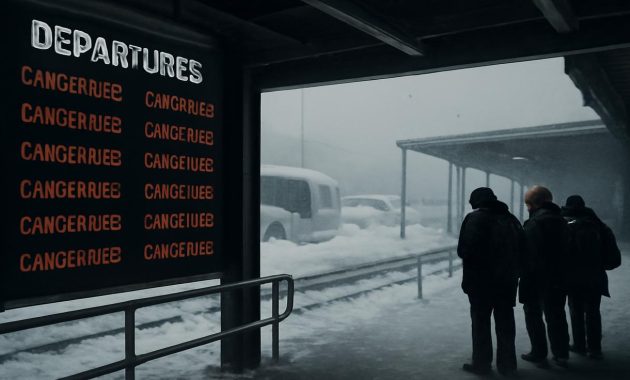
The first flakes drift in almost shyly, like they’re testing the air, as if this valley hasn’t seen a thousand winters before. You notice them from the kitchen window—tiny white sparks spinning in the wind, not yet a storm, not yet a story. But somewhere beyond the horizon, an enormous engine of weather is churning, gathering cold and moisture and momentum. Your phone buzzes on the counter. A familiar tone. A familiar phrase. Winter Storm Warning.
The Storm That Redraws the World
At first, the words don’t quite land. You tap open the alert, expecting something routine: a few inches, maybe a slick commute, a day of nuisance. Instead, the numbers leap from the screen like something misprinted.
Up to 55 inches of snow possible…
Fifty-five inches. Not a dusting, not a “stay home if you can” event. This is something else entirely—a winter recalibration. A storm that can bury cars to their mirrors, mute city soundscapes into eerie silence, and turn train lines and highways into pale, silent fossils under a shifting white sea.
Outside, the flakes have grown larger now, cottony and deliberate, swirling around porch lights and streetlamps. The wind has a new edge to it—a low, restless murmur under the usual neighborhood sounds. Somewhere in the distance, you hear the faint growl of a snowplow making an early pass, as if it, too, has read the warning and decided to start early.
The Anatomy of a Warning
Weather warnings are oddly intimate things. They arrive on our personal screens, lit up in our palms, but they’re born from satellite eyes and radar scans hundreds of miles above us. They are the product of models and math, yes, but they’re also small human messages of urgency: Pay attention. Something big is coming.
In this case, the warning describes a classic yet supercharged winter system. A low-pressure center is expected to deepen as it slides along a sharp temperature boundary, drawing frigid Arctic air down and colliding it with moist air streaming from distant oceans. That clash is the spark. The atmosphere, loaded with moisture and chilled to the bone, transforms invisible vapor into billions of unique crystals that will soon blanket everything you know.
Forecasters talk in probabilities and ranges: 30 to 55 inches in the hardest-hit zones, lower totals around the edges. Heavy snow bands that could sit over one community for hours, leaving another just miles away wondering what all the fuss is about. It’s a reminder that storms are not uniform blankets but living, shifting creatures with their own temperaments and surprises.
When Roads Become Memory
It helps to imagine the storm on the scale of a single highway. Picture a familiar road you know well—maybe the main four-lane that stitches your town to the next, or the interstate that hums day and night. Picture it at rush hour: headlights, taillights, trucks, buses, the easy rhythm of people moving toward and away from their lives.
Now imagine that same road twelve hours into this storm. Snow is no longer gently falling; it is driving, horizontal, stinging exposed skin. Visibility crashes. The white lines vanish first, then the contours of the road’s shoulder. The asphalt—the solid, black certainty that has always guided you—disappears beneath an increasingly indistinct white sheet.
Snowplows form convoys, orange lights flashing like small ships in an unsteady sea. But even they begin to struggle as snow rates climb—three, four inches an hour, more in some places. What they push aside piles up quickly on the shoulders, growing into walls that narrow the road with every pass. Interchanges clog, minor accidents multiply into chain reactions, and suddenly the graceful flow of traffic fractures into stuck, idling lines.
Local transportation officials know these patterns too well. They’ve spent days refining their plans, deciding when to pretreat the roads, when to pull back plows for safety, when to close key routes. The storm, however, has its own schedule. It rarely aligns neatly with human convenience.
How a Region Slows to a Crawl
When the forecast climbs toward four feet of accumulation, the language shifts from “difficult travel” to “potentially impossible travel.” It’s not only about the snow depth but the compounding effect: drifting, refreezing, disabled vehicles blocking plow routes, exhausted crews working marathon shifts.
To understand the scale, it helps to stack the numbers next to everyday reference points:
| Snow Amount | What It Can Mean |
|---|---|
| 6 inches | Slippery roads, slower commutes, minor delays, manageable plowing. |
| 12–18 inches | Hazardous travel, potential closures, heavy strain on plow crews and emergency services. |
| 24–36 inches | Widespread shutdowns, many roads impassable without continual plowing, risk of stranded motorists. |
| 40–55 inches | Prolonged paralysis of road networks, buried vehicles, limited access for emergency responders, cleanup measured in days, not hours. |
By the time you approach the upper end of that scale, roads don’t just become difficult; they effectively vanish, replaced by an uneven terrain of drifts and sculpted ridges. Even walking across a parking lot can feel like crossing a low mountain range.
Rails Under Snow and Silence
Railways tend to feel elemental—steel on earth, their lines so straight and certain that we imagine them as constants. Snow complicates that certainty. When inches turn into feet, rail networks inherit the same fragility as highways, just in different ways.
Think of a set of tracks running through an open field. In your mind, they’re clean, polished by use, stretching to the horizon. Now cover them with a foot of snow. A passing train might carve a dark channel through the white. But in a storm that keeps feeding the landscape, that channel quickly fills back in. Add another foot, then another, then a blizzard wind that sculpts the snow into hard, wind-packed drifts that rise above the rails, above the platforms, swallowing the signals and switch gear.
Rail operators face a double challenge: clearing the tracks themselves and ensuring that station platforms, overhead power lines (for electrified systems), and critical switching points remain functional. In heavy snow, even a simple door on a train car can freeze shut, trapping warmth inside and cold outside, locking passengers in a temporarily sealed world.
Schedules that once felt industrial and precise start to blur, then collapse. First, there are delays. Then service adjustments. Then, finally, the blunt phrase: suspended. Freight trains that carry fuel, food, and crucial supplies are forced to wait, heavy steel snakes immobilized beneath a storm that pays no attention to timetables.
How a Single Drift Stalls a System
One of the strange truths of rail is that a very localized problem—a single drift, a frozen switch, a downed line—can have ripples far beyond the spot itself. A snow-packed rail crossing in a rural cut can delay trains hundreds of miles away, as dispatchers reshuffle priorities and reroute what they can. The system is both robust and delicate: built for massive forces, but vulnerable to the tiniest critical failure.
In the days leading up to this storm, railway maintenance crews inspected snowplow-equipped locomotives, tested switch heaters, stocked de-icing agents. Just as highway crews read the same bulletins and models, rail staff also followed the forecasts with a particular kind of attention: not just how much snow would fall, but where, when, and under what winds.
As the warning escalated and mentions of “potentially historic totals” crept into official language, contingency plans quietly came alive: skeleton service schedules, emergency staffing, overnight accommodations for crews who might not make it home. The storm becomes not just a weather event, but a logistical puzzle that needs to be solved in real time, in whiteout conditions.
Inside the Human Weather
Out in the storm, it’s all swirling snow and roaring wind. Inside our homes, there’s a different kind of weather brewing. You feel it in the shift of conversation: neighbors comparing notes on generators, grandparents calling to ask if you have enough food, text threads about whether schools will close and when.
The phrase “up to 55 inches” carries more than meteorological meaning. It brings a subtle memory rush. Maybe you recall the blizzard from your childhood, when snow banks were higher than your shoulders and school was closed for a week. Or the more recent storm that stranded you on a highway for hours, your car slowly filling with condensation on the windows as you listened to AM radio updates.
The air inside your house smells different today—more like wool and damp boots, like coffee and slow-cooked food. You find yourself counting candles, checking flashlights, testing batteries. You move with the quiet focus of someone who understands that the routine can snap quickly under the weight of a winter like this.
The Psychology of a Big Winter
A major storm like this is as much a mental event as a physical one. There’s anticipation—the anxious kind and the secretly thrilled kind. The part of you that worries about power loss and medicine refills, and the part that feels a childlike excitement at the idea of the world forced to pause, of obligations buried under fresh drifts.
Communities respond in different ways, shaped by their histories with winter. In places that live under a regular rhythm of heavy snow, big storms are woven into culture: snowblower maintenance is a social currency, and stories of “that big one back in…” are retold like family legends. In regions less used to deep snow, the same forecast can feel almost existential, a challenge to basic assumptions about mobility and normal life.
Yet across all those differences, the core reaction is shared: we look out the window more. We watch the sky change. Past and future both press in. How bad will it get? How long until we dig out? What will this look like in memory?
Preparing for a Slow, White World
By the time the serious snow arrives—those thick, relentless curtains of white—you’ve already made dozens of small decisions. Some of them feel perfunctory: filling the gas tank, charging phones, pulling the heavy boots from the back of the closet. Others feel more symbolic: choosing which books to pull from the shelf, topping off the bird feeder outside the kitchen window, texting friends you haven’t spoken to recently just to make sure they’re paying attention to the forecast too.
Winter preparedness often gets boiled down to lists—flashlights, batteries, blankets, food. But beneath those lists is a more meaningful act: creating a little island of resilience in the middle of something bigger and uncontrollable. You’re acknowledging, in a practical way, that nature gets the last word on movement and speed.
Officials urge people to stay off the roads once the storm intensifies. This isn’t just about individual safety; it’s about the shared system. Every car that avoids the highway is one less potential blockage for plows and ambulances. Every person who chooses to stay home lightens the load, just slightly, on responders who will spend the night stepping out of warm vehicles into a world of stinging snow and howling wind.
Small Acts, Big Impact
If you listen carefully to the storm’s approach, what you hear beneath the weather bulletins is a kind of quiet coordination. Grocery clerks staying late to manage pre-storm crowds. Utility workers on standby, ready to chase down outages in the teeth of the wind. Transit operators studying maps, deciding which routes can survive the first blows and which must shut down early. Neighbors sharing tips on how to keep pipes from freezing or where to shovel so plows don’t push your hard work back into the driveway.
None of this stops the snow, of course. But it does something important: it softens its impact. It turns a purely destructive force into a shared challenge. Not a battle won or lost, but a passage endured—and, afterward, retold.
After the Whiteout
One of the strangest moments in any huge storm comes when it simply… ends. Not with a dramatic final gust, but with a gradual lightening. The snowflakes thin, then stop. The wind, still cold, loses its cutting edge. The world doesn’t “go back to normal” right away; it just becomes suddenly, almost shockingly, still.
You open your door to a transformed landscape. Familiar landmarks have changed shape, rounded and softened under the weight of snow. Cars become gentle mounds. Fences reduce to faint, straight lines running through white dunes. Tree branches sag and glitter, wrapped in icy coats that catch the thin winter sun.
The roads are gone—at least visually. What you see instead is a shared, continuous surface, broken only by the raised humps of buried curbs or the occasional exposed fire hydrant. Somewhere under there, asphalt waits. But for now, it might as well be on another planet.
Then come the sounds. Engines turning over reluctantly in the cold. The distant, steady grind of snowplows resuming the long work of carving civilization back into the landscape. Shovels scraping. The muted thud of snow falling from roofs and tree limbs. Voices drifting across yards as people compare totals, trade stories, laugh in short, visible puffs of breath.
Trains, when they return, will be late and cautious, their fronts pushing through carved channels of white. Buses will move slowly, testing each intersection like unfamiliar ground. For days, maybe longer, travel will be measured not in minutes but in layers: how many inches between where you stand and where you’re going, how many plow passes needed to find the baseline again.
But life, stubbornly and beautifully, resumes. Children clamber onto high piles of plowed snow, turning them into temporary fortresses and mountain peaks. Adults, weary and sore-backed, still find themselves pausing in the shoveling to notice how the afternoon sun turns untouched fields into sheets of tiny, glittering stars.
Remembering What Winter Can Do
Storms like this one—storms that threaten to drop 55 inches of snow and overwhelm the veins and arteries of a region—carry a lesson that is older than cities, older than railroads or highways or weather apps.
They remind us that for all our engineering and scheduling and predictive algorithms, we remain bodies under a sky. We move at the pace the weather allows. We adapt. We step back when nature steps forward with its full, unburdened force.
In the weeks after, the plowed piles shrink. The world reclaims its colors: asphalt gray, brick red, evergreen, and the muted browns of winter trees. Train schedules normalize, highways dry, parking lots widen back into their full painted grids. But memory holds onto that moment when everything slowed—when roads and rails vanished under a temporary ocean of white, and the whole region paused to listen to the storm’s story.
And maybe, the next time your phone vibrates with a winter alert, you’ll feel not just the usual flicker of inconvenience, but also a quiet respect. Because you’ll remember that once, not so long ago, the sky dropped nearly five feet of snow, and for a while, it rearranged everything.
FAQ
Why is a storm with up to 55 inches of snow so dangerous for roads?
At those snow totals, roads can become quickly buried and indistinguishable, making it easy for vehicles to slide off or get stuck. Plows struggle to keep up when snow falls several inches per hour, and stranded cars can block emergency vehicles and plows, creating widespread, long-lasting gridlock.
How does heavy snow affect rail networks?
Deep snow can cover tracks, freeze switches, bury signals, and interfere with overhead power lines on electrified routes. Even a single blocked section can disrupt train schedules over large areas, forcing delays, cancellations, or complete suspension of services until tracks are cleared and equipment is safe.
What should people do when a major winter storm warning is issued?
Limit travel as much as possible, stock up on essentials, charge devices, and prepare for potential power outages. Follow local advisories, keep emergency kits ready, and avoid driving once conditions worsen so roads remain clear for plows and emergency responders.
Are regions usually prepared for storms of this size?
Areas used to heavy snow often have robust plowing fleets and winter protocols, but a storm approaching four or five feet can strain even the best-prepared systems. In places less accustomed to significant snow, the impact can be more severe, as infrastructure and resources may not be designed for sustained, extreme conditions.
How long does cleanup take after a storm this big?
Cleanup can take several days or more. Main routes and critical emergency corridors are cleared first, followed by secondary roads, neighborhood streets, and parking areas. Rail services, bus routes, and other transportation systems often return gradually, with modified schedules until crews can fully restore normal operations.