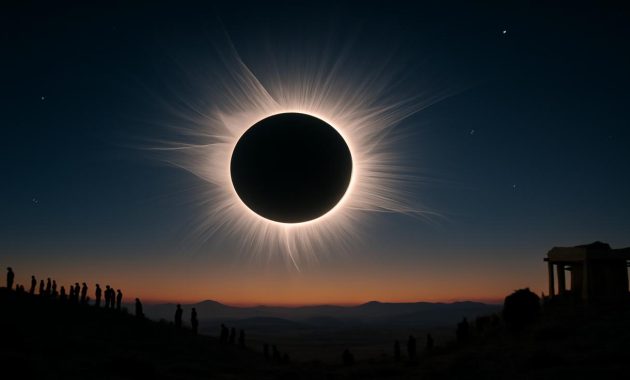
The news arrived not with a bang, but with a quiet press release that ricocheted through observatories, classrooms, and late-night group chats around the world: astronomers have confirmed the exact date of the century’s longest solar eclipse. A day, not so far from now, when the sun itself will vanish in the middle of the afternoon. A day when the sky will dim, stars will flicker awake, and a strange chill will crawl along the ground as if dusk has arrived hours too early. Already, people are circling the date on calendars, planning road trips, dreaming of darkened fields and mountaintops, wanting—deeply, almost instinctively—to be under that shadow when it falls.
When the Sun Blinks
Solar eclipses happen more often than many people realize, but most slip by unnoticed, crossing lonely stretches of ocean or remote land. This one is different. Astronomers have confirmed that on this single, specific day, the moon will slide in front of the sun in such perfect alignment, and linger there for so long, that it will become the longest total solar eclipse of the century. Not just a fleeting blink, but a drawn-out, almost cinematic pause in daylight.
Imagine standing in the middle of a clear afternoon. The light is bright and ordinary—the kind you barely register because you were born into it. Then, over the course of an hour, the sun transforms from a neat circle into a crescent, as if some invisible force is slowly taking a bite out of it. The landscape responds in whispers at first. Colors flatten. Shadows sharpen. The air cools, the way it does just after a storm passes. Birds begin to go quiet.
And then, if you’re in the path of totality—the narrow track where the eclipse will become complete—something inside your brain starts ringing the ancient alarm bell. The last sliver of sun vanishes. Day collapses into an eerie twilight. Above you, where the sun should be, there is a black disk surrounded by a ragged, pearly halo. That ghostly halo is the sun’s corona, usually drowned in daylight, now suddenly and extravagantly visible. Stars and planets step forward onto the stage of the midday sky. A 360-degree sunset glows along every horizon, as if the world is ringed with fire.
This, astronomers say, will last longer than any other totality you will see in your lifetime. Long enough that you may have time to look up, look around, look back up again, and feel the experience settle into your memory in layers instead of a single, panicked moment of awe.
The Path of a Moving Shadow
Though the confirmed date is fixed, the eclipse experience will not be the same for everyone. Totality—when the sun is fully covered—will carve a slender, curving path across Earth’s surface. Outside that path, millions will still see a partial eclipse, as if the sun has been transformed into a cosmic crescent. But inside it, day will genuinely turn to night.
Astronomers have mapped this journey of shadow with exquisite precision. The moon’s umbra—the darkest part of its shadow—will race across the planet at thousands of kilometers per hour, touching down first over open water, then sweeping across land, cities, farmlands, deserts, and mountains. In some regions, totality will last more than seven minutes, an extraordinary stretch of time for such a rare event. For comparison, many total solar eclipses barely cross the two- or three-minute mark.
Communities are already preparing. Local councils in small towns along the path are quietly bracing themselves for an influx of visitors that may double or triple their population for a day. Farmers are puzzling over how their livestock will react; anyone who has seen an eclipse on a farm remembers the way cows cluster near barns and chickens hurry to roost, convinced that night has come early. Hotels in prime viewing zones are sketching out reservation plans. Friends are sending each other rough maps with arrows—“Here. If the weather’s clear, we go here.”
To give a sense of how different the experience will be depending on where you stand, consider this simplified overview of possible viewing conditions across typical eclipse zones:
| Region Type | Approx. Totality Duration | Sky Conditions (Typical) | Viewing Experience |
|---|---|---|---|
| Coastal areas | 3–5 minutes | Variable clouds, haze | Dramatic horizon, reflections over water, potential misty darkening. |
| Inland plains & farmland | 4–6 minutes | Often clear, big open sky | Panoramic view of the shrinking sun and 360° twilight glow. |
| Mountain regions | 5–7 minutes (high peaks) | Clear but windier, crisp air | Sweeping vistas, racing shadow visible over slopes and valleys. |
| Urban centers (partial only) | 0 minutes (no totality) | Hazy, light pollution | Noticeable dimming, crescent sun through glasses, streetlights flickering on. |
Wherever you are, it will be a day when people step outside and look up together, in a world that often forgets to do either.
The Science Under the Shiver
If you strip away the shivers and goosebumps, a solar eclipse is a simple alignment: Earth, moon, and sun tidily stacked in a straight line. But inside that simplicity hides a chain of cosmic coincidences so precise it borders on outrageous. The sun is about 400 times larger than the moon—and also about 400 times farther away. Because of this neat ratio, from where we stand, they appear almost exactly the same size in the sky. The moon can, on rare occasions, cover the sun perfectly, like a coin laid flat over a glowing eye.
The details of this upcoming eclipse—the where, when, and how long—are the product of orbital clockwork that astronomers have learned to read like music. They track the moon’s slightly elliptical orbit, noting whether it’s closer to Earth (making it appear larger) or farther away (shrinking it just enough that some eclipses become “annular,” leaving a ring of sun). They map Earth’s own tilt and spin, the shape of its surface, even how sunlight will thread through the atmosphere to paint that strange, bruised twilight during totality.
This time, everything lines up for a showstopper. The moon will be close enough and the alignment clean enough that totality stretches to its maximum possible length. For scientists, that long, deep shadow is a research gift. Telescopes will be poised to study the corona in visible light—no special spacecraft needed, just a sky gone dark. Researchers will sharpen their models of solar storms and magnetic fields, hoping to better predict the mood swings of the star that powers our climate and disrupts our electronics.
But for everyone else—teachers bringing students to playgrounds, parents holding eclipse glasses over small, determined faces, the couple who’ve been planning their eclipse-watching honeymoon for years—the science will hum quietly in the background, like the power lines behind the town. The main event is visceral. It’s the moment your body insists that something impossible is happening in the sky.
How the World Reacts When Day Turns to Night
If you’ve never been in the path of totality, it’s hard to understand why people chase eclipses around the globe, spending savings and vacation days for a few precious minutes of dark. On paper, the math is not persuasive. But the experience itself rewrites the arithmetic.
In the minutes approaching totality, the world begins to feel slightly wrong. The light takes on a metallic sheen, as if the saturation has been turned down a notch. Shadows go razor-sharp, their edges crisp and uncanny. If you stand under a tree, every gap between the leaves becomes a tiny projector, casting hundreds of crescent suns onto the ground. Photographers call this phenomenon “pinhole projection,” but up close it looks like someone has spilled golden fish scales across the sidewalk.
Animals notice the change before you do. Insects ramp up their dusk chorus. Birds wheel overhead, unsettled, then retreat to roost as the sky darkens. Dogs fall quiet. Cats stand at windows, tails twitching. In that final sliver of sun, people tend to fall silent too, as if the air itself is asking for attention.
When totality hits, it happens rapidly—light snapping off the way it does in a theater when the film begins. Streetlights and porch lamps flicker alive. Temperature drops can be dramatic, especially in open landscapes; you might feel the cool reach up your arms in a swift, invisible tide. Some people shout, some cry, some merely stare, lips parted. For a few minutes, everyone in that shadow shares the same focal point, the same astonishment ricocheting down their nerves.
Across cultures, eclipses have stirred myth and meaning for millennia: dragons devouring the sun, jaguars consuming the light, cosmic battles taking place overhead. Even in an age of careful, disciplined science, those old stories feel less like superstition and more like a human attempt to reach for language equal to the event. This upcoming eclipse, stretched to record length, will give us more time than usual to sit inside that story.
Preparing for a Once-in-a-Lifetime Sky
Choosing Your Place in the Shadow
Planning for the century’s longest solar eclipse is as much about geography as it is about timing. The single most important decision is whether you can get yourself into the path of totality. Being even a little outside that narrow band means you’ll see only a partial eclipse—a remarkable event in its own right, but missing the gut-punch drama of day turning fully to night.
Astronomers and local agencies will provide detailed maps, but your own priorities matter too. Do you want a quiet field where the nearest sound is the wind rustling grass? A mountaintop overseen by thin air and distant glaciers? A small town that turns its main street into an impromptu viewing party? Whichever you choose, think about weather patterns: regions that are usually clear at that time of year will give you better odds than cloud-prone coasts.
Seeing the Sun Safely
There is a hard rule with solar eclipses, and it applies every single time: never look directly at the sun without proper protection, except during the brief minutes of totality when the sun is completely covered. Regular sunglasses, no matter how dark, are not safe. The invisible power of sunlight can damage your eyes in a way you won’t feel until it’s too late.
You’ll need eclipse glasses that meet international safety standards or a solar viewer made specifically for looking at the sun. Many educational groups distribute them ahead of major eclipses. Another option, especially for children, is indirect viewing: a simple pinhole projector made from cardboard, or even watching the crescents on the ground under a leafy tree. During totality itself, you can remove protective glasses and look directly at the corona—but the instant even a sliver of sun reappears, eye protection must go back on.
What to Bring (Besides Wonder)
On the day itself, treat the eclipse like a cross between a picnic, a small expedition, and a communal ritual. Pack water, snacks, a hat, layers to handle the temperature drop, and perhaps a blanket or camping chair so you can lie back and watch the sky without craning your neck. If you plan to photograph the eclipse, practice with your camera beforehand; fumbling with unfamiliar settings while the universe is putting on its rarest performance can be a frustrating distraction.
Often, the most rewarding decision is to let the first minutes of totality be camera-free. Let your eyes, your skin, your ears do the recording. The photos will circulate online sooner or later, in millions of variations. Your own felt experience—the hush of the crowd, the sudden wind, the ring of fire in the sky—belongs only to you.
The Legacy of a Shadow
Years from now, people will ask where you were on the day the sun disappeared. Big eclipses have a way of stitching themselves into personal timelines: the eclipse you watched as a child through a shoebox projector; the one that caught you by surprise on a road trip, when the traffic thinned and the sky dimmed; the one that made you pull your kids out of school for a day because some lessons can’t be given indoors.
This upcoming eclipse, stretched to become the longest of the century, carries an extra weight of story. There will be couples who decide to get engaged under that eerie twilight. There will be scientists whose careers are nudged forward by the data they collect in those seven minutes of darkness. There will be children who feel, maybe for the first time, the scale of the universe pressing gently but unmistakably against the scale of their own lives.
In the weeks leading up to it, conversations will bloom: in classrooms, coffee shops, over kitchen tables. Parents will hunt for explanations that make sense to curious eight-year-olds—how the moon, which seems so small, can possibly erase the sun. Friends will coordinate travel, some choosing to meet halfway across the world, anchored by a moving spot of shadow. Cloud forecasts will be watched with a level of attention normally reserved for major storms and holidays.
And then, for those few long minutes, all of that planning and anticipation will fall away, replaced by the raw experience of standing on a sunlit planet that has, somehow, briefly forgotten the light.
Questions People Are Already Asking
How rare is this kind of long solar eclipse?
Total solar eclipses occur somewhere on Earth every one to two years, but most are brief or cross remote regions. An eclipse that reaches this length of totality—pushing past seven minutes—is extraordinarily rare and happens only a few times in a millennium.
Will everyone on Earth see the eclipse?
No. Only people located along the path of totality will see the sun fully covered. Others outside that path may see a partial eclipse, and many regions of the world will miss it entirely due to the geometry of Earth’s rotation and the moon’s shadow.
Is it safe to go outside during the eclipse?
Yes. Being outdoors is perfectly safe. The only real danger is looking directly at the sun without proper eye protection at any time other than the brief period of totality.
Can I watch the eclipse without special glasses?
You should never look directly at the sun without certified eclipse glasses or a proper solar viewer, except during totality when the sun is completely covered. If you don’t have glasses, use indirect methods like pinhole projection or watching the dappled crescents under trees.
What if it’s cloudy where I am?
Clouds can hide the sun, but they can’t erase the eclipse. You will still notice the sky darkening, the temperature dropping, and animals reacting. If you are mobile, watching weather forecasts and being ready to move toward clearer skies can improve your chances of a perfect view.
Will there be another eclipse like this soon?
There will be other solar eclipses, and some might even pass over your region again in your lifetime. But an eclipse of this duration and drama is a once-in-a-century event. Even devoted eclipse chasers will mark this one as a highlight.
How should I explain the eclipse to children?
Simple, concrete language works best: the moon is moving between Earth and the sun, casting a big shadow on our planet. You can use a flashlight (sun), a small ball (moon), and a larger ball (Earth) to demonstrate. Emphasize that it’s safe and beautiful—as long as everyone uses eye protection when the bright part of the sun is still visible.
On the appointed day, whether you stand in a crowded field or on a quiet hillside, you’ll be sharing something with countless others scattered along the path of shadow: the rare, humbling experience of watching daytime itself dim and hearing the world fall briefly, wonderfully, out of its usual rhythm.