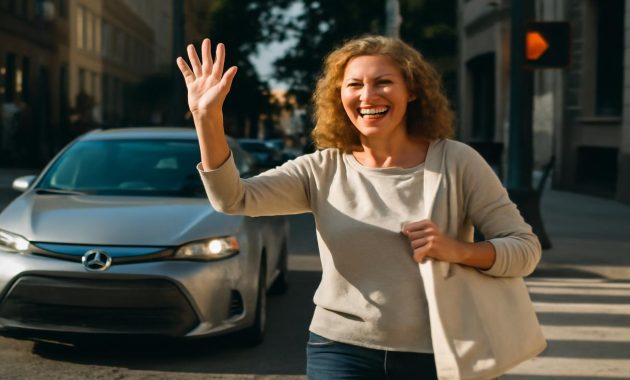
The first time I noticed it, I was standing at a crosswalk in the late afternoon, light slanting low between buildings, the air just cool enough to make me wish I’d brought a jacket. A car slowed, then stopped, even though the light was still yellow for them and red for me. I stepped off the curb, hurried across, and—almost without thinking—lifted my hand in a small, quick wave: thank you. The driver nodded, a tiny tilt of the chin, and we both disappeared back into our own days. The whole exchange lasted maybe three seconds. Yet for the rest of my walk I couldn’t stop thinking about that tiny, almost ritualistic gesture: the “thank you” wave we toss at strangers in cars, as if it were a reflex built into our bodies.
The Tiny Ritual at the Crosswalk
Once you start looking for it, you see it everywhere. The kid with the overstuffed backpack, joggers with earbuds in, older folks moving a little slowly, parents pushing strollers—they all do it. A little upward flick of the hand, maybe a half-smile, maybe an apologetic shrug that says, “I know you had the right of way, or maybe I did, but either way—thanks for not running me over.”
Psychologists have started paying attention to these microscopic courtesies that pass between strangers: the door held open at a coffee shop, the nod on a narrow hiking trail, the thank-you wave at a crosswalk. On paper, they’re nothing. No names are exchanged, no stories told. But as researchers map patterns in these behaviors, something interesting emerges: the people who instinctively offer that little wave are not just doing something polite. They’re revealing something deeper and surprisingly consistent about who they are.
These gestures are like personality Polaroids. They may be blurry, fleeting snapshots, but they capture enough detail for psychologists to peek into the way a person tends to interpret the world—cautious or trusting, self-focused or other-focused, hurried or present. The thank-you wave, it turns out, is not just about traffic etiquette. It’s about how we see ourselves in relation to everyone else humming through the same streets.
The Psychology Hidden in a Raised Hand
Personality researchers often talk about five broad traits: openness, conscientiousness, extraversion, agreeableness, and neuroticism. No one is purely one thing or another; we’re all messy blends, changing with context. But when psychologists look at everyday micro-behaviors, like how people behave at intersections, patterns begin to line up with those traits in subtle but significant ways.
The thank-you wave often shows up hand-in-hand with higher levels of agreeableness—people who naturally feel a pull toward cooperation and harmony. It also correlates, in many cases, with conscientiousness: a sense of responsibility, of wanting to “do the right thing” even when no one is grading you. And then there’s empathy, the quiet engine under the hood of many prosocial behaviors. People who imagine the car driver’s point of view—impatient, late, maybe tired—are more likely to acknowledge their small act of kindness.
To understand how this might play out in the real world, picture two versions of the same crosswalk. In version one, a driver brakes a little too sharply as you step out. Your heart jumps. You hurry across and toss out a quick wave: an unspoken truce, recognition that you both shared a potentially awkward moment and came through okay. In version two, you’re annoyed the car didn’t stop earlier. You stalk across, eyes straight ahead, no wave. In both scenes, you’re safe. But the emotional residue—on both sides of the windshield—is wildly different.
That residue matters. Researchers studying “micro-kindness” have found that tiny courtesies between strangers often ripple outward. The driver who gets that wave is more likely to extend patience to the next pedestrian or merge more generously in traffic. The wave is not just feedback; it’s fuel. It rewards cooperation in a system that otherwise feels anonymous and transactional.
The Traits Behind the Gesture
When psychologists and behavioral scientists talk about the thank-you wave, they’re not saying everyone who does it is secretly a saint. But they’ve noticed that the people who consistently offer that wave tend to share a set of traits, habits, or mindsets that cluster together.
| Observed Trait | How It Shows Up at the Crosswalk | Likely Everyday Expression |
|---|---|---|
| Agreeableness | Instinctively waves as a sign of courtesy and peacekeeping. | Softens disagreements, says “thank you” to service workers. |
| Conscientiousness | Feels a subtle obligation to acknowledge the driver’s effort. | Shows up on time, follows through on commitments. |
| Empathy | Imagines the driver’s day and wants them to feel appreciated. | Checks in on friends, notices when others seem off. |
| Social Awareness | Reads the delicate choreography between cars and walkers. | Picks up on tone, body language, unspoken group norms. |
| Internal Locus of Control | Believes their small response can improve a neutral moment. | Takes initiative instead of waiting for others to act. |
Notice how none of these traits are flashy. We’re not talking about charisma, boldness, or the kind of confidence you can photograph. We’re talking about the slightly invisible architecture of character: the quiet decision, made over and over, to be just a bit more gentle with other people than circumstances strictly demand.
In interviews, some people who wave at drivers describe it as “just what you do.” That phrase, “what you do,” is a clue. It suggests that the behavior has become integrated into their identity—a habit that sprang from earlier choices and now runs almost automatically. Others say they started doing it after feeling ignored or nearly hit as drivers themselves; empathy built from frustration. Their wave is both gratitude and a faint plea: let’s all be better at this.
Street-Level Civility in an Anonymous World
Modern cities can feel like carefully organized anonymity. You can share a subway car with a hundred people and never make eye contact, brush shoulders on a sidewalk with someone you will never see again. At the crosswalk, the barrier of glass and steel makes it even easier to treat each other as obstacles instead of fellow travelers who also forgot to defrost the chicken for dinner.
Yet the thank-you wave slips through that anonymity. It’s one of the last surviving fragments of neighborly etiquette in a world where fewer of us know our literal neighbors. It’s a reminder that social fabric doesn’t only happen at dinner parties or in long conversations; it also happens in blinks—micro-moments of acknowledgment.
Social psychologists sometimes call this “thin trust,” the low-level trust extended to strangers who have not yet proven themselves. We trust the bus driver to stop at our corner, the barista to hand us coffee not laced with arsenic, the crossing guard to glance both ways. The wave is a way of feeding that thin trust. It’s like putting one more thread into the invisible rope that keeps a city from fraying into pure self-interest.
Here’s the twist: acting as if this thin trust matters tends to change the actor, too. Experiments in positive psychology show that people who engage in small gratitude rituals—even when they start out deliberately or awkwardly—often report feeling more connected and less isolated over time. The thank-you wave may begin as etiquette, but repeated a thousand times, it becomes a worldview: I am not alone here. We are navigating this together.
The Non-Wavers: Different Traits, Not Villains
What about the people who don’t wave? Are they automatically selfish or unkind? Psychologists are more careful than that. Personality is only part of the story; context and mood get the other half of the script. A person who normally waves might keep their hand stuffed in their pocket on a bad day, lost in thought or urgency. A parent wrangling two toddlers across a busy road may be working with a different hierarchy of needs: safety first, courtesy later.
Some non-wavers may score lower on traits like agreeableness or social awareness, yes. They might be more inward-focused, less tuned into those tiny interpersonal moments. Others grew up in environments where such gestures simply weren’t modeled. If no one in your town waved at drivers, it might never occur to you to start. Cultural norms vary wildly; in some places, too much gesturing at cars might be seen as odd or even suspicious.
This is where the research gets subtle. The thank-you wave is associated with certain personality traits, but not determined by them. It’s a signal, not a sentence. Seeing someone fail to wave tells you very little about their capacity for kindness in more consequential situations. It might only be telling you that today, in this three-second window, they were somewhere else in their mind.
Still, the distribution of wavers and non-wavers across a city offers an intriguing snapshot of the collective mood. In some neighborhoods, nearly every crossing looks like a tiny polite dance: car slows, pedestrian hurries, hands rise, heads nod. In others, eye contact is rare, gestures rarer. You can feel the difference, like a change in air pressure, even if you can’t quite name it at first.
How a Simple Wave Rewires Your Own Day
For the individual, the story gets even more interesting. Psychologists exploring the everyday practice of gratitude often ask participants to keep simple logs: noting moments when they thanked someone or were thanked. The patterns that emerge are surprisingly robust. People who actively offer gratitude—even in laughably small ways—tend to report:
- Lower daily stress
- A greater sense of control in chaotic environments
- More positive memories of their day in hindsight
- A stronger sense of belonging, even in large cities
The thank-you wave, as mundane as it seems, plugs directly into this circuitry. When you raise your hand to a driver, you’re not only acknowledging them; you’re also telling yourself a story about how the world works. In that story, other people are not just threats or competitors on the road; they’re collaborators helping you cross safely. You move from “I survived traffic” to “someone made space for me.” Same event, different emotional imprint.
Neuroscience adds another layer. Acts of gratitude, however tiny, nudge the brain’s reward system—releasing little flickers of dopamine and serotonin. The effect is mild but real, and, importantly, cumulative. A life peppered with these moments can feel qualitatively different from one where everyone is just silently enduring each other.
You Can Choose to Be the Person Who Waves
Here’s the quietly radical thing about all of this: waving thank you is a choice. It’s not dependent on income, title, or even mood. It asks for almost no time and zero material resources. Yet over weeks, months, and years, choosing to make that motion can subtly shift both your own character and the climate around you.
If you want to experiment with it, you don’t need a self-help manual, just a few simple intentions:
- Notice the moment the car yields or slows.
- Lift your hand, even a few inches, in acknowledgment.
- Make brief eye contact, if it feels safe, as if to say, “I see you.”
- Carry on—no need to overthink the interaction afterward.
You might feel slightly self-conscious at first, especially in places where it’s not the norm. But social behaviors are contagious. One person starts waving; another copies; soon, an entire intersection feels a little more human. You become part of a quiet counterculture of kindness, resisting the gravitational pull of indifference.
Over time, you may notice that the wave spills over. You start nodding to the cyclist who lets you cross the bike lane, thanking the person who steps aside on a crowded sidewalk, holding the elevator door an extra second. Your personality doesn’t change overnight, but your habits do, and habits are the scaffolding on which personality hangs in day-to-day life.
What Our Streets Say About Us
If an alien anthropologist hovered over a busy city intersection, taking notes, they’d see a bewildering dance: metal boxes surging forward and stopping, humans darting between them, colored lights dictating who moves when. But zoom in further, and they’d see something hopeful: micro-negotiations, glances, gestures, waves. They’d see that even in the most engineered, rule-driven spaces, we still rely on human signals to grease the gears.
Psychologists look at those signals and see more than etiquette. They see clues about how willing we are to trust each other, how much we value being seen, and how ready we are to invest in kindness that will almost certainly never be repaid directly. The thank-you wave is a sliver of character made visible: modest, unremarkable, easy to miss—and, in its own way, profound.
When you cross the street tomorrow and a car yields, you have maybe a heartbeat to decide what kind of person you’re going to be in that tiny scene. Do you rush across, eyes on your phone, pretending no one did you a favor? Do you slow just enough to look up, lift your hand, and turn two strangers on a road into a pair of humans sharing a gentle nod?
Psychologists would say that choice aligns closely with specific personality traits. But they’d also say something else: personality isn’t a prison. It’s a set of tendencies, and every day, in the middle of traffic, rain, errands, and fatigue, you get to decide which tendencies you strengthen.
The wave doesn’t change traffic patterns. It doesn’t fix the long, grinding issues of urban life. But it does one stubbornly hopeful thing: it stakes a quiet claim that, even here, where engines rumble and time runs thin, we are capable of grace. A hand lifts, a driver nods, and for one small, unremarkable second, the city remembers it is full of people.
FAQ
Do psychologists really study things as small as a thank-you wave?
Yes. Social and personality psychologists often study everyday “micro-behaviors” because they reveal patterns of empathy, trust, and cooperation. The thank-you wave is one of many tiny actions that help researchers understand how personality shows up in real life.
Does waving at cars mean I have a specific personality type?
Not a rigid type, but it is associated with higher levels of traits like agreeableness, conscientiousness, and empathy. It suggests you’re inclined toward courtesy and social awareness, though many other factors influence your personality as a whole.
If I don’t wave, does that mean I’m selfish?
No. Not waving can reflect distraction, stress, cultural norms, or simple habit. While patterns over time may hint at personality tendencies, a single moment at a crosswalk doesn’t define your character.
Can I “train” myself to become the kind of person who waves?
Yes. Repeatedly practicing small gestures of gratitude and acknowledgment can gradually shape your habits and, over time, reinforce traits like empathy and social connectedness. Personality has stable elements, but behavior is surprisingly flexible.
Do these tiny gestures really make a difference in society?
They do, especially in aggregate. Small acts of courtesy strengthen “thin trust” between strangers and can influence how safe, cooperative, and humane a community feels. One wave is minor; thousands of them help set a social tone.