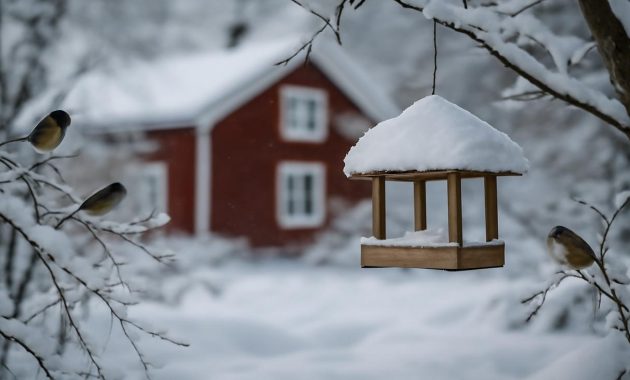
The first time I saw a Norwegian garden with absolutely no bird feeders, I thought something had gone terribly wrong. It was late winter in a small coastal town outside Bergen. Snow clung to the spruce branches. The air had that sharp, metallic stillness that makes every sound seem louder. A raven called once and then, oddly, there was just…nothing. No chattering sparrows jostling on a feeder. No frantic blue tits darting in like tiny jeweled bullets. No flutter of wings around fat balls or peanut cages. Just the soft hiss of falling snow and the measured, unhurried silence of a place perfectly at ease with itself.
Back home, my garden is a miniature airport for birds. Seed feeders swing from hooks, fat balls dangle like bizarre fruit, and the birdbath is an eternal drama of splashing, squabbling, and occasional outrage. I buy sacks of sunflower hearts, specialized winter mixes, suet pellets. I fret when the feeders run low. I top them up like a nervous host making sure no guest ever sees the bottom of the snack bowl.
So when a Norwegian friend calmly explained that, no, they don’t really feed garden birds as a cultural norm—and that some ecologists think our kind of year-round feeding might actually do more harm than good—I felt something between disbelief and mild betrayal. Aren’t bird feeders one of the purest, gentlest ways to help nature? Isn’t this what “good” people do, one seed scoop at a time?
It turns out the answer is…complicated. And the quiet, feeder-less gardens of Norway might hold a lesson we’ve been reluctant to hear.
How We Fell in Love With Feeding Birds (And Built Tiny Bird Empires)
In many parts of Europe, the UK, and North America, feeding birds is less a hobby and more a soft obsession. We talk about our “regulars” like they’re neighbors: the bossy robin, the one-legged pigeon, the coal tit that always takes one seed and disappears into the hedge. Fat balls show up in supermarket aisles right next to bread and milk. There are entire catalogues devoted to bird food, feeder designs, and garden “wildlife stations.”
If you stand very still in a typical suburban garden on a winter afternoon, you can actually hear the infrastructure of this obsession: the thin clack of plastic feeders, the tiny patter of seeds on earth, the whirr of wings as blue tits queue like commuters. It feels proactive. Helpful. In a world that’s unraveling at the edges, here is something concrete and kind you can do with your own two hands: keep a few vulnerable lives going through the cold months.
But in Norway, the cultural story of birds runs along a different track. Yes, some people put out food in winter—particularly in the colder, inland regions—but the idea of turning your garden into a permanent feeding station, 365 days a year, is far less common. Many Norwegians, raised closer to wild landscapes and harsher weather, carry a quieter, sterner conviction: wildlife should mostly fend for itself.
“Nature knows what it’s doing,” one older Norwegian man told me, shrugging as we watched a pair of magpies shifting through seaweed on the shore. “If birds need our help all the time, it’s probably we who have done something wrong. Better to fix that than to put out more food.”
The Subtle Difference: Garden Pet vs. Wild Neighbor
This is where the first real divide opens. When we in more urbanized, densely populated countries feed birds, we often slide—without noticing—from “supporting wild animals” to “curating a little show.” We start to think of the birds almost as semi-pets. They are wild, yes, but wild on our terms, in our space, on our schedule, with our seed mix.
In Norway, there’s a more stubborn line between what is wild and what is domestic. Birds are not there to entertain or comfort you. They are not moral homework or a measure of your kindness. They are part of an older, harsher, larger system in which winters kill and summers compensate. It can feel cold, emotionally—but biologically it has a sort of steady, unsentimental wisdom.
What Happens When We Turn Our Gardens Into Bird Buffets
Hang a feeder in your garden and watch what happens. Within days, word spreads. Tits arrive first, then finches, then sparrows. A robin stakes out a perch. A woodpecker might muscle in, hanging awkwardly from the wire cage. It feels miraculous: your little patch, alive and thrumming.
But underneath the delight lies a tangle of ecological side effects.
Disease, Crowding, and the Problem of “Too Many” Birds
Any time you gather large numbers of animals in one place, you create a festival for pathogens. Shared feeders and dirty perches become hotspots for disease transmission: salmonellosis, trichomoniasis, avian pox. Studies from the UK and elsewhere have shown clear links between garden feeding and outbreaks that cause mass die-offs of certain species, particularly finches.
Norway, with its more restrained feeding culture, has so far seen fewer of these dramatic, feeder-driven disease spikes. When birds spread out across a snowy landscape to forage naturally—picking at birch seeds, berries, insect eggs—their contact is slower, more diffuse. A sick bird is less likely to infect a dozen others on the same crowded tray in a single afternoon.
There’s also the simple matter of numbers. Our constant, rich feeding can inflate winter populations of some common birds beyond what the landscape would normally support. That might sound great, but it can mean fiercer competition for natural food sources in spring and summer—and a distortion of the balance between species. Dominant, adaptable birds can boom; more specialized or shy species may quietly lose ground.
Predators Learn the Schedule Too
If you’ve ever seen a sparrowhawk rocket through your garden like a guided missile, you know that bird feeders are not just buffets for songbirds. They’re also all-you-can-eat restaurants for predators.
Now, predators are not villains. Sparrowhawks, cats, corvids—they’re all part of the story. But when we concentrate birds in one small area, usually with restricted escape routes and predictable routines, we might be turning natural hunting into something closer to a trap.
Norwegian ecologists tend to look at this and ask: why are we bending entire local food webs around one human habit? Why are we comfortable creating intense micro-theatres of life and death outside our kitchen windows, instead of pushing for healthier landscapes where birds can spread out, hide, and hunt in less artificial ways?
The Norwegian Alternative: Feed Less, Restore More
We often talk about bird feeding as if it’s the only accessible, everyday thing ordinary people can do. Seed or nothing. Feeder or apathy. But in Norway, there’s a different emphasis: don’t feed more—fix more.
A Culture of Letting Nature Be Messy
Walk through a typical Norwegian neighborhood and you notice something subtly different in the gardens. There are often rough corners left wild on purpose: a tangle of shrubs, an unmown slope, an old tree stump melting back into the soil. Lawns exist, but they’re often smaller, less obsessively manicured. People are generally more comfortable with “ugly” nature—dead wood, dry stalks, half-fallen branches—that make excellent foraging and nesting sites for birds.
Rather than propping birds up with constant external food, the Norwegian approach leans toward giving nature the raw materials to do its own work. That might mean:
- Planting more native shrubs and trees that produce berries, seeds, and insect habitat.
- Leaving seed heads on flowers through winter instead of cutting everything down in autumn.
- Allowing hedges to thicken and become real shelter, not just green fences.
- Keeping old trees when possible, even if they’re a bit gnarled or hollow.
From a bird’s point of view, these small decisions can matter more than any feeder. They create a world where food is scattered, hidden, and continuous—a buffet written into the landscape itself, not dangling from a hook.
When Feeding Does Happen, It’s Seasonal—and Modest
This doesn’t mean Norwegians never feed birds. In the darkest months, when snow is deep and temperatures fall well below freezing for long stretches, many people still hang out fat balls or put seeds on a table, especially in more rural or northern areas. But there’s a cultural sense that this is a temporary kindness in the harshest weeks, not a permanent obligation.
If you compare habits between a typical bird-lover abroad and a nature-conscious Norwegian, the difference might look a little like this:
| Aspect | Common Bird-Feeding Culture | Typical Norwegian Approach |
|---|---|---|
| Feeding Season | Often year-round | Mostly deep winter or very cold spells |
| Intensity | Multiple feeders, constant refills | A few simple feeding spots, modest amounts |
| Main Focus | Watching birds up close | Maintaining healthy, semi-wild gardens and landscapes |
| View of Birds | Gentle guests, semi-pets | Independent wild neighbors |
| Emotional Driver | “I must help them directly” | “I must not make them dependent on me” |
This slower, cooler approach can be frustrating if you crave the instant gratification of a busy feeder. But if your goal is long-term resilience rather than immediate drama, the Norwegian logic starts to feel uncomfortably sound.
Are We Helping Birds—or Our Own Loneliness?
There’s another layer under all this: a very human one.
For many people, bird feeding isn’t just about ecology. It’s about company. It’s about small flashes of life at the kitchen window when days are short and the world feels distant. Elderly people, those living alone, kids in apartments—feeders give them a direct line to something wild and bright and alert.
In countries where people are more often cut off from wilder landscapes, this becomes a kind of emotional lifeline. You can’t get to the forest every day, but you can top up the seeds. You can’t fix climate policy this week, but you can save the robin in your garden.
Norway, with its culture of cabins, hiking, and everyday contact with big landscapes, offers a different kind of medicine for that ache. When you can step into a pine forest after work or ski across open hills on weekends, your relationship to wildness shifts. Birds are no longer something you must summon to your window to feel connected; they’re part of a vast, shared backdrop that you move through together.
This doesn’t make Norwegians better or more virtuous. It just means their emotional dependency on feeders is weaker. And that allows them to ask harder questions about whether constant feeding serves the birds—or mainly serves the people watching them.
So…Should We Stop Feeding Garden Birds Altogether?
Here’s where things get uncomfortable. Because if you listen closely to Norwegian scientists and nature managers, and to a growing number of ecologists elsewhere, a quiet consensus emerges: feeding isn’t automatically good or bad. It’s context-dependent. And in many cases, we probably need to do less of it, more carefully, and for better reasons.
When Feeding Makes Sense
There are times when putting out food really can save lives and populations:
- During extreme cold snaps or heavy snow that lasts weeks.
- In heavily built-up areas where natural food is severely limited.
- For certain threatened species under expert guidance, where supplemental feeding is part of a conservation plan.
In these scenarios, targeted, temporary feeding can be a bridge—a way of buying time while we work on the bigger, harder fixes: restoring habitats, changing agricultural practices, creating cleaner, richer cities for wildlife.
When Less Is More
But if you live in a reasonably green area, with trees, hedges, and some natural structure, and you’re feeding intensively all year round just because you love the show…well, that’s when the Norwegian voice in the back of the room clears its throat.
It might suggest:
- Reducing feeding outside the hardest winter months.
- Cleaning feeders frequently and spacing them out to reduce crowding.
- Switching some of your time and money toward planting native species and improving your garden structure.
- Accepting that not every quiet day in the garden is a sign of failure; sometimes it’s just birds being busy elsewhere, as they should be.
None of this is as instant or emotionally satisfying as filling a feeder and watching the rush. It requires patience and a willingness to let go of some control. It asks you to trade a bit of daily spectacle for the slower, quieter satisfaction of knowing the birds don’t actually need you very much—and that this is a mark of success, not indifference.
Learning to Love Birds With More Distance—and More Respect
On my last evening in Norway that winter, I walked a little path that wound behind some houses and out toward the edge of a frozen bay. It was one of those blue-grey twilights when the snow glows from within. The only sound was the dry whisper of my boots and the distant creak of ice.
At first, I thought there were no birds at all. No feeder chorus, no dunnock ticking nervously in the hedge. Just stillness. Then my eyes adjusted. There, in the rowan tree: waxwings, dozens of them, moving like careful ornaments among the last frostbitten berries. Out on the bay: a loose raft of eiders, bobbing and diving in slow, graceful arcs. Above the pines: a tiny group of crossbills, chipping softly as they prised seeds from cones high overhead.
Nobody had put out food for them. Nobody was watching from a kitchen window counting species on an app. They were simply there, doing what birds have done in winter for as long as there have been winters: shifting, adapting, surviving, sometimes failing, mostly succeeding.
Standing in that cold, quiet, almost-empty-seeming place, I realized that maybe the question isn’t, “Should we feed garden birds or not?” Maybe it’s, “How do we love birds in a way that serves them first and our need to feel helpful second?”
Norwegians, with their airy, feeder-light gardens and their firm belief that wild things should stay wild, might not have all the answers. But they do offer a gentle correction: sometimes, the kindest way to help is to step back, to give space, to improve the stage instead of feeding the actors.
It’s a harder kind of love. It doesn’t always come with a flurry of wings at the window. But somewhere, in the quiet shuffle of waxwings in a rowan tree that no one has pruned into useless tidiness, you can feel the difference.
Frequently Asked Questions
Is it wrong to feed birds in my garden?
Not inherently. Feeding can be helpful during harsh weather or in very urban areas with little natural food. The key is moderation, hygiene (clean feeders regularly), and focusing more on improving habitat than on constant feeding.
Do Norwegians really never feed birds?
Some do, especially in winter, but it’s generally less intense and less year-round than in many other countries. The cultural emphasis is more on keeping nature robust and semi-wild than on close, daily interaction via feeders.
Can bird feeders spread disease?
Yes. Crowded feeders, dirty trays, and old food can help diseases spread quickly between birds. If you feed, clean equipment often, avoid overcrowding, and stop feeding temporarily if you notice sick birds.
What’s a better alternative to constant feeding?
Plant native trees, shrubs, and flowers; leave seed heads and some leaf litter; keep hedges dense; and allow a corner of your garden to be a bit wild. These steps create natural, diverse food sources and shelter year-round.
Should I stop feeding birds outside of winter?
In many regions, reducing or stopping feeding outside the hardest months is a good idea, especially if there’s already plenty of natural food. Use the rest of the year to build better habitat so birds depend less on your feeders and more on the landscape itself.