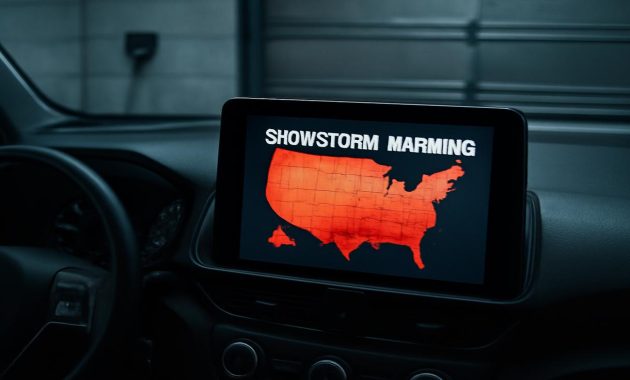
The news broke just after sunset, landing like a quiet, electric charge across living rooms and bus stops and late trains everywhere: official and confirmed, heavy snow is coming—tonight. Not a dusting, not a maybe, but a thick, disruptive, bone-deep storm with the kind of confidence that rearranges plans and redraws the map of tomorrow. As the last light drains from the sky, people stand at windows, scroll their phones, and listen to the language of alerts: “major disruptions,” “widespread travel chaos,” “only travel if absolutely necessary.” Somewhere out there, in the dark beyond the town’s edge, the storm is already forming itself, gathering cold, gathering intent.
The Long Wait Before the First Flake
There is a unique, charged quiet that arrives with a forecast like this. You can feel it long before a single snowflake falls—an almost physical pause in the air. The streets still hum with evening traffic, but everyone, it seems, is already half a step into tomorrow, imagining how the world will look when they open the curtains in the morning.
In kitchens, mugs clink against countertops as people hover between weather apps and boiling kettles. Notifications flash in tiny red circles: school districts “monitoring the situation,” rail networks “reviewing timetables,” airlines “anticipating significant delays.” The language is careful and measured, but between the lines, there’s something raw and simple: this is going to be big.
Step outside, and the air feels thinner, almost metallic. Streetlamps throw cones of amber light onto pavements where frost is already knitting a faint, crystalline sheen. You can smell the coming cold—a sort of absence, like the world is slowly being emptied of its warmth. Somewhere beyond the town, an invisible front of arctic air is pushing southward, shouldering aside milder currents, locking moisture into intricate ice geometry that will soon cascade from the sky.
For now, though, there is only waiting. The sky is a flat, featureless slab of grey-black, heavy as a closed door. Somewhere behind it, stirred by pressure and temperature and distance, patterns are forming: the future storm, pixel by pixel, crystal by crystal.
The Science Inside the Storm
On a meteorologist’s screen, what feels like magic to most of us appears as loops of color and contour lines. The storm has already been named and framed by the time we hear about it. Satellite images, radar sweeps, and models that crunch trillions of calculations have narrowed this night down to a verdict: heavy snow is no longer a possibility; it is an appointment the atmosphere fully intends to keep.
Cold air tumbles down from the north and northeast, colliding with moisture-laden currents from the west. Where they meet, the air rises, cools, and condenses. But instead of raindrops, ice crystals assemble like tiny architecture—branching arms, hexagonal symmetry, delicate and temporary. Each crystal is a story of its journey: the temperatures it passed through, the humidity it encountered, the micro-turbulence it spun inside.
Higher up, where the air grows thinner and harsher, clouds thicken into vast, grey engines, churning moisture into layers. The meteorological phrases—“frontal system,” “low-pressure trough,” “occluded front”—flatten the drama, dressing upheaval in measured, technical calm. But the reality is almost primal: sky water being remade into sky stone, poised to fall in silent, uncountable millions.
On the ground, these predictions sharpen into warnings. Official alerts move from “be aware” to “be prepared” to “take action.” Color-coded maps bloom across screens: blue deepens to purple, then to shades bordering on black. Travel agencies adjust their advice. Utility companies move staff into standby. Gritters and plows line up like a quiet, orange army awaiting its cue.
How the Warnings Turn into Decisions
For emergency planners, this is the hour of spreadsheets and phone calls. Road crews are briefed on priority routes. Hospital managers check staff schedules, knowing that some shifts might stretch long into tomorrow. Police and rescue teams review their lists: stranded motorists, fallen trees, blocked rural lanes—problems they know by heart from storms of winters past.
In one sense, the storm is not even here yet. In another, it has already begun—as a set of decisions unfolding in living rooms and boardrooms, on farm tracks and factory floors. Do you cancel the early meeting? Reschedule the delivery? Stock up on essentials? The snow is still a whisper in the atmosphere, but already it is rearranging human plans with a firm, invisible hand.
Travel Chaos in Slow Motion
The forecasts are unusually blunt: travel tomorrow will be “severely impacted,” “hazardous,” “slow and difficult.” You can almost feel the future traffic jam taking shape, lane by lane, as if the storm is laying out a net over the road network, ready to catch every vehicle that dares it.
Out on the motorways, lorries grind through the last dry hours, their headlights carving beams into the thinning night. Drivers listen to late-night radio hosts reading out updates, callers sharing anxieties, and weather experts calmly explaining isobars and wind chill. They know the script: when the snow hits hard, gradients turn treacherous, junctions choke, and even experienced drivers find themselves sliding—gently at first, then helplessly—off course.
Rail lines, too, are bracing. Ice on the overhead lines, drifts blown onto tracks, frozen points, and staff shortages are all part of the expected fallout. The language from operators is careful but clear: reduced services, emergency timetables, contingency plans. At stations tonight, departure boards still glow green and on time. By dawn, many of those tidy rows will be bruised with delays and cancellations.
Airports remain lit like small cities on the outskirts of the dark, but even their runways are no match for determined weather. De-icing rigs stand at the ready. Crews rehearse the routines of disruption: rebooking, re-routing, re-assuring. For some travelers, tonight is an anxious dance of “will we make it out before the worst hits?” For others, it’s the growing realization that their journey has already been quietly surrendered to the storm.
What the Numbers Say
Behind each blunt headline—“heavy snow,” “major disruption”—there are forecasts measured in centimeters, hours, and risk levels. Meteorologists are talking about accumulations that can blanket low-lying towns and high-ground villages alike. Combine that with sub-zero temperatures and strong gusts of wind, and the equation shifts from “difficult” to “dangerous.”
To make sense of some of the practical impacts people will likely face, it helps to see the situation laid out simply:
| Area of Impact | What to Expect | Suggested Action |
|---|---|---|
| Road Travel | Snow-covered roads, black ice, stranded vehicles, very slow journeys | Avoid non-essential trips; carry blankets, water, and a charged phone |
| Rail Services | Delays, cancellations, reduced timetables, crowded remaining services | Check status before leaving; allow extra time; consider alternative days |
| Air Travel | Flight delays, diversions, possible airport closures | Monitor flight updates; pack essentials in hand luggage; expect queues |
| Power & Utilities | Local power cuts, disrupted repairs in remote areas | Keep torches, batteries, and warm layers ready; charge devices in advance |
| Everyday Life | School closures, canceled appointments, supply delays | Reschedule if possible; check on vulnerable neighbors; stay informed |
The numbers themselves—snow depth in centimeters, wind speeds in kilometers per hour, frost severity in degrees below zero—are the clinical language of risk. But for most people, what matters is simpler: how long will it take to get home, will the kids be at school, will the heating hold out, will they make it to the people who need them?
The World Redrawn in White
Then, sometime after midnight, it begins. At first, it’s easy to miss: a faint, swirling dust in the halo of a streetlamp. The first flakes are hesitant, small and few, as if the sky is clearing its throat before speaking. But ten minutes later, those tentative specks have thickened into a steady, silent swarm.
Snow has a way of removing sound from the world. As it gathers on roofs, roads, and railings, noises become muffled, distant. The usual late-night rumble of traffic quietens as drivers ease back or stay home altogether. Footsteps are replaced by soft, compressing crunches. Even the wind, though still present, seems to blow through a softer, more forgiving medium.
By 2 a.m., parked cars have changed shape, their sharp lines blurred into smooth mounds. Pavements vanish. Gardens become a single, unbroken sheet, interrupted only by the darkest silhouettes of trees, now frosted and heavier than they were an hour before. The snow doesn’t so much fall as arrive, remaking the familiar with every passing minute.
Somewhere, a lone set of footprints appears along a side street—someone walking a restless dog, or finishing a late shift. Each step sinks, compresses, leaves a brief, dark imprint before new flakes soften it. The air tastes clean and dry, and even the simple act of breathing feels different, cooler somehow, edged with ice.
Inside Homes, a Different Weather
Indoors, a second, quieter kind of storm plays out. Radiators click and hum. Kettles are boiled more often than usual. People who promised themselves they would be in bed by ten find themselves still awake after midnight, peering out at the changing world. There is a childlike thrill mixed with adult worry: a snow day’s giddy anticipation braided with responsibilities that don’t vanish just because the roads might.
Parents mentally rehearse the morning’s possibilities: digging out the car, improvising childcare, logging in to work from the kitchen table instead of the office desk. Students wonder if lectures will be moved online, if exams will be rescheduled. Small business owners calculate the cost of a day lost to customers who simply can’t get there.
Yet, layered over these anxieties, there is that strange sense of collective pause that heavy snow can bring. Plans shrink to the scale of the home, the building, the street. The towering urgency of the usual to-do lists is quietly, temporarily leveled under the blanketing logic of weather stronger than human scheduling.
When Disruption Becomes Connection
By dawn, the forecast has proved itself without hesitation. The world outside the window is altered—soft, bright, and oddly hushed. Cars move slowly, if at all, tires spinning briefly on hidden ice. Sirens are sporadic, sharp against the white quiet. Somewhere in the distance, the rasping, metallic growl of a snowplow grows and fades, like an animal passing through.
The travel chaos the alerts promised is no longer hypothetical. Social feeds overflow with photos of snow-choked driveways, video clips of buses skidding sideways, still images of long queues on buried ring roads. Timetables are rewritten in red text: “Canceled,” “Delayed,” “Do not travel.” Advice hardens: stay home if you can, delay journeys, let the plows and gritters work.
Yet at the very same time, another story emerges, one that doesn’t fit neatly into alert levels and disruption reports. Neighbors who have never spoken beyond a nod now exchange snow shovels and check in on older residents. Teenagers, suddenly free from school, volunteer to clear paths or carry shopping. A stranger pushes a stuck car free from packed snow while another directs from behind, hands raised, breath steaming in the cold air.
Travel chaos, in its blunt, logistical sense, often has this unexpected side effect: it reveals how interlinked we are. When systems falter—trains that don’t arrive, deliveries that don’t make it, roads that fail their purpose—we see, in sharper contrast, the small, human routes that still work: a knock on a door, a shared thermos of coffee, a lift offered in a four-wheel-drive where buses can’t reach.
The Small Rituals That Get Us Through
Inside, people adapt. Working days start later or not at all. Laptops appear at dining tables. Children build lopsided snowmen between bouts of streaming cartoons. Shops open late, with hand-written signs taped to glass doors: “Due to weather, reduced hours today.”
The rituals of coping become almost as predictable as the weather maps: extra blankets piled on couches, candles collected “just in case” of an outage, pots of soup or stew simmering longer than strictly necessary, filling the home with a slow, sustaining warmth. Windows become frames for a temporary exhibition: the quiet choreography of falling snow, the shy appearance of a fox cutting across a white lawn, the sudden, joyful eruption of children with sleds on a hill that, yesterday, was nothing more than grass.
This is disruption, yes—but also reorientation. A day or two when the usual directions of life are rerouted, when journeys shrink to walking distance, and time feels oddly stretched, as if the snow has thickened not just the air, but the hours themselves.
Storms as Stories We Share
In a few days—or a week, at most—the snow will likely loosen its grip. Thaw will seep into the edges of pavements and roofs; gutters will drip steadily; roads will regain their dark, functional sheen. The travel chaos will become a memory measured in hours lost, appointments missed, contingency plans tested to their limits.
Yet storms like this rarely leave without also planting themselves into the shared story of a place. People remember “that winter when the snow came all at once,” “the morning we woke up and couldn’t open the front gate,” “the day the buses stopped and we all walked home together.” These are the weather stories that stick—not just because of the hardship, but because of the sudden, tangible reminder that the world outside our walls is powerful enough to stop us in our tracks.
For all our technology, all our planning and forecasting and alerts, a single night of heavy snow can still redraw the rules. It can turn a twenty-minute commute into a three-hour ordeal or into a canceled journey that leads, instead, to an unexpected, quiet day at home. It can transform a neighborhood of strangers into a loosely assembled crew of helpers and path-clearers.
And it can remind us, with a clarity sharper than cold air, that we live inside a system vastly larger than ourselves—one that can turn water into architecture in the sky, and chaos into connection on the ground.
Frequently Asked Questions
How dangerous is this heavy snow event expected to be?
Authorities are warning of major disruptions and potentially hazardous conditions, especially on untreated roads and exposed routes. While not every area will experience the worst of it, the combination of significant snowfall, ice, and low visibility means that travel could become risky, particularly overnight and in the early morning. If you don’t absolutely need to travel, staying put is strongly advised.
Should I cancel my travel plans for tomorrow?
If your journey is non-essential, the safest option is to postpone it. Transport operators are already anticipating delays and cancellations, and road conditions may deteriorate quickly. If travel is unavoidable, check live updates from transport providers, allow extra time, pack warm clothing and emergency supplies, and let someone know your route and expected arrival time.
What can I do to prepare at home tonight?
Charge phones and essential devices, locate torches and spare batteries, and gather extra blankets and warm layers. If safe to do so, clear drains and pathways to reduce icy build-up. Have basic food, any necessary medications, and drinking water accessible. If you rely on regular care or medical equipment, ensure caregivers and providers know about the forecast and have a backup plan if travel is disrupted.
How will this affect schools and workplaces?
Many schools and workplaces operate on a case-by-case basis during severe weather. Decisions often depend on local road conditions, bus routes, and staffing levels. It’s wise to check official messages from schools, employers, or local authorities early in the morning, and to be ready for short-notice changes such as remote working, delayed openings, or full closures.
What about vulnerable people in my community?
Heavy snow and ice can be particularly challenging for older adults, people with mobility issues, and those living alone. If you can do so safely, consider checking in on neighbors who might struggle to get food, medications, or heating sorted. A quick call, a cleared path, or an offer to pick up essentials can make a significant difference.
How long is the disruption likely to last?
While the heaviest snowfall is expected to begin late tonight and continue into tomorrow, impacts could linger for several days depending on temperature, additional showers, and how quickly crews can clear key routes. Ice is often a problem even after the main snowfall ends, especially overnight. Staying updated with local forecasts and advisories will give the best sense of when conditions are improving in your specific area.
Is there anything positive to take from a storm like this?
Beyond the very real challenges, heavy snow often brings a rare pause to everyday routines and can foster a sense of shared experience. Streets grow quieter, skies brighter, and communities sometimes closer. While safety must always come first, there is space, too, for noticing the transformed landscape, for appreciating the slowed pace, and for recognizing how closely we are all tied to the moods and movements of the natural world.