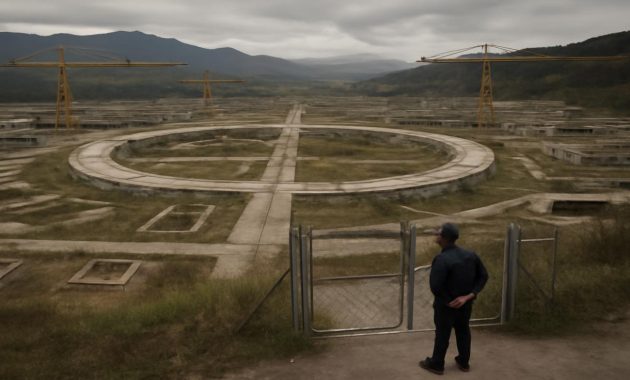
On a gray winter morning outside Beijing, a group of young physicists stood in a half-empty conference room, staring at a slide that none of them wanted to see. It was just a single sentence, really—dry, bureaucratic, oddly quiet for something that would reverberate through labs across the world. Funding for China’s proposed next-generation particle collider, the one that was supposed to outsize CERN’s Large Hadron Collider and push the boundaries of physics, was being “reconsidered indefinitely.” Translation: the grand race to build the world’s largest particle accelerator had just been paused. Maybe for a decade. Maybe forever.
The Dream That Grew Too Big, Even for China
For years, the idea had felt almost inevitable. China had built the world’s fastest trains, the largest radio telescope, the biggest dam. Why not the most powerful machine humanity has ever created to probe the fabric of reality itself?
The proposal was as bold as it was breathtaking: a Circular Electron Positron Collider (CEPC), a ring up to 100 kilometers in circumference, sprawling beneath the countryside like a buried halo of technology. This was not just a machine—it was a national statement. China would leap to the front of fundamental physics, not by small steps, but with a single staggeringly ambitious stride.
Inside the labs and offices, there was a feeling of momentum. Whiteboards filled with scribbles of Feynman diagrams and energy scales. Cafeteria conversations swirled around Higgs precision measurements, dark matter, and the tantalizing possibility of particles still hiding in the shadows beyond the Standard Model. In university corridors, graduate students whispered that this was the collider their careers would grow up with—the project that would define their generation.
But outside, another mood was quietly building: a cold, mathematical calculation. The price tag was ballooning. Construction costs, land acquisition, cooling systems, power consumption—it all piled up in columns of digits that no longer looked like even a wealthy nation’s passion project. As the global economy trembled, as debts rose, as domestic needs jostled for attention, the accelerator stopped looking like a proud inevitability and started looking like a very expensive question.
The Price of Looking Deeper into Reality
Particle accelerators are strange monuments. They don’t soar into the sky like towers or dams; they hide in tunnels. But their cost is sky-high just the same. Building a collider large enough to outclass CERN’s 27-kilometer ring is like deciding to build a buried city of magnets, cryogenics, sensors, and data pipelines—and then promising to run it for decades.
In China, estimates for the CEPC began modestly and then swelled. Depending on whose numbers you trust, the final total could have reached tens of billions of dollars once construction and long-term operation were included. Even for a country known for mega-projects, this number began to feel heavy.
Officials faced a brutal list of trade-offs. How do you justify a colossal machine built to chase invisible particles when there are pressing needs above ground: public health systems, aging populations, rural development, climate resilience? It wasn’t that the government stopped believing in science. It was that particle physics, with its remote and intangible promises, suddenly found itself sitting across the table from urgent and visible realities.
Unlike bridges or high-speed rail, a collider doesn’t pay for itself in tickets sold or cargo hauled. Its currency is knowledge—and the returns on that knowledge are indirect, delayed, and uncertain. Economists can point to the transformative technologies that have emerged from fundamental research—medical imaging, superconducting magnets, the World Wide Web itself—but those origin stories take decades to unfold, and they never come with a clear, reassuring price-per-discovery tag.
The Numbers Behind the Decision
Within the quiet corridors of planning committees, spreadsheets began to win over dreams. The cost per year, per experiment, per international collaboration was sliced and calculated. At the same time, Europe was wrestling with its own version of the same problem: whether to build a successor to the LHC, the Future Circular Collider (FCC), another behemoth ring likely to cost tens of billions of euros.
In a way, this was supposed to be a race—a friendly one, wrapped in the language of “global collaboration” but tinged with the unmistakable scent of competition. Europe had gone first with the LHC; now China had the chance to lead the next chapter. But as cost estimates climbed in both regions, something interesting happened. Instead of sprinting faster, both sides began to edge toward the brakes.
| Collider Project | Region | Approx. Tunnel Size | Purpose | Funding Status |
|---|---|---|---|---|
| LHC (Large Hadron Collider) | Europe (CERN) | 27 km | Discovered Higgs boson; ongoing experiments | Operating; upgrades underway |
| FCC (Future Circular Collider) | Europe (CERN) | ~100 km (proposed) | Next-generation proton/electron collider | Concept stage; not fully funded |
| CEPC (Circular Electron Positron Collider) | China | ~100 km (proposed) | High-precision Higgs factory; new physics search | Planning stalled; funding halted |
On mobile screens, those rows of data compress into something stark: one machine humming, one dream on the drawing board, and one dream now folded and placed gently in a filing cabinet.
How Do You Put a Price on Curiosity?
Stand in a particle physics control room when a new dataset comes in, and the atmosphere feels like the world’s nerdiest space launch. Screens glow with tracks and probabilities, and someone puts on coffee at impossible hours. These are people who dedicate their lives to questions most of us only touch in late-night conversations: What is the universe made of, really? Why does matter exist and not just energy? Is the Higgs boson just the beginning of a deeper story?
For scientists in China, the CEPC wasn’t about national prestige as much as it was about continuity. The LHC had given humanity the Higgs, that elusive piece of the Standard Model puzzle discovered in 2012. But it had also hinted that there might be more, if only we could look more closely and more precisely. A new collider, especially an electron–positron one, could turn the Higgs into a finely studied laboratory rather than a single, triumphant discovery.
Physicists imagined measuring the Higgs boson’s properties with exquisite precision, scanning for tiny deviations from theory that might reveal new particles, new symmetries, perhaps even the scaffolding of a more fundamental theory. It’s like staring at a seemingly ordinary painting until a hidden pattern reveals itself—and realizing the painter knew far more than you did.
But what do you say to a finance minister who asks, “How many hospitals equal one new measurement of a particle’s decay channel?” There is no good answer, only competing visions of the future. One where curiosity itself is seen as infrastructure, as vital as roads and bridges. Another where the payoff of fundamental physics is too distant to justify when immediate problems keep knocking at the door.
China’s Changing Scientific Story
It would be easy to frame this as China turning its back on big science, but that misses the nuance. The country has not abandoned research; it is shifting emphasis. Applied technologies—artificial intelligence, quantum communication, green energy, semiconductor independence—now sit closer to the nerve center of national strategy. These are fields where the link between investment and tangible power feels more visible, more controllable.
A giant particle collider, by contrast, is a leap of faith. You throw immense resources at a question with no guarantee that the universe will reward you with answers that translate cleanly into geopolitical advantage. The payoff is more existential: new knowledge, new understanding, perhaps new tools centuries from now that no one can currently name.
China’s decision to halt or slow the CEPC is a signal that even for a nation often perceived as fearless in building massive projects, there are limits when the costs swell and the benefits remain ethereal. The choice is not anti-science; it is, in a way, hyper-strategic science. It’s a bet that the future will be shaped more by near-term, deployable technologies than by the long, slow gaze into the heart of matter.
The Human Side of a Halted Dream
In all the talk of billions and megaprojects, it’s easy to forget the people. Somewhere in Beijing, a graduate student is revising their PhD topic because the collider they hoped to work on may never exist. A mid-career physicist who returned to China after working abroad is wondering if they should leave again. Young engineers who trained in superconducting magnet design or cryogenics are quietly asking: What now?
These are not abstract losses. Big scientific instruments act like gravity wells for talent, pulling in people from around the world and keeping them orbiting. When a project like the CEPC is frozen, that organizing center dissolves, and people scatter. Some will find their way into other scientific fields, some into industry. Others might leave physics entirely.
In a lab office, papers may still be pinned to corkboards: conceptual designs of detector components, sketches of tunnel routes across rural landscapes. It’s not that these dreams are shredded; they’re more like seeds put back into a jar, waiting for some future spring that may or may not come.
And yet, there is resilience in the community. Chinese physicists remain deeply involved in experiments at CERN and other facilities. Smaller accelerators, precision experiments, and theory work continue. Science rarely stops outright; it changes tempo. The music slows, but it does not fall silent.
A Pause That Echoes Far Beyond China
China’s hesitation ricochets through the halls of physics worldwide. For years, many assumed that if Europe hesitated on building its next collider, China would simply surge ahead and claim the crown. The world’s biggest machine for understanding the universe would migrate east, along with much of the intellectual gravity it generates.
With both Europe and China now cautious, the entire field faces a sobering question: has humanity hit a psychological spending ceiling for exploring fundamental physics? Are we, collectively, deciding that there is a limit to how much we are willing to pay for deeper knowledge of reality, even when we can afford it in principle?
In global workshops and conferences, alternatives are being debated: smaller-scale experiments, more precise tabletop setups, clever astrophysical observations that use the universe itself as a giant laboratory. There is a rising sense that maybe the next big breakthrough won’t come from a larger ring of magnets, but from a smarter idea, a subtler experiment, a reimagining of what “big science” even means.
What We Lose—and What We Might Gain
When a project like the CEPC goes on ice, something intangible is lost. It’s not just the possibility of new physics; it’s the shared audacity of deciding, as a species, to build something that exists mostly to answer questions. There is a rare beauty in that collective decision, a whisper that says: it matters to us, as a civilization, to know.
But pauses can be fertile, too. Legal, financial, and political constraints often force creativity. Without an easy path to “just build a bigger machine,” physicists are pushed to think more laterally. Can machine learning wring more insight from existing data? Can astrophysical surveys test theories once reserved for colliders? Can smaller, cheaper accelerators be networked or used in novel ways?
In the longer arc of scientific history, this moment may be remembered less as the time China stepped back from a grand race with Europe and more as a pivot point. A reminder that progress is not a single, straight, tunnel-shaped line.
For now, though, there is a quiet ache in the community. The world’s largest particle accelerator remains, for the moment, a shared dream postponed. The ring in the ground that might have been carved beneath Chinese soil instead exists only in diagrams and what-ifs.
Somewhere, a young scientist who grew up watching videos of the Higgs discovery is staring at a computer screen, considering a different path in physics. The universe has not become less mysterious. But the way we choose to approach that mystery is being renegotiated, again.
A Future Written in Pencil, Not Ink
It’s tempting to frame this as an ending: China walks away, the dream collapses, the great collider race is over. But if you listen carefully to the language used by committees and ministries, the words are softer, more reversible. Reconsidered. Delayed. Paused. The project is not so much dead as it is dreaming in a drawer.
Economic winds change. Political priorities shift. New technologies emerge that might shrink costs or open new pathways. It’s possible that in ten or twenty years, some version of the CEPC—or an entirely new concept—will rise again, either in China, Europe, or somewhere else entirely. The universe is patient. Our attempts to investigate it come in waves.
In the meantime, the existing LHC will continue to run, upgraded and sharpened. Theoretical physicists will keep pressing on ideas: supersymmetry, extra dimensions, dark sectors, and models not yet given names. Astrophysicists will scan the skies for clues in the cosmic microwave background, in gravitational waves, in the distribution of galaxies.
And all around the planet, in classrooms and quiet bedrooms lit by phone screens, kids will stumble on the same questions that launched this whole story: What is everything made of? Why does it exist at all? You don’t need a 100-kilometer machine to feel the tug of those questions. But if we ever do build such a machine, it will be because those questions refused to let go of us.
FAQs
Why did China halt plans for its massive particle accelerator?
The main reasons were cost and shifting priorities. The proposed collider, the CEPC, carried a projected price tag of many billions of dollars. As economic pressures and domestic needs grew, and as other strategic technologies rose in importance, Chinese decision-makers became more cautious about committing to such a vast, long-term, and uncertain investment.
Was the Chinese collider meant to compete with CERN in Europe?
In practice, yes, there was a competitive aspect, even if wrapped in diplomatic language about collaboration. China’s CEPC and Europe’s proposed Future Circular Collider would have occupied similar scientific territory: next-generation machines focused on precision Higgs measurements and beyond-Standard-Model physics. Building one first would bring scientific prestige and long-term influence.
Does halting the project mean China is abandoning basic science?
No. China continues to invest heavily in research, but the balance is tilting toward fields with more direct technological and economic payoffs, such as AI, quantum technologies, and advanced manufacturing. Fundamental physics is not being abandoned, but mega-projects like a 100-kilometer collider now face higher scrutiny and competition for funds.
What does this mean for the future of particle physics globally?
It signals a period of uncertainty. Without clear commitment from either China or Europe to build the next giant collider, the field must explore alternative approaches: smaller, more focused experiments, novel detector technologies, deeper analysis of existing data, and cosmological and astrophysical probes. Big discoveries may still come—but not necessarily from ever-larger rings in the ground.
Could the Chinese collider project be revived in the future?
Yes, it’s possible. The current status is more of an indefinite pause than a permanent cancellation. If economic conditions improve, political priorities shift, or new technological advances reduce costs, China—or an international consortium including China—could revisit the idea. For now, though, it remains an unrealized blueprint.
Why are particle colliders so expensive?
They require enormous tunnels, ultra-precise superconducting magnets, powerful cryogenic systems, highly sophisticated detectors, and massive data-processing infrastructure. Construction spans years or decades, and operating costs remain high. These machines are essentially custom-built, underground cities of advanced technology dedicated to a single purpose—probing nature at the smallest scales.
Do we really need a bigger collider to make new discoveries?
Not always—but often, yes. Higher energies and greater precision expand the range of phenomena we can directly test. However, many scientists are optimistic that breakthroughs can also come from clever smaller experiments, from astrophysical observations, and from theoretical insights. A larger collider is a powerful, but not the only, path forward.