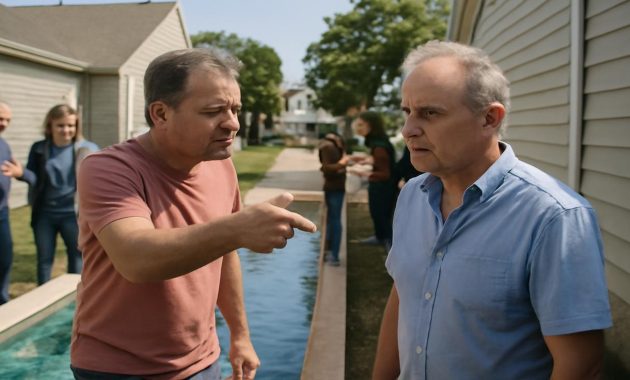
The first rumor slips over the hedges on a Tuesday morning, carried on the scent of cut grass and fresh chlorine. By the time the mail truck rattles down Maple Court, everyone has heard some version of it: that Mark at Number 12 built a luxury pool right up to the property line—and now wants his neighbor, Lucy at Number 10, to pay for half. Nobody has the full story, but that never stopped a street from choosing sides before.
The Day the Digging Started
Long before lawyers and surveys and whispered accusations, there was just the sound of machines. It began as a low growl, the sort that rattles picture frames and spooks skittish pets. On that early-spring morning, the air was cool enough that breath fogged on exhale, and yet the construction crew arrived in shirtsleeves, coffee cups steaming as they unloaded equipment.
Lucy remembers standing at her kitchen sink, fingers damp from rinsing blueberries, when she saw the first bite of earth get scooped from the narrow strip between their two properties. The side-yard, they all called it. A no-man’s-land of crabgrass, hostas that came with the house, and the leaning cedar fence that had been there longer than either of them.
She’d assumed it was just landscaping. Maybe a new patio or a retaining wall. That’s what you tell yourself when you’re halfway through a bowl of cereal and in no mood for neighborhood drama. So she watched the excavator swing, listened to the backup beeps, and tried to decide if she should say something. Maybe wander over with a pleasantly nosy, “What’s all this?”
Instead, she did what many of us do when we sense trouble brushing against our quiet lives: she went to work and hoped it would sort itself out before she got home.
The Shape of a Dream
By the end of the week, the hole was unmistakable. Rectangular, deep, lined with steel rebar and plywood forms. A pool-shaped void carved into the shared edge of their lives. You could smell wet concrete even before the truck arrived, that mineral tang that clings to the back of your throat. The crew moved with choreographed efficiency, humming to the rhythm of poured dreams.
“You’re really doing it,” shouted Kevin from across the street, a retiree who’d been predicting a pool boom for years. “About time someone around here went all in.”
Mark beamed. “Heated, saltwater, the whole package,” he called back. “It’s going to be the gem of the block.”
The gem sat sixteen inches from the rusted fence posts that marked the fuzzy boundary between Number 10 and Number 12. On more than one afternoon, a concrete-splattered worker leaned against that fence, boot soles half on one side, half on the other, as if even gravity couldn’t decide where the line really lived.
Inside her house, Lucy pretended not to notice. She told herself that neighborly goodwill deserved a long leash. People build patios. People put up pergolas. People plant towering evergreens that spend autumn carpeting your gutters. None of it is worth a feud.
But on the third week, when the pool walls rose like pale blue cliffs and the coping stones went on, something tautened in her gut. The water—when it came—would be right there. Right up against what she’d always thought of as her side yard. Her space. Her sky.
Where There’s a Line, There’s a Story
Property lines are strange things. They exist mostly in paper and memory, invisible until someone dares to press against them. For years, the line between 10 and 12 Maple Court was little more than a leaning fence and a gentlemen’s agreement about whose turn it was to trim the hedge.
“We bought extra width here,” Mark liked to say. “Previous owner told me that strip used to be part of this lot. Survey must be off.”
“Funny,” Lucy would answer. “Because our paperwork says the exact opposite.”
It was the kind of low-level disagreement that neighborhoods absorb, like the distant hum of a freeway: always there, rarely noticed. Until someone plants a luxury pool right next to it.
When the scaffolding came down and the tile shimmered in the early summer sun—blue on blue, an echo of the sky—Maple Court collectively gasped. From the sidewalk, the pool looked like something out of a resort brochure. Sun shelf, underwater bench, recessed lighting. A sleek glass safety barrier along three sides. Along the fourth, though, there was just that old fence, now dwarfed by the glossy white coping stones that kissed its posts.
It was beautiful. It was excessive. It was undeniably, uncomfortably close.
The Conversation That Changed Everything
On the first Saturday after the water trucks came, there was a knock on Lucy’s door. Not the casual double-tap of a neighbor dropping off mail, but the firm, practiced knock of someone arriving with a point to make.
She wiped her hands on a dish towel and opened the door to find Mark standing there in mirrored sunglasses, a manila folder tucked under his arm like a shield.
“Got a minute?” he asked.
They sat at her dining table, sunlight pooling on the hardwood floor between them. He spread out glossy architectural renderings she’d never seen before. In all of them, the pool hugged the property line like a second, sparkling boundary.
“So,” he began, “as you’ve probably noticed, we went ahead with the pool. It’s technically a shared amenity now, given where the line falls. The value bump hits both properties. That’s kind of the beauty of the design.”
She blinked. “Shared?”
“Yeah,” he said, flipping to a page with numbers and bullet points. “The contractor confirmed we built right on the boundary. So you benefit from half of this.” He tapped a figure circled in red: Estimated Property Value Increase: $120,000.
He smiled the way people smile when they’re sure they’re being generous. “I’m just asking that you cover fifty percent of the construction cost. It’s only fair. We’re talking about an investment in both our homes.”
“You’re asking me,” she said slowly, “to pay half of a pool you decided to build without asking me, that I didn’t want, and that is currently sitting on—or possibly over—my land?”
“Not asking,” he said, bristling. “Expecting. You can’t freeload on my investment. Everyone on the street is going to want in on this thing.”
The room felt suddenly smaller, the edges of the table too sharp. Outside, kids’ laughter drifted down the block, punctuated by the distant slap of a diving test—one of his teenage sons hitting the water for the hundredth time that day.
“I never agreed to this,” she said. “And I’m not paying for it.”
The silence between them thickened, congealed. He gathered his papers with stiff, precise movements.
“You’re going to regret taking that position,” he said quietly. “And when this goes to court, everyone will know who decided to be unreasonable.”
The Street Picks a Side (Or Three)
Word traveled faster than the mosquitoes that summer. The story came with variations depending on who told it. At the book club, it was about property rights. At the block’s group text, it was about entitlement. At the corner where dog walkers gathered beneath the old maple, it was about respect—or the lack of it.
No one could resist adding their own seasoning:
- “He showed her a contract and everything,” claimed one neighbor. “She promised years ago to split any major improvements.”
- “She’s the only reason we have any trees left on this street,” another countered. “She’d never agree to more concrete, much less a pool.”
- “The property line is weird back there,” someone else added. “I heard the pool might actually be partly on her land.”
Barbecues that once included the whole street quietly fractured. On one driveway, you could hear vigorous support for property values and “thinking bigger.” On another, people sipped wine and whispered about entitlement and boundary creep.
To some, Mark was the visionary. A neighbor who’d taken a tired yard and turned it into something out of a vacation rental ad. Of course the value bled over the fence. Of course she should contribute. Anything else was selfish.
To others, he was the aggressor. You don’t drop a luxury amenity inches from someone’s kitchen window and then send them a bill. It wasn’t just the money. It was the arrogance of assuming that more, bigger, flashier was automatically better for everyone.
Lines You Can’t See on a Survey
In the evenings, when the sun slid behind the tidy row of houses across the street, the new pool came to life. Underwater LEDs shifted the water from turquoise to indigo to a surreal, electric violet. Music drifted over the fence—bass-heavy and insistent. The air filled with grill smoke and splashing and the clink of ice against glass.
From her back porch, Lucy could hear every shouted joke, every shriek, every Bluetooth notification pinging from someone’s phone. Her once-quiet evenings had become a soundtrack she never chose.
She found herself resenting the sound of water, which felt like its own small crime. She’d always loved lakes, rivers, the lazy hush of rain on summer leaves. Now the slap of cannonballs and the constant swish of pool filters turned that love into a low simmer of irritation.
“You’re letting him live in your head,” her sister said over the phone. “Get a survey, get a lawyer, and get on with it.”
So she did. A surveyor arrived one bright morning with tripods and reflective markers, weaving his careful geometry through the garden beds. Red flags sprouted in the grass like a new, nervous crop. The result, printed on crisp paper and smudged within hours by the sweat of many hands, showed what she’d suspected and secretly dreaded: the pool’s concrete shell extended nineteen inches over the line. Onto her property.
“That’s encroachment,” the lawyer said later, his office lined with framed plats and aerial photos. “You didn’t consent. That matters. A lot.”
He outlined the options in a voice that had delivered countless unwelcome realities:
- Demand removal of the portion encroaching on her lot—costly, messy, and guaranteed to ignite the street.
- Negotiate an easement or license, allowing the pool to remain with strict conditions and compensation.
- Do nothing and risk that, one day, someone would call it precedent.
Outside his window, a row of box elders shivered in the breeze. Property lines. Tree roots. Shade. Noise. Money. The quiet crush of proximity—it all tangled together.
When Money Meets Meaning
On paper, the dispute looked simple. A table of numbers, cleanly aligned, might have made it seem almost rational:
| Item | Mark’s View | Lucy’s View |
|---|---|---|
| Construction Cost | Shared investment in both homes | His choice, his expense |
| Value Increase | Both properties benefit equally | Unwanted change, not true “benefit” |
| Property Line | “Flexible” interpretation, old stories | Survey is the final word |
| Noise & Privacy | Normal neighborhood activity | Loss of peace, loss of control |
| Fair Outcome | She pays half; they share access | He fixes encroachment and bears full cost |
But no spreadsheet could capture the way her chest tightened each time a stranger’s voice carried over the fence, or the flicker of satisfaction he felt watching guests gasp at his gleaming backyard. The pool was never just water and tiles; it was identity poured in concrete.
In hushed living rooms and over picket fences, neighbors dissected the conflict as if it were a morality play. Was this about property rights or community spirit? About fairness or generosity weaponized? About a dream or an imposition?
On one level, the answer was obvious: you don’t spend someone else’s money for them and then send a bill. On another level, it touched something more slippery: the belief that what increases financial value must also increase human value, and that anyone who refuses that bargain is irrational.
Who Crossed the Line First?
By late summer, the street itself felt subtly redrawn. Driveways became meeting halls. Sidewalks turned into corridors of opinion. If you walked from one end of Maple Court to the other, you could feel the temperature change—not the air, but the social weather.
There were the Team Dream Pool folks, who saw ambition and improvement and “not settling” as inherently good. “He took a risk, he made the block nicer, and she’s punishing him for it,” one neighbor insisted while watering petunias.
There were the Team Stunned Homeowner supporters, who saw the pool as the physical form of a personality type they’d met too many times before. “This is what happens when people decide their vision matters more than your consent,” someone else said, tugging at a weedy dandelion as if it were the root of the whole problem.
Then there was a quieter third camp, unaligned but uneasy. They couldn’t defend the pool encroachment or the surprise invoice, but they were equally disturbed by the idea of forcing a neighbor to chip out part of an already-built, already-filled dream. “Nobody wins if that thing gets jackhammered,” the mail carrier muttered one morning, sliding letters into boxes on both sides of the divide.
In a way, the street was asking itself a question larger than any single property line: In tight quarters, whose version of “the good life” gets to define everyone else’s? The answer, it turned out, was messy.
A Negotiated Truce, Not a Happy Ending
Under pressure from his own attorney, who used the words “clear encroachment” and “litigation risk” more than once, Mark eventually tempered his stance. The demand for half the cost softened into an “offer” to create a shared pool agreement. When that went nowhere, he pivoted again, proposing a lump-sum “easement fee” in exchange for the right to let the pool remain as is.
“Think of it as me buying a tiny strip of your land,” he said during one of their strained, lawyer-advised conversations. “You walk away with cash and no hassle. I walk away with my pool intact. Everyone wins.”
“Everyone,” she replied, “except the version of me who used to enjoy sitting on her porch without feeling like she was crashing someone else’s pool party.”
In the end, with equal parts reluctance and exhaustion, they struck a deal: he would pay her for a formal easement, recorded in the county books. She would not owe a cent toward construction. He would install sound-dampening panels along the fence line and agree to quiet hours. The pool would stay. The boundary would remain, now drawn both in legal language and in the thickened air between them.
The street exhaled—partly in relief, partly in resignation. No fences were torn up. No excavators returned to crack what had been poured. But something intangible had been broken and re-set, like a bone that would always ache in bad weather.
On late autumn evenings, when the pool cover caught fallen leaves and the air turned sharp with the scent of woodsmoke, it was easier to forget the summer’s tension. Easier, but not entirely possible. Neighbors still crossed the street a few houses early, adjusting their walking routes by instinct. Casual waves became curt nods or studied non-acknowledgment.
The line had always been there, running quietly beneath the sod and shrubbery. It took a dream pool and a bold invoice to make it visible. Once seen, it couldn’t be unseen.
What Maple Court Remembers
Years from now, new families will move onto Maple Court. They’ll see the gleaming ribbon of water tucked beside an aging fence and assume it’s always been that way, as permanent as the streetlights. Maybe they’ll hear a version of the story from a long-timer—shortened, simplified, the sharp edges worn down by retelling.
They might hear that once, a man built his dream a little too close to someone else’s comfort, and tried to make her pay for the privilege. Or that once, a woman refused to recognize the “gift” of increased property value, insisting instead on a quieter kind of wealth: the right to choose what her home meant to her.
They might hear that the street took sides, and that in taking sides, everyone learned something about themselves: how much noise they could live with, how much brightness they could accept through their curtains, how tightly they clung to the idea that what’s good for one must be good for all.
Mostly, though, Maple Court will remember the hum of that first excavator and the way it seemed, in hindsight, like the sound of something larger breaking ground: the illusion that we can live inches from one another and never really have to ask, out loud, where one life ends and another begins.
FAQ
Was the neighbor legally required to pay for the pool?
No. In most places, you are not required to pay for improvements a neighbor chooses to build on their own property, especially if you never consented. The exception is when there is a prior written agreement or a legally shared structure, which didn’t exist in this story.
Can a neighbor build a pool right up to the property line?
It depends on local zoning laws and building codes. Many areas require setbacks—minimum distances from property lines for pools and other structures. A proper survey and permits are usually needed. Building too close, or over the line, can result in fines or forced modifications.
What happens if a structure encroaches on your property?
Options typically include asking for removal of the encroaching portion, negotiating an easement (permission for it to remain), or seeking compensation. Ignoring it can create legal issues later, especially when selling your home.
Does a neighbor’s pool always increase your property value?
Not always. While some buyers may see nearby amenities as a plus, others view noise, privacy concerns, and maintenance risks as negatives. Value isn’t just market price; it’s also quality of life, which is subjective.
How can neighbors avoid conflicts like this?
Communication before construction is key. Sharing plans, confirming property lines with a survey, and putting any shared-cost agreements in writing can prevent misunderstandings. Just as important is respecting that not every neighbor shares the same vision of “improvement.”