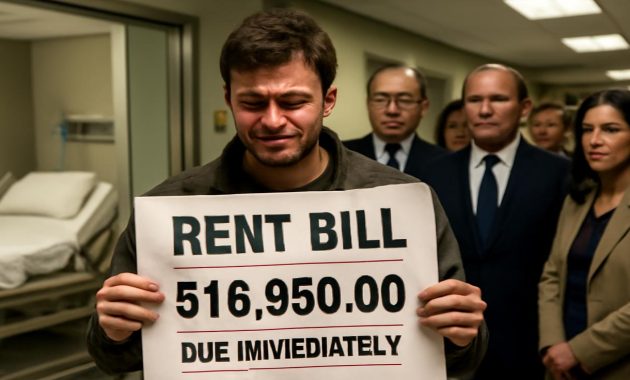
The bed is the first thing he remembers. Not the machines, not the blue curtains swallowing what little light there was, not the sour-sweet smell of disinfectant and wilted flowers. Just the narrow metal frame, the raised rails, the white sheets creased where his mother’s fragile body had rested. For weeks it was the entire landscape of his life. It was where he held her hand. Where she coughed and whispered and slept. Where he sat in a plastic chair until his spine burned and his legs went numb, watching each rise and fall of her chest as if the world might split open if it stopped.
When she died, they stripped the bed in seconds. Blankets in a cart, pillowcase in a liner, mattress wiped, rails clacked down. A nurse patted his arm – was it his arm? – and murmured something about being “so sorry for your loss.” The curtains opened. The bed, suddenly bare, looked smaller than he remembered. For the first time he saw it not as a place where his mother lived out her last days, but as an object the hospital needed back.
He walked out into the January rain with a plastic bag of her things – a paperback novel, a half-knitted scarf, her glasses with one arm taped. And for a time, the bed disappeared from his mind, just one more thing the hospital could wheel away and forget.
It would return weeks later, not in a quiet ward or a late-night memory, but inside a white envelope – as a bill.
The Envelope That Lit the Fuse
The first time he opened it, he thought it had to be a mistake. A clerical error. The kind of thing a quick phone call clears up. The letterhead was familiar, the logo of the hospital printed in reassuring soft colors he had once associated with lifesaving, not bookkeeping.
Deep in the letter, below the polite block of text and the list of account numbers, was the figure. Four digits. A sum that was more than a month’s rent on the modest flat where he was now sorting through his mother’s clothes. A sum that seemed to jump off the page and land in his chest.
“Outstanding bed and room charges for the period following patient death until formal discharge process completion.”
He read the line again. And again. “Following patient death.” He tried to imagine his mother’s ghost, quietly occupying a bed the hospital was charging for as if she were still reading, still knitting, still softly apologizing to nurses for being, as she always put it, “such a bother.”
What unfolded next is what people now debate in comment sections and dinner tables, what newspaper columns frame as a symbol of something larger and more uncomfortable than one grieving family’s misfortune: a long, lonely fight over bed rent for a woman who was no longer alive, and the three words that echo through every letter, every appeal, every official statement.
“Rules are rules.”
The Fine Print on Grief
On the second phone call, he started taking notes. Names, dates, small details. His mother had kept notebooks for everything – recipes, relatives’ birthdays, the serial numbers of household appliances – and, without quite realizing it, he had become a notetaker too. Now the pages filled with phrases like “administrative window” and “bed occupancy policy.”
The billing officer on the other end of the line was not unkind. Her voice made the appropriate apologetic dips. She sounded sincere, even a little embarrassed, as she explained that the hospital charged rent not only for the time his mother occupied the bed, but for the days afterward, while her file moved slowly through the system. Days when the bed was technically blocked, unavailable for other patients, even if it stood empty and already scrubbed of her presence.
“It’s in the terms and conditions,” she said at one point, almost pleading. “The admission documents your mother signed. It’s standard practice.”
He remembered that day – the admission. His mother, already pale, signing papers he knew she hadn’t fully read because the nurse was hovering and the monitor beeped and nobody wants to argue about fine print when they’re struggling to breathe. He had co-signed one of the forms, pen scratching through a field of small print his eyes only skimmed.
Now, in the harsh fluorescent light over his kitchen table, he reread those forms. Words that had once looked like administrative background noise suddenly glowed with meaning: “bed occupancy may incur charges until administrative discharge is formally completed.” His mother’s shaky signature floated beneath them like a quiet surrender.
He appealed. Of course he appealed. He explained that his mother had been dead. That they had vacated the room within hours, that they had not asked for storage, that no one had warned them a meter would keep running while they were picking out a coffin. The response was politely firm. The bed may have been empty, but in the hospital’s system, it was still hers. And the system, like the bed, must be turned over in its own time.
| Timeline | What Happened |
|---|---|
| Day 0 | Mother passes away; family leaves hospital the same day. |
| Days 1–14 | Hospital bed stands empty; internal paperwork not fully processed. |
| Week 4 | First bill arrives, including charges for the “post-death” period. |
| Weeks 5–12 | Appeals, phone calls, letters exchanged; “policy” is repeatedly cited. |
There is something peculiarly ruthless about meeting grief with bureaucracy. The hospital wasn’t demanding money for another treatment, a scan, a last attempt from a heroic surgeon. It was billing for waiting time, for a ghostly occupation that lived only in the realm of software and policy manuals. Grief, it turns out, is not exempt from the logic of the spreadsheet.
The Bed as Battlefield
By the time the story hit the news, the bed had become an unwilling symbol. Its narrow metal frame grew in people’s imaginations, turning into a kind of moral battleground where two visions of society collided. On one side, those who saw the charge as barbaric, a sign of a system so captured by rules and revenue that it had forgotten its human purpose. On the other, those who said – sometimes through gritted teeth, sometimes with a shrug – that space costs money. That hospitals are not infinite, and neither are their budgets.
The son, hesitant at first, had agreed to go public only after another letter arrived hinting at collections and legal action if the bill remained unpaid. He was not a natural campaigner. He spoke softly into cameras, his grief still new enough that certain words caught in his throat. He teared up when he described packing his mother’s slippers into a bag, when he talked about the smell of her shampoo lingering on the pillowcase.
“I thought when she died, that was the end of it,” he told one reporter outside the brick facade of the hospital. “I didn’t expect to keep paying for the space where her body used to be.”
Inside, administrators scrambled. Statements were drafted. Phrases like “within the framework of existing regulations” and “consistent with standard healthcare practice” appeared in neat paragraphs approved by legal teams. No one wanted to be the villain in the story of the grieving son and the empty bed, but no one wanted to be the one who broke ranks with policy either.
Public opinion did what it always does now: it split, flared, and fed on itself.
Two Sides of a Broken Mirror
In the heat of outrage, it’s easy to imagine a simple moral landscape: the grieving son and his dead mother against a faceless, profit-hungry institution. But the comments and letters that poured in painted a more complicated, sometimes uncomfortable, picture.
So many people wrote just to say: this happened to us, too.
A daughter who had lost her father to cancer recounted being charged for “late notice” of his death, as if she should have filed paperwork between calling relatives and choosing a suit for his burial. A widow described hospital parking tickets piling up while she sat at her husband’s bedside, afraid that if she went to move the car, she might not be there when he took his last breath.
The stories spilled out like water from a cracked dam, each one a small variation on a theme: rules applied with inflexible precision to the messiest moments of human life. Death, it turned out, came with a tail of invoices and policy clauses that could stretch for months after the funeral flowers had withered.
Then there were the other voices, quieter but insistent. Healthcare workers, administrators, even a few hospital accountants wrote in to explain how the bed – that simple metal frame – was part of an ecosystem under strain.
“If we waive charges in all these cases,” one manager wrote anonymously, “we still have to pay staff, maintain equipment, keep the lights on. Those costs don’t vanish because someone has died. Beds are blocked while we handle necessary post-mortem procedures. It’s not cruelty, it’s arithmetic.”
Some pointed out that delays in paperwork often weren’t about laziness or callousness, but sheer overload. Too few staff, too many patients, a river of forms and digital checkboxes that could jam up when one person called in sick or another unexpected emergency hit. The notion that anyone was gleefully squeezing bereaved families for bed rent was, in their eyes, offensive. They were barely keeping the place running.
And so the argument hardened into a kind of moral stalemate: Is it more indefensible to send a grieving son a bill for an empty bed, or to expect a hospital to swallow costs that a spreadsheet – that utterly unromantic instrument – insists are real? What do we owe one another at the fragile edge where life ends, and what do we owe the institutions we expect to save us until that last, shuddering minute?
When Rules Meet the Raw Edge of Being Human
The phrase kept appearing like a rubber stamp on every letter the son received: “As per policy.” The people he spoke to rarely used those exact words. They said “I’m afraid our hands are tied,” or “We have to be consistent,” or the haunting, flattening refrain: “Rules are rules.”
Behind the glass of a hospital office window, a policy makes a certain kind of sense. To the person drafting it, it’s a way to make sure like cases are treated alike, that staff aren’t forced to make messy, subjective decisions when they’re already exhausted. It’s meant to be fair, or at least predictable. In a system that consumes money faster than it can print out invoices, policies are sometimes the only levees holding back chaos.
But policies are blunt instruments, and grief is not. When a human being is folded into a “case,” something essential is quietly shaved off. The son knew this every time he heard his mother referred to by her patient number. The administrators knew it, too, even if they couldn’t always afford to admit it out loud.
Humans live in exceptions. We live in all the moments that rules, by their nature, cannot fully account for: the father who refuses to leave his dying child long enough to add money to the parking meter; the elderly wife who doesn’t open her mail for weeks because seeing her husband’s name on an envelope hurts too much; the son who thought death closed the ledger on his mother’s hospital stay, not opened a new column of charges.
What this case exposed, in its small but piercing way, is how often systems expect us to behave like tidy stories when we’re more like spilled ink.
The Intimate Cost of Public Outrage
While the internet argued, life in the son’s small flat went on with a kind of reluctant slowness. Bills, the ordinary kind, still arrived: electricity, water, council tax. He was learning how to cook for one. How to sleep without a phone on his chest, waiting for a call from the hospital. The hospital’s invoices sat in a separate stack, heavy as if printed on thicker paper.
Friends told him to ignore them. “They won’t really take you to court,” one said. “It’s terrible PR. They’ll back down once they see it’s blown up in the media.” Others urged him to fight, to refuse on principle, not just because he couldn’t afford it. A local charity offered to help with legal advice. A neighbor dropped off a casserole with a hand-written note: “For you and your mum – she’d be horrified by this.”
Every new headline about his case made his phone buzz. Sometimes he didn’t answer, letting reporters leave messages that blurred into one another. Sometimes he did pick up, and told the same story with the same raw details until it began to feel rehearsed, like a part he’d been cast in without auditioning.
“What do you want?” a journalist asked him once, voice gentler than most.
He thought of the bed. The way the sheets still held the heat of his mother’s body the last time he touched her hand. The way the room had already begun to erase her before he’d even made it to the car park.
“I want them to admit it’s wrong,” he said. “I want them to see me as a person, not an account number. I want…”
He hesitated. The word felt naïve, almost childish, but he said it anyway.
“I want mercy.”
That word doesn’t appear in many policy documents. Mercy. It lives in the spaces between lines, in the quiet moments when someone decides to bend a rule or apply it with a gentler hand. It requires discretion, and discretion is risky in systems afraid of being accused of favoritism or inconsistency.
Mercy is also exhausting. It can’t be automated. It takes time, and time is the currency every underfunded hospital seems to have least of.
What We See When We Look at an Empty Bed
Somewhere in that same hospital, months after the first bill was sent, the bed that had held his mother was almost certainly occupied again. Perhaps by another elderly woman who apologized too much. Perhaps by a young man in a motorbike accident. Perhaps by someone who would survive and walk out under the spring sun, blinking at the brightness and marveling that the world kept moving while they lay staring at ceiling tiles.
Hospitals, by necessity, see beds as resources. Fill, empty, clean, re-fill. Each one a unit in a complex calculus of capacity, cost, and care. In a world without bottomless funding, there is no escaping that logic completely.
But for the people who sit beside those beds, who sleep with their heads pressed to their loved one’s hand, counting heartbeats instead of sheep, a bed is never just a bed. It is the last geography of a life, the final address of a body that once moved freely through kitchens and parks and crowded buses. To attach a price tag to that space after death feels, to many, like billing someone for the air they breathed in their final goodbye.
That is why this story, more than most, split public opinion right down the grain. Because it touches an unspoken fear we carry in the back of our minds: that when our turn comes, or when someone we love lies on a narrow metal frame under buzzing fluorescent lights, the tally of our final days will be measured not just in memories and whispered words, but in units, codes, and outstanding balances.
After the Fight, the Echo
Eventually, under the pressure of headlines and politicians weighed in with carefully balanced statements, the hospital made a decision. They issued a short announcement saying that, “in light of exceptional circumstances,” the outstanding charges on the account would be waived. They expressed regret for any distress caused. They promised to review their policies.
On paper, it looked like victory. The son would not have to pay thousands in rent for the weeks his dead mother’s bed stood empty. The story turned a corner from outrage to resolution, and other news crowded in to take its place.
But victories in stories like this always feel partial. The policy review might lead to new guidelines, clearer communication, perhaps a cap on post-death charges. Or it might result in little more than a reworded line in an already dense document. The administrators would move on to other crises. The public outrage would simmer down, only to flare again when the next story – another bill, another family, another “rules are rules” moment – pierced the noise.
In his flat, the son sat for a long time with the letter that confirmed the charges were gone. He read it twice, then folded it deliberately and slid it into a drawer next to his mother’s glasses and the unfinished scarf. Relief washed through him, mixed with something sourer. Bitterness at the months he’d spent in a second, quieter kind of vigil – this time over paperwork and threats instead of heart monitors and IV drips.
He walked to the small park near his home where, years before, his mother had sat on a bench while he rode his bike in wobbly circles. The trees were bare, branches scratching at a low, grey sky. Somewhere, in another part of the city, another son or daughter might be sitting beside a hospital bed, counting breaths, trying not to think about what comes after.
There will always be rules. There will always be beds to manage, invoices to send, forms to sign with hands that would rather be holding someone they love. The question this story leaves hanging in the air, long after the last headline has faded, is this:
Can we build systems that recognize the cost of a bed without forgetting the weight of the body that once lay upon it? Can we design rules that hold firm most days but make room for mercy at the edge of life, when the human heart is least able to navigate fine print?
That answer won’t be found in any billing system. It lives, as it always has, in quiet choices made by people who remember that behind every account number is someone clutching a plastic bag of belongings, stepping out into the rain, trying to learn how to live in a world where a bed stands empty and a voice they loved has gone silent.
Frequently Asked Questions
Why did the hospital charge rent after the patient had died?
The hospital’s position was that the bed remained “occupied” in its system until all administrative steps after death were complete. During that time, the bed was considered unavailable for other patients, and existing policies allowed the hospital to continue charging for it.
Is this kind of post-death billing common?
While not always publicized, many healthcare systems have rules that extend charges beyond the moment of death, covering administrative processing, paperwork, and other internal procedures. The exact practices vary widely between hospitals, regions, and countries.
Could the family have avoided these charges by acting differently?
In most cases, families have little control over post-death administrative timelines. They can clear personal belongings quickly, but the internal discharge process is handled by the institution. Unless clearly informed in advance, families usually don’t know that delays might incur additional costs.
Why didn’t the hospital just make an exception from the beginning?
Hospitals often avoid making individual exceptions because they fear setting precedents or being accused of inconsistency. Staff are encouraged to follow policy to protect the institution and themselves, even when a situation feels morally uncomfortable.
What can be changed to prevent similar situations in the future?
Possible improvements include clearer communication at admission about any post-death charges, automatic waivers or caps for the period after death, and giving staff limited discretion to show leniency in exceptional cases. Ultimately, it requires policy makers to balance financial realities with compassion at life’s most vulnerable moments.