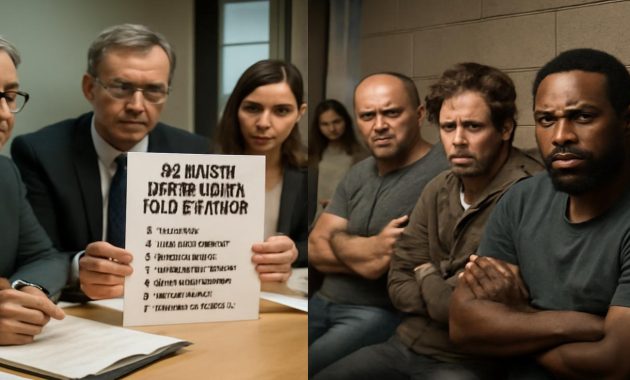
The afternoon he lost his kids, Mark noticed the dust first.
It floated in the slanted light of the courthouse hallway, tiny grains spinning over the gray tile like they had nowhere else to be. The judge had just read the decision. The lawyers were gathering their papers. Somewhere, a door clicked shut. But all Mark could see was the dust, and all he could hear was the echo of a sentence that would follow him for years: “It is in the best interests of the children that primary custody be awarded to their mother.”
He had come into this building convinced that “real men” fight, that “real fathers” never walk away, that the very fact that he was their dad meant he had a right to raise his kids. But the law—and the quiet, methodical testimony of psychologists and social workers—had something colder to say.
Because behind the soft language of “best interests” are hard decisions. Judges listen to stories people rarely tell outside closed doors: late-night crises, whispered confessions in therapists’ offices, in-home evaluations where the truth wafts up from the dirty dishes and the bruises no one meant to leave. Family lawyers sit in the middle of all of it, between the anger and the heartbreak, the lies and the half-truths. And there are patterns, they say. Patterns about the kinds of fathers they quietly hope will not keep custody, no matter how loudly those men insist they’re “good dads.”
These reasons aren’t the ones people talk about at backyard barbecues or in comments sections. They don’t fit neatly into memes about “deadbeat dads” or “crazy ex-wives.” They’re more uncomfortable, more complicated—and, according to the people who spend their working lives in the blast radius of broken families, painfully common.
They sound, at first, like accusations: He’s not a real man. But under that phrase lies something more precise—he’s not acting like an adult who can safely hold a child’s heart in his hands.
The myth of the “good dad” who only shows up for the highlight reel
Ask a family lawyer what custody disputes actually look like, and they’ll rarely talk about cartoon villains. Instead, they talk about men who love their kids fiercely and inconsistently. Men whose phones light up with photos on birthdays but stay silent on ordinary Tuesdays. Men who post pictures of fishing trips online but don’t know the name of their child’s teacher.
In their offices, lawyers hear the same sentence on repeat: “I’m a good dad. I love my kids.” It’s not usually a lie. Love is there, but it’s a specific kind of love—a highlight-reel love. Psychologists have another word for it: intermittent presence. It’s the dad who’s magic on weekends but missing in the messy middle of life. Homework? That’s “her thing.” Doctor’s appointments? “I’m not good with that stuff.” Parent-teacher conferences? “Work’s been insane.”
Over time, this creates a home that looks stable from the outside—Dad has a job, there’s food on the table—but feels hollow to a child. The secure base kids need is made from hundreds of small, boring acts of showing up. Without that steady ground, children can learn a bitter equation: connection = performance. Be fun, be charming, be easy, and you’ll get Dad’s attention. Be tired, needy, or complicated, and you disappear.
Family courts are starting to notice. In custody evaluations, professionals now ask detailed questions about the invisible, unglamorous labor of parenting: Who remembers the asthma inhaler? Who buys winter boots before the snow comes? Who knows what scares the child at night? When the answers keep circling back to one parent, the court begins to see the other not as a “good dad,” but as a guest star.
When anger at the ex quietly becomes emotional abuse of the child
In the hushed conference rooms where custody settlements are negotiated, there’s a particular shift lawyers dread. It happens when a father’s voice—steady while he talks about finances or schedules—tightens almost imperceptibly when the conversation turns to his former partner. The words sharpen. The story becomes less about the children and more about winning.
Psychologists call it misdirected aggression. Kids call it something else: “Dad hates Mom, so I think he kind of hates the part of me that’s like her.” They don’t say it in court, usually. They say it on therapists’ couches, in school counselor offices, in the quiet of a car drive home with the one parent who isn’t using them as a messenger or a spy.
Using a child as a battlefield doesn’t always look like shouting. It can sound like:
- “Your mom is trying to turn you against me.”
- “If it weren’t for your dad, we’d have a better house.”
- “Don’t tell your mother about this. She’ll just use it against me.”
Each of those sentences asks a child to do something impossible: choose a side in a war they never declared. When courts appoint guardians ad litem or custody evaluators, they listen carefully for this quiet corrosion. A father who cannot separate his rage at his ex from his relationship with his child risks being seen, not as passionate, but as dangerous in a slower, more insidious way.
Lawyers will tell you that this is one of the most “unpopular” reasons they support limiting a dad’s custody. It doesn’t fit public narratives about abuse. There are no black eyes, no police reports. Just a kid with a stomachache every transition day, a teenager who suddenly refuses overnights, a little one who apologizes for liking the other parent. Emotional abuse leaves no photos to post as evidence, and yet, in the long run, it may be the deepest reason judges quietly shift custody away from some fathers.
The “provider only” father who refuses the emotional paycheck
There’s a phrase that comes up again and again in legal and psychological reports: “He’s a good provider.” The mortgage is paid. The fridge has food. The kids have backpacks and birthday gifts and a roof that doesn’t leak. In many cultures and generations, that was the gold standard of fatherhood. You work. You provide. You’re a man.
But in custody disputes, that phrase has started to sound less like a compliment and more like an incomplete sentence. Because children don’t just need a financial provider; they need an emotional one. They need comfort, attunement, patience, the kind of listening that doesn’t check a phone every 30 seconds.
Family psychologists talk about “emotionally unavailable fathers” with an almost chilly consistency. These are men who may never lift a hand in anger yet still leave their children starved. They’re physically present, often proud of the sacrifices they make, but they’ve outsourced the emotional work of parenting to someone else—the other parent, a grandparent, a screen. When the kids cry, they call Mom. When they’re sick, they want Grandma. When they’re scared, they ask a sibling to sleep in their room.
In court, this can be hard to prove. There are no receipts for bedtime stories not read, no documentation for the way a father’s eyes glaze over when his daughter talks about the drama in her classroom. But evaluators see it in home visits: the child who automatically moves toward one parent for comfort, the father who jokes away feelings or tells a crying eight-year-old to “toughen up.”
Modern custody decisions lean more and more on psychological research showing that emotional connection is as crucial to child development as shelter and nutrition. A father who believes his job ends at the paycheck may discover, too late, that the court’s idea of “a real parent” is different from his own.
Hidden addictions and the quiet chaos they unleash
On paper, he’s holding it together. The job hasn’t fired him. The arrest record is clean. He swears he only drinks “a little” to calm his nerves, only uses pills “for pain,” only gambles “for fun.” But the story told in court is always wider than the story told to friends.
Family lawyers keep mental lists: the dad who “never drinks around the kids” but showed up stumbling at a school concert; the father who insists his cannabis use is medicinal while the house smells like a fogged-in concert hall; the man whose online betting “doesn’t affect anyone” while the electricity bill sits unpaid on the kitchen counter. Addiction, in these rooms, is almost never about a single moment of catastrophe. It’s about a slow erosion of safety.
Children living with a secretly addicted parent become experts in weather. They scan the air for tension when the key turns in the lock. They adjust their volume to match the mood. They become small, careful, hyper-aware. On the surface, they may appear “well-behaved.” Underneath, their nervous systems are running marathons.
Psychologists who testify in custody cases talk about this as chronic, ambient instability. The parent may insist he’s sober “most of the time.” But kids don’t measure safety in percentages. They measure it in nights they can fall asleep without listening for arguments, in mornings where the adults wake up when they’re supposed to.
Courtrooms are full of complicated truths: men who are both loving fathers and active addicts, who genuinely adore their children and still forget to pick them up, who promise they’ll quit and mean it—until the next craving. Unpopular as it sounds, many of the professionals in the room quietly agree: until sobriety is consistent and supported, full custody can be a risk too high to take.
Comparison of Common Risk Factors Lawyers and Psychologists Watch For
| Risk Factor | What Professionals Look For | Impact on Children |
|---|---|---|
| Emotional manipulation | Bad-mouthing other parent, forcing kids to choose sides | Anxiety, divided loyalties, long-term trust issues |
| Intermittent presence | Fun weekends, low day-to-day involvement | Insecure attachment, confusion about love and reliability |
| Addiction issues | Substance use, gambling, secretive behavior | Unstable home, hypervigilance, emotional distress |
| Controlling behavior | Isolation, monitoring, financial control | Fear, low self-worth, difficulty forming boundaries |
| Chronic irresponsibility | Missed pickups, unpaid bills, unstable housing | Insecurity, disrupted routines, school and social problems |
The quiet cruelty of control disguised as “being involved”
Some men never raise their voices in court. They appear calm, reasonable, deeply concerned. They talk about “structure” and “discipline” and “wanting what’s best.” Only when you watch the patterns closely does the shape of something darker appear: control.
Control can look respectable. It can wear a collared shirt and speak in measured tones. It insists on approving every doctor, every school, every activity—not out of shared parenting, but as a way of policing the other parent’s choices. It floods the inbox with “questions” that are really accusations. It demands video calls on a rigid schedule, then uses every missed ring as evidence of the other parent’s failure.
Lawyers sometimes call these cases “high-conflict,” but psychologists often push back: this isn’t two people fighting equally. It’s one person pulling all the strings. A controlling father might:
- Track the other parent’s location through the children’s devices.
- Insist children report back on everything that happens in the other home.
- Threaten to withhold child support or contact to force compliance.
To a child, this doesn’t feel like love. It feels like walking on a tightrope over a canyon of someone else’s moods. Kids learn quickly that one wrong word can spark hours of tension between the grown-ups they rely on. They fold in on themselves, editing their stories to keep the peace.
Courts are increasingly sensitive to this dynamic. When the need for control overrides flexibility, empathy, and respect, judges may see it as a warning sign: if he cannot co-parent with an adult, how will he adapt to a child who grows, changes, and needs their own voice?
When “I’m doing my best” is code for chronic irresponsibility
There’s a particular fatigue in the eyes of school staff, pediatricians, and therapists who testify in custody cases. They’ve done the reminder emails, the follow-up calls, the “just checking in” messages. Somewhere on their desks is a stack of forms signed by one parent and conspicuously blank in the other signature line.
Irresponsibility isn’t a single forgotten lunchbox. It’s a pattern. The dad who misses pickup three times in a month and blames traffic each time. The father who repeatedly “forgets” the allergy medication. The man who swears he’ll enroll the kids in counseling, then never makes the appointment. In isolation, each slip is forgivable. Together, they form a quiet storm.
Professionals talk about “executive functioning” in parents almost as much as they talk about it in kids now. Can this adult manage schedules, commitments, health needs, school demands? When a parent consistently cannot—whether due to disorganization, untreated mental health issues, or sheer refusal—the child becomes the backup plan.
Kids step in to remember what grown-ups forget. They pack their own bags. They remind Dad about the inhaler. They learn, far too young, that the person in charge can’t be fully trusted. This doesn’t always make headlines, but in the slow, careful calculus of custody decisions, it can tip the balance.
A father may insist, “I’m doing my best.” And maybe he is, from where he stands. But the law is less interested in effort than in effect. If his “best” still leaves children chronically late, hungry, scared, or scrambling, judges and psychologists may conclude that his best is not yet enough to anchor a child’s primary home.
Why some “not real men” should lose custody—and what a real father actually looks like
All of this cuts against popular stories of masculinity. The men at the center of these decisions don’t always look like villains. Many love their children with a depth that surprises even them. They cry in parking lots, in lawyer’s offices, in quiet bedrooms after the kids have gone back to the other home. They are not monsters.
But loving a child is not the same as being safe for a child.
Family lawyers and psychologists, those professionals so often accused of “hating men” or “siding with mothers,” will tell you something more nuanced: they don’t want fathers to lose custody. They want fathers to become worthy of it. They’ve seen, countless times, men rise to that challenge. The dad who gets sober and stays that way. The one who walks into therapy for the first time and starts unraveling generational rage. The father who apologizes to his child for the first time and means it.
When they talk about “not real men,” what they usually mean is this: men who are still boys in crucial ways, who use their children to soothe their own wounds instead of doing the work to heal them.
A real father, in the quiet definitions that shape custody decisions, looks very different:
- He puts the child’s stability above his need to win.
- He shows up in ordinary moments, not just big performances.
- He is willing to be uncomfortable—to sit with feelings, to hear hard feedback, to change.
- He understands that power over a child is not a right, but a responsibility.
- He takes his own healing seriously, because he knows unhealed pain always finds a smaller body to land in.
Back in that courthouse hallway, Mark eventually stopped staring at the dust. His lawyer walked him outside. The sky was that washed-out city blue, too bright and too distant. Somewhere across town, his kids were finishing a math worksheet, or fighting over a game, or asking what time Dad would call.
He could have let the decision harden him. Many men do. They turn the loss into a story of injustice, of women and courts and systems conspiring against “real men.” But there’s another path, quieter and much harder: to ask, with bare and brutal honesty, What kind of father have I actually been? Not the father in his own head. Not the father in the photos on his phone. The father his children feel every day.
The unpopular reasons some dads lose custody are not really about punishing men. They’re about protecting children from the gaps between intention and impact, love and safety, presence and responsibility. In that gap, real manhood—real fatherhood—is not proven by biology, bravado, or a name on a birth certificate. It’s proven in the thousand unnoticed choices that tell a child, again and again: you are safe with me.
Frequently Asked Questions
Do courts automatically favor mothers over fathers?
Most modern family courts are required by law to make decisions based on the “best interests of the child,” not the gender of the parent. However, if one parent has historically handled most of the day-to-day care, that pattern often influences the outcome, regardless of whether that parent is the mother or the father.
Can a father with past issues ever regain custody?
Yes. Courts often look favorably on genuine, sustained change. Completing treatment programs, maintaining sobriety, engaging in therapy, and consistently showing up for parenting time can all support a future request to modify custody arrangements.
Is emotional abuse really enough for a dad to lose custody?
Emotional abuse can absolutely affect custody decisions, especially when documented by therapists, school staff, or custody evaluators. Courts increasingly recognize that harm isn’t only physical; chronic belittling, manipulation, and using children as messengers can be deeply damaging.
What can fathers do to strengthen their custody case?
Active, reliable involvement is key: attend school events and medical appointments, maintain a stable home, communicate respectfully with the other parent, follow court orders, and, if needed, seek help for mental health or addiction issues. Documentation of consistent effort matters.
How can a child’s voice influence custody decisions?
Depending on age and jurisdiction, a child’s preferences may be considered, often through a guardian ad litem, therapist, or in-camera (private) interview with the judge. Their wishes are weighed alongside safety, stability, and overall well-being, not followed blindly.